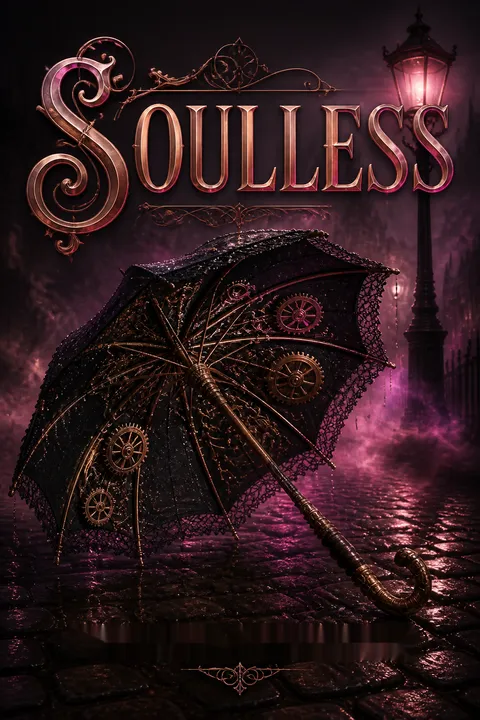


Plot Summary
Treacle Tart and Fangs
At a London ball, Alexia Tarabotti slips into the library for food and finds a vampire trying to bite her. His fangs vanish when he touches her: Alexia is a preternatural, whose contact cancels supernatural power.
When he attacks again, she fights back with her weighted parasol and a wooden hair stick, killing him by accident. The discovery brings Conall Maccon, Earl of Woolsey and werewolf head of the Bureau of Unnatural Registry, to the scene with his composed Beta, Professor Lyall.
They identify the dead man as an unregistered, starving vampire. His poor clothes and ignorance of preternaturals suggest that someone has made him outside the rules. Maccon conceals Alexia's identity, but she resents being treated as a liability rather than a possible investigator.
The opening makes Alexia's unusual nature legible through action rather than exposition: her touch removes the vampire's advantage, while her intelligence and physical nerve finish what the supernatural rule began. Yet the killing is accidental, and the consequence is not triumph but entry into a political problem. Maccon's instinct to conceal her protects her from scandal while also repeating the social diminishment she already experiences as an unmarried woman excluded from useful work. Her resentment therefore has two sources: guilt over the dead vampire and anger at being denied agency. The mystery begins where those pressures meet.
An Invitation in Hyde Park
Alexia's family treats the ball's reported death as gossip, while her mother and half sisters continue to overlook her interests. On a walk with her friend Ivy Hisselpenny, Alexia meets actress Mabel Dair, a drone serving Countess Nadasdy, queen of London's Westminster vampire hive.
Dair delivers a sealed invitation. Before Alexia accepts, she consults Lord Akeldama, an eccentric, information-rich vampire living outside any hive. He explains that the dead vampire's ignorance has left the hives suspicious: they may believe Alexia or the Registry knows how new vampires are appearing.
Maccon warns that vampires regard preternaturals as their ancient counterbalance and tells Alexia not to enter the hive. She goes anyway, determined to learn what happened and unwilling to let powerful men decide what she can investigate.
The invitation turns a private act of self-defense into a contest over knowledge. Alexia's first response is neither recklessness for its own sake nor blind trust: she consults Akeldama, weighs the risks, and chooses to go because uncertainty itself gives others power over her. Her mother's household supplies the social counterpoint. There, Alexia's intellect is inconvenient; among vampires, it may be dangerous. Maccon's warning carries genuine concern, but his command repeats the paternal logic she has resisted since childhood. Her decision asserts that protection without consent can become another form of confinement.
Three Unmade Vampires
While Alexia prepares for the hive visit, Lyall investigates vampire records in Canterbury and learns that registered roves have disappeared. A local werewolf loner adds a worse report: the coastal loners have vanished too, leaving him alone.
At the Westminster hive, Countess Nadasdy first tests Alexia's preternatural touch, then her courtiers challenge the danger she represents. Alexia refuses to be intimidated and presses the queen about the dead vampire. Nadasdy admits that three new vampires have appeared in her territory within two weeks.
They know neither hive customs nor the Registry's laws, and two died soon after the hive captured them. The queen has hidden the incidents from the authorities. Outside, the drone Angelique secretly asks Alexia to find her missing rove master, confirming that disappearances and unexplained arrivals may be connected.
The evidence widens from one anomalous death to a system failing at both ends: new vampires appear without recognized makers, while established outsiders vanish. Nadasdy's admission matters because authority here is not synonymous with knowledge. Her secrecy protects the hive's standing, but it also delays investigation and leaves dependents such as Angelique exposed. Alexia's insistence on asking direct questions brings concealed facts into view, even as her status makes her a feared presence. The scene also frames the supernatural community as political rather than monolithic: queens, courtiers, drones, and government agents have different stakes in the same crisis.
The Locked Hackney
After leaving the hive, Alexia mistakenly enters a different hackney and discovers a man waiting inside. A wax-faced driver locks the carriage while the stranger tries to drug her with chloroform. Alexia screams, kicks, and struggles until a werewolf's howl and a crash stop the cab.
Maccon, who has followed her despite her refusal of a guard, pulls her clear; the attacker escapes. In the street, Maccon kisses her, then stops when Lyall arrives with urgent news: vampires and werewolf loners are disappearing in several places.
Alexia adds the hive's report of three inexplicable new vampires. The parallel disappearances confirm a larger operation, and the kidnappers' questions show Alexia herself is a target. Maccon assigns protection, while their sudden attraction leaves both unsettled.
The attack converts an abstract warning into bodily risk, and Alexia's response remains characteristic: she resists with whatever tools are available, even when a corset and carriage walls restrict her movement. Maccon's rescue is protective, but it follows his decision to disregard her wishes, making intimacy and authority difficult to separate. The kiss briefly gives their antagonism a physical answer, only for Lyall's report to restore the larger danger. Personal desire cannot suspend political reality. The convergence of Alexia's hive intelligence with Lyall's field evidence also establishes her value as an investigator, though Maccon has not yet learned how to acknowledge that value without trying to control her.
The American's Scale
At a dinner party, Maccon pointedly avoids Alexia, so she turns her attention to an American scientist, Mr. MacDougall. He studies whether the soul can be measured and explains that his vampire brother was forcibly changed, then rejected and hunted by their Puritan family.
That history drew MacDougall from banking into biology. The next day, he takes Alexia driving and shares his theory that supernatural transformation may involve a blood-borne agent and a measurable physical difference.
Alexia challenges the ethical danger of predicting who can survive transformation, but their scientific exchange delights her. Maccon's jealousy becomes obvious when he visits her afterward. Their conversation exposes his contradictory behavior and Alexia's fear that his earlier kiss was only an impulse, not an honest intention.
MacDougall's family story gives the scientific debate an intimate cost: transformation can mean survival and belonging in one society, but exile and attempted murder in another. His research is humane in motive, yet Alexia recognizes that measurement could turn a vulnerable population into a more efficiently managed one. The story refuses to make scientific curiosity automatically virtuous. Meanwhile, her interest in MacDougall is genuine but also a defense against Maccon's withdrawal. Alexia can discuss souls as empirical objects more easily than she can ask whether someone desires her. Her intellectual confidence and romantic insecurity coexist without canceling each other.
The Bitch's Dance
Maccon struggles to apologize, and Alexia finally confronts him about the kiss and his coldness at dinner. He admits he has been resisting his attraction, then kisses her again. Their encounter is interrupted by Alexia's mother and Lyall.
While Ivy Hisselpenny watches in alarm, Lyall explains that Maccon has been following werewolf courtship customs, waiting for the female to choose and signal pursuit. Alexia learns that the pack's Bitch's Dance gives the woman control, but she is not a werewolf and cannot be expected to know its rules.
The explanation helps her read Maccon's behavior, though it does not settle what she wants. The prospect of a relationship now carries social risk as well as desire, and Alexia must decide whether to meet him on unfamiliar terms.
Lyall's explanation translates instinct into a social grammar, but it does not excuse Maccon's failure to communicate. The courtship custom grants female choice within a specific community, while Alexia stands outside that community and must infer its rules after being affected by them. Her confusion is not a personal deficiency; it is the predictable result of two social systems colliding without translation. Ivy's presence underscores the cost of secrecy, since Alexia cannot explain the deepest reason her own identity makes intimacy complicated. The scene shifts agency back toward Alexia: knowing the rule does not obligate her to follow it.
Full Moon, Open Window
That night, Alexia sees the wax-faced attacker climb toward her bedroom window while a vampire guard tries to stop it. The creature survives a fall and breaks free, proving it is neither an ordinary human nor a known supernatural being.
By morning, Maccon reports that chloroform thieves have broken into the Registry and stolen files on roves, loners, and Alexia. He fears the attackers now know she can neutralize supernatural creatures.
When he visits, Alexia's family discovers their intimacy; Maccon offers marriage, but Alexia refuses to be forced into a loveless match. Her mother forbids her from attending a rout. With the full moon approaching, Alexia instead arranges to visit Akeldama, despite the danger and the guards posted around her.
The window attack makes the threat uncanny in a precise way: the pursuer looks human but ignores injuries that should stop a human body. The stolen files then link that creature to organized surveillance and turn Alexia's hidden identity into a vulnerability. At home, the marriage scene echoes the same problem of control. Her family sees a compromising situation as leverage, while Maccon's offer may be sincere but arrives amid pressure and danger. Alexia's refusal protects her right to choose, even when it risks losing security. Her decision to visit Akeldama is therefore not mere defiance; it is a deliberate attempt to recover information and agency.
Akeldama's House Breached
On the full-moon night, Alexia reaches Akeldama's home with vampire guards following at a distance. His drones are away gathering information, and the household is unusually exposed. Intruders enter, scatter chloroform through the rooms, and incapacitate Alexia and Akeldama.
They carry both prisoners through a concealed descending chamber into the underground Hypocras Club, where scientists store supernatural captives. Left together in a locked cell, Akeldama reveals that the wax-faced creature is an artificial man, an automaton controlled by the word VIXI written on its forehead.
He believes erasing that command may disable it. Before captors take him away, Akeldama asks Alexia to let him see a sunset if he survives. She promises, now aware that this conspiracy threatens her closest unusual friend as well as herself.
The attack succeeds not through superior strength alone but by exploiting timing, chemical knowledge, and the absence of Akeldama's household network. His home, usually a theater of abundance and information, becomes a trap. The automaton's command word introduces a vulnerability grounded in language and machinery, a counter to Alexia's bodily gift. Akeldama's request to see the sunset shifts the stakes from political intrigue to mortality: the ancient vampire asks for a fragile, finite experience. Alexia's promise is a commitment made under uncertainty, revealing that loyalty for her is not sentiment alone but a practical obligation she intends to honor.
The Club's Human Face
The club's staff treat Alexia as an unexplained prisoner until MacDougall arrives and recognizes her. His identification links her to the Registry files and gives the club's director, Mr. Siemons, the answer he lacked: Alexia is a preternatural whose touch can cancel supernatural abilities.
Siemons describes the club's project as defense of the commonwealth, but his laboratories reveal its real method. Scientists have abducted vampires and werewolves, experimented on them, and pursued a plan to exploit Alexia's power in a campaign against supernatural people.
MacDougall is horrified, though his earlier research helped draw Alexia into the club's orbit. She refuses to cooperate. Siemons orders a test and sends her into a cell with a full-moon werewolf, betting her abilities will not act quickly enough to save her.
MacDougall's recognition turns acquaintance into a moral test. His scientific curiosity was not itself criminal, but it connected him to an institution that converts inquiry into coercion. His horror cannot undo his participation, and his hesitation leaves Alexia to face the consequences. Siemons's language of public safety masks a program of captivity and bodily exploitation; the gap between stated purpose and actual method is the novel's sharpest critique of instrumental reason. Alexia's refusal asserts that consent is not an optional courtesy in research. The imposed werewolf test makes her body the contested site where competing theories, political fears, and ethical limits collide.
A Wolf Becomes Conall
The werewolf charges Alexia in the dark, but his instincts falter when he nears her. She tackles him and holds on as her touch reverses his transformation, revealing Maccon, naked and exhausted. He explains that the club drugged and captured his pack as well as him. Alexia tells him Akeldama is being tortured and describes the experiments.
Their physical contact keeps Maccon human through the full moon, allowing them to plan rather than succumb to the wolf's frenzy. As they argue and cling to each other, Maccon makes clear that he intends marriage, not a passing liaison. Alexia's doubts begin to give way; she chooses him, and calls him her love, just before the danger returns.
The reversal is both rescue and revelation: Alexia's power can interrupt not only supernatural strength but the full-moon transformation that governs Maccon's life. Yet its effect depends on sustained contact, making trust materially necessary rather than merely symbolic. Maccon's dependence unsettles his accustomed authority, while Alexia gains control of a situation in which she had been treated as a specimen. Their declaration of love emerges inside captivity, but it is not simply a reward for danger. It follows repeated misreadings, an explanation of custom, and Alexia's insistence on an uncoerced choice. Intimacy here becomes collaboration under pressure.
Blood on the Corridor
Siemons enters the cell with the automaton and learns that Alexia can return Maccon to human form. When the creature grabs her, Maccon throws a shard of mirror into its back, but the automaton carries Alexia away before he can follow. Chloroform and the full moon make Maccon's transformation imminent. Alexia cuts her arm against the embedded glass, leaving bright blood drops along the route to the club's exsanguination chamber.
There, she finds Akeldama staked to a platform and connected by tubes to a human test subject. Scientists are preparing an electrical procedure meant to transfer supernatural vitality. Alexia realizes they will use her next. Maccon's trail has led him toward her, but the experiment is already underway.
The corridor sequence turns Alexia's quick thinking into a literal signal. She cannot overpower the automaton, so she uses her own injury to give Maccon a route through a maze designed to conceal the violence inside it. The blood trail also reverses the captors' logic: the body they intend to study becomes an instrument of rescue. In the chamber, the machine's tubes make the club's ideology visible. It does not merely observe supernatural life; it attempts to extract and redirect it. Akeldama's suffering makes the abstract project personal, while the approaching wolf promises rescue at a terrible cost.
The Word Is Broken
As the scientists prepare Alexia for the machine, Maccon bursts through the chamber door in wolf form and tears into the staff. Siemons holds Alexia at knifepoint, but she escapes his grip. The automaton continues fighting Maccon until Akeldama, barely alive, tells Alexia to erase the command on its forehead.
She wipes away the final letters, weakening the construct; later Akeldama clears the rest, and its body collapses into gears, wax, and foul blood. Alexia then touches Maccon and restores his human form.
A newly made vampire, created by the club's experiment, attacks MacDougall, who fights back. Maccon subdues the vampire, frees Akeldama, and helps secure the chamber. Siemons is captured, and the surviving supernatural prisoners are released.
The climax resolves its central problems through combined capacities rather than a single heroic force. Maccon supplies strength, Alexia breaks the automaton's command, and Akeldama contributes knowledge even while gravely weakened. Their cooperation is the opposite of Siemons's system, which isolates bodies and treats them as resources. The newly made vampire demonstrates the experiment's success in its most horrifying form: the club can produce supernatural life, but only through coercive transfer and at terrible human cost. MacDougall's struggle against his own research's consequences gives him a narrow chance to act differently. Destruction of the construct and liberation of captives end the immediate threat, but not the political reckoning.
A Place on the Council
With Siemons imprisoned and the Hypocras Club dismantled, Queen Victoria visits Alexia and offers her the vacant position of muhjah, a preternatural adviser on the Shadow Council. Alexia accepts, pleased by work that matches her investigative mind.
The queen confirms that Maccon recommended her long before the crisis, and Alexia learns he wants both a partner and a capable political ally. She agrees to marry him. The investigation's public fallout exposes the club's illegal experiments, though powerful institutions deny involvement.
The vampires largely snub the wedding invitation, while Akeldama and the Westminster hive remain connected to Alexia's new life. Her family responds chiefly with astonishment and wedding plans. At last, Alexia's knowledge and stubborn independence earn her formal authority rather than another warning to stay home.
The resolution answers the opening's exclusion: Alexia wanted useful work, and the Crown gives her a position where her reasoning and preternatural status matter. Yet appointment is not a simple triumph over hierarchy. The queen values Alexia partly because she can mediate between supernatural powers and daylight society, placing her inside the state that once kept her identity secret. Maccon's recommendation confirms that his attraction has never required her to become less capable, though Alexia's independent acceptance remains essential. The marriage and office therefore resolve different needs: intimacy chosen freely, and public agency institutionally recognized. The scandal also leaves accountability incomplete, since the larger scientific establishment evades responsibility.
Epilogue
Alexia marries Maccon in an ivory gown, with Ivy as her bridesmaid and Akeldama's drones managing the details. Before the ceremony, she takes Akeldama by the hand to watch the sunset he feared he would never see again. The wedding gathers the queen, the pack, and much of London society, while most vampires stay away.
Afterward, the werewolves honor Alexia with a circling dance, and she and Maccon leave for Woolsey Castle. In the carriage, their teasing resumes with familiar heat. Alexia has lost her spinster status, gained a political office, and kept the right to argue with her husband.
The ending gathers the novel's different forms of belonging without smoothing away their tensions. Alexia gives Akeldama the sunset he asked for, a gesture that honors the mortal vulnerability her touch briefly restores to him. At the wedding, the werewolves' formal recognition answers the social exclusion she has endured, while the vampires' absence shows that political acceptance remains contested. Her ivory dress, rather than white, acknowledges that her life has never fit conventional ideas of feminine purity or passivity. The carriage scene refuses a solemn, static happily-ever-after: marriage becomes another arena for mutual challenge. Alexia's fulfillment depends not on being absorbed into Maccon's world, but on carrying her own authority into it.
Analysis
Soulless makes social membership as consequential as supernatural biology. Vampires depend on hives, werewolves on packs, and humans on class and family structures; each community offers protection while demanding obedience. Alexia occupies the unstable margin of all three. Her preternatural touch can neutralize supernatural force, but her deeper challenge is refusing to let institutions decide what her power means or what work she may do. The Hypocras Club's rhetoric of public safety shows how fear can turn inquiry into domination: its members speak of knowledge while imprisoning the beings they study and planning their elimination. Their cruelty is not opposed to reason so much as licensed by a narrow definition of whose lives deserve protection.
The novel's romance tests the same conflict on a more intimate scale. Maccon's werewolf courtship customs presume a shared cultural code, but Alexia cannot consent meaningfully to rules she has never been told. Lyall's explanation does not erase Maccon's mistakes; it enables Alexia to judge them and choose for herself. Their attraction becomes credible when Maccon's physical dependence during the full moon meets Alexia's practical competence, and when he offers marriage without requiring her to become submissive. Her eventual political appointment extends that partnership beyond the private sphere. She is not rewarded by being absorbed into a man's status; she gains a public role because her judgment is useful.
The ending remains knowingly imperfect. The club is exposed and shut down, yet the broader institutions evade full accountability, and the vampires' refusal to attend the wedding signals continuing resistance. Alexia's success is therefore not a fantasy of universal acceptance. It is the more specific achievement of making a place from which she can act, investigate, love, and argue without surrendering her self-command.
Review Summary
Soulless is a comedic paranormal romance set in Victorian London, blending steampunk elements with vampires and werewolves. Readers praise Carriger's witty writing, engaging characters, and clever world-building. The story follows Alexia Tarabotti, a soulless spinster who becomes entangled in supernatural mysteries. While some criticize the pacing and genre-mixing, many find it a delightful, humorous read. The romance between Alexia and Lord Maccon is particularly enjoyed. Overall, the book is well-received for its unique blend of genres and entertaining narrative.
People Also Read






Characters
Alexia Tarabotti
The unignorable investigatorAlexia is a sharp-minded, full-figured English gentlewoman of Italian descent who has been treated as an inconvenient spinster by her family and society. As a preternatural, her touch cancels supernatural abilities, a fact that makes her both useful and feared among vampires and werewolves. She reads widely, asks blunt questions, and prefers evidence to deference. Her independence is not effortless bravado: she carries real doubts about her desirability and place in the world, even as she refuses to let those doubts dictate her choices. She is drawn toward work that matters and relationships in which her judgment is taken seriously. A weighted parasol and a well-stocked mind are equally characteristic tools.
Conall Maccon
The formidable AlphaConall Maccon is the Earl of Woolsey, leader of the Woolsey werewolf pack, and a senior Bureau of Unnatural Registry official. Large, blunt, and often ruled by instinct, he has learned to manage supernatural affairs but is less adept at explaining his own feelings. He respects strength and dislikes timidity, qualities he finds in Alexia even when her arguments exasperate him. His protectiveness can slide into command, particularly when he believes danger is imminent. Beneath the rough manners is a leader who understands responsibility and fears losing control during the full moon. His relationship with Alexia forces him to translate pack instinct into choices a woman outside the pack can freely make.
Professor Randolph Lyall
The measured secondLyall is Maccon's Beta, trusted investigator, and quiet interpreter of werewolf customs. Slender where his Alpha is imposing, he relies on observation, protocol, and tact rather than display. He can recognize danger in a neglected report and understand the emotional pattern Maccon himself cannot yet name. His calm manner makes him a stabilizing presence in both pack business and Alexia's developing relationship with Maccon. Lyall's loyalty does not mean blind agreement: he corrects his Alpha when instinct becomes bad judgment. He offers Alexia information without treating her questions as an intrusion, making him one of the few supernatural officials who consistently recognizes her competence.
Lord Akeldama
The gilded intelligence brokerAkeldama is an ancient vampire who has left hive life and built a household of male drones around himself. His extravagant clothes and theatrical manners conceal a first-rate intelligence network and a keen political mind. He delights in gossip, fashion, and Alexia's company, but his affection is not romantic; her touch briefly makes him mortal, and he values that reminder of human sensation. As a rove, he views hive authority with skepticism, though his independence carries loneliness and risk. He is generous with information when he trusts someone and protective of the people under his roof. His flamboyance is both self-expression and armor, a way to remain unmistakably himself in a world organized by obedience.
Ivy Hisselpenny
Alexia's loyal confidanteIvy is Alexia's close friend, a kind and socially observant young woman whose taste in hats is far less reliable than her loyalty. She enjoys gossip and romance, but she also understands the reputational risks Alexia faces and tries to warn her when a situation could become scandalous. Her gentler temperament contrasts with Alexia's directness without making her foolish. Ivy can read emotional tensions that Alexia prefers to intellectualize, particularly in the developing attachment between Alexia and Maccon. She offers companionship in a society that often leaves Alexia isolated, even though Alexia keeps the deepest secret of her supernatural identity from her.
Mr. MacDougall
The searching American scientistMacDougall is an American researcher who studies whether the soul and supernatural transformation can be measured. His interest stems from his older brother's forced transformation into a vampire and the family's rejection that followed. He approaches the subject with intellectual enthusiasm and a genuine hope that knowledge might prevent needless deaths. Yet his scientific idealism leaves him vulnerable to institutions that claim noble purposes while committing abuses. He is impressed by Alexia's intelligence and welcomes her criticism, though he lacks the decisiveness her danger demands. His character embodies the difference between asking a consequential question and accepting responsibility for what others may do with its answer.
Countess Nadasdy
The guarded hive queenNadasdy rules London's Westminster vampire hive, an ancient political institution with strict customs and carefully maintained authority. Her outwardly gentle, shepherdess-like appearance contrasts with her age, strength, and capacity for menace. She values control and status, but the arrival of vampires without recognized makers unsettles the assumptions on which her power rests. She summons Alexia because the preternatural may know something the hive cannot explain, even as her courtiers regard Alexia as a threat. Nadasdy's secrecy is partly political calculation and partly fear of losing control. She illustrates how even an apparently untouchable ruler can be made vulnerable by a crisis outside her experience.
Mabel Dair
The actress with accessDair is a successful actress and a drone in Countess Nadasdy's household. Her bright, approachable manner makes her an effective social intermediary, but she understands the delicacy of hive business and chooses her words carefully. She treats Alexia with more kindness than the queen's male courtiers do, helping make the first meeting possible.
Angelique
The stranded hive maidAngelique is a French maid and drone whose rove master has disappeared. At the Westminster hive she has beauty and useful skills, but little security without her master's protection. Her private appeal to Alexia turns a political mystery into a personal danger for people with less power than the hive's rulers.
Mr. Siemons
The commonwealth's fanaticSiemons is a leading figure at the Hypocras Club, a scientific organization devoted to understanding supernatural beings. He presents his work as public defense, but his language of security permits coercion, confinement, and experimentation. He is not a chaotic villain; he is controlled, persuasive, and confident that a righteous end excuses the means. That combination makes him dangerous. His certainty reveals how institutions can turn fear into a program of violence while preserving the self-image of rational service.
Queen Victoria
The sovereign's final authorityQueen Victoria oversees the human and supernatural political order through advisers from different communities. Practical and decisive, she recognizes that the existing Shadow Council lacks a balancing voice and that the Hypocras Club signals deeper unrest. She values experience but is willing to appoint someone outside customary channels when the situation demands it. Her brief visit to Alexia's family home brings the Crown's authority into a domestic space that has long underestimated Alexia.
Mrs. Loontwill
The anxious social climberAlexia's mother is preoccupied with appearances, suitable marriages, and the prospects of her two younger daughters. She frequently interprets Alexia's independence as an embarrassment and her intellect as an inconvenience. Her concern is real, but it is shaped by a social world that prizes female compliance and status. She responds to scandal by trying to control Alexia rather than listen to her, exposing the emotional cost of the household's persistent disregard.
Floote
The discreet household allyFloote is the Loontwills' butler and was formerly in service to Alexia's father. His reserve conceals practical knowledge and a deep, steady loyalty to Alexia. He helps her move through the household's rules when she needs to act without her family's interference, while expressing concern through quiet service rather than speeches.
Biffy
Akeldama's capable favoriteBiffy is one of Akeldama's drones, handsome, strong, and perceptive beneath his polished appearance. He cares for his master with genuine tenderness and helps coordinate the household's information network. His loyalty combines affection with competence, showing that Akeldama's flamboyant home is also a disciplined community.
Plot Devices
Preternatural touch
The supernatural equalizerAlexia's touch cancels supernatural abilities, temporarily making vampires and werewolves as vulnerable as ordinary humans. This rule drives the first encounter with the starving vampire, explains why hive members fear her, and later gives her a way to interrupt Maccon's full-moon transformation. It is not simply a weapon: contact can also restore a moment of human sensation to a supernatural person. The ability makes Alexia politically valuable while complicating ordinary intimacy, since closeness has physical consequences for those around her. Its limits and uses turn the body into a site of negotiation rather than a passive source of power.
The missing and the new
A paired supernatural mysteryUnregistered vampires appear without a maker while rove vampires and werewolf loners disappear. The two patterns first look like separate administrative problems, but their convergence draws BUR and the hives toward the Hypocras Club. The new arrivals provide experimental subjects, while missing outsiders are less likely to be protected by powerful institutions. Their ignorance of supernatural customs also lets the conspirators test artificial transformation. The paired mystery links the club's laboratory procedures to the broader political imbalance and gives Alexia and Lyall complementary evidence to pursue.
The command on the automaton
A word that controls machineryThe wax-faced attacker appears impervious to ordinary blows and survives injuries that would kill a person. Akeldama recognizes it as an artificial creature and identifies the forehead marking as its control mechanism. The word gives the construct a readable weakness, while the need to erase its letters makes the solution depend on close contact with something Alexia finds repulsive. The automaton also embodies the Hypocras Club's effort to manufacture life and power through machinery. Its breakdown exposes gears, metal, and corrupted blood beneath its human imitation.
The full moon
A recurring loss of controlThe full moon drives werewolves into a dangerous transformation that requires confinement and claviger handlers. It sets the clock for the conspiracy's attack, prevents Maccon's pack from guarding Alexia, and leaves Maccon vulnerable when the club captures him. Alexia's ability to hold him in human form offers a temporary alternative to the pack's usual restraints, but only while they remain in contact. The moon therefore functions as both external deadline and intimate pressure, forcing Maccon to depend on the person whose freedom he has often tried to manage.
Soul measurement
Science turned into weaponryMacDougall's question about measuring the soul begins as an effort to understand why some people survive supernatural transformation and others do not. The Hypocras Club bends similar research toward identifying, reproducing, and weaponizing supernatural capacities. The contrast makes scientific method morally consequential without treating curiosity itself as villainous. Measurement promises prediction and control, but the attempt to extract supernatural vitality turns people into specimens. Alexia's existence further unsettles the scientists' categories because she has neither the ordinary soul nor the supernatural excess they seek to quantify.

Download PDF
Download EPUB
.epub digital book format is ideal for reading ebooks on phones, tablets, and e-readers.








