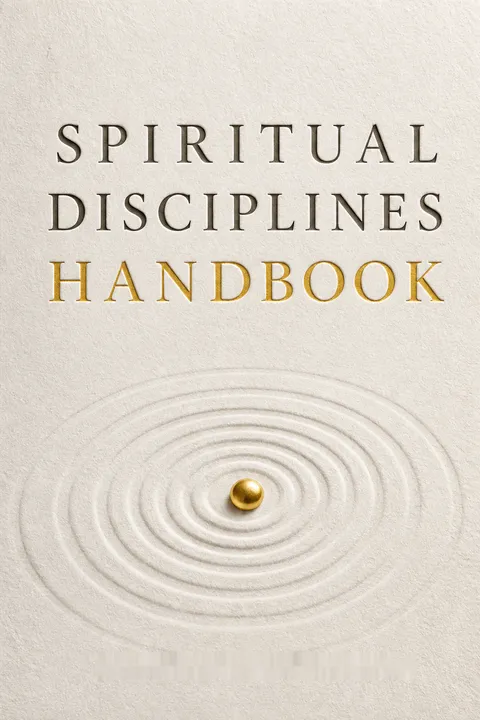


Key Takeaways
Treat spiritual practices as open doors, not levers that force God to act.
Practices make room. Calhoun calls intentional ways of making space for God spiritual disciplines. They do not produce transformation by themselves; they create opportunities to notice God and respond. In the revised edition’s opening story, Calhoun tries to repair a small water-damaged icon and makes the damage worse. Her teacher eventually restores it, showing her how often she tries to fix her own failures instead of asking for help.
Relationship is the goal. A practice can become another achievement to manage, but its purpose is communion with God and growth in Christlikeness. Calhoun organizes the book around worship, the destination of every discipline. The same practice may help one person and frustrate another, and no routine obligates God to provide a particular experience.
The icon story gives the handbook a useful test: does a practice make a person more receptive, or simply more preoccupied with performing well? Repetition can train attention, but attention is not the same as spiritual change. The distinction between a means and an outcome guards against turning prayer, fasting, or service into a private achievement system. It also makes room for difficulty: a practice may expose impatience or self-reliance without immediately making either disappear.
Choose a practice by following the ache beneath your busyness.
Begin with desire. Calhoun argues that longing for change can be a sign of spiritual openness, not proof of failure. Jesus asked people what they wanted, then engaged the deeper need beneath their request. The book’s organizing guide is WORSHIP: Worship God, Open myself to God, Relinquish the false self, Share my life, Hear God’s Word, Incarnate Christ’s love, and Pray.
Make one small choice. Notice a need, struggle, or spiritual dryness, then select a practice that fits it. The handbook suggests spending about twenty minutes exploring a chosen practice rather than trying to master every discipline. Desire is a starting point, not a guarantee that every impulse is wise. The aim is to bring it to God, not to demand a particular result.
This approach replaces a generic improvement plan with a more diagnostic question: what is the actual hunger underneath the complaint? That can make spiritual practice feel less like a duty imported from someone else’s life. Desire still needs interpretation, since people can confuse relief, approval, or control with deeper need. The book’s strongest safeguard is its insistence that desire be held in relationship with God, Scripture, and other people rather than treated as self-validating.
Build a rule for life around your real limits, not your ideal self.
Design a livable rhythm. A rule for life is a short, realistic pattern of practices that supports a person’s relationship with God. It is not a complete schedule or a scorecard. Calhoun points to the early church’s shared commitments to teaching, fellowship, shared meals, and prayer as one example of a rule shaped for a community’s actual life.
Start with what fits. A rule should account for responsibilities, energy, relationships, and the season of life, while making room for growth and rest. Calhoun suggests examining where you feel close to God, what is neglected, and what you hope to become. Even fifteen minutes set aside daily adds up to more than eleven full eight-hour days over a year. A rule can be revised, but it should be given time to take root.
A rule for life resembles a personal constitution: it sets priorities before urgency gets to make every decision. Its emphasis on limits is particularly important, because ambitious plans can disguise a wish to become a different person overnight. A useful rhythm is neither maximal nor effortless; it is sustainable enough to shape attention over time. The framework also invites regular review, since a schedule that once supported care may become impractical when work, health, or family circumstances change.
Protect regular rest from the belief that unfinished work makes stopping irresponsible.
Rest is part of faithfulness. Calhoun describes Sabbath as a recurring day set apart for rest, worship, and delight. It recalls Israel’s release from slavery and treats human limits as real rather than as obstacles to overcome. Jesus challenged the use of Sabbath rules that made a restorative gift feel like another burden.
Make stopping concrete. Calhoun recommends planning a twenty-four-hour Sabbath around nourishing activities and setting aside work, errands, and devices. A household might put phones and work materials in a box before the day begins. Daily rest, quiet, and retreat also help interrupt busyness. The point is not to replace paid work with chores, but to stop producing for a time and receive life, relationships, and creation as gifts.
Rest changes more than energy levels. It challenges the idea that a person’s value depends on being useful, and it makes attention available for relationships that productivity tends to crowd out. The practice is strongest when designed around the actual sources of strain, rather than imposed as a rigid religious standard. Caregiving, shift work, and illness can make a conventional weekly day off difficult, so the underlying principle is a dependable rhythm of stopping, adapted to real constraints.
Examine your defenses so approval and achievement stop defining your worth.
Notice the constructed self. Calhoun calls an identity built on unstable sources such as status, productivity, reputation, or other people’s approval the false self. Because those sources can disappear, the identity they support is vulnerable. She contrasts it with the Christ-in-me identity, the given sense of being loved by God rather than having to earn worth through performance.
Tell the truth without self-punishment. Confession and self-examination mean asking God to reveal how actions harm relationships, then seeking forgiveness and change. Calhoun recommends naming specific behavior instead of hiding behind vague regret, and inviting trusted people to point out blind spots. Detachment helps loosen the grip of status, possessions, and control. Submission, in her account, is freely yielding to God and one another, not accepting abuse or oppression.
The false-self idea connects identity to the strategies people use to secure belonging: impressing, pleasing, controlling, or staying indispensable. Naming those strategies can create choice where there was only reflex. Confession is most constructive when it combines accountability with a secure sense of worth; shame alone often encourages more concealment. The book’s explicit rejection of submission to abuse matters because spiritual language about surrender can otherwise be used to protect harmful authority.
Make spiritual growth a shared practice, not a private performance.
Other people help reveal us. Calhoun presents community as part of spiritual formation, not an optional supplement. Christians share a common life and are called to encourage, forgive, serve, and tell the truth to one another. Jesus taught and traveled with a group of disciples, while sharing particularly intimate moments with Peter, James, and John.
Choose relationships with depth. A covenant group is a committed, usually long-term group that practices honest sharing, confidentiality, prayer, encouragement, and challenge. Accountability partners and spiritual friends offer similar support in smaller settings. Calhoun’s own covenant group helped her through correction and grief. These relationships ask members to share more than public successes, but they do not require every group to serve the same purpose or have the same structure.
Community turns private intention into a relationship with consequences: someone can notice patterns the individual misses, offer support, and ask whether stated values match daily choices. It also complicates formation in productive ways, because people must practice patience and repair rather than merely admire them. Openness, however, is not automatically safe. Trust, confidentiality, and freedom from coercion are essential conditions, not decorative extras. The book’s emphasis on long-term commitment is a reminder that depth usually needs more than occasional contact.
Let prayer include listening, reflection, and silence, not only requests.
Use more than one mode. Calhoun presents prayer as relationship, with practices ranging from spoken requests to quiet attention. The examen is a brief review of the day that asks when love and connection felt strongest, and when they felt weakest. It helps bring overlooked experiences into prayer rather than judging the day by its most dramatic events.
Read for encounter. Lectio divina is a slow, prayerful reading of Scripture intended to deepen relationship with God, not merely gather information. Its movements are quiet preparation, reading, reflection, response, and resting with the text. In contemplative prayer, a person waits attentively without trying to control what happens. These practices do not guarantee a message or a strong feeling. Calhoun’s counsel is to return gently to attention when the mind wanders.
The range of prayer practices recognizes that attention, emotion, memory, and language do not always work in the same way. Reviewing a day can surface patterns that a list of requests misses, while slow reading interrupts the habit of scanning for information alone. Listening also requires humility about interpretation: an intense thought is not automatically divine guidance. Scripture, time, and the perspective of trusted people can help distinguish spiritual attentiveness from a wish to hear confirmation.
Make worship tangible through justice, generosity, compassion, and care for creation.
Love takes practical form. Calhoun’s disciplines include service, justice, stewardship, compassion, truth telling, forgiveness, and care of the earth. Their common thread is that faith should affect how people treat neighbors and use resources. She recounts students filling hundreds of bags with roadside litter, a modest local effort that changed her view of environmental responsibility. Stewardship similarly asks whether possessions, time, and abilities are being shared rather than treated as entirely private property.
Hold love and truth together. Compassion means seeing suffering and responding with help, not merely feeling concern. Justice addresses unfair treatment and material needs. Forgiveness rejects revenge without pretending wrongdoing did not happen; the book distinguishes forgiveness from collusion in ongoing abuse. These practices make worship visible in ordinary decisions, public responsibilities, speech, and relationships.
This section prevents spirituality from shrinking into a private feeling. It asks whether devotion changes the distribution of attention, money, time, and protection. That standard is demanding because good intentions can coexist with habits that preserve comfort or unfairness. The book also makes a valuable distinction between forgiveness and excusing harm. One further test follows naturally: acts of service should respond to what people actually need, not only to what allows the helper to feel generous.
Match disciplines to your season instead of demanding constant spiritual productivity.
Growth has weather. Calhoun describes spring as a time of new desire, summer as a season of service and fruitfulness, autumn as transition, and winter as dryness, loss, or waiting. These seasons can recur throughout life. A difficult or quiet period is not automatically evidence that a person has failed spiritually; it may call for practices that support honesty, patience, and trust rather than more activity.
Fit practice to circumstance. The handbook also describes broad stages of growth: awakening, purgation, illumination, and union. They are guides, not a fixed timetable. A parent with young children may find shared prayer or service more realistic than extended solitude, while a person facing a major decision may need reflection and counsel. The Holy Spirit, in Calhoun’s image, coaches a person toward practices suited to age, capacity, and current circumstances.
Seasonal language gives readers permission to understand change without turning every spiritual low into a diagnosis. It also counters the assumption that maturity always means doing more. These categories work best as prompts for reflection, not labels that assign people a permanent stage or prescribe a universal remedy. Life circumstances can be uneven, and grief or illness may require practical, relational, or professional support alongside spiritual practice. Adaptation is not a loophole; it is part of taking human limits seriously.
Analysis
This handbook is less a linear argument than a field guide: it offers a large repertoire of Christian practices, each tied to a desire, a purpose, and a set of questions or exercises. Its organizing claim is that practices do not manufacture holiness. They create room for attention, response, and cooperation with the Holy Spirit. The distinction matters because the same outward activity can express trust or become image management. A fast, prayer routine, or act of service is not automatically transformative simply because it is difficult or religious.
The book’s most useful design choice is matching practice to longing and circumstance. Instead of prescribing one ideal devotional routine, it directs readers to ask what is happening in their spiritual and ordinary lives. The WORSHIP structure makes a sprawling catalog navigable, while the seasonal model discourages treating spiritual dryness as a simple failure of discipline. The cost of abundance is that a handbook can overwhelm readers or make spiritual growth feel like a menu to optimize. Calhoun repeatedly resists that outcome by advising readers to choose a small number of fitting practices and leave room for limits.
The framework also joins inward attention to public responsibility. Silence and contemplation are not ends in themselves; they belong beside community, forgiveness, stewardship, and justice. That connection is a meaningful corrective to spirituality reduced to private calm. Conversely, outward activity can become another form of avoidance if a person never attends to grief, motives, or exhaustion. The book’s range suggests that formation needs both receptivity and action, and that the balance changes across a lifetime.
Theologically, the handbook assumes Christian beliefs about the Trinity, Scripture, sin, grace, and the indwelling presence of Christ. Readers outside that tradition may still recognize its practical insights about attention, routine, limits, and mutual care, but the book’s explanation of why these practices matter depends on that faith. Its lasting contribution is therefore not a universal technique for self-improvement. It is a disciplined way of asking how a person’s desires, body, relationships, and daily choices can become more open to God and more loving toward others.
Review Summary
Spiritual Disciplines Handbook is highly praised as a comprehensive resource for spiritual growth. Readers appreciate its practical approach, diverse disciplines, and applicability to various life stages. Many recommend reading the introduction first and using it as a reference rather than cover-to-cover. The book is valued for deepening one's relationship with God, offering flexibility in practice, and providing a structured approach to spiritual formation. Some found it dense, but most consider it an essential tool for personal and group spiritual development.
People Also Read






Glossary
Spiritual disciplines
Practices that open spaceIntentional practices, relationships, and experiences that help a person attend to God and respond to the Holy Spirit. Calhoun treats them as ways of making room for transformation, not techniques that guarantee it. Their value lies in their purpose and use, not in spiritual credit or mastery of a complete program.
WORSHIP
Seven paths toward worshipCalhoun’s organizing acronym for the handbook’s categories of spiritual practices: Worship God, Open myself to God, Relinquish the false self, Share my life, Hear God’s Word, Incarnate Christ’s love, and Pray. It serves as a guide for choosing a practice in response to a person’s current desires and needs.
Rule for Life
A realistic spiritual rhythmA brief, adaptable pattern of practices that supports a person’s relationship with God and others. A Rule for Life accounts for responsibilities, limits, desires, and changing circumstances. It is intended as a life-giving scaffold, not a comprehensive timetable, rigid moral checklist, or method of earning divine approval.
false self
Identity built on unstable thingsAn identity constructed around sources of worth that can be lost, such as achievement, status, productivity, reputation, possessions, or approval. Calhoun describes it as defensive and vulnerable because it depends on maintaining those external supports. Spiritual practices of relinquishment and truth-telling help expose these attachments and turn attention toward identity received from God.
Christ-in-me identity
Belovedness received as giftCalhoun’s phrase for the identity grounded in Christ’s presence and God’s love, rather than in performance or public recognition. It is received, not earned. This understanding is meant to provide a secure center from which a person can admit failure, relinquish status-seeking, and love others without needing their approval to establish personal worth.
Examen
Prayerful review of the dayA practice associated with Ignatius of Loyola that reviews the day in God’s presence to notice where love, gratitude, connection, or spiritual fruit were most and least evident. Rather than judging the day as simply good or bad, the examen uses its experiences as material for prayer, self-awareness, and discernment.
Lectio divina
Prayerful reading of ScriptureA contemplative approach to Scripture that seeks an encounter with God rather than information alone. Calhoun describes movements of quiet preparation, slow reading, reflection on a word or phrase, personal response in prayer, and resting with the text. The reader listens without trying to force a message or hurry through the passage.
Visio divina
Prayer through attentive seeingA practice of seeking God through images, icons, art, and the natural world. The practitioner becomes quiet, gazes attentively, notices feelings and associations, and responds to God in prayer. Calhoun presents visual beauty as a possible path to worship, while distinguishing the practice from treating an image as an object of worship.
Welcoming Prayer
Release control, welcome GodA prayer practice for meeting ordinary or emotionally charged moments with awareness of God. It involves noticing bodily and emotional reactions, releasing the urge to secure approval, safety, or control, and welcoming Christ into the experience as it is. The practice aims to interrupt reactive habits and foster trust and freedom.
container discipline
A practice holding other practicesCalhoun’s term for a broad practice that provides a setting in which other spiritual disciplines can happen. Solitude, for example, can create room for prayer, study, silence, or reflection. A container discipline is less a single exercise than an intentional context that protects attention from competing demands.
FAQ
What's Spiritual Disciplines Handbook about?
- Focus on Transformation: The book emphasizes spiritual disciplines as transformative practices that help individuals grow into the likeness of Christ.
- Seven Parts Structure: It is divided into seven parts, each focusing on different aspects of spiritual growth, such as worship, prayer, and community.
- Practical Guidance: Offers practical exercises, reflection questions, and spiritual practices to deepen one's relationship with God.
Why should I read Spiritual Disciplines Handbook?
- Comprehensive Resource: It serves as a valuable guide for anyone looking to deepen their spiritual life through structured practices.
- Encouragement for Growth: Encourages readers to engage in practices that promote transformation and intimacy with God.
- Practical Application: Provides exercises and reflection questions that readers can apply to foster a more profound connection with God.
What are the key takeaways of Spiritual Disciplines Handbook?
- Spiritual Practices Matter: Highlights the importance of spiritual disciplines as pathways to transformation and a deeper relationship with God.
- Community and Accountability: Emphasizes the role of community in spiritual growth, encouraging accountability partnerships and small groups.
- Holistic Approach: Integrates worship, service, and personal reflection, showing the interconnectedness of faith and daily life.
What are the best quotes from Spiritual Disciplines Handbook and what do they mean?
- “You are not a soul with a body; you are a body with a soul.”: Emphasizes the importance of recognizing our physical existence as integral to our spiritual journey.
- “Spiritual disciplines are means to prevent everything in your life from being filled up.”: Highlights the necessity of creating space for God amidst life's busyness.
- “The essence of hospitality is a heart open to God.”: Reflects the idea that true hospitality stems from a relationship with God, encouraging welcoming spaces for others.
What are the spiritual disciplines discussed in Spiritual Disciplines Handbook?
- Worship: Includes practices like celebration and gratitude, helping individuals honor and adore God.
- Prayer: Covers various forms such as intercessory and contemplative prayer, fostering communication with God.
- Service and Community: Encourages living out faith through acts of service and building authentic relationships within the body of Christ.
How does Spiritual Disciplines Handbook address the concept of community?
- Importance of Community: Stresses that spiritual growth is not a solitary journey, highlighting the need for authentic relationships.
- Covenant Groups: Introduces covenant groups committed to helping each other grow spiritually, providing a safe space for sharing.
- Accountability: Emphasizes the role of accountability partners in fostering spiritual growth through shared journeys.
What practical exercises are included in Spiritual Disciplines Handbook?
- Reflection Questions: Prompts readers to consider their spiritual journey and the application of disciplines in their lives.
- Spiritual Exercises: Provides specific exercises like journaling and prayer practices to engage with the material actively.
- Guided Practices: Includes guided practices to help readers engage with particular disciplines, solidifying the concepts discussed.
How can I implement the teachings of Spiritual Disciplines Handbook in my daily life?
- Start Small: Begin with one or two disciplines that resonate with you and incorporate them into your routine.
- Create a Schedule: Set aside specific times for prayer, reflection, and community engagement to develop a deeper spiritual life.
- Engage with Others: Find a small group or accountability partner to share your journey, providing support and encouragement.
What is the significance of silence and solitude in Spiritual Disciplines Handbook?
- Deepening Connection: Presented as essential practices for deepening one’s relationship with God by stepping away from distractions.
- Listening to God: Emphasizes that silence creates space for listening to God’s voice and discerning His guidance.
- Personal Growth: Helps individuals confront inner thoughts and feelings, leading to personal growth and transformation.
How does Spiritual Disciplines Handbook define and approach prayer?
- Variety of Prayer Forms: Discusses forms like intercessory and breath prayer, each serving different purposes.
- Communication with God: Frames prayer as a vital means of expressing thoughts and building intimacy with the divine.
- Encouragement to Practice: Provides practical tips and exercises to help individuals engage in meaningful prayer.
What are some specific spiritual disciplines discussed in Spiritual Disciplines Handbook?
- Breath Prayer: Links prayer with breathing, encouraging repetition of a short prayer or phrase reflecting deepest desires.
- Centering Prayer: Focuses on quieting the mind and resting in God’s presence, using a prayer word to maintain focus.
- Fasting: Discussed as a way to let go of attachments and seek God’s guidance, emphasizing spiritual growth over self-denial.
How does Spiritual Disciplines Handbook define spiritual friendship?
- Covenant Friendship: Described as a relationship where individuals support and encourage each other in their spiritual journeys.
- Mutual Growth: Aimed at mutual growth in faith, hope, and love, helping each other recognize blind spots.
- Grounded in God: Rooted in a shared relationship with God, allowing for deeper connections and accountability.
About the Author
Other books by Adele Ahlberg Calhoun
Download PDF
Download EPUB
.epub digital book format is ideal for reading ebooks on phones, tablets, and e-readers.








