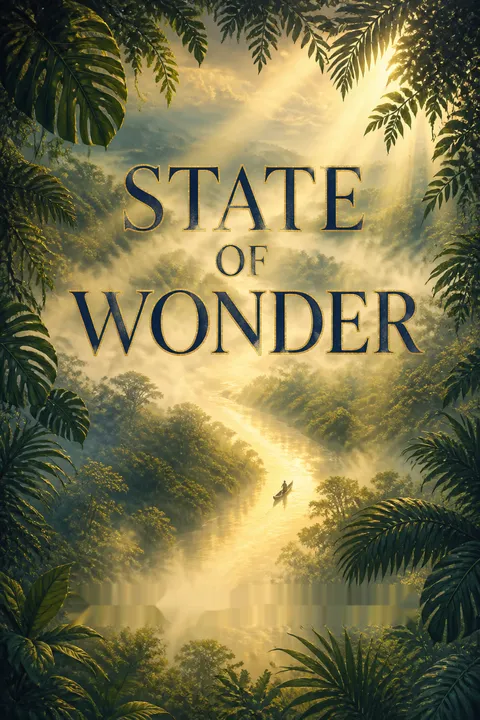


Plot Summary
The Blue Death Notice
A rain-damaged aerogram from Brazil tells Vogel Pharmaceuticals that Anders Eckman, Marina Singh’s close colleague, has died of a fever in the Amazon. His body has been buried there, and the researcher who sent the notice, Dr. Annick Swenson, offers almost no explanation. Vogel’s president, Jim Fox, accompanies Marina to tell Anders’s wife, Karen, and their three sons.
Karen had expected her husband to return, not a stranger’s account of his death. When Marina reads the letter, Karen collapses beside the family dog and demands that Anders be brought home. The immediate crisis is not only grief: no one can reach Swenson, and Fox admits Anders had been sent to make her account for a secretive research project.
The letter’s blue paper makes institutional distance painfully tangible: a company’s decision and a researcher’s handful of sentences become a family’s catastrophe. Marina’s role as messenger exposes the gap between medical competence and emotional preparedness. She can name facts, but she cannot supply the rituals, relatives, or reliable information that help a family survive them. Karen’s refusal to accept the account is not simple denial. With no body and no trustworthy chain of communication, doubt remains a rational response to incomplete evidence.
The Journey She Inherits
Karen receives another letter from Anders, written before the death notice and describing fever, fear, and longing for home. The mismatch deepens her uncertainty, but she asks Marina to travel to Brazil because she cannot leave her sons.
Marina agrees, though she is frightened of the jungle and wary of Swenson, the formidable Johns Hopkins teacher whose approval once governed her life. Preparing for the trip, Marina takes the antimalarial Lariam and recognizes that it caused the nightmares she suffered as a child during visits to her father in India.
On the plane, another drug-fueled dream returns her to the obstetric operation that ended her surgical career: she accidentally blinded a newborn. She leaves for Brazil carrying grief, guilt, and a promise to return quickly.
The journey begins as a favor, but its emotional force comes from Marina’s habit of treating requests as obligations. Karen’s appeal gives that habit a moral object, while the old surgical mistake reveals how much of Marina’s life has been organized around avoiding a second failure. The Lariam revelation changes her childhood story without erasing its pain: she had blamed India and separation from her father for nightmares caused by medication. Brazil will similarly force her to revise the stories she tells herself about responsibility, danger, and what she can endure.
Letters in the Wrong Box
Marina arrives in Manaus without her suitcase or the satellite phone Fox gave her. Her driver, Milton, secures replacement clothes and directs her toward Swenson’s apartment, where young caretakers Barbara and Jackie Bovender live.
At first they treat Marina as another company emissary and defend Swenson from oversight. They also reveal that Anders spent weeks waiting to meet the researcher. Barbara later invites Marina to inspect Swenson’s neglected mail. There Marina finds Karen’s many unanswered letters, alongside Anders’s correspondence and her own.
Karen had kept writing while Anders’s letters travelled slowly toward Minnesota; he had no way to know whether any had arrived. Marina takes the letters for safekeeping and realizes that the Bovenders’ gatekeeping has kept both families in the dark.
The undelivered letters turn communication into a material problem, not a metaphor: a box, an ignored routine, and a missing phone divide people who are actively trying to reach one another. Marina sees that the company’s failure to maintain contact has consequences beyond lost data. Karen’s writing has become evidence of care without an audience, while Anders’s uncertainty about the mail compounds his isolation. The Bovenders are not villains so much as young custodians of a system they barely understand, and their protective intentions help produce the very silence they fear.
The Opera Box
After a fever leaves Marina weak, Barbara brings her a harsh traditional remedy, stays through its violent effects, and nurses her back to health. The two women attend Manaus’s grand opera house, where Swenson unexpectedly occupies the box behind them.
Marina has imagined confronting her, but the encounter leaves her listening like a student again. After the performance, Swenson walks with Marina and Easter, a deaf boy in her care, to a restaurant. She explains that Anders resisted leaving, became seriously ill, and died after refusing to return while he still could.
She says he did not die alone because Easter stayed with him. Swenson will not give a fuller account, and Marina understands that she cannot make the older doctor answer to her. Still, she follows her into the jungle.
The opera’s staged descent into the underworld gives Marina a structure for approaching grief, but the real encounter refuses theatrical resolution. Swenson controls the pace and information, keeping Marina in the familiar posture of a pupil awaiting judgment. Her account of Anders complicates blame: he made choices, yet Swenson’s authority and the expedition’s conditions shaped the choices available to him. Easter’s presence offers one concrete mercy, but it cannot answer Karen’s questions. Marina’s decision to continue is therefore not confidence in Swenson. It is recognition that leaving would preserve ignorance.
Into Swenson’s Green
The next morning Marina rejects the easy return flight and boards Swenson’s pontoon with Easter at the wheel. On the river, Swenson describes how she became embedded among the Lakashi, an isolated community whose trust she earned through years of research and occasional medical care.
She insists that outside intervention can damage a community as surely as neglect can, a claim Marina questions after learning how Swenson’s work has made her responsible for people who seek treatment. At night, torches and cries announce their arrival.
The Lakashi crowd the boat to welcome Swenson, then touch Marina with curious hands until Swenson stops them. Easter leads Marina to a locked storage hut and sleeping porch. There she discovers Anders’s keepsake box, his papers, and a note asking that Easter be helped to reach Karen Eckman.
The river crossing changes Marina’s practical world before it changes her beliefs. She must rely on Easter’s local knowledge and Swenson’s authority, even while distrusting both. Swenson’s argument against intervention is not detached theory: she has accepted the benefits of being a doctor while resisting the obligations those benefits create. Anders’s note makes the question personal. Easter is no longer only a child Marina has met; he is connected to Anders’s final plans and to the family waiting in Minnesota. The box also converts absence into an unfinished responsibility.
The Village Keepsakes
At the Lakashi station, Marina takes a place in the laboratory, testing the stability of the researchers’ compound and learning how little can be judged from Swenson’s sparse reports. She meets the other scientists, including Thomas Nkomo, Dr. Budi, and the Saturns, while the village’s routines teach her to work without clocks, phones, or reliable mail.
Anders’s influence survives in Easter’s painstaking attempts to write the alphabet and the two names he learned from him. At night, Easter cries out in his sleep.
Marina recognizes the terror of a nightmare and comforts him, then lets him sleep beside her. Soon Easter begins leaving Anders’s letters in her bed, fragments of messages he never managed to send. Marina starts writing to Fox, Karen, and her mother, hoping a passing boat will carry her words out.
The station’s daily work gives Marina a way to be useful without immediately resolving the larger mystery. Her scientific training helps her see what the project can and cannot prove, while Easter draws out a form of care that does not depend on speech. Their shared nightmares connect without making their experiences identical: Marina’s dreams return her to childhood separation, while Easter’s grief is attached to a man who taught him letters. The mail ritual reverses the earlier failure. Writing becomes less a guarantee of being heard than a repeated act of keeping relationship possible.
The Anaconda’s Grip
On a trip to the trading post, Marina travels with Alan and Nancy Saturn and Benoit, a Lakashi man hoping to become a guide. Benoit spots an anaconda among floating plants and hauls it into the boat, seeking the kind of daring feat tourists admire.
The snake coils around Easter and begins crushing him. The adults pull from different directions, but Marina reaches for the boat’s machete, cuts off the snake’s head, and then saws through its body while the coils keep tightening. Nancy gives Easter rescue breaths until he begins breathing again.
Back at the village, the Lakashi celebrate the snake as a feast, while Marina stays beside Easter as he recovers. Swenson praises her composure, then reveals that she is seventy-three and pregnant after testing the fertility research on herself.
The attack forces Marina to act before she can retreat into the identity of a pharmacologist who no longer operates. Her response is not a triumphant return to confidence; it is improvised work under pressure, with Nancy’s knowledge and the others’ help essential to survival. The snake also changes her bond with Easter from sympathy into bodily responsibility. Swenson’s pregnancy gives the research an intimate cost. A proposed means of extending fertility is no longer an abstract promise to patients. It is happening inside the investigator who has spent decades controlling the experiment.
The Martins and Moths
Nancy Saturn and Dr. Budi take Marina to a clearing where Lakashi women chew the bark of the Martin trees. Marina sees girls begin the practice after their first menstruation and watches pregnant women avoid it.
The scientists explain that the bark, combined with the purple martinet moth, appears to preserve fertility and protect women from malaria. Dr. Swenson has long studied the fertility effect, while the other researchers have been testing the malaria connection.
The Rapp mushrooms growing beneath the trees are valuable to the Lakashi’s rituals, so the team hides the site to protect both the community and its rare ecosystem. Marina tries the bark and learns that the results are still being tested. When she asks where Anders was buried, the doctors admit they do not know.
The clearing makes the novel’s scientific questions visible as a living system rather than a formula. The tree, moth, human practice, and forest conditions cannot yet be separated into a simple product, and the scientists’ uncertainty matters as much as their promise. Marina’s training encourages isolation of variables, but the research resists that method. The secrecy around the Rapps protects the Lakashi from extraction even as it limits outside scrutiny. Anders’s unknown burial exposes the cost of this arrangement: the same isolation that shields a fragile community can leave a grieving family without evidence.
The Surgeon Returns
Swenson takes Marina to a Lakashi woman whose labor has become dangerous because the baby is breech. With no sterile theatre, anesthesiologist, or proper retractors, Marina argues for trying to turn the child, but Swenson insists on a cesarean.
Marina proceeds with the limited equipment available, using shoehorns as retractors and a village woman as her assistant. She delivers a healthy boy and closes the incision while Swenson guides her. The mother survives the operation, and the household welcomes the child.
Marina has performed surgery for the first time in thirteen years, since the mistake that drove her out of obstetrics. Swenson tells her she will need Marina’s skill when her own baby comes. Marina resists the assignment, but the operation has shown that her old knowledge remains within reach.
The operation shifts Marina’s past from a sealed verdict into a skill she can use again. The improvised tools and crowded hut make expertise depend on adaptation, not ideal conditions, while the outcome depends on the assistant and Swenson’s guidance as well as Marina’s hands. The scene also refuses a clean opposition between intervention and restraint: Marina’s surgery disrupts the village’s ordinary care, yet it answers an immediate danger. Swenson’s confidence in Marina is both recognition and pressure, renewing the responsibility Marina has spent years avoiding.
Fox Reaches the River
Marina keeps gathering evidence about the compound and writes to Fox, but her messages have no reliable route out. Then a boat arrives carrying Fox, Milton, and Barbara Bovender.
Barbara has led them through the river system after Fox refused to wait for news of Marina; on the way, their boat was attacked by the Hummocca, and Barbara saw a figure she believed was her dead father. Fox inspects the research and is impressed by the data. Swenson reveals that she is nearly seven months pregnant, and he realizes the project has reached human testing.
Marina tells Fox that Swenson needs her for the coming birth and hides the urgency of Swenson’s condition. Fox agrees to leave without Marina. His departure gives her a chance to stay, but it also leaves her complicit in concealing what the company is funding.
Fox’s arrival brings the institutional world physically into the camp, but it cannot restore its usual authority. His interest is shaped by the evidence he can take back to Vogel; Swenson’s work is shaped by outcomes the company has not been told to expect. Marina stands between them, using omission to protect a project whose malaria benefits may be broader than its commercial purpose. Barbara’s vision appears at first to be a private crisis, yet it becomes a clue about the Hummocca and Anders’s fate. The rescue party arrives carrying both oversight and the next mystery.
A Costly Birth
After Fox leaves, Swenson tells Marina that the fetus has died and that her blood pressure is dangerously high from preeclampsia. She refuses transfer to a hospital, fearing that exposure would jeopardize the research, and asks Marina to perform a cesarean.
Marina operates in the jungle with limited supplies and a blood transfusion from Thomas Nkomo. The baby has sirenomelia, a rare condition in which the legs are fused, and cannot survive. Marina saves Swenson, then remains at her bedside through fever and recovery.
While reading and monitoring her former teacher, Marina learns that Swenson remembers the surgical accident in Baltimore and believes Marina’s mistake was rushing, not lack of ability. The reassurance does not undo the past, but it gives Marina a different account of what happened.
Swenson’s refusal of hospital care makes scientific commitment inseparable from self-endangerment. Marina’s consent is constrained by affection, professional knowledge, and the danger of leaving Swenson untreated. The stillborn child makes the fertility project’s promise costly in the most literal way: biological possibility does not guarantee a livable outcome. Marina’s recovery of surgical confidence occurs alongside grief, not after it. Swenson’s judgment of the Baltimore operation challenges Marina’s settled self-condemnation, but the novel does not pretend that a teacher’s belated reassurance can erase the injured child or the years Marina lost.
The Unburied Man
As Swenson recovers, she tells Marina that Barbara’s supposed vision of her dead father may have been a glimpse of a white man in the jungle. That possibility forces Swenson to admit that Anders was never found.
While ill, he wandered away from the sleeping porch; Easter raised the alarm, but searches failed, and Swenson declared him dead to the others. Marina now understands that the burial in Swenson’s letter was a lie meant to settle the matter. She takes Easter, gathers oranges, peanut butter, and the Rapp mushrooms, and sets out toward the Hummocca territory.
Thomas and Benoit try to accompany her, but Marina leaves them behind to keep them from the danger. When arrows strike the boat, she calls out the few words she knows and waits for the people hidden in the trees.
The revelation does not simply replace death with hope. Swenson’s lie began as an attempt to impose a manageable ending on an event she could not control, but it deprived Karen and Marina of the chance to search. Barbara’s vision restores uncertainty as a form of evidence. Marina’s decision to travel alone echoes the way she accepted the original mission, but now she acts from attachment rather than obedience. Her gifts are practical and symbolic at once, especially the mushrooms whose value could endanger the Lakashi if exposed.
The Bargain for Easter
The Hummocca gather along the riverbank, and Marina recognizes Anders among them, gaunt but alive. He tells her not to offer the Rapp mushrooms, which could reveal the Lakashi’s secret and invite violence. He accepts the oranges and peanut butter as gifts, but the Hummocca demand Easter. A woman climbs aboard and reaches for the boy, who clings to Marina.
Anders explains that the child belongs to this tribe, and that resisting would put them all in danger. Marina refuses at first, then hands Easter over so she can take Anders away. The boy reaches back toward her as the Hummocca hold him. Marina and Anders flee downriver with the gifts and the boat, leaving the child she had come to love with the people who claim him.
The rescue is deliberately not a victory without remainder. Marina recovers Anders by accepting a bargain that costs her Easter, whose attachment to her was real but did not make him hers. The Hummocca’s claim exposes the limits of benevolent possession: Swenson had also taken responsibility for Easter by keeping him, but her care did not erase his origins. Marina’s choice protects the living people on the boat while producing a new wound. Anders’s survival answers Karen’s opening uncertainty; it does not make Marina’s decision to leave Easter feel clean.
Home Is Not the Same
Back at camp, Swenson explains that she took Easter from the Hummocca years earlier when he was gravely ill, then told them he had died rather than return him. Marina and Anders leave for Manaus the next morning.
He sleeps beside her, and they share a brief intimacy born of shock, tenderness, and their long friendship, not a settled future together. On the journey home, Anders sees the harpy eagle he had hoped to photograph. In Minnesota, he runs from the taxi into his yard and reunites with Karen and their sons.
Marina watches from the car, knowing she has brought him back but left Easter behind. The return restores Anders to his family, while Marina’s experience of home has changed: she has crossed from dependable company doctor to someone who has chosen, concealed, and lost.
The ending resolves the book’s most urgent question without repairing every relationship or injury. Anders’s return gives Karen and the boys the reunion Marina was sent to secure, but Marina does not claim a place in their family’s restored life. The harpy eagle makes Anders’s return briefly luminous, linking the birding dream that drew him south to the life he nearly lost. Swenson’s history with Easter mirrors Marina’s own difficult choice, making care and ownership impossible to disentangle. Home remains beloved, yet Marina returns with knowledge that cannot be folded back into her old routines.
Analysis
State of Wonder asks what happens when care, science, and authority occupy the same territory but follow different rules. Marina arrives believing that facts will settle Anders’s death and that professional competence will tell her what to do. Instead, the Amazon repeatedly exposes the limits of those beliefs. Letters arrive too late; illness cannot always be named; a clinical discovery cannot be separated from the people and ecology that make it possible. The novel makes uncertainty concrete through bodies: a blinded infant, Easter trapped by a snake, a laboring woman on a hut floor, and Swenson’s failing pregnancy. These episodes complicate the idea that trained intervention is automatically benevolent, without making inaction morally clean. Swenson’s defense of scientific independence protects the Lakashi from commercial exploitation, yet her secrecy also permits her to mislead families and institutions. Marina’s development is not a conversion to Swenson’s worldview. She becomes more capable of acting without pretending that her actions are pure or fully informed. Her rescue of Anders requires surrendering Easter, a decision that prevents the ending from becoming a simple reward for courage. Meanwhile, the fertility research challenges the cultural promise that reproductive choice means keeping every possibility open indefinitely. The experiment offers time, but Swenson’s pregnancy reveals that biological extension can carry suffering rather than freedom. Finally, the novel treats home not as an untouched refuge but as a place Marina can return to only after being altered by what she has seen. Anders’s reunion with Karen resolves the family’s immediate loss; Marina’s unresolved grief for Easter preserves the cost of the rescue. The book’s deepest measure of knowledge is therefore not how much a person can discover, but whether they can recognize what their discoveries and decisions demand of others.
Review Summary
State of Wonder received mixed reviews. Many praised Patchett's vivid descriptions of the Amazon and compelling characters, particularly Dr. Swenson. Critics appreciated the exploration of ethical issues in medical research. However, some found the plot implausible and criticized the protagonist Marina as frustratingly passive. The novel's slow build and abrupt ending drew both praise and criticism. Overall, reviewers found it an engaging, thought-provoking read despite some flaws, with Patchett's prose and storytelling ability widely commended.
People Also Read










Characters
Marina Singh
The reluctant field doctorA clinical pharmacologist at Vogel, Marina is precise, dutiful, and accustomed to earning security through competence. Her Indian father and Minnesotan mother left her feeling conspicuous in both family histories, while an obstetric mistake made her abandon surgery and judge herself harshly. She is attached to Anders as a colleague and friend, and involved with Jim Fox in a private relationship complicated by his age and authority. The Amazon unsettles her reliance on plans and measurable outcomes. She becomes more willing to act under uncertainty, though her care for others repeatedly places her in morally difficult situations.
Anders Eckman
The devoted birdwatcherMarina’s longtime laboratory colleague is a warm, observant physician who loves birds, his wife Karen, and their three sons. His ease with people makes him seem suited to Vogel’s diplomatic mission, but his curiosity leads him to become deeply involved in the Amazonian research. He is patient with Marina’s reserve and attentive to the details of their shared work. His letters reveal a man who can be frightened and lonely without losing his humor or tenderness. His interest in the natural world is not an escape from family life but one of the ways he experiences it.
Dr. Annick Swenson
The formidable researcherA brilliant physician and scientist, Swenson was Marina’s demanding teacher and now leads long-term research among the Lakashi. She values scientific independence, distrusts institutional interference, and treats time as a resource to be spent on work rather than social obligation. Her authority can be exhilarating and intimidating; she expects others to keep pace with her and rarely softens a judgment for comfort. She is capable of practical care, but her sense of responsibility is selective and shaped by the consequences she believes intervention will bring. Her history with mentor Martin Rapp informs both her ambitions and her blind spots.
Jim Fox
Vogel’s grieving executiveFox is Vogel’s president and Marina’s lover, a widower who tries to balance personal tenderness with the company’s financial and scientific obligations. He trusted Anders to approach Swenson and regrets the decision after receiving news of Anders’s death. His desire to protect Marina is genuine, but his authority also allows him to ask more of her than he would ask of himself. He believes in the project and needs reliable evidence of its progress. His emotional history makes him alert to loss, though it cannot make him fully understand what Marina encounters in the jungle.
Karen Eckman
The steadfast correspondentAnders’s wife and mother of their three boys, Karen is practical, observant, and more courageous than she initially credits herself for being. She knows her husband’s habits and worries when his letters change, then has to confront the possibility that he will not return. Her correspondence becomes a record of loyalty maintained across distance and failed communication. Karen understands the burden of hope even as she cannot immediately relinquish it. Her request to Marina grows from love for Anders and responsibility to their children, not from a wish to escape her own grief.
Easter
The river-wise deaf boyEaster is a deaf, unusually perceptive boy who navigates the river, handles the pontoon’s engine, and communicates through gesture, attention, and action. He is closely associated with Swenson’s research station and learns from Anders, whose lessons leave him with letters and names to practice. Easter is playful in the water and watchful when others are vulnerable. He responds strongly to changes in the people around him, even when he cannot hear their words. His competence makes adults underestimate how much he understands, while his vulnerability reminds them that skill does not make a child invulnerable.
Milton
The resourceful Manaus driverMarina’s driver in Manaus, Milton knows the city, its river traffic, and the practical routes between Swenson’s scattered worlds. He helps Marina find basic supplies, connect with the Bovenders, and navigate local obstacles. His calm is not passivity: he reads situations quickly and acts before others have solved them. He offers Marina kindness without pretending to control the Amazon, and his loyalty carries beyond the city when he helps Fox reach the research station.
Barbara Bovender
The restless gatekeeperA young Australian writer living in Swenson’s Manaus apartment, Barbara is charming, protective of Swenson, and more emotionally perceptive than her casual manner suggests. She and her husband Jackie help keep strangers from reaching the researcher, although their loose approach to mail has serious consequences. Barbara befriends Marina through illness, outings, and shared loneliness. She is drawn to people who seem fearless, yet her own fear can sharpen her instincts. Her story about seeing her dead father becomes important because she is willing to report an experience she cannot explain.
Jackie Bovender
The itinerant surferBarbara’s husband, Jackie is an itinerant surfer whose plans follow the waves rather than a conventional career. He is playful and physically confident, but he becomes carsick and depends on Milton for transport. Jackie shares Barbara’s devotion to Swenson and helps create a hospitable home in Manaus. His lightness can irritate Marina, yet he is not indifferent to Anders or the difficult circumstances around them.
Thomas Nkomo
The patient field scientistA physician from Dakar, Nkomo works with Swenson and the other researchers in the jungle. He learns Lakashi through listening and repetition, approaching language with humility rather than demanding fluency. His concern for Anders and his loyalty to his wife inform his responses to Marina’s mission. He is both a scientist and a neighbor, attentive to the human obligations that laboratory work can obscure.
Alan Saturn
The devoted Rapp discipleA senior researcher from Michigan, Alan Saturn reveres Martin Rapp, whose teaching shaped his ideas about science and independence. He contributes to the malaria research and has lived long enough in the jungle to accept its physical demands. His intense admiration sometimes narrows his view of Rapp’s private conduct and of the people affected by his choices. He is married to Nancy, whose challenges make him reconsider the story he tells about his mentor.
Nancy Saturn
The clear-eyed botanistA botanist and public-health researcher, Nancy studies the reproductive effects of the Martin trees and works closely with the Lakashi women. She is pragmatic, attentive to social behavior, and willing to question the heroic accounts that colleagues tell about their mentors. During the anaconda attack, her medical quick thinking helps save Easter. Her marriage to Alan includes frank disagreement, but she does not confuse affection with uncritical agreement.
Dr. Budi
The meticulous researcherA highly disciplined scientist on Swenson’s team, Budi works with clinical research and careful measurement. Her quiet manner can make her easy to overlook, but she is technically capable and willing to intervene when a colleague is in danger. She understands the cost of sustained work and values evidence without pretending that the laboratory answers every ethical question.
Martin Rapp
The celebrated field mentorA celebrated botanist and Swenson’s mentor, Rapp represents a model of uncompromising field science to many of his former students. He taught through observation and demanded that expeditions continue despite discomfort. His influence shaped Swenson’s ambitions and Alan Saturn’s understanding of a life devoted to discovery. The accounts of him differ, revealing how admiration can preserve a person’s brilliance while excluding the costs of his conduct.
Marina’s mother
The protective parentMarina’s Minnesotan mother raised her while navigating the distance between Marina and her Indian father. She tries to protect her daughter from fears she believes a child cannot manage, including the effects of antimalarial medication. Her care is sincere, though her silence leaves Marina to misunderstand the source of her childhood nightmares.
Benoit
The aspiring jungle guideA young Lakashi man who hopes to become a tour guide, Benoit studies birds and practices languages. He helps the scientists communicate with other communities and takes part in the dangerous river journey to the trading post.
Josh Su
Marina’s former husbandMarina’s former husband from medical residency, Josh is part of the life she left behind when she changed specialties. Their marriage ended amicably, but its timing sits beside her deeper grief over abandoning obstetrics.
The Lakashi community
The research’s living contextThe Lakashi are an isolated river community whose practices, knowledge, and trust sustain Swenson’s research. They are not a backdrop to the scientists’ work: they make decisions about their own lives, protect their customs, and respond to outsiders on their own terms. Their relationship with the researchers is shaped by both care and unequal power.
Plot Devices
Aerograms and delayed mail
Distance made visibleThe blue airmail sheets carry Anders’s reports, Karen’s unanswered letters, Swenson’s notice of death, and later Marina’s attempts to reach home. Because the letters move slowly and unpredictably, their arrival dates distort what the characters know about one another. The correspondence gives Karen reason to doubt the death notice and later preserves Anders’s voice, but it cannot provide immediate help. The device turns isolation into a practical force: a letter can arrive after its writer is believed dead, while dozens of messages can remain unopened in one apartment.
Lariam and recurring dreams
The past returns chemicallyMarina takes Lariam to prevent malaria, and its neurological side effects bring back nightmares that began during childhood trips to India. She discovers that medication, not India itself, caused those dreams. The drug also intensifies her sleep disturbances in Brazil, where her dreams mingle with guilt over her surgical mistake and fear for Anders. It gives the book a bodily link between past and present: Marina’s mind can misread an experience for years, while new circumstances make the old interpretation impossible to maintain.
The Martin trees and moths
A discovery with two futuresThe Lakashi women chew Martin tree bark, and the purple martinet moth contributes to effects that appear connected both to extended fertility and resistance to malaria. The research depends on a specific ecosystem that the scientists have not learned to reproduce elsewhere. This makes the trees scientifically valuable and politically vulnerable. Swenson’s secrecy protects the Lakashi and the habitat from outside extraction, but it also shields the project from ordinary oversight. The same biological process supports two very different promises, and the researchers disagree about which promise deserves priority.
The Rapp mushrooms
Protection with a priceThe rare blue Rapp mushrooms grow beneath the Martins and matter to Lakashi ritual life. Their discovery makes the research site valuable to outsiders, so the scientists conceal its location to protect the community and the fragile habitat. Marina later carries some mushrooms toward the Hummocca as a possible gift, but Anders warns that revealing them could endanger the Lakashi. The mushrooms embody the danger of turning a living cultural practice into a commodity, even when the person seeking to trade them believes she is acting for good reasons.
The Amazonian river system
A route without guaranteesThe rivers connect Manaus, the research station, and neighboring communities, but their many branches make travel dependent on memory, local knowledge, and chance. Boats carry supplies, letters, researchers, and would-be rescuers; they also expose travelers to storms, dangerous wildlife, and hostile territory. The river is never a simple road home. Marina’s ability to follow it depends first on Easter and later on Anders, while Barbara’s mistaken turn becomes a clue that redirects the search. Movement is possible, but arrival never guarantees safety or return.
FAQ
Synopsis & Basic Details
What is State of Wonder about?
- A Journey of Discovery: State of Wonder follows Marina Singh, a pharmacologist, as she travels to the Amazon to investigate the death of her colleague and the mysterious research of Dr. Annick Swenson.
- Unraveling Secrets: The story explores themes of ambition, ethics, and the complexities of human relationships as Marina navigates the challenges of the jungle and the secrets surrounding Dr. Swenson's work.
- Personal Transformation: Marina's journey is not only a quest for answers but also a personal transformation, as she confronts her past and grapples with the moral implications of scientific progress.
Why should I read State of Wonder?
- Intricate Plot: The novel offers a compelling narrative with unexpected twists and turns, keeping readers engaged and invested in the characters' fates.
- Rich Character Development: Patchett crafts complex and nuanced characters, each with their own motivations and flaws, making them relatable and thought-provoking.
- Exploration of Themes: State of Wonder delves into profound themes such as the ethics of scientific research, the clash of cultures, and the search for meaning in a complex world, prompting reflection and discussion.
What is the background of State of Wonder?
- Amazonian Setting: The novel is set in the remote Amazon rainforest, a location that serves as both a physical and metaphorical wilderness, highlighting the challenges and mysteries of the natural world.
- Pharmaceutical Research: The story is rooted in the world of pharmaceutical research, exploring the ethical dilemmas and personal sacrifices involved in the pursuit of scientific progress.
- Cultural Clash: The narrative examines the clash between Western and indigenous cultures, highlighting the complexities of cultural exchange and the impact of human intervention on traditional ways of life.
What are the most memorable quotes in State of Wonder?
- "The dead were dead were dead were dead and still Marina Singh did not have to shut her eyes to see Anders Eckman eating an egg salad sandwich...": This quote captures Marina's struggle with grief and the persistence of memory, highlighting the emotional core of the story.
- "Hope is a horrible thing, you know. I don't know who decided to package hope as a virtue because it's not. It's a plague.": Karen's raw and honest statement reveals the pain of uncertainty and the burden of false hope, adding depth to her character and the novel's themes.
- "You underestimate yourself." "You overestimate Dr. Swenson. And me. We would be strangers to one another.": This exchange between Mr. Fox and Marina highlights the complex dynamics of their relationship and the challenges of self-perception, revealing the characters' inner conflicts.
What writing style, narrative choices, and literary techniques does Ann Patchett use?
- Character-Driven Narrative: Patchett employs a character-driven narrative style, focusing on the inner lives and emotional journeys of her characters, making their experiences relatable and compelling.
- Detailed Descriptions: The author uses vivid and detailed descriptions of the Amazonian landscape, creating a rich and immersive setting that enhances the story's atmosphere and themes.
- Subtle Foreshadowing: Patchett skillfully uses subtle foreshadowing and callbacks, creating a sense of unease and anticipation while adding layers of meaning to the narrative.
Hidden Details & Subtle Connections
What are some minor details that add significant meaning?
- The Blue Aerogram: The bright blue airmail paper used to announce Anders' death is a recurring symbol of distance and delayed communication, highlighting the challenges of connecting across vast spaces.
- The Recurring Mention of Rain: The frequent references to rain in the Amazon foreshadow the emotional turmoil and the sense of being overwhelmed that the characters experience.
- The Description of the Lab: The small, shared lab where Marina and Anders worked for seven years symbolizes their close relationship and the shared history that is disrupted by his death.
What are some subtle foreshadowing and callbacks?
- Marina's Childhood Dreams: The recurring nightmares Marina experiences as a child, triggered by Lariam, foreshadow her later struggles with the drug's side effects and the emotional turmoil of her journey.
- Anders' Birding Obsession: Anders' passion for birdwatching foreshadows his fascination with the Amazon and his desire to explore the unknown, ultimately leading to his fateful trip.
- The Mention of the Hummocca Tribe: The early mention of the Hummocca tribe, and their reputation, foreshadows the later revelation of Anders' fate and the dangers that Marina will face.
What are some unexpected character connections?
- Marina and Karen's Unspoken Bond: Despite their different lives, Marina and Karen share an unspoken connection, a bond that is strengthened by their shared grief and the complexities of their relationships with Anders.
- Milton's Knowledge of Dr. Swenson: Milton, the driver, has a surprising connection to Dr. Swenson, revealing a hidden network of relationships and information in Manaus.
- The Bovenders' Connection to Dr. Swenson: The Bovenders' role as caretakers of Dr. Swenson's apartment reveals a complex dynamic of dependence and control, adding layers to their seemingly carefree personas.
Who are the most significant supporting characters?
- Milton: The driver, Milton, serves as a guide and confidant to Marina, offering practical assistance and a sense of stability in the chaotic world of Manaus.
- The Bovenders: Barbara and Jackie Bovender, despite their initial evasiveness, play a crucial role in connecting Marina to Dr. Swenson and revealing the complexities of her world.
- Thomas Nkomo: Dr. Nkomo, a fellow researcher, provides insight into the Lakashi tribe and the ethical dilemmas of scientific research, challenging Marina's perceptions and assumptions.
Psychological, Emotional, & Relational Analysis
What are some unspoken motivations of the characters?
- Mr. Fox's Guilt: Mr. Fox's decision to send Anders to the Amazon is driven by a deep sense of guilt and responsibility, stemming from his own past mistakes and a desire to protect Marina.
- Dr. Swenson's Isolation: Dr. Swenson's desire for isolation and control is rooted in her fear of losing her research and her belief that she is the only one capable of understanding its true potential.
- Marina's Need for Closure: Marina's journey is driven by a need for closure and understanding, not only about Anders' death but also about her own past and her place in the world.
What psychological complexities do the characters exhibit?
- Marina's Trauma: Marina's past trauma from a medical error and her childhood nightmares reveal a deep-seated fear of failure and a need for control, which are challenged by her experiences in the Amazon.
- Dr. Swenson's Obsession: Dr. Swenson's obsessive dedication to her research and her disregard for personal relationships highlight her complex and often contradictory nature, driven by a desire for scientific achievement.
- Anders' Need for Validation: Anders' desire to go to the Amazon and his need to be liked by Dr. Swenson reveal a deep-seated insecurity and a longing for validation, which ultimately contribute to his tragic fate.
What are the major emotional turning points?
- The News of Anders' Death: The initial shock and grief over Anders' death set the stage for Marina's journey and her emotional transformation.
- Marina's Encounter with Dr. Swenson: The tense and confrontational meeting with Dr. Swenson forces Marina to confront her own assumptions and biases, leading to a shift in her perspective.
- The Discovery of Anders' Survival: The revelation that Anders might still be alive ignites a new sense of hope and urgency, driving Marina to take greater risks and challenge her own limitations.
How do relationship dynamics evolve?
- Marina and Mr. Fox: The relationship between Marina and Mr. Fox evolves from a professional connection to a complex and often fraught personal relationship, marked by unspoken desires and unresolved conflicts.
- Marina and Dr. Swenson: The dynamic between Marina and Dr. Swenson shifts from a student-teacher relationship to a complex interplay of respect, resentment, and a shared understanding of the challenges of scientific research.
- Marina and the Bovenders: Marina's relationship with the Bovenders evolves from initial skepticism to a grudging respect and a shared understanding of the complexities of Dr. Swenson's world.
Interpretation & Debate
Which parts of the story remain ambiguous or open-ended?
- The True Nature of the Drug: The exact nature and potential of Dr. Swenson's drug remain ambiguous, leaving readers to question the true motivations behind its development and the ethical implications of its use.
- The Fate of the Lakashi Tribe: The future of the Lakashi tribe and their way of life remains uncertain, highlighting the fragility of indigenous cultures in the face of modernization and scientific progress.
- The Meaning of Marina's Transformation: The extent of Marina's personal transformation and her future path remain open-ended, leaving readers to ponder the long-term impact of her experiences in the Amazon.
What are some debatable, controversial scenes or moments in State of Wonder?
- Dr. Swenson's Treatment of Anders: Dr. Swenson's seemingly callous treatment of Anders, both before and after his death, raises questions about her ethics and her capacity for empathy.
- The Use of the Lakashi People: The novel raises questions about the ethics of using indigenous people for scientific research, highlighting the power dynamics and potential for exploitation.
- Marina's Decision to Leave Easter: Marina's decision to leave Easter with the Hummocca tribe, despite her growing attachment to him, raises questions about her own moral compass and the limits of her compassion.
State of Wonder Ending Explained: How It Ends & What It Means
- Anders' Return, Easter's Departure: The ending sees Anders return home, but Easter is left behind, highlighting the bittersweet nature of Marina's journey and the sacrifices made in the pursuit of knowledge and connection.
- Uncertain Future: The novel concludes with a sense of uncertainty about the future, both for the characters and for the world they inhabit, leaving readers to ponder the long-term consequences of their actions.
- Transformation and Acceptance: Despite the ambiguity, the ending emphasizes the transformative power of the journey, as Marina comes to terms with her past and accepts the complexities of the present, finding a new sense of purpose and understanding.
About the Author







Download PDF
Download EPUB
.epub digital book format is ideal for reading ebooks on phones, tablets, and e-readers.








