

Key Takeaways
Ask whether materialism can explain the reason, morality, and science it uses.
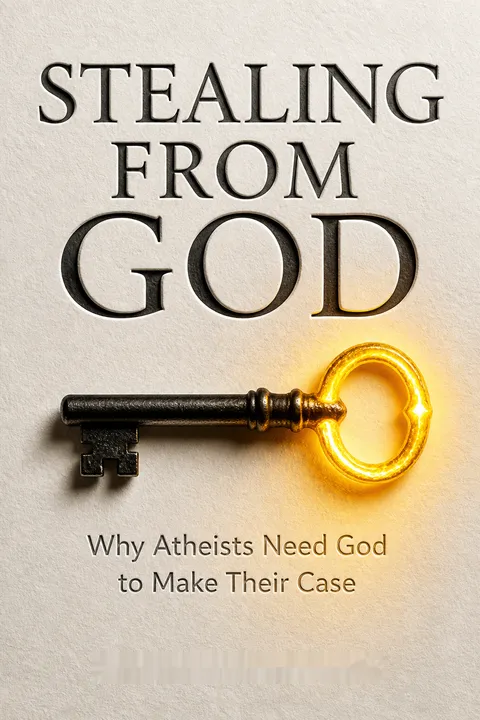
The argument in brief. The book opens at a funeral, where Coach speaks of faith and hope after losing his wife and son. His conviction frames the central challenge: can a world of matter alone explain the things people rely on when they argue about reality? Turek says atheists often use causality, logic, information, moral judgment, evil, and science while rejecting the God he believes grounds them. He calls these intellectual borrowings C.R.I.M.E.S., an acronym for those six areas. His target is chiefly atheistic materialism, the view that physical matter is all that exists, not every possible form of atheism.
A test of coherence. The book’s recurring method is to ask whether a worldview can support its own claims. Turek argues that theism explains these features of experience better than materialism, while cautioning that discrediting atheism alone does not establish Christianity.
The book’s strongest organizing idea is a coherence test: a worldview should account for the standards by which it argues. This is a useful discipline far beyond religious debate, since political and scientific theories also depend on assumptions they may leave unexamined. But explanatory difficulty is not the same as logical impossibility. Showing that one account of reason or morality is incomplete does not, by itself, prove that God is the correct explanation. The book is most persuasive when it turns a familiar objection back into a question about foundations, and less persuasive when it treats that question as already settled.
Treat a cosmic beginning as a question about causes, not just physics.
The first-cause case. Turek argues that if space, time, and matter began to exist, their cause cannot itself be made of space, time, and matter. He infers a cause beyond nature, with the power to create and, because creation involves a choice, a personal agent. The argument is not that everything needs a cause. It is that things that begin need one, while God is proposed as an unbegun cause.
A disputed nothing. The book challenges physicist Lawrence Krauss’s use of quantum vacuums to explain a universe from nothing: a quantum vacuum has physical properties, so it is not absolute nothingness. Turek also invokes cosmic expansion and fine-tuning as evidence for a beginning and purposeful design. He acknowledges that a first cause alone does not identify Christianity.
The distinction between an empty physical state and literal nonbeing is philosophically important. A theory that explains how a universe develops from a prior physical condition has not necessarily explained why there is any physical reality at all. Still, the inference from a cosmic beginning to a personal creator contains additional steps. A cause outside spacetime need not be personal simply because personal agency is familiar in human life. The argument gives readers a clear way to separate cosmological models from questions about ultimate explanation, while leaving open how much the available physics can establish about that ultimate cause.
Make every worldview answer for the standards it relies on.
Reason needs foundations. Turek focuses on logic, especially the law of noncontradiction: a claim and its opposite cannot both be true in the same sense at the same time. In a debate, even denying this principle seems to rely on it. The author argues that logical laws are not material objects or temporary human conventions, because people use them to reason about a reality beyond themselves.
The materialist difficulty. If thoughts are entirely determined by physical processes, Turek asks, why trust a thought’s claim to be rationally true? He presents this as a self-defeating problem for materialism. His proposed alternative is that an enduring rational Mind grounds logic and makes human reasoning possible. The argument is meant to challenge the foundations of materialism, not merely one atheist’s conclusion.
The self-reference test is a sharp tool: a claim that denies truth or logic seems to undermine itself as it is asserted. The deeper issue is whether physical causes necessarily make reasoning unreliable. Some naturalist philosophers distinguish reliable reasoning from conscious control, arguing that cognitive capacities can be shaped by their success in tracking the world. That response is not automatic proof that naturalism works, but it shows why the debate cannot be resolved by labeling all material explanations self-refuting. Turek identifies a genuine explanatory burden: a worldview needs an account of why its reasoning processes deserve trust.
Use biological information to ask what kinds of causes can produce it.
Code and design. Turek points to DNA’s long, ordered sequences as information that resembles a coded message. Drawing on Stephen Meyer, he argues that chemistry explains how molecules interact but not why the genetic sequence carries functional instructions. He also cites the sudden appearance of many animal body plans in the Cambrian fossil record and argues that new forms require genetic and epigenetic information, not just altered DNA.
Order beyond organisms. The book extends the case through final causality, its term for processes directed toward an outcome. A heart pumps, an embryo develops, and natural processes follow regular patterns. Turek argues that such order points to an intelligence that sustains nature, whether or not evolution explains some biological change. He presents intelligent design as an inference from evidence, not simply an answer inserted where knowledge is missing.
The information analogy encourages a productive question: what mechanisms produce and preserve functional biological sequences? It also warns against assuming that naming a process explains its origin. Yet an analogy between DNA and human writing does not establish that both arose in the same way. Evolutionary mechanisms can alter and select existing biological variation, and their explanatory reach must be assessed rather than dismissed by analogy. The book’s design inference is therefore strongest as a challenge to explain the origin and organization of life, not as a demonstration that every feature of biology was directly engineered.
Separate knowing right from explaining why rightness binds everyone.
The grounding question. The story of Megan Kanka, a child murdered by a sex offender, makes the moral argument concrete. Turek says most people know that rape and murder are wrong, including those who deny God. His question is not whether atheists can behave morally, but what makes moral judgments objectively true and binding. He distinguishes knowing a moral rule from explaining its existence.
Rivals to God. The book considers Sam Harris’s proposal that morality concerns the well-being of conscious creatures. Turek replies that science might identify what promotes well-being, but cannot by itself explain why well-being is morally authoritative. He argues that evolution describes what helps organisms survive, not what they ought to do, and that a society’s preferences cannot supply a standard beyond that society.
The distinction between moral knowledge and moral grounding is valuable: explaining how people acquire moral beliefs is not identical to deciding whether those beliefs are true. The harder question is whether moral realism necessarily requires a divine lawgiver. Secular moral realists argue that moral truths can be objective without being commands from a person, while theists argue that such truths need a deeper source. The example of a grave crime makes clear why mere popularity or social agreement feels inadequate, but emotional certainty about a moral wrong does not by itself settle which metaphysical account explains it.
Use the reality of evil to challenge every worldview, not just belief in God.
Evil and goodness. Turek draws on Augustine’s view that evil is not an independent substance, but a damage or absence in something good, like rust in a car. On this account, calling an act evil already assumes some standard of good. He argues that atheists who condemn cruelty while denying objective morality rely on a standard their worldview cannot explain.
A Christian response. The book also faces the harder question of why a good God permits suffering. Turek points to human freedom, character formed through hardship, and a ripple effect in which events can produce consequences beyond anyone’s view. He recounts Gary Bingham, who was born after his mother was raped and later became a pastor. The story illustrates a possible good arising from evil, but does not make the original harm good.
The privation account helps explain how evil can be real without being a rival substance equal to goodness. It also clarifies why moral protest seems to require a standard. But a moral standard does not alone explain why a benevolent, powerful God permits particular suffering. The book’s appeal to human limits and unforeseen consequences is logically possible, yet difficult to test in individual tragedies. The story of Bingham offers a human example of resilience and purpose, not a universal answer. A careful response can preserve that hope without treating every atrocity as an instrument whose hidden benefit is known.
Read violent Bible passages in context before treating them as timeless commands.
A reading method. To address biblical commands concerning the Canaanites, Turek recommends checking the historical situation, the kind of writing, the passage’s intended audience, and whether it prescribes conduct for readers today. He calls this method STOP. Applied to the conquest accounts, he argues that ancient military language could use hyperbole, that the target was idolatrous practice rather than an ethnicity, and that the commands belonged to ancient Israel rather than the present.
The moral difficulty. Turek also says that, even if the accounts describe literal deaths, God as creator has authority over life in a way humans do not. He presents this as a theological answer, not a license for people to imitate those acts. His case depends on historical and literary interpretations that readers may dispute.
The method’s most transferable lesson is simple: texts need context before they become moral instructions. Historical setting, genre, audience, and scope routinely change how a passage should be understood. The book’s interpretation of conquest language is one possible reading, but arguments about hyperbole and ancient warfare do not erase the ethical weight of the passages. Nor does divine authority automatically persuade a reader who questions the text’s portrayal of God. Close reading improves the debate, even where it does not end it.
Distinguish repeatable science from historical claims about origins.
Two kinds of inquiry. Turek separates operational questions, such as how an engine works, from historical questions about how the universe or life began. Historical sciences infer past events from present evidence, much as detectives do. In the O. J. Simpson trial, jurors interpreted the same forensic evidence differently, a reminder that evidence does not interpret itself.
Assumptions matter. Turek argues that scientists rely on philosophy, logic, causality, and assumptions about the reliability of observation. He criticizes methodological naturalism, the rule that scientific explanations must use natural causes, for excluding intelligent causes before examining evidence. His Henry Ford analogy says a car’s natural laws explain how it operates, while an engineer explains its origin. He argues that science can support theism and that theism makes science intelligible.
The distinction between mechanisms and historical reconstruction is useful, especially when scientific authority is invoked on questions that cannot be rerun in a laboratory. The analogy between a car and its maker also captures how explanations at different levels can coexist. However, historical sciences still test hypotheses against independent traces, and limiting a scientific method to natural causes need not amount to a philosophical denial of God. The book is right that science rests on assumptions it cannot prove using experiments alone. Its critique is less convincing when it treats methodological naturalism as automatic evidence of ideological bias.
Treat the resurrection as a historical claim that deserves evidence.
From theism to Christianity. Turek organizes his case around four questions: whether truth and God exist, whether miracles are possible, and whether the New Testament is historically reliable. If a creator exists, he argues, miracles are possible in principle. He then presents evidence for the New Testament, including early testimony, eyewitness detail, embarrassing depictions of the disciples, and references from non-Christian writers.
The central event. The book highlights Paul’s early report that many people claimed to have seen Jesus alive after his death. It also points to the disciples’ willingness to suffer rather than recant, and to the Gospels’ differences in minor details alongside agreement about the central claim. Turek concludes that the resurrection best explains the evidence and supports Jesus’ identity as divine.
The cumulative approach is stronger than relying on a single proof text: dates, named people, independent sources, and socially awkward details all matter to historical judgment. Still, evidence that witnesses sincerely believed a claim is not identical to evidence that the claim happened, and martyrdom alone establishes commitment rather than accuracy. Differences among accounts can reflect independent testimony, but they can also require careful explanation. The historical case invites assessment rather than dismissal; the move from early Christian testimony to a bodily resurrection remains an inference whose strength depends on how competing explanations are weighed.
Let evidence inform belief, then decide whether trust follows.
Assent is not trust. Turek distinguishes believing that Jesus is the savior from believing in Jesus by entrusting oneself to him. Evidence can support the first judgment, while the second involves commitment. The book compares this with deciding to marry: gathering evidence about a person matters, but a relationship requires a step of trust.
The human question. Coach’s faith at his wife’s funeral gives the argument its emotional frame. Turek argues that Christianity offers redemption, a relationship with God, and hope beyond death, while God does not force people into that relationship. He ends by urging readers who doubt Christianity to investigate Jesus rather than reject claims they have not examined. The book’s final appeal is both intellectual and personal.
The distinction between accepting a proposition and relying on a person is psychologically and ethically important. Many decisions require action before certainty is complete, and trust can be a rational response to accumulated evidence. Yet religious commitment is not simply a neutral choice made after facts are tallied: upbringing, community, fear, grief, and prior experience shape what feels credible and safe. The book’s appeal is strongest when it invites honest investigation and acknowledges the personal stakes. It is less helpful when disagreement is mainly attributed to unwillingness to submit, since sincere readers can weigh the same evidence differently.
Analysis
Stealing from God is an ambitious Christian apologetic built around a memorable reversal: arguments used against God may depend on realities that materialism struggles to explain. Its narrative method is accessible. A grieving husband, a murdered child, public debates, and the familiar language of science keep abstract questions attached to lived experience. The book also usefully distinguishes the existence of a belief from its justification, and asks readers to inspect assumptions rather than accept scientific prestige as a substitute for argument.
Its central weakness is a tendency to move too quickly from explanatory difficulty to theism. That a naturalistic account of logic, consciousness, or moral normativity is contested does not establish that it is impossible, nor does an immaterial feature automatically imply a divine mind. The repeated self-refutation charge is powerful against crude claims such as nothing is true, but not every physicalist account entails that reason is unreliable. Likewise, a cosmic beginning may motivate a first-cause argument without identifying that cause as personal, morally perfect, or Christian.
The science chapters are especially vulnerable to overstatement. Historical inquiry depends on inference from traces, but naturalistic methods are not necessarily a commitment that nothing supernatural exists. They can be a practical restriction on testable explanations. The book’s positive account of design therefore needs to compete with specific natural mechanisms, not only challenge a philosophical rule. Its New Testament discussion also offers cumulative historical evidence, but sincerity, early testimony, and textual reliability do not independently demonstrate a resurrection.
The book remains valuable as a map of foundational questions and as a forceful account of why theism matters to its author. Its best contribution is not a knockout proof, but a demand for intellectual symmetry: atheists and theists alike should explain the assumptions they use, distinguish evidence from interpretation, and admit where an inference exceeds what the evidence alone can guarantee.
Review Summary
Stealing from God by Frank Turek receives mixed reviews. Supporters praise its logical arguments against atheism and defense of Christianity, finding it intellectually satisfying and valuable for apologetics. Critics argue it misunderstands atheism, uses straw man arguments, and is condescending. Some readers appreciate Turek's writing style and examples, while others find it repetitive and flawed. The book's central premise, that atheists inadvertently rely on concepts that require God's existence, resonates with many readers but fails to convince others.
People Also Read



Glossary
C.R.I.M.E.S.
Six disputed foundationsTurek’s acronym for causality, reason, information and intentionality, morality, evil, and science. The book argues that atheists appeal to these features of reality while atheistic materialism cannot adequately explain them. The acronym organizes the book’s critique; it is not a neutral or universally accepted classification of arguments.
Materialism
Physical reality is allThe view that physical matter and its processes are all that exist. Turek treats materialism as the dominant foundation of contemporary atheism and argues that it cannot account for immaterial realities such as logical laws, objective moral values, or a mind capable of rational judgment. Other philosophers use the term in different ways.
Law of noncontradiction
Opposites cannot both holdA basic principle of logic stating that a proposition and its negation cannot both be true at the same time and in the same sense. Turek uses it to expose claims that seem to undermine themselves, such as asserting that no truth exists while presenting that assertion as true.
Inference to the best explanation
Choose the strongest explanationA form of reasoning that compares possible explanations for evidence and favors the one judged to account for it most adequately. Turek applies it to features such as genetic information, cosmic beginnings, and historical testimony, arguing that intelligent agency explains them better than unguided natural causes.
Final causality
Processes directed toward endsThe idea, associated in the book with Aristotle and Aquinas, that natural processes are directed toward characteristic outcomes or functions. Examples include a heart pumping blood and an embryo developing into an organism. Turek argues that this goal-directed order ultimately depends on an intelligent source.
Methodological naturalism
Restrict explanations to natureA rule for inquiry that limits explanations to natural causes. Turek argues that applying this rule to origins excludes intelligent or supernatural explanations before evidence is assessed. Critics distinguish this methodological limit, used to make testable investigations possible, from the broader metaphysical claim that only nature exists.
STOP
Contextual Bible-reading guideA method Turek proposes for interpreting difficult biblical passages. Readers examine the historical situation, the literary type, the passage’s intended object or audience, and whether it prescribes behavior for people today. He uses the method to argue that ancient conquest commands should not be read as timeless instructions.
Operation science
Study of repeatable processesTurek’s label for scientific investigation of recurring processes that can be observed and tested, such as how an engine functions. He contrasts it with origin science, which reconstructs historical events from traces. The distinction is intended to explain why scientific confidence about present mechanisms does not automatically settle questions about origins.
Origin science
Study of past eventsTurek’s label for inquiry into historical events that cannot be repeated directly, including the origins of the universe and life. Investigators infer what happened from evidence that remains in the present. The book compares this process with forensic investigation, where evidence requires interpretation and competing explanations must be assessed.
About the Author
Other books by Frank Turek
Download PDF
Download EPUB
.epub digital book format is ideal for reading ebooks on phones, tablets, and e-readers.








