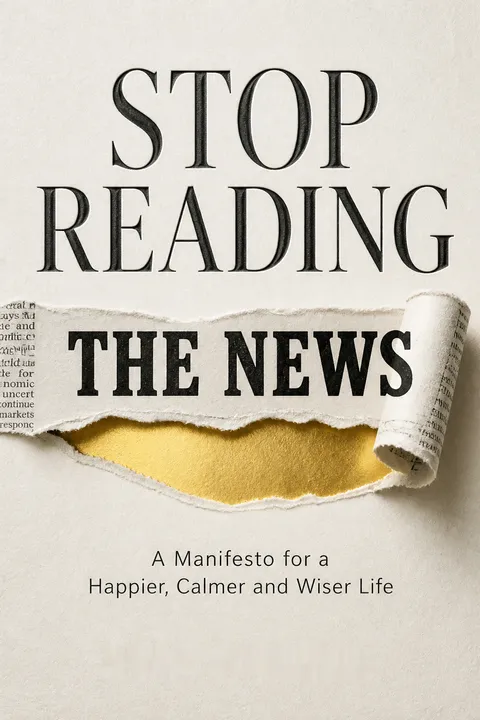


Key Takeaways
Treat novelty as a poor proxy for what deserves your attention.
A revealing confrontation. Rolf Dobelli traces his argument to a visit to the Guardian, where he was expected to discuss his book but was asked instead to defend his criticism of news. He challenged the assembled journalists, arguing that much of their daily output served entertainment more than understanding. The paper published his argument that same day, and readers flocked to it. The episode captures the book's central distinction: an event can be new, dramatic, and widely repeated without being important to a particular person's life.
A personal test. After years of voracious news consumption, Dobelli asked whether it had improved his decisions or understanding. He concluded that it had not. His claim is not that the world lacks important events, but that constant updates rarely tell people what matters to them.
What's striking is the gap between public importance and personal relevance. News organizations must serve broad audiences, while individuals make decisions in particular families, jobs, and communities. That mismatch helps explain why a headline can feel urgent without changing any practical choice. Attention research also distinguishes salience, what captures notice, from value, what improves a decision. The book is strongest when it asks readers to test the latter. Its absolute case can be too sweeping, though: emergency alerts and local reporting can be directly useful. The sharper lesson is to demand a clear reason for each source's place in a daily routine.
Build understanding through depth, not a daily pile of disconnected updates.
Choose a field. A circle of competence is an area a person understands well, or is deliberately working to master. Dobelli argues that information tied to this circle is more likely to improve decisions than general headlines. A heart surgeon, for example, benefits more from current medical research than from political spectacles unrelated to patient care. As expertise grows, its boundaries can expand through study, expert conversations, and careful reading.
Trade breadth for context. News delivers fragments, but books, textbooks, and substantial articles can explain causes and connections. Dobelli recommends reading deeply, revisiting valuable material, and using search engines for specific questions without following every link into unrelated stories. Long-form writing is not automatically reliable or relevant, especially when advertising shapes it, but it gives complexity more room than a short update.
This approach resembles deliberate practice: improvement comes from focused work in a domain, not from accumulating trivia about many domains. It also offers a useful defense against the illusion that awareness equals expertise. Still, an overly narrow information diet can produce blind spots. Scientific breakthroughs, policy changes, or economic shifts sometimes matter across professional boundaries. A practical balance is to establish a deep core, then schedule limited, purposeful exploration outside it. The crucial distinction is between exploration with a question and aimless exposure that lets headlines choose the question.
Run a 30-day news fast before deciding whether you need the habit.
Make the break real. Dobelli recommends a month without news, not merely a promise to browse more selectively. Remove news apps, newsletters, and browser shortcuts; avoid television news and social feeds. He predicts that the first week may bring restlessness, fear of missing something, and a sense of social disconnection. His experience was that the urge eased with time, and significant information still arrived through friends, family, or specialized sources.
Use a softer route if needed. One alternative is a single weekly publication, read in print, in one sitting, with a time limit. Dobelli also describes relapsing into daily coverage during the 2016 US election, then stopping again when he noticed its effects on his mood and attention. His practical point is forgiving but firm: a lapse is a reason to restart, not abandon the experiment.
A time-limited experiment is more persuasive than a permanent vow because it turns a broad argument into something observable. Readers can compare sleep, concentration, mood, and time use before and during the month. This resembles a simple personal trial, although expectation can influence the result, so tracking specific behaviors is better than relying only on a general sense of calm. The soft option also acknowledges that habits and circumstances differ. A person responsible for monitoring a safety issue may need alerts; the experiment should remove habitual browsing, not essential information.
Assume headlines bend judgment toward vivid risks and ready-made explanations.
Salience is not probability. Dobelli describes negativity bias, the tendency for negative events to command more attention than equally significant positive ones. Availability bias makes events easier to judge when examples come readily to mind, so repeated coverage can make rare dangers seem common. News also encourages hindsight bias: once an event has happened, a compressed account can make its causes seem obvious. Dobelli points to the 2008 financial crisis, which arose from interacting conditions rather than one simple trigger.
Keep opinions provisional. Confirmation bias leads people to favor evidence that supports existing beliefs. A continuous stream of stories makes it easy to find apparent support for almost any position, while public relations campaigns and targeted content can further shape what people see. Dobelli recommends seeking strong counterarguments and asking what evidence could change a conclusion, rather than forming a view on every topic.
These biases are not signs of stupidity; quick attention to danger and familiar evidence can be adaptive in immediate situations. The problem is that an attention-grabbing media environment can turn those shortcuts into poor estimates of risk and certainty. The useful response is not blanket distrust, which can make genuine warnings easier to dismiss, but calibration: compare an alarming story with base rates, historical context, and competing explanations. A news fast may reduce exposure, yet it cannot replace the skills needed to evaluate information that genuinely affects a decision.
Protect uninterrupted attention as the scarce resource news quietly spends.
Count the hidden minutes. The book cites estimates of roughly 58 to 96 minutes of daily news use. Dobelli adds the time needed to regain focus after interruptions, plus the lingering attention consumed by stories that keep returning to mind. Together, these costs can approach an hour and a half a day. Over a year, that is a substantial block of time that could go to work, relationships, rest, or concentrated learning.
Depth needs room. Working memory can hold only a limited amount at once, and difficult material takes sustained attention to understand and retain. Hyperlinks and autoplay invite repeated shifts away from a text. Dobelli connects this fragmented reading to weaker concentration and less creative thought. He also cites research on London taxi drivers whose intensive route learning corresponded with brain changes, illustrating that repeated mental demands can shape the brain, though not necessarily in the same way for every reader.
The strongest point here is not that every news item damages cognition, but that interruptions have costs beyond the seconds spent looking at a screen. Switching tasks requires rebuilding the mental context that made the original work intelligible. This makes attention a design problem as much as a willpower problem: alerts, feeds, and autoplay create friction against sustained thought. Claims about lasting brain changes deserve caution, since the studies described do not establish that news alone causes broad cognitive decline. Still, protected reading time is a sensible response to a fragmented environment.
Do not confuse witnessing distant suffering with helping anyone.
Exposure can overwhelm agency. Much news reports events far beyond an individual reader's influence. Dobelli connects this repeated exposure to learned helplessness, a pattern in which uncontrollable stress can encourage passivity. He describes experiments in which animals exposed to unavoidable shocks behaved differently from animals able to stop them. The book argues that news can create a similar feeling of helplessness, which may spill into areas of life where action is possible.
Turn concern into action. Following a disaster does not itself assist those affected. Dobelli suggests supporting effective aid organizations with money rather than treating attention or emotional distress as proof of compassion. He also argues that constant coverage of successful and famous people can intensify status comparisons, further unsettling readers. A more useful filter is to ask whether a story points toward a concrete action, a responsibility, or a decision within reach.
The distinction between attention and assistance is valuable in an economy where platforms profit from emotional engagement. Concern becomes more useful when it leads to a specific, accountable response rather than repeated viewing. At the same time, exposure can inform people about abuses and emergencies, and reporting sometimes helps mobilize aid or public pressure. The answer is not indifference, but a deliberate path from information to action. Readers can choose a trustworthy organization, a local responsibility, or a civic task, then stop consuming repetitive coverage that adds distress without changing the response.
Keep democratic scrutiny, but demand investigation and explanation instead of constant alerts.
Separate journalism's jobs. Dobelli argues that democracy needs a free press, but daily news snippets are not the same as journalism that uncovers wrongdoing or explains complex events. Investigative reporting takes time to verify facts and follow evidence. Explanatory reporting connects events to background conditions and causes. He points to the Washington Post's Watergate investigation as an example of sustained scrutiny, not merely rapid updates.
Make informed choices deliberately. Citizens can examine candidates' records, study referendum arguments, and discuss opposing views without following every headline. Dobelli warns that the competition for attention can push outlets toward louder, shorter, more polarizing coverage. He also describes how public relations and advertising can influence what appears to be ordinary reporting. His argument is not that watchdog journalism is unnecessary, but that it should be supported as a distinct public good.
This distinction avoids a false choice between compulsive news consumption and civic ignorance. Democratic oversight depends on reliable institutions that investigate power, while citizens need enough context to judge what those institutions report. The tension is economic: slow, specialist work costs money, while free, fast content competes for attention. That makes a reader's choices consequential. Paying for or sharing rigorous reporting may support a healthier information system more directly than clicking through every alert. Still, a journalism diet must preserve access to urgent local and public-interest information.
Replace headline small talk with one researched story and real conversation.
Make conversation substantial. Dobelli's proposed news lunch gives two people a focused exchange: each spends about fifteen minutes explaining one important subject, including its context and the reasoning behind their view. The purpose is not to recite headlines, but to learn something relevant from another person's knowledge. The rest of the meal can develop those ideas or move into ordinary conversation.
Build a better public sphere. Dobelli imagines expanding the format into gatherings where a journalist explains a current investigation and a scholar or specialist presents a slower, less visible issue. The event would combine expertise, conversation, and social contact in a manageable lunch break. This offers a concrete substitute for passive scrolling: fewer topics, more context, and a chance to question the person presenting the information.
The news lunch treats knowledge as social and interpretive, not merely a stockpile of facts. A speaker's expertise, assumptions, and uncertainty become visible in conversation, giving listeners context that a short post rarely supplies. The format also counters the tendency to mistake having an opinion for understanding a subject. Its limitation is access: expert-led meals can exclude people with little time, money, or professional networks. Libraries, schools, and community groups could adapt the same principle through open, low-cost discussions centered on one well-prepared topic.
Analysis
Dobelli's most durable contribution is a reframing of news from a civic virtue into a designed habit with opportunity costs. The book asks a sharper question than whether a report is true: does repeated exposure improve understanding, decisions, or action enough to justify its claim on attention? That standard is useful because it distinguishes information from knowledge and emotional response from effective help.
The narrative makes the case memorable by placing an unusual personal experiment inside a wider critique of media incentives. News organizations need novelty and attention; readers need relevance and context. Those goals overlap sometimes, but not reliably. The proposed alternatives, focused reading, expert conversation, and investigative journalism, show that the book opposes the dominant news format more than knowledge itself.
Its argument is less secure when it treats news consumption as uniformly harmful. The text links exposure to stress, shallow thought, passivity, and changes in brain structure, but some cited findings do not establish that news alone causes these outcomes for all people. It also understates circumstances in which rapid reporting is useful, including local emergencies, public health warnings, and accountability campaigns. A reasonable application is therefore not ignorance as a moral achievement, but intentional control over frequency, source, and purpose.
The book's strongest practical test is simple: before opening a feed, identify what decision or understanding the information could change. If the answer is unclear, the update may be entertainment disguised as duty. If it matters, seek reporting with evidence, context, and a path to action. This preserves the author's central concern while avoiding the mistake of treating every form of journalism as interchangeable.
Review Summary
Readers find Stop Reading the News thought-provoking but polarizing. Many appreciate Dobelli's arguments against news consumption, citing reduced stress and improved focus. However, some criticize his extreme stance and repetitive writing. The book is praised for its concise format and compelling reasoning, though some find it simplistic or irrelevant to their situations. Critics argue Dobelli oversimplifies complex issues and ignores the importance of staying informed. Overall, readers agree the book offers valuable insights but debate its practicality and universal applicability.
People Also Read



Glossary
Circle of competence
Area of genuine expertiseA circle of competence is the field or fields in which a person has substantial understanding, or is intentionally building it. Dobelli uses the idea to help readers judge which information can improve their work and decisions. Its boundaries matter more than its size: areas outside the circle may require study before confident judgment.
Negativity bias
Negative information weighs moreNegativity bias is the tendency for negative information to attract more attention and exert more influence than comparable positive information. Dobelli argues that news organizations exploit this tendency by emphasizing alarming, shocking, or conflict-driven events. Repeated exposure can make the world seem more dangerous and distressing than a balanced assessment would suggest.
Availability bias
Recall shapes perceived likelihoodAvailability bias is the tendency to judge a question using examples that come readily to mind rather than information that may be more representative. Vivid, frequently repeated stories are easy to recall, so people can mistake their mental availability for their actual frequency or importance. News can make dramatic events unusually prominent in memory.
Confirmation bias
Favoring evidence for existing beliefsConfirmation bias is the tendency to notice, interpret, and remember information in ways that support existing beliefs while discounting contradictory evidence. Dobelli argues that an endless stream of reports makes it easy to find apparent support for almost any position. He recommends actively seeking strong counterarguments and identifying what evidence could change a view.
Hindsight bias
The past seems predictableHindsight bias is the tendency to regard an outcome as more predictable after it has occurred than it seemed beforehand. Short news explanations can strengthen this impression by assigning a complex event to a small number of causes. The result is misplaced confidence about both why an event happened and whether it could have been anticipated.
Learned helplessness
Uncontrollability encourages passivityLearned helplessness describes a pattern in which repeated exposure to situations that cannot be controlled can reduce efforts to act. Dobelli applies the concept to news about distant crises, arguing that readers may feel emotionally stirred but powerless to affect events. He warns that this passivity can influence areas of life where meaningful action is possible.
Affect heuristic
Feelings substitute for analysisThe affect heuristic is a judgment shortcut in which an immediate positive or negative feeling influences an assessment. Dobelli argues that news can trigger strong reactions before readers have enough context to evaluate complicated questions. The feeling may then be mistaken for a reasoned conclusion, encouraging opinions on subjects a person has not studied.
Sturgeon's Law
Most output is low qualitySturgeon's Law is the claim that most of what is produced in any category is poor or unworthy of attention. Dobelli applies it to news as well as literature and other forms of output. The point is not that every publication is worthless, but that abundance alone does not make content valuable and readers need their own filters.
News lunch
Focused expert conversation over lunchA news lunch is Dobelli's proposed alternative to headline-driven conversation. Participants each present one subject they understand, explaining its context and significance rather than listing several updates. He imagines extending the format into public gatherings with journalists and specialists, giving participants a chance to ask questions and discuss a carefully chosen issue.
Explanatory reporting
Reporting that connects causesExplanatory reporting presents the background, driving conditions, and relationships that help make an important event understandable. In Dobelli's distinction, it is different from rapid news updates, which often report isolated facts without enough space to explore context. It requires subject knowledge, careful analysis, and room for complexity.
FAQ
What's "Stop Reading the News" about?
- Author's Perspective: "Stop Reading the News" by Rolf Dobelli is a manifesto advocating for a life without the constant consumption of news.
- Core Argument: Dobelli argues that news is irrelevant, misleading, and harmful to mental health, akin to sugar for the body.
- Personal Experience: The book is based on Dobelli's personal journey of giving up news and the positive effects it had on his life.
- Broader Implications: It explores how news consumption affects decision-making, creativity, and overall well-being.
Why should I read "Stop Reading the News"?
- Mental Clarity: The book offers insights into achieving a happier, calmer, and wiser life by eliminating news consumption.
- Practical Advice: Dobelli provides practical steps and a 30-day plan to help readers reduce or eliminate their news intake.
- Critical Thinking: It encourages readers to think critically about the information they consume and its impact on their lives.
- Unique Perspective: The book challenges conventional beliefs about the necessity of staying informed through news.
What are the key takeaways of "Stop Reading the News"?
- News is Irrelevant: Most news stories do not impact personal decision-making or understanding of the world.
- Mental Health Impact: Consuming news can lead to stress, anxiety, and a distorted perception of reality.
- Focus on Competence: Dobelli emphasizes focusing on one's circle of competence rather than being distracted by irrelevant news.
- Alternative Information Sources: Books and long-form articles are recommended for deeper understanding and knowledge.
How does Rolf Dobelli suggest we stop reading the news?
- Radical Abstinence: Dobelli advocates for completely cutting out news consumption to experience its benefits.
- 30-Day Plan: He suggests a 30-day trial period of news abstinence to observe the positive changes in life.
- Soft Option: For those who find it too radical, he recommends limiting news to one weekly publication.
- Focus on Books: Replace news with reading books and long-form articles to gain deeper insights.
What is the "Circle of Competence" concept in "Stop Reading the News"?
- Definition: The circle of competence refers to areas where an individual has expertise and understanding.
- Focus on Relevance: Dobelli advises focusing on information relevant to one's circle of competence for better decision-making.
- Avoid Distractions: News often falls outside this circle, leading to wasted time and energy on irrelevant information.
- Professional Success: Mastery within one's circle of competence is key to professional and personal success.
How does news consumption affect mental health according to Rolf Dobelli?
- Stress and Anxiety: News consumption triggers stress responses, leading to increased cortisol levels and anxiety.
- Negativity Bias: The news exploits our natural tendency to focus on negative information, impacting mental well-being.
- Chronic Stress: Continuous exposure to news can lead to chronic stress, affecting overall health and quality of life.
- Cognitive Overload: The constant influx of news can overwhelm the brain, reducing focus and concentration.
What is the "News is to the Mind What Sugar is to the Body" analogy?
- Comparison to Sugar: Dobelli compares news to sugar, suggesting it is addictive, easily consumed, and harmful in excess.
- Lack of Nutritional Value: Just as sugar lacks nutritional value, news lacks substantive information that benefits the mind.
- Short-term Gratification: Both provide short-term gratification but have long-term negative effects on health and well-being.
- Detox Recommendation: Dobelli recommends a detox from news to improve mental clarity and focus.
How does "Stop Reading the News" address the issue of fake fame?
- Fake Fame Concept: The book discusses how news creates celebrities who are famous for trivial reasons, not achievements.
- Distorted Perception: This fake fame distorts the relationship between fame and actual competence or power.
- Impact on Society: It shifts focus away from individuals who have made significant contributions to society.
- Avoiding Fake Fame: By avoiding news, one can focus on genuine achievements and contributions.
What are the potential benefits of stopping news consumption according to Dobelli?
- Improved Quality of Life: Dobelli claims that stopping news consumption leads to a clearer mind and better decision-making.
- Increased Time: Eliminating news frees up time for more meaningful activities and pursuits.
- Enhanced Creativity: Without the distraction of news, creativity and deep thinking are more likely to flourish.
- Better Understanding: Focusing on books and long-form content provides a deeper understanding of the world.
What are some of the best quotes from "Stop Reading the News" and what do they mean?
- "News is to the mind what sugar is to the body." This quote highlights the addictive and harmful nature of news consumption.
- "The news is irrelevant." Dobelli emphasizes that most news stories do not impact personal life or decision-making.
- "You become what you give your attention to." This quote underscores the importance of focusing on meaningful content.
- "Avoid trifling conversation." Inspired by Benjamin Franklin, it suggests seeking deeper, more valuable discussions.
How does Rolf Dobelli address the role of news in democracy?
- Democracy Without News: Dobelli argues that democracy can function without the constant consumption of news.
- Historical Context: He points out that major democratic movements occurred before the advent of modern news media.
- Informed Voting: Voters can make informed decisions by focusing on candidates' achievements rather than news reports.
- Investigative Journalism: Dobelli supports investigative journalism but distinguishes it from the daily news cycle.
What is the "News Lunch" concept proposed by Rolf Dobelli?
- Definition: The "News Lunch" is a proposed format for meaningful discussions over lunch, focusing on one topic.
- Deep Conversations: It encourages in-depth conversations rather than superficial news consumption.
- Intellectual Exchange: Participants share insights and perspectives, enriching each other's understanding.
- Alternative to News: It serves as an alternative to traditional news, fostering deeper connections and learning.
About the Author
Other books by Rolf Dobelli
Download PDF
Download EPUB
.epub digital book format is ideal for reading ebooks on phones, tablets, and e-readers.








