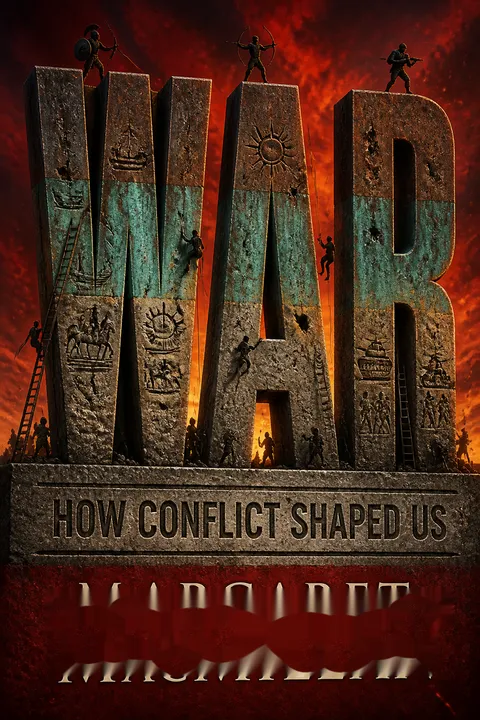


Key Takeaways
Study war as part of society, not as peace's temporary breakdown
War belongs in history. MacMillan defines war not as violence alone, but as organized violence pursued by political communities against other political communities. Its reach extends beyond battle: it has redrawn borders, toppled rulers, moved populations, and shaped national identities. The book's central claim is that war and society have developed together, so neither can be understood in isolation.
The evidence reaches deep. Ötzi, a man preserved in ice from around 3300 B.C., had an arrowhead lodged in his shoulder and wounds suggesting a violent death. Archaeological evidence of violent deaths and fortifications appears across early societies. Such findings challenge the comforting idea that war is a recent breakdown of an otherwise peaceful human past, though they cannot reveal every motive or social context.
What's striking is the shift in scale: a battlefield becomes a clue to how a society organizes authority, identity, and resources. That approach resembles systems thinking, which studies how institutions and behaviors shape one another rather than searching for a single cause. It also guards against treating war as an unfortunate interruption that can be excluded from ordinary history. The limit is evidentiary: ancient remains show that violence occurred, but rarely establish whether a particular event was war, feud, or something else. The book's strongest claim is therefore about war's enduring importance, not a precise account of its prehistoric origins.
Build strong institutions, but watch how war makes them powerful
War builds the state. Defending territory requires leaders, records, taxes, supplies, and disciplined forces. Historian Charles Tilly's compact formula, cited by MacMillan, captures the reciprocal process: states make war, and war makes states. Rome counted citizens partly to assess taxes and military obligations. In seventeenth-century Britain, naval demands helped expand public finance: the Treasury and Bank of England became lasting institutions developed in part to fund war.
Power can bring order. Strong states have broken private armies, restrained local violence, and sometimes widened rights in exchange for military service. In Athens, the need for rowers helped poorer men gain political standing. But centralized power also lets governments regulate labor and resources, and repress dissent. The same machinery that secures a society can mobilize it for destruction.
This account makes state capacity morally double-edged. Public administration can provide security and services, yet the same ability to count people, collect revenue, and coordinate supply can enable coercion on a vast scale. That is a useful corrective to the assumption that government is either simply protective or simply oppressive. The key question is not only how much capacity a state has, but who can direct it and hold it accountable. Military pressure may accelerate reform, but it does not guarantee fair outcomes: rights can expand for some while others bear the costs of extraction.
Treat war's stated trigger as a spark, not the fuel
Incidents expose tensions. Wars may be publicly tied to a single insult, attack, or assassination, but deeper interests often make that incident consequential. Britain used Captain Jenkins's severed ear as a rallying point in 1739, while the underlying dispute concerned trade and imperial reach. In 1914, the assassination of Archduke Franz Ferdinand gave Austria an opening to confront Serbia, while alliances and military plans widened the crisis into a European war.
Motives recur. MacMillan groups them broadly as greed, self-defense, and emotions or ideas. Fear can prompt preventive action, while honor, nationalism, religion, and revenge can turn compromise into apparent betrayal. Leaders also often neglect the desired peace after victory. The Iraq planning example makes the danger concrete: defeating a government is not the same as knowing how to govern the aftermath.
The distinction between a trigger and a cause is valuable because it separates public justification from strategic context without assuming every official explanation is a lie. It also highlights how perception matters: a government can sincerely fear a threat and still misread it. The book's examples support a practical test for political claims: ask what interests were already in conflict, what alternatives were available, and what settlement the leaders sought. The caution is that broad motives such as fear and ambition can explain too much unless tied to specific decisions, institutions, and evidence.
Technology changes war only when societies learn how to use it
Tools need institutions. New weapons do not automatically decide wars. The longbow helped overturn the advantage of armored knights at Crécy in 1346, but its effect depended on training, tactics, and the organization of English forces. Gunpowder transformed European warfare only as governments built reliable weapons, trained soldiers to use them, and raised the money to maintain standing armies.
Adaptation runs both ways. Tanks and aircraft helped overcome the defensive deadlock of the First World War, while later armies developed countermeasures. Societies also reject useful technology when it threatens established status or seems unnecessary. Japan's warrior elite resisted further gun development after internal order was established, leaving the country less prepared when American ships forced it to open in 1853. Military innovation is therefore social and political, not just mechanical.
The argument avoids technological determinism, the idea that a new device dictates historical change on its own. A weapon matters when organizations can integrate it into doctrine, logistics, and training, and when leaders accept the institutional disruption it brings. This resembles innovation in civilian industries, where invention and adoption are distinct stages. The Japanese case also shows that resistance can be locally rational: guns threatened samurai status, while peace reduced their immediate value. Such choices can still carry future costs, especially when a society mistakes a temporary lack of need for lasting security.
Mass patriotism turns citizens, factories, and civilians into battlefield resources
Modern war mobilizes society. The French Revolution joined nationalism to mass recruitment. The 1793 levée en masse called young men to fight, married men to make arms and carry supplies, women to produce clothing, children to prepare bandages, and older people to encourage the troops. Industrial production later multiplied the scale. In the First World War, nearly 70 million men entered armed forces; during the Second, the major belligerents made hundreds of thousands of aircraft and tanks, alongside millions of rifles.
The front expands. Governments directed factories, food, labor, transport, and scientific research toward victory. Once civilians and industry sustain the military, leaders can treat civilian life as part of the enemy's war-making capacity. The term total war describes conflicts that draw whole societies and their resources into the struggle, weakening the boundary between battlefield and home.
National belonging can turn participation into a perceived duty, while industrial systems make that duty materially consequential. This helps explain why modern war changes daily life far beyond the battlefield. It also clarifies a central moral danger: once workers, infrastructure, and morale are framed as military assets, civilian protection becomes easier to dismiss. Yet mobilization is not identical to consent. Governments may claim national unity while restricting speech, labor, or movement. The more thoroughly a society is organized for war, the more important it becomes to scrutinize who decides that the emergency exists and when it ends.
Train soldiers to act together without making obedience morally blind
Cohesion keeps people fighting. Recruits do not simply arrive as ready-made warriors. Training, shared rituals, uniforms, discipline, and stories of past heroes help replace civilian loyalties with unit identity. Historian William McNeill called the pleasure and solidarity produced by coordinated movement muscular bonding. Such cohesion can help soldiers function under fire: at Antietam, the inexperienced 16th Connecticut regiment broke apart under attack, while better-trained units held together.
The same bonds can enable abuse. Discipline and loyalty can suppress individual hesitation as well as panic. Christopher Browning's study of a German police battalion in occupied Poland found that most members were not committed anti-Semites, yet few chose to leave when given the option to avoid participating in massacres. Women have also fought, including Soviet pilots and infantry in the Second World War, challenging the belief that combat is naturally a male role.
Group identity can be both a protective resource and a channel for moral disengagement. Organizational psychology often distinguishes coordination from unquestioning conformity: teams need shared procedures, but they also need credible ways to refuse unlawful orders and report misconduct. The distinction matters because atrocity is not explained only by exceptional cruelty; routine obedience can help make it possible. The book also usefully separates average physical differences from social expectations about gender. Still, including women in military institutions is not itself proof of equality; access, authority, and treatment matter as much as formal participation.
Take civilians seriously: they are targets, workers, resisters, and survivors
Civilians bear deliberate costs. Sieges, forced labor, famine, deportation, sexual violence, and bombing have repeatedly struck people outside uniform. During the siege of Leningrad, around a million residents died, while many others escaped. In 1945, Soviet forces raped an estimated two million women in Germany, illustrating how sexual violence can punish individuals and humiliate a defeated society. The Second World War may have killed 50 to 80 million civilians, though the records and definitions make any total uncertain.
They also shape outcomes. Civilians supply labor, food, information, and political support, or withhold them through resistance and noncooperation. Wartime labor drew women into jobs previously reserved for men; in Britain, women made up 34 percent of industry and transport by 1918, up from 23 percent before the war. These changes could open opportunities, but many disappeared when soldiers returned.
The civilian category is not a synonym for passive. People can sustain a war effort, resist occupation, or simply improvise enough to survive. That range complicates both military narratives, which can erase civilian agency, and moral narratives that treat whole populations as either innocent victims or willing collaborators. The figures also need careful reading: civilian death counts vary depending on whether famine, disease, and displacement-related deaths are included. The underlying point survives that uncertainty. When military strategy treats a population as leverage, the distinction between harming an enemy's capacity and harming its people becomes dangerously thin.
Make laws of war enforceable, not merely admirable declarations
Restraint has a history. In the American Civil War, scholar Francis Lieber drafted rules for Union soldiers that became General Order 100 in 1863. Later Geneva agreements focused on wounded soldiers, prisoners, and civilians; the Hague conferences addressed how war could be conducted. Together, these efforts helped develop modern international rules, including distinctions between the right to begin a war and the rules governing conduct during one, known as ius ad bellum and ius in bello.
Rules face a power problem. Agreements can guide behavior, but there is no reliable global police force to enforce them. States have ignored protections when they judged military necessity or victory more important. The book points to mass bombing by Allied powers as well as atrocities by Axis powers, underscoring the tension between universal standards and selective accountability. New forms of resistance also complicate who counts as a combatant and who receives legal protection.
Rules can matter even when enforcement is imperfect: they establish standards, help document violations, and give outsiders grounds to challenge official conduct. But law's credibility depends on consistency. If powerful states demand accountability from opponents while exempting themselves, the rules can look like instruments of hierarchy rather than shared restraint. The difficult issue is not merely identifying a violation, but building institutions capable of investigating it impartially. The history here also cautions against treating legal recognition as a substitute for political judgment. A formally lawful action may remain destructive, and a morally urgent intervention can still be exploited for strategic gain.
Read war stories critically: memory can honor, distort, or recruit
Art shapes what war means. Shakespeare's Henry V gives audiences both the pull of battlefield glory and the fear of ordinary soldiers, while Francisco Goya's prints expose cruelty that official victory scenes hide. Modern photography and film widened the record, but images can still be staged, selected, or censored. Even Alexander Gardner rearranged bodies in some Civil War photographs. Artistic form does not guarantee an unfiltered account.
Remembrance is selective. The First World War was first commemorated by many as a necessary sacrifice, then increasingly portrayed as futile as another European war approached and the veterans died. Different countries centered different episodes: Gallipoli for Australia, Vimy Ridge for Canada, and Verdun for France. Such choices can create shared mourning, but leaders can also use them to simplify history and bolster present-day national claims.
The book treats memory as an active political force rather than a neutral storehouse. That insight connects naturally to media literacy: every image has a frame, every commemoration has an editor, and omission can be as influential as falsehood. Yet skepticism should not flatten all accounts into propaganda. A photograph can be manipulated and still preserve evidence; a national memorial can unify while leaving uncomfortable history outside its frame. A useful reader's question is not simply whether a representation is true, but what it makes visible, what it conceals, and whose interests its version of the past serves.
Treat cyber and autonomous weapons as war, even without front lines
Future conflict may look unfamiliar. MacMillan warns against assuming that large wars between states have disappeared. Alongside conventional forces, conflicts can involve insurgents, urban armed groups, and networks without clear bases or uniforms. As more people live in cities, governments face harder problems of maintaining order without harming the population they claim to protect.
New tools create new vulnerabilities. Cyberattacks can disrupt government and financial systems; the Stuxnet virus disabled much of Iran's nuclear program in 2010. Tiny surveillance drones and autonomous weapons raise questions about human control and accountability. The book stresses that war forecasts often fail: planners expected different patterns in both world wars. Studying the past cannot predict every weapon or crisis, but it can expose recurring risks, including arms races, miscalculation, and leaders who treat conflict as manageable.
The technological concern is less about machines becoming independently evil than about responsibility becoming harder to locate. When targeting, surveillance, and decisions are distributed among software, operators, commanders, and political leaders, accountability can dissolve into procedure. Cyber conflict also unsettles familiar ideas of invasion because disruption may cross borders without troops crossing them. Still, new capabilities do not erase old political motives: fear, ambition, and misjudgment remain central. Historical analogy is most useful here as a warning about overconfidence, not as a claim that tomorrow's conflict will simply repeat yesterday's.
Analysis
MacMillan's central contribution is relational: war is not an isolated event imposed on society, but a form of organized action that societies create, regulate, and are then changed by. This lens connects military history to state formation, public finance, citizenship, gender, technology, law, art, and memory. The book's narrative moves across those domains without reducing war to a single master cause. Greed, fear, status, and ideology recur, but their force depends on institutions, political choices, and available means.
The argument is strongest when it reveals feedback loops. States mobilize resources to fight, and that mobilization builds bureaucracies capable of governing civilian life. Shared participation can widen political claims, yet the same national belonging can license coercion against outsiders. Discipline allows a unit to withstand fear, but can also normalize cruelty. These are not contradictions to be resolved; they are mechanisms that explain how collective goods and collective harm can grow from the same arrangements.
The wide sweep also creates risks. Prehistoric evidence cannot establish a universal human propensity with the confidence that surviving states and written records sometimes allow. Cross-cultural examples are illuminating, but the book's acknowledged emphasis on the West means that its account of modern transformation is not a complete global history. Terms such as total war clarify a change in scale, but can conceal substantial variation between societies and conflicts. Casualty figures likewise depend on what is counted, especially when famine and disease follow fighting.
The ethical force of the book comes from refusing both easy comfort and fatalism. War is neither an accidental interruption nor an unavoidable destiny. Its recurrence has structural causes, but its timing and form depend on choices that can be examined. The practical lesson is not that historical study makes conflict disappear. It is that societies need a more honest account of how threats are framed, how wars are begun, whose lives are treated as expendable, and what political settlement is intended. Without those questions, military power can appear precise and controllable even when its social consequences are not.
Review Summary
War: How Conflict Shaped Us explores war's impact on human society, technology, and culture. MacMillan argues that war is not an aberration but a fundamental part of human experience. The book covers various aspects of war, including its causes, conduct, and effects on civilians. Reviews praise MacMillan's breadth of knowledge and engaging writing style, though some criticize the lack of a central argument. Readers appreciate the historical anecdotes and thought-provoking insights, but some find the structure disjointed. Overall, the book is seen as a valuable overview of war's role in shaping human history.
People Also Read
Glossary
Total war
Society-wide mobilized conflictA form of war in which the state mobilizes a large share of society's people, economy, industry, and scientific capacity. The term is associated with the world wars, when civilian labor and infrastructure became integral to military power and the distinction between battlefield and home front weakened.
home front
Civilian life under warThe civilian sphere understood as part of a country's war effort. The term reflects modern conflict's dependence on factories, transport, food production, labor, public morale, and government coordination, as well as the growing vulnerability of civilian populations to attack.
levée en masse
Mass revolutionary mobilizationThe French government's 1793 declaration that the nation's people and resources were requisitioned for the defense of the Republic. Young men were assigned to military service, while other groups were directed toward arms production, supply, clothing, bandages, and public encouragement of the troops.
muscular bonding
Solidarity through coordinated movementHistorian William McNeill's term for the emotional solidarity people can experience by moving together in rhythm. MacMillan applies it to military drill: synchronized movement can create belonging and confidence, helping soldiers act collectively under pressure rather than as isolated individuals.
Thucydides Trap
Rising power, established powerA modern label for the claim that war is likely when a rising power threatens an established one. The term draws on Thucydides' account of conflict between Athens and Sparta. MacMillan notes that the proposed rule depends on selective readings of history and remains disputed, not a law that makes war inevitable.
asymmetric war
Unequal forces, unconventional methodsConflict in which a weaker force challenges a much stronger opponent through methods that exploit the stronger side's vulnerabilities. Examples in the book include guerrilla attacks and improvised explosive devices, which can impose costs on technologically advanced forces without matching their weapons directly.
ius ad bellum
Rules for starting warThe body of legal and ethical principles concerning when a war may justifiably be initiated. It raises questions about self-defense, legitimate authority, last resort, and the grounds for intervention. The concept is distinct from rules governing conduct once fighting has begun.
ius in bello
Rules during warThe principles governing conduct during armed conflict, including the treatment of prisoners, civilians, and wounded combatants, and limits on methods of warfare. These rules apply to how war is fought, regardless of whether the decision to begin it was justified.
FAQ
What is War: How Conflict Shaped Us by Margaret MacMillan about?
- Comprehensive exploration of war: The book examines war as a fundamental and enduring aspect of human history, showing how conflict has shaped civilizations, politics, culture, and individual lives.
- Intertwined with society: MacMillan argues that war is not just an interruption of peace but a force deeply woven into the development of societies and states.
- Paradoxical human experience: The narrative delves into the paradoxes of war—its capacity for both destruction and progress, horror and allure, and its persistent mystery in human affairs.
Why should I read War: How Conflict Shaped Us by Margaret MacMillan?
- Insight into human nature: The book offers profound reflections on what war reveals about human society, challenging assumptions about violence, peace, and civilization.
- Historical breadth and relevance: MacMillan provides a sweeping analysis from ancient to modern times, connecting past conflicts to contemporary global issues.
- Nuanced and accessible: The blend of historical analysis with personal accounts makes complex topics accessible and emotionally resonant, encouraging critical thinking about war’s causes and consequences.
What are the key takeaways and themes from War: How Conflict Shaped Us by Margaret MacMillan?
- War as a human activity: War is deeply embedded in human culture, reflecting both our capacity for violence and for organization, loyalty, and sacrifice.
- Societal transformation: Conflict has driven the rise and fall of empires, technological advances, and social reforms, but also immense suffering and cruelty.
- Regulation and memory: Societies have long tried to regulate war’s destructiveness and remember it through art, literature, and commemoration, shaping public attitudes and political uses of history.
How does Margaret MacMillan in War: How Conflict Shaped Us explain the origins and causes of war?
- Archaeological and anthropological evidence: The book discusses prehistoric violence, such as Ötzi the Iceman, to show that organized conflict predates written history.
- Biological and cultural debates: MacMillan explores whether war is innate to human nature, comparing humans to other primates and considering the influence of culture and politics.
- Motivations for war: Greed, competition, self-defense, fear, honor, ideology, and nationalism are all examined as driving forces behind why humans fight.
What are the main reasons for war according to War: How Conflict Shaped Us by Margaret MacMillan?
- Resource competition and greed: Wars often arise from desires for territory, wealth, or power, as seen in historical conquests and imperial expansions.
- Self-defense and fear: Nations and groups fight to protect themselves from real or perceived threats, sometimes launching preventive wars.
- Emotions and ideology: Concepts like honor, glory, religion, and nationalism can motivate societies to go to war, sometimes valuing abstract ideals over human life.
How does War: How Conflict Shaped Us by Margaret MacMillan describe the process of making a soldier?
- Transformation through ritual and training: The transition from civilian to soldier involves symbolic acts, uniforms, and the forging of new group identities.
- Discipline and cohesion: Rigorous training and discipline create “muscular bonding,” enabling individuals to function as cohesive units under stress.
- Moral and psychological challenges: Soldiers face fear, the need to obey orders, and the risk of moral compromise, with comradeship and leadership playing crucial roles in their experience.
What does Margaret MacMillan in War: How Conflict Shaped Us say about the experience of fighting in war?
- Complex and paradoxical: Combat is a mix of fear, chaos, camaraderie, and sometimes exhilaration, with experiences varying by context and individual roles.
- Psychological pressures: Soldiers must overcome natural inhibitions against killing, deal with fear of death, and navigate the demands of obedience.
- Importance of leadership and bonds: Strong leadership and deep bonds among soldiers sustain morale and effectiveness, while poor leadership can lead to disaster.
How does War: How Conflict Shaped Us by Margaret MacMillan address the impact of war on civilians?
- Civilians as victims and actors: Civilians often suffer the worst consequences—displacement, violence, starvation—but also contribute to war efforts and sometimes resist or collaborate.
- Gendered violence: Women face particular dangers, including sexual violence used as a weapon of war and a means of humiliation.
- Resilience and adaptation: Civilians develop coping strategies and sometimes experience social changes, such as shifts in gender roles or workforce participation.
What does War: How Conflict Shaped Us by Margaret MacMillan reveal about efforts to control and regulate war?
- Historical attempts at regulation: From ancient customs to modern conventions like the Geneva and Hague Conventions, societies have tried to limit war’s destructiveness.
- Challenges of enforcement: Violations of war laws are frequent, especially when ideological or racial factors dehumanize enemies or when powers act in self-interest.
- Just war theory and modern dilemmas: The book discusses philosophical debates about justifications for war and the challenges posed by guerrilla warfare, terrorism, and new technologies.
How does War: How Conflict Shaped Us by Margaret MacMillan explore the relationship between war, society, and government power?
- War as a driver of state formation: The need to organize and sustain war has historically led to the creation of stronger states and bureaucracies.
- Expansion of government control: War often expands government influence over populations, economies, and social institutions, sometimes leading to reforms and greater rights.
- Dual impact on states: While war can strengthen states and drive progress, it also risks undermining governments through defeat, revolution, or prolonged conflict.
What role does nationalism play in war according to War: How Conflict Shaped Us by Margaret MacMillan?
- Powerful collective identity: Nationalism inspires people to fight and sacrifice for their country, often elevating war to a sacred or heroic cause.
- Nation-building through war: War has been seen as essential to the creation and survival of nations, unifying diverse peoples.
- Demonization and total war: Nationalism can justify total war tactics, including targeting civilians, and lead to the demonization of enemies.
What are the best quotes from War: How Conflict Shaped Us by Margaret MacMillan and what do they mean?
- On the mystery of war: “War remains, as it always has been, one of the chief human mysteries,” highlighting the enduring complexity of conflict.
- On military discipline: Frederick the Great’s “A soldier must fear his officer more than the enemy” underscores the importance of internal discipline.
- On comradeship: Plutarch’s “Men wear their helmets and breastplates for their own needs, but they carry their shields for the men of the entire line” expresses the deep bonds among soldiers.
- On war’s paradox: Frederic Manning’s “War is waged by men; not by beasts, or by gods. It is a peculiarly human activity…” reflects war’s dual nature as both tragedy and response to human failings.
About the Author
Other books by Margaret MacMillan
Download PDF
Download EPUB
.epub digital book format is ideal for reading ebooks on phones, tablets, and e-readers.








