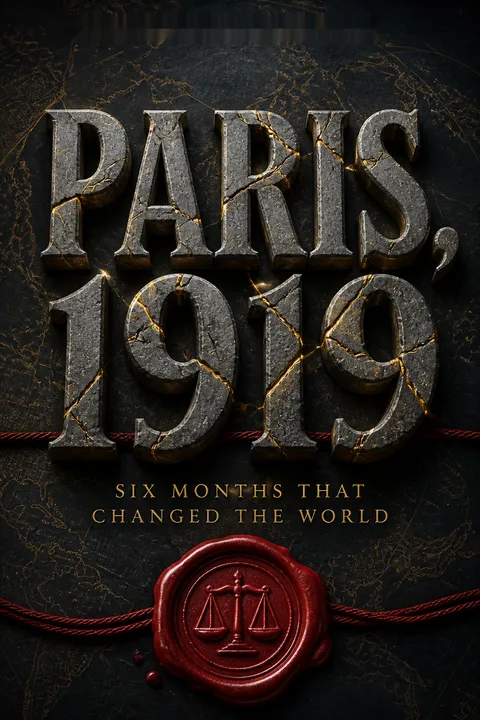


Key Takeaways
Paris tried to remake the world, but lacked power to enforce its design
Six months, global stakes. From January to June 1919, Paris became the center of negotiations over defeated empires, new borders, famine, revolution, and a new international order. More than thirty countries sent delegates, while petitioners arrived with claims ranging from national independence to labor rights. The Big Four spoke as if they could redesign the world, but their armies were demobilizing, their publics wanted peace, and their treasuries were strained.
Decisions met reality. On the ground, local governments and armies were already acting. Railways, fuel shortages, distance, and weak forces limited what the conference could make happen. The peacemakers could draw a border or threaten a government, but they could not reliably enforce every decision. Their authority was real, yet much smaller than the grand language of world government suggested.
What's striking is the gap between deciding and delivering. A conference can produce rules quickly, but implementation depends on logistics, resources, and the willingness of people far from the negotiating table. Paris is a useful warning against mistaking diplomatic visibility for control. The limits were not simply failures of character: even capable leaders could not spend troops and money their electorates would no longer provide. At the same time, invoking limited power can excuse avoidable choices, so a fair account must ask both what leaders could enforce and what they chose not to try.
Define the people before promising them self-rule
A promise without a unit. Self-determination meant that people should have a voice in choosing their government, but Wilson never clearly said which people counted: a language group, a race, a territory, or a political community. In central Europe, these categories overlapped. Serbs and Croats spoke nearly the same language but differed in religion and script; in parts of Belarus, a resident might identify by local region and faith rather than nationality.
Maps could not settle identity. Plebiscites seemed democratic, but they raised practical questions: who could vote, where, and under what conditions? Some people had moved; others faced pressure from armed groups or governments. Experts gathered statistics, while rival delegations challenged the figures. The principle gave hope to peoples under empire, but it offered no simple method for drawing fair borders in mixed populations.
The principle is powerful because it turns subjects into political agents. Its weakness is that it can make national identity look like a fact waiting to be measured, rather than a choice shaped by institutions, language, religion, and circumstance. Once a border requires a single answer, mixed identities become a problem for the mapmaker. The conference could not avoid making choices, but it could have been more explicit that every method, including a plebiscite, favors some definitions of belonging over others.
Read ideals and domestic politics as parts of the same negotiation
Three leaders, different fears. Wilson arrived with a vision of democratic cooperation and a belief that he spoke for ordinary people. Clemenceau, shaped by France's invasion and devastation, put security against Germany first. Lloyd George was more pragmatic, weighing the peace against British elections, labor unrest, trade, and the empire. Their temperaments mattered, but so did the limits imposed by their own countries.
Personal choices carried costs. Wilson deliberately excluded leading Republicans from the American delegation, even though Senate approval would be needed at home. He later refused to compromise with Republican moderates. Clemenceau kept control of French policy in his own hands, while Lloyd George shifted positions under pressure from voters and allies. The conference was never a meeting of free-floating ideals. Each leader negotiated abroad while answering to political forces at home.
The negotiations show why foreign policy cannot be separated from domestic politics. A leader may promise an international settlement, but a legislature, electorate, or coalition government determines what can be sustained. Wilson's exclusion of Republicans weakened the very ratification he needed; Lloyd George's flexibility helped him bargain but also made him appear inconsistent. A character-driven account is especially useful here, provided personalities are not treated as the whole explanation. Institutions and political incentives can turn a private trait into a public consequence.
Build peace institutions with enforcement and member buy-in
A new club for peace. The League of Nations was intended to replace balance-of-power politics with collective security: members would protect one another's independence and settle disputes through common institutions. Its design included an assembly, an executive council, and a permanent secretariat. It also supported work on labor standards and international law. The International Labour Organization, created alongside the League, survived even after the League itself ceased to function.
Commitment remained voluntary. The League had no standing army, many decisions required unanimity, and the United States never joined. Wilson expected the organization to repair imperfect settlements, but its members were reluctant to surrender control over when they might use force. A body meant to restrain national self-interest therefore depended on nations choosing to restrain themselves.
The League's design exposes a recurring problem in collective action: members want the protection of a group without giving the group dependable authority over their choices. Unanimity protected sovereignty but also made decisive action difficult. Yet the institution was not meaningless simply because it could not prevent another world war. Its labor and legal work shows that international bodies can succeed in bounded tasks even when they fail at their grandest promise. The key is to match an institution's mandate to the authority and resources its members will actually grant.
Set a clear Russia policy before half-measures create new enemies
Confusion shaped intervention. Allied leaders knew little about Russia after the revolutions and civil war began. They sent troops, maintained a blockade, and supported anti-Bolshevik forces, yet disagreed about whether their aim was to overthrow the new government, contain it, or simply protect local interests. By the end of 1918, more than 180,000 foreign troops were on Russian soil, scattered across a vast country.
Talk and force pulled apart. Wilson and Lloyd George backed an invitation for Russian factions, including the Bolsheviks, to meet at Prinkipo and discuss peace. The factions refused or failed to agree. A later mission led by William Bullitt returned with possible terms, but the leaders would not own its results. Allied actions did little to defeat the Bolsheviks, while convincing them that the Western powers were hostile. The policy was neither a decisive intervention nor a credible negotiation.
Russia illustrates how an unclear objective can make every instrument work against the others. Negotiating while blockading, and opposing a government while supporting its rivals, sends signals that are difficult to interpret as anything but hostility. The Allies also faced a genuine constraint: intervention was expensive, unpopular, and unlikely to succeed with the forces available. That nuance matters. A coherent policy would not necessarily have produced a better outcome, but incoherence made it harder to judge costs, explain choices, or change course.
Treat the reparations bill separately from the myths built around it
Defeat was not visible everywhere. Germany's army had been beaten before the November 1918 armistice, but Allied troops did not march into Berlin. German soldiers returned home in order, allowing nationalists to claim that Germany had not really been defeated. The Treaty of Versailles reduced Germany's armed forces, took territory and colonies, and imposed reparations. Article 231 established legal responsibility for damage; Germans came to remember it as a declaration that they alone had caused the war.
The bill was not fixed at signing. The Allies postponed the total until a commission set it in 1921 at 132 billion gold marks. Germany ultimately paid far less, about 22 billion marks between 1918 and 1932. That does not mean the settlement was harmless: uncertainty and humiliation mattered. But the book challenges the claim that an impossible reparations burden alone wrecked Germany and led directly to Hitler.
A settlement has both material effects and symbolic meaning. The reparations schedule could be revised, but the perception of an imposed, dishonorable peace became politically durable. That distinction prevents two opposite errors: treating the treaty as an irresistible cause of the next war, or dismissing German resentment because the final payments were lower than feared. The armistice also left room for competing stories about defeat. Political myths do not need to be accurate to become powerful; they need an audience and an unresolved grievance.
New borders made states, then stranded millions inside someone else's nation
A national map was never tidy. The conference tried to redraw central Europe around nationality, strategic security, railways, and economic survival. Those aims collided. Poland received access to the Baltic through a corridor that placed about two million Germans under Polish rule; Danzig became a free city tied economically to Poland but populated mainly by Germans. In Upper Silesia, a plebiscite followed years of dispute over an industrial region claimed by both countries.
New states inherited old divisions. Czechoslovakia included about three million German speakers and more than a million Hungarians. Yugoslavia united South Slavs, but Serbs dominated its government and army, deepening Croat and Slovene grievances. Across Europe, roughly thirty million people became minorities in states built around other national identities. Borders ended some disputes while giving disappointed groups reasons to contest them.
The mapmakers faced a genuine dilemma: borders had to support trade and defense, yet each adjustment placed some people under a government they did not want. The resulting states were not simply artificial creations; local leaders and armies had already shaped many of them. But recognition and territorial rewards strengthened particular groups inside those states. This is why minority protections mattered as more than humanitarian decoration. Without credible institutions to make plural citizenship safe, a border settlement could function as a pause in conflict rather than its resolution.
When promises conflict, the powerful decide whose grievance counts
Japan used leverage; China used argument. Japan wanted the German concessions in Shantung and pressed the Allies by threatening not to sign the German treaty. China, represented forcefully by Wellington Koo, argued that Shantung was Chinese territory and that wartime agreements had been signed under pressure. The peacemakers acknowledged the strength of China's case, but Japan's position mattered more to their effort to keep the conference united.
A second promise was rejected. Japan also proposed adding a principle of racial equality to the League covenant. A majority on the commission supported it, but Wilson ruled that strong objections prevented adoption, fearing the political consequences at home. Japan received the Shantung concessions; China did not receive the public justice it sought. The decision helped spark China's May Fourth protests, a nationalist movement that turned many young Chinese against Western liberal promises.
This episode makes leverage visible. China offered a legal and moral argument; Japan attached its demands to the immediate survival of a major treaty. The result reveals that principles do not operate independently of bargaining power. The racial equality proposal also exposed a contradiction: an institution could promise equal treatment among states while its founders avoided a direct challenge to discrimination within their own societies. That contradiction did not make cooperation impossible, but it made the language of universal fairness harder to trust.
Britain's promises to Arabs, Jews, and France made Palestine a three-way trap
Wartime promises overlapped. Britain and France had secretly discussed dividing Ottoman Arab lands in the Sykes-Picot Agreement. Britain also encouraged the Arab revolt with promises of independence, then issued the Balfour Declaration supporting a Jewish national home in Palestine. The commitments were imprecise and difficult to reconcile. At the conference, Feisal argued for Arab independence, while Chaim Weizmann sought a protected Jewish home. Neither delegation could simply speak for everyone living in the region.
Local wishes were weakly heard. Palestine's Arab majority opposed the Zionist program, a fact confirmed by an American inquiry, but its findings were ignored. The British mandate incorporated the Balfour commitment without resolving the conflict over political power or future borders. The result was not a clean handoff from empire to self-rule, but a system built on promises that different communities understood in incompatible ways.
The problem was not merely that Britain made too many promises. It made commitments to different audiences, used different definitions of the territory, and left the political relationship among those audiences unsettled. A mandate could administer land, but it could not manufacture consent. The Arab, Jewish, French, and British positions were not interchangeable claims, and acknowledging that complexity does not make the conflict inevitable. It does show why statements of goodwill need clear boundaries, representative consultation, and a credible plan for sharing authority.
Turkey's nationalists overturned a treaty the Allies could not enforce
The settlement met resistance. In May 1919, Greek troops landed at Smyrna with Allied approval. The occupation quickly turned violent, worsening Turkish fears that the empire's remaining territories would be divided among foreign powers. Mustafa Kemal, later known as Atatürk, moved into Anatolia, organized nationalist resistance, and rallied officers and local groups around the claim that Turkish-inhabited lands should remain whole.
Sèvres was replaced by force and negotiation. The 1920 Treaty of Sèvres proposed a greatly reduced Turkey, an independent Armenia, and extensive foreign control. The Allies lacked the troops and unity to impose it. Turkish forces defeated the Greeks, retook Smyrna in 1922, and forced a new settlement at Lausanne in 1923. That treaty recognized a sovereign Turkey and set borders far closer to those of the modern state.
The fate of Sèvres shows that a treaty's authority depends on more than the signatures of victors. The Allies underestimated Turkish nationalism, overestimated their own willingness to enforce the settlement, and treated local military capacity as a secondary detail. Atatürk's success was not guaranteed, but it changed the bargaining position completely. The lesson is not that armed resistance always wins. It is that when a settlement denies a population's core political claims, enforcement becomes a continuing commitment, not a ceremonial act.
Analysis
The book's central achievement is to replace a simple morality play with a story about power under constraint. Paris was not a single-minded tribunal imposing a finished world order. It was a crowded, improvised negotiation in which leaders tried to honor wartime promises, satisfy voters, manage collapse, and preserve alliances. Their claims to speak for humanity often sat beside narrow national interests, but that inconsistency was not merely hypocrisy. It reflected a genuine problem: universal principles had to be applied by governments that still answered to particular publics and possessed unequal power.
The narrative is strongest when it moves between the conference table and events on the ground. A map decision over Smyrna mattered because Greek troops could occupy it; a proposed Armenian state mattered less once no power would defend it. This makes implementation, not intention alone, the book's key measure of political judgment. It also complicates the familiar claim that Versailles directly caused the Second World War. The treaty contributed grievances and opportunities for propaganda, but the book emphasizes the intervening choices that shaped whether those grievances became war.
The story also exposes a limit in the ideal of self-determination. National independence offered a way out of empire, yet mixed populations could not be divided cleanly into matching states. The peacemakers often treated borders as solutions when they were also distributions of risk and authority. Minority rights and international institutions were attempts to manage that problem, but neither could substitute for political consent or sustained enforcement.
The result is neither a defense of the settlement nor a verdict that it was doomed. It is an account of contingent decisions made under pressure, some imaginative and some careless. The conference could create institutions and borders, but it could not create a shared willingness to maintain them. That distinction is the book's most useful guide to reading both the peace of 1919 and the conflicts that followed.
Review Summary
Reviewers widely praise Paris 1919 as a comprehensive, engaging account of the Paris Peace Conference, highlighting MacMillan's detailed portraits of Wilson, Clemenceau, and Lloyd George. Many appreciate her argument that the Treaty of Versailles wasn't directly responsible for Hitler's rise. Readers value the book's global scope, covering the Middle East, Balkans, and Far East. Common criticisms include occasional loss of narrative clarity amid dense detail and organizational challenges. Most reviewers award four or five stars, recommending it as essential reading for understanding twentieth-century history's foundations.
People Also Read
Glossary
Self-determination
Choosing one's political futureThe principle that a people should have a voice in choosing its government and political status. In 1919, it became a powerful promise to national movements, but the term did not specify who counted as a people: a language group, a territory, a race, or a political community. The ambiguity made it difficult to apply in regions with mixed populations.
Fourteen Points
Wilson's peace principlesA set of principles Woodrow Wilson presented in January 1918 as a basis for ending the First World War and creating a more stable international order. They included open diplomacy, reduced armaments, national self-government, restoration of invaded territory, and a League of Nations. Their broad language inspired people across the world, while leaving many specific political questions unresolved.
League of Nations
International peace organizationAn organization created after the First World War to help settle disputes and provide collective security. It had an assembly, an executive council, and a permanent secretariat, but no independent military force. Many decisions required unanimity, and the United States never joined. The League's work also included mandates, minority protections, and international labor standards.
Mandate
League-supervised administrationA territory placed under the administration of a power authorized by the League of Nations. The system was presented as trusteeship for peoples not yet considered ready to govern themselves, rather than as outright annexation. In practice, mandatory powers retained substantial control, and many territories experienced the arrangement as colonial rule under a new name.
Council of Four
Four leaders' negotiating groupThe small group that became the central decision-making body of the Paris Peace Conference in late March 1919. It consisted of Woodrow Wilson, Georges Clemenceau, David Lloyd George, and Vittorio Orlando. Meeting frequently and often privately, the four leaders settled major disputes, including Germany's terms, while excluding most other delegates from the decisive conversations.
Article 231
Germany's reparations liabilityAn article in the Treaty of Versailles assigning Germany and its allies responsibility for damage caused by the war. The clause helped establish the legal basis for reparations, while a following article limited Germany's liability to specified categories of damage. In Germany, Article 231 became known as the war guilt clause and a symbol of the treaty's alleged injustice.
Sykes-Picot Agreement
Secret British-French partition planA secret 1916 agreement between Britain and France that outlined how they would divide areas of the Ottoman Empire after the war. It assigned zones of direct control and influence, while leaving Palestine for international administration. The agreement later clashed with British promises to Arab leaders and became a source of distrust between Britain and France.
Balfour Declaration
British support for a Jewish homelandA 1917 statement by the British government expressing support for establishing a national home for the Jewish people in Palestine. It also said that the rights of existing non-Jewish communities should not be harmed. The declaration did not define the future political status of Palestine, and its commitments proved difficult to reconcile with British promises to Arab leaders.
May Fourth Movement
Chinese nationalist protest movementA wave of student-led protest that began in China in May 1919 after news spread that the Paris Peace Conference would transfer German rights in Shantung to Japan. Demonstrations expanded into broader nationalist action and a rejection of the Western powers' claims to uphold justice. The movement helped redirect Chinese political thought and activism.
Megali idea
Vision of an enlarged GreeceA Greek nationalist vision of restoring a larger Greek political world, drawing on the ancient Greek and Byzantine past. It included ambitions for territory in Thrace, the Aegean, and Asia Minor, with Constantinople especially powerful as a historical symbol. At the Paris Peace Conference, this aspiration helped drive Greek claims far beyond Greece's existing territory and capacity.
Treaty of Sèvres
Allied treaty to partition TurkeyThe 1920 peace treaty imposed on the Ottoman government after the First World War. It proposed a greatly reduced Turkish state, foreign control or influence over extensive territories, and provisions for Armenian independence and Kurdish autonomy. Turkish nationalists led by Mustafa Kemal rejected the settlement and defeated its military arrangements, leading to the Treaty of Lausanne in 1923.
About the Author
Other books by Margaret MacMillan

Download PDF
Download EPUB
.epub digital book format is ideal for reading ebooks on phones, tablets, and e-readers.








