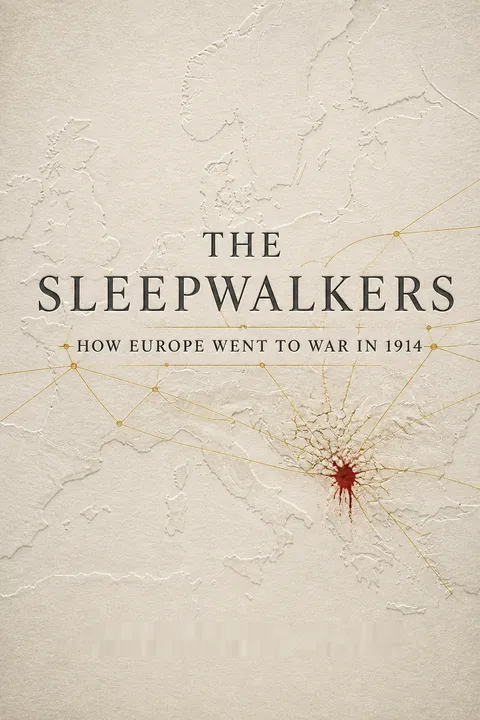


Key Takeaways
Trace the decisions that made war possible, not a supposed march toward it.
Follow the sequence. On 28 June 1914, Archduke Franz Ferdinand and his wife were shot in Sarajevo. Thirty-seven days later, Europe was at war. The conflict mobilized 65 million troops and left about 20 million dead and 21 million wounded. Clark argues that this catastrophe cannot be explained as the automatic result of decades of nationalism, alliances, or arms building. Those forces mattered, but only as they shaped choices made by particular people in particular moments.
Keep alternatives visible. The book follows decision-makers in Belgrade, Vienna, Berlin, St Petersburg, Paris, and London, asking how each interpreted events and what options they believed remained. The war emerged through interacting decisions, misread signals, and missed chances. The point is not that war had no causes, but that its outbreak was not inevitable.
The distinction between explaining a background condition and explaining an outcome is especially useful here. Long-term pressures can make some choices more likely without making them compulsory. Clark’s sequence-based approach restores the decisions that hindsight tends to flatten into a single march toward war. Its discipline is also demanding: no one state or policy can be understood in isolation. The approach does not make structural forces disappear. It asks how those forces entered the calculations of real actors, which is where an abstract cause becomes politically consequential.
Treat national maps as political forces, not neutral geography.
A nation on paper. Serbia’s expansionist vision drew on the 1844 memorandum known as Načertanije, which argued that Serbian lands should be unified in one state. Popular epics, especially stories surrounding the medieval Battle of Kosovo, made this claim feel like a debt to history rather than a new political project. Yet the places claimed were ethnically mixed, and many inhabitants did not identify as Serbs. Macedonia, for example, was claimed by Serbs, Bulgarians, and Greeks, each promoting a different map of its population.
Myth shaped policy. Serbian governments had limited resources and shifted attention among contested territories as circumstances changed. But the national ideal encouraged covert activism beyond Serbia’s borders and made restraint difficult to defend at home. The result was a recurring gap between an expansive imagined homeland and the complicated people living in it.
A map can describe territory, but it can also prescribe who belongs and what history supposedly demands. That distinction helps explain why territorial disputes become harder to settle once they are framed as unfinished national restoration. Clark’s account is particularly strong on the friction between national narratives and mixed local identities. The caution is that explaining a nationalist claim’s emotional force does not validate its boundaries. A community’s attachment to a historical map cannot, by itself, settle the rights of people who live inside it.
When state and secret networks overlap, official denials lose credibility.
The state had shadows. In 1903, Serbian army officers assassinated King Alexandar and Queen Draga. Their conspiracy did not disappear after the new dynasty took power. Officer networks continued to influence appointments, intelligence, and policy. In 1911, some of these men formed Ujedinjenje ili smrt!, known as the Black Hand, a secret organization committed to unifying Serbs through revolutionary activity.
Control was uncertain. Black Hand members and fellow travellers had connections inside the army and border services. Apis, the head of Serbian military intelligence, helped organize the plot against Franz Ferdinand, and Serbian weapons and officers were involved. Prime Minister Nikola Pašić appears to have learned of the plot, but acted slowly and could not reliably control the networks. This is not proof that his government ordered the assassination. It is evidence that official Serbia and covert Serbian nationalism could not be cleanly separated.
The episode illustrates a difficult problem of attribution: a government may not command a clandestine network, yet its institutions can supply personnel, weapons, access, and protection that make the network effective. That overlap makes denials less persuasive abroad and weakens accountability at home. Clark carefully distinguishes foreknowledge and entanglement from proof of a direct state order. That distinction matters. Treating every unofficial actor as a government agent would overstate the evidence, while treating state and network as wholly separate would miss how power actually worked.
A Balkan quarrel could activate promises made far beyond the Balkans.
A local spark, continental wiring. The alliance system had changed markedly between 1887 and 1907. France and Russia formed a military alliance, while Britain reached separate understandings with each. These arrangements were not a simple set of automatic war commands, but they shaped how leaders interpreted a crisis. After the Balkan Wars enlarged Serbia and weakened Ottoman power, France increasingly treated a Balkan conflict as a way to draw Russian forces into a wider struggle against Germany.
Commitments were asymmetric. Russia saw Serbia as a useful Balkan partner and as part of its wider strategic concern with the Turkish Straits. France wanted Russia’s military weight directed against Germany. Britain’s obligations to France remained deliberately ambiguous. By 1914, the result was a dangerous possibility: an Austro-Serbian dispute might bring in Russia, then Germany, then France, with Britain’s role still uncertain.
Alliances do more than promise assistance. They change what each government expects its partners to do, and those expectations can shape decisions before any treaty is formally invoked. Here, a local Balkan conflict carried strategic value for France and Russia for different reasons, while Britain’s ambiguity added uncertainty rather than a clear brake. The framework explains how a regional dispute could become a system-wide crisis. It also warns against treating an alliance as a single, stable actor: partners may share a trigger while wanting very different outcomes.
Read each government as a contested arena, not a unified actor.
Policy had many authors. Clark rejects the idea that each country acted like a single person with one clear intention. In Russia, the Tsar could undercut ministers; foreign ministers and ambassadors sometimes pursued their own initiatives. In France, senior diplomats could obstruct a minister’s policy. In Austria-Hungary, the foreign ministry, army, imperial court, and Hungarian leadership all influenced decisions. Britain’s Edward Grey controlled foreign policy for years, but concealed commitments to France from much of his own cabinet.
Power shifted between offices. The influence of a minister, monarch, military commander, or ambassador depended on the moment and on the people around them. This made policy hard to read from outside and hard to coordinate at home. A state’s public position might therefore conceal disagreement, competing plans, or unofficial commitments that its rivals could not see.
The picture of government as a network rather than a unitary actor makes mixed signals easier to understand. It also changes how responsibility is assessed: a decision can reflect one faction’s initiative, another faction’s acquiescence, and a leader’s failure to coordinate them. The model should not obscure who held formal authority. Grey, for example, had unusual continuity and influence, while the British cabinet still constrained his choices. Clark’s emphasis on internal division is most persuasive when it clarifies both the source of a policy and the limits on its author.
Do not mistake diplomatic calm for a stable peace.
Détente had limits. In July 1912, Kaiser Wilhelm II and Tsar Nicholas II met at Baltic Port. Their governments exchanged reassuring words about peace and armaments, but made no major agreements. Meanwhile, Russia continued encouraging Balkan partners, while Germany urged restraint on Austria. The two sides were not pursuing the same policy beneath the friendly language.
Cooperation could mislead. Britain and Germany also worked together during the Balkan crisis, especially through the ambassadors’ conference in London. Their collaboration encouraged each to believe the other might restrain its allies. Yet neither abandoned its alliance relationships, and London’s own policy toward France remained unclear to Berlin. Détente was real, but limited and reversible. It could lower immediate tension while making leaders less alert to the risks of their next move.
Diplomatic cooperation can reduce friction without resolving the interests that produced it. The danger is not simply hypocrisy. Leaders may sincerely value calm while interpreting the same temporary success as evidence that their own strategy is working. That can encourage them to take risks under the belief that partners will contain the consequences. Clark’s account makes this paradox vivid: détente helped manage disputes, but also fed misplaced confidence about how far escalation could be controlled.
Austria's ultimatum was built to force rejection, not negotiate terms.
A demand with a trigger. Austria-Hungary’s July ultimatum contained ten demands, including suppression of anti-Austrian organizations and participation by Austrian officials in Serbian investigations. Vienna had reason to distrust a Serbian inquiry, since Belgrade had not conducted a serious investigation after the assassination. But the demand for Austrian participation touched directly on Serbian sovereignty and was expected to be unacceptable.
The reply was neither simple surrender nor flat refusal. Serbia accepted or conditionally accepted many points, while rejecting direct Austrian involvement and phrasing other responses in ways that left room for dispute. The Austrian envoy broke off relations. Vienna’s leaders had agreed that a diplomatic success alone would be inadequate, yet they had no clear plan for what victory should produce. German backing encouraged the gamble. The ultimatum was therefore both a response to a real security problem and a move designed to leave war open.
An ultimatum can be a negotiating instrument, a coercive signal, or a device for making rejection appear inevitable. Here, the mixture of legitimate security concerns and demands that compromised Serbian independence blurred those purposes. The Serbian reply deserves the same scrutiny: its concessions were substantial in appearance, but carefully qualified in practice. The episode resists a clean morality play. Neither side approached the document as a neutral route to agreement, and that is precisely why its wording mattered so much.
Russia's partial mobilization risked war because no partial plan existed.
Preparation looked like attack. Russia’s military planning did not contain a workable mobilization against Austria alone. Its railway schedules, reserves, and units were interdependent. Yet the government began broad pre-mobilization measures and then tried to authorize a partial mobilization, believing this might deter Austria without triggering a general war. German and Austrian observers saw troop movements, recalled reservists, and military trains, and could not reliably distinguish preparation from an imminent attack.
The system tightened. The Tsar briefly halted a general mobilization order after receiving a personal appeal from Kaiser Wilhelm, but Russia ordered general mobilization on 30 July. Germany declared war on Russia on 1 August. These steps did not mechanically cause war, but each narrowed the time and choices available to the next government. Mobilization was meant to protect; in practice, it amplified fear and made retreat look increasingly dangerous.
This is a vivid case of the security dilemma: one government’s attempt to reduce vulnerability can make its opponent feel more exposed. The problem was intensified by technical interdependence, since Russia could not cleanly prepare against Austria without also affecting its posture toward Germany. Such constraints turn military timetables into political pressure. Still, mobilization did not erase agency. Leaders approved, delayed, or expanded measures, and those choices determined whether preparation remained reversible.
Analysis
The book’s central achievement is to change the explanatory unit. Instead of treating 1914 as the product of a single cause, it treats the crisis as a sequence of interactions among governments that were internally divided, poorly informed about one another, and increasingly committed to incompatible readings of the same events. This is more than a plea for nuance. It explains why familiar structural factors, such as nationalism, alliances, and armaments, do not by themselves account for timing. They created pressures and expectations; decisions activated them.
The method resembles process tracing in political science: each link must be shown, not inferred from the outcome. That discipline exposes the contingent steps between Sarajevo and general war. It also clarifies why responsibility and causation are different questions. A government may not intend a continental war, yet still make choices that foreseeably raise its likelihood. Conversely, a state may have legitimate security concerns and still choose a response that sharply increases danger.
The strongest analytical insight is the interaction between domestic fragmentation and international signaling. Governments were not unified actors, but outsiders often treated them as such. A public statement, an ambassador’s assurance, or a military measure could be mistaken for settled national policy when it represented only one faction or one office. That opacity made deterrence unreliable. A warning meant to reassure one audience could alarm another, while a show of resolve intended to preserve peace could be read as preparation for attack.
The account also resists a simple symmetry of blame. Clark’s multi-sided analysis does not imply that every actor was equally responsible, or that all policies were morally equivalent. It instead asks readers to distinguish intention, capability, knowledge, and consequence. The distinction is essential: otherwise, the explanation collapses into either national exoneration or a single-villain story. The war was neither an impersonal accident nor a fully scripted conspiracy. It was a catastrophe assembled by decision-makers who believed they could control a crisis they had helped make less controllable.
Review Summary
The Sleepwalkers examines how Europe stumbled into World War I, challenging the notion that Germany bore sole responsibility. Christopher Clark presents the July 1914 crisis as resulting from complex diplomatic failures across all major powers rather than deliberate warmongering. The extensively researched work focuses on Serbian nationalism's destabilizing role, the precarious alliance system, and fragmented decision-making processes. While academically dense and requiring concentration, readers find Clark's analysis groundbreaking for distributing blame widely and emphasizing the Balkans' centrality. Critics debate his "sleepwalkers" metaphor, questioning whether leaders were truly blind to war's approach. Most reviewers praise the meticulous scholarship despite its demanding 550+ pages.
People Also Read
Glossary
Balkan inception scenario
Balkan crisis triggers alliance warClark’s term for the possibility that a conflict beginning between Austria-Hungary and Serbia would draw in Russia, activate French support for Russia, and ultimately involve Germany and possibly Britain. French strategists saw a Balkan conflict as a likely way to secure Russian military action against Germany, while Russian leaders saw Serbia as a strategic partner.
Načertanije
Serbian national expansion programA secret 1844 memorandum by Serbian interior minister Ilija Garašanin outlining Serbia’s national and foreign policy. It argued for unifying Serbs within a larger Serbian state and drew authority from a selective reading of medieval Serbian history. Published in 1906, it became an influential reference point for Serbian nationalist thought and territorial aspirations.
Black Hand
Serbian secret nationalist networkThe popular name for Ujedinjenje ili smrt!, a secret society founded in Belgrade in 1911 by officers and civilians committed to unifying Serbdom through revolutionary work. It maintained cells and connections across Serbia’s military and border services and into Habsburg territory. Apis, head of Serbian military intelligence, was its leading figure.
Mlada Bosna
Bosnian revolutionary youth milieuYoung Bosnia was not one centrally organized group but a loose collection of revolutionary youth circles in Bosnia-Herzegovina. Its members included Serbian nationalists and other opponents of Habsburg rule. Some activists overlapped with Serbian nationalist networks, and several participants in the Sarajevo assassination belonged to this broader milieu.
fluidity of power
Shifting influence inside governmentsClark’s description of how influence over foreign policy moved among monarchs, ministers, military leaders, ambassadors, and officials. The balance changed with political circumstances and personal alignments. As one office or faction gained influence, another could lose it, making national policy less coherent and harder for foreign governments to interpret.
Period Preparatory to War
Russian pre-mobilization measuresA Russian regulation that authorized extensive military preparations before formal mobilization. Measures included recalling reservists, readying supplies, preparing railways, and increasing security at military sites. Because many measures resembled the opening stages of mobilization, other powers could interpret them as preparations for an imminent attack.
About the Author
Other books by Christopher Clark
Download PDF
Download EPUB
.epub digital book format is ideal for reading ebooks on phones, tablets, and e-readers.








