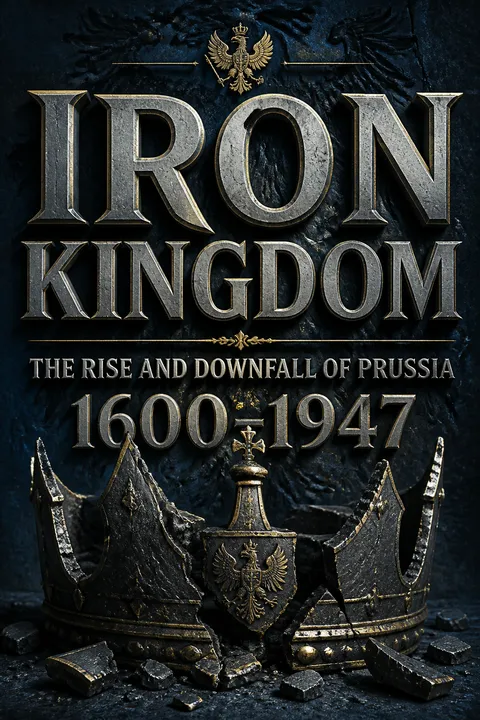


Key Takeaways
Treat Prussia as a political construction, not Germany’s inevitable destiny
A state without a natural core. Brandenburg, the Hohenzollerns’ original base, was flat, sandy, landlocked, and short of major resources. The dynasty’s power began not with a unified people or a grand national plan, but with a patchwork of territories acquired through inheritance, marriage, diplomacy, and political calculation. Some new lands lay hundreds of kilometres from Berlin, separated by other rulers’ domains.
Making subjects into Prussians. Each acquisition added populations with different laws, religions, and local loyalties. The name itself came from a distant Baltic territory, not Brandenburg. For centuries, the state had to build administrative connections and allegiance across its fragments. The result was a polity whose unity was made, negotiated, and sometimes resisted, rather than inherited from a shared culture.
The opening insight unsettles the familiar habit of treating nations as natural containers. Prussia is a clear case of political institutions preceding a widely shared national identity: boundaries and dynastic claims assembled the territory, while later governments worked to make that assembly feel coherent. This distinction helps separate a state’s capacity to govern from its population’s sense of belonging. It also complicates any story in which German unification appears to be Prussia’s preordained destination. The same territory could support different political futures, and its eventual role in Germany was contingent on choices, alliances, and crises.
Let catastrophe create capacity, but do not confuse survival with strength
A war that nearly erased Brandenburg. During the Thirty Years War, foreign armies repeatedly occupied Brandenburg, extorted its inhabitants, and devastated local economies. In parts of the Mark, roughly half the population died. The elector could not reliably protect his subjects or control troops passing through his lands. Neutrality offered little safety when stronger powers ignored it.
Recovery through state-building. Frederick William, the Great Elector, built a more reliable army and a central military administration. The General War Commissariat helped organize resources and collect revenue, weakening the Estates’ control over taxation. The experience of disorder also gave thinkers such as Samuel Pufendorf a powerful argument for stronger sovereign authority: without a state able to restrain violence, people remained exposed. Yet the new capacity remained fragile and expensive.
The story draws a sharp distinction between a state’s claim to protect and its actual ability to do so. In modern terms, legitimacy and capacity reinforce each other, but they are not interchangeable: fear of disorder can justify centralization without proving that central government reaches everyday life. Clark’s account also warns against treating war as an automatic engine of progress. Conflict can accelerate administrative change, but it can destroy the people, wealth, and trust on which effective government depends.
Win leverage through alliances when your territory cannot defend itself
Geography narrowed the choices. Brandenburg-Prussia sat between larger powers and possessed distant territories on both its western and eastern edges. Its rulers repeatedly faced competing threats from Sweden, Poland, Austria, France, and, later, Russia. A commitment that protected one province could expose another, making foreign policy a problem of competing risks rather than simple loyalty.
Diplomacy could outperform force. The Great Elector gained territory and full sovereignty over Ducal Prussia partly by exploiting conflicts among larger states. He changed partners when circumstances demanded it, a deliberate oscillating policy known as Schaukelpolitik. Subsidies from allies helped fund his army, while switching alliances increased his bargaining value. But success had limits: after defeating Sweden in Pomerania, he still had to surrender his gains when France and Austria opposed his claim.
This is a useful corrective to histories that reduce foreign policy to a ruler’s character. The recurrent shifts in Berlin reflected a structural dilemma: a fragmented state faced threats on several fronts, while its military resources were too small to settle every dispute alone. Alliance-making was therefore both a survival technique and a source of instability. The account also shows why tactical wins do not guarantee durable gains. A smaller power can exploit a favourable moment, but lasting security depends on whether other states accept the new arrangement.
Protect plural belief because rulers cannot manufacture religious consent
The ruler and the people disagreed. In 1613, Elector John Sigismund converted to Calvinism while most of his subjects remained Lutheran. His advisers hoped to move Brandenburg toward the Reformed faith, but attempts to alter worship provoked riots and resistance from the Estates. The Elector backed down, and the dynasty remained confessionally distinct from much of its population.
Tolerance grew through necessity. Later rulers learned to manage a religiously mixed state. The Great Elector sheltered French Huguenot refugees and admitted some Jews, but his policies combined practical benefits with selective restrictions. In the eighteenth century, Pietists built schools and charities with state support, while Moses Mendelssohn and other Jewish intellectuals helped create a Jewish Enlightenment. Yet Jewish access to public office and equal civic standing remained sharply constrained.
Prussian toleration is most revealing when treated as a political practice rather than a timeless national virtue. A ruling minority had reasons to restrain religious conflict, and refugee settlement could serve both humanitarian and economic aims. Those motives could produce real protections without establishing equal rights for everyone. The distinction matters: toleration can reduce coercion while leaving hierarchy intact. Religious pluralism becomes a test of government because it exposes the limits of a ruler’s power to make private conviction conform to public policy.
Build a disciplined army without assuming the state reaches every village
Military scale required local bargains. Frederick William I expanded the army from about 40,000 men to more than 80,000 by 1740. His canton system assigned districts to regiments, enrolled eligible men, and used exemptions and furloughs to limit disruption to farms and trades. It drew the nobility into officer service and made the army a powerful instrument of the monarchy.
Capacity was not total control. The army and bureaucracy remained small compared with the population and often depended on local officials, landowners, and intermediaries. Edicts could be ignored or delayed; even the schooling laws of 1717 were not implemented everywhere. The growing military establishment also did not turn every town or village into a barracks. Soldiers often worked civilian jobs, lived with families, and negotiated daily life with the communities around them.
This distinction is important for avoiding the easy equation of a large army with a wholly militarized society. Prussia’s military strength rested on institutions that reached into local life, but those institutions still relied on local cooperation and made room for exemptions, evasion, and negotiation. The result was neither a modern mass state nor a society ruled entirely from Berlin. State capacity often grows through bargains with intermediaries, not by eliminating them, and those arrangements can remain uneven even when military performance looks formidable.
A Prussian victory could secure territory and trigger a stronger coalition
Frederick changed the balance of power. In 1740, he invaded Habsburg Silesia, a wealthy province bordering Prussia. The attack helped launch the War of the Austrian Succession. Prussia secured Silesia after two wars, but Austria refused to accept the loss and worked to reverse it. In 1756, Frederick invaded Saxony, fearing encirclement, and drew Prussia into the Seven Years War against a much larger coalition.
Survival became an achievement. Prussia won important battles, but also suffered devastating losses. At Kunersdorf in 1759, it lost about 19,000 men. It survived because its enemies struggled to coordinate and their interests diverged. The war also helped turn Prussian subjects into a more politically engaged public: people followed battles, raised funds, and increasingly identified the king’s fate with their own.
Prussia’s rise illustrates a classic security dilemma: measures intended to make one state safer can make its neighbours feel less secure, prompting them to coordinate against it. Frederick’s success depended not only on battlefield skill but on the coalition’s inability to sustain common purpose. The emerging patriotism also had a vulnerable centre. It focused heavily on Frederick himself, so it should not be mistaken for a settled, inclusive national identity. Military success can create political attachment, but that attachment may remain personal and provisional.
Keep public debate alive, but notice whose citizenship remains conditional
Conversation became political infrastructure. In late eighteenth-century Prussia, clubs, reading societies, Masonic lodges, journals, and bookshops gave educated people places to exchange ideas. Kant’s call to use reason for oneself belonged to a wider culture of discussion. The state sometimes supported this activity, and civil servants made up a substantial share of contributors to the influential Berlin Monthly.
The public sphere had boundaries. Jewish thinkers such as Moses Mendelssohn joined this intellectual world, and Berlin salons brought Jews and Christians together. But emancipation remained incomplete, and access to state service was limited. The same government that encouraged debate could censor publications, and the king’s celebrated tolerance did not prevent discriminatory law. Public discussion widened political expectations without making participants equal in status or influence.
The section reveals a productive tension: institutions of discussion can help people learn to judge public questions, yet their reach is shaped by who is allowed into the room and whose arguments count. The Prussian public sphere was not simply a nursery for opposition; civil servants, officials, writers, and merchants often shared its networks. That closeness to government gave conversation access to policy, while also limiting its independence. The history invites readers to ask not only whether debate is free, but who can turn speech into authority.
Use defeat to reform institutions, not merely replace commanders
Jena exposed systemic failure. In 1806, Napoleon defeated Prussia’s armies at Jena and Auerstedt, and fortresses surrendered with little resistance. The collapse discredited the old military leadership and created space for reforms by Stein, Hardenberg, Scharnhorst, and their allies. The October Edict of 1807 opened occupations and landholding beyond traditional corporate restrictions and declared the end of hereditary personal servitude.
Reform remained contested. Scharnhorst reorganized the army; Humboldt reshaped education and helped found Berlin University; Hardenberg pursued administrative and economic change. Yet reforms were limited by aristocratic resistance, fiscal crisis, and royal caution. The 1848 revolution later forced further change, but the monarchy survived and liberal demands were only partly met. Defeat opened the system, but did not make reformers masters of it.
The reform era shows how institutional failure can create a window for change, while also warning that crisis does not hand reformers unlimited power. The reforms combined military necessity, economic liberalization, and new ideas of citizenship, but their effects were negotiated and uneven. A parallel with organizational change is useful: replacing leaders may be visible, yet durable transformation depends on rules, incentives, education, and authority. Prussia changed because these pieces shifted together, though the old elites retained enough influence to limit the result.
Make national unity through institutions, not declarations alone
A German policy took shape gradually. After 1815, Prussia gained territory in the west and north, while Austria lost its position in the northwest. The German Confederation remained weak, leaving room for Prussia to expand its influence through security proposals and customs agreements. The Zollverein, the German Customs Union established in 1834, eventually included states containing about 90 per cent of the German population outside Austria.
Economic integration did not guarantee political loyalty. The customs union helped Prussia develop a German-wide political outlook, but member states joined for practical fiscal reasons, not necessarily from allegiance to Berlin. In 1848, nationalists sought unity through a parliament; Prussia’s king rejected the crown offered by that assembly. Bismarck later achieved unification through a Prussian-led war and political bargaining, not by simply fulfilling a popular consensus already in place.
The path from customs union to empire is not a straight line from economics to nationhood. Shared rules can make cooperation easier and establish a state as a useful organizer, but they do not erase local interests or create automatic loyalty. The failed 1848 parliament and the later success of Prussian diplomacy show that institutional design and coercive capacity mattered alongside popular sentiment. National unity was made through competing projects, and the eventual settlement reflected which actors could coordinate power.
Prussian unification dissolved the state whose history it claimed to complete
The German Empire changed Prussia’s role. After 1871, Prussia remained dominant in territory, population, bureaucracy, and military command, but it was no longer an independent European power. Its identity became entangled with a German Empire that was federal in form and Prussian-led in practice. The monarchy and its institutions had helped create a larger nation-state, but the new state also weakened Prussia’s distinct political life.
Neither virtue nor guilt explains the whole story. The Allies abolished Prussia in 1947, condemning it as a source of militarism and reaction. Clark rejects both the old celebration of Prussia as Germany’s inevitable fulfilment and the postwar claim that it alone caused Nazism. Prussian history contains efficient administration, religious pluralism, coercion, conquest, and political failure. Germany was not simply Prussia’s completion; unification helped bring Prussia’s separate existence to an end.
The ending challenges teleological history: an outcome can look inevitable once it has happened, even when the path was contingent and contested. Prussia’s institutions helped unify Germany, but the resulting empire altered the political arena in which those institutions operated. It is also analytically risky to treat a long-lived state as having one unchanging character, whether virtuous or pathological. The more useful question is how particular institutions and political choices interacted, and how their consequences changed across different eras.
Analysis
Clark’s central achievement is to replace a moral verdict on Prussia with an account of political construction. The state begins as a vulnerable patchwork, gains administrative and military capacity through war, and repeatedly negotiates its authority with provincial elites, confessional communities, and foreign powers. This approach makes the later German Empire intelligible without turning it into the inevitable destination of Brandenburg’s history. It also prevents the reverse error: treating Prussia as a single, fixed cause of twentieth-century catastrophe.
The book’s strongest analytic distinction is between capacity and cohesion. Prussia could field a formidable army and build an unusually capable bureaucracy while remaining culturally fragmented and administratively shallow. Its officials often relied on local intermediaries; its inhabitants did not automatically identify with the state; and its victories could provoke rival coalitions. State power was real, but not total. The recurring gap between external reputation and internal resources helps explain why Prussian policy alternated between audacity and anxiety.
The narrative also shows how political legitimacy is made from mixed materials. Coercion, law, ritual, education, religious patronage, public debate, and patriotic memory each contributed, but none worked consistently for every group. Toleration could coexist with discrimination. Reform could widen legal freedom while preserving social hierarchy. National integration could expand through customs and administration without producing loyalty to Berlin. The result is not a smooth modernization story but a history of successive bargains, many unstable.
A useful comparative lens is to treat Prussia as a case of state-building under constraint. Political science often distinguishes infrastructural power, the ability to implement decisions across society, from despotic power, the ability of rulers to decide without negotiation. Prussia periodically possessed the latter in military emergencies while lacking the former in everyday local governance. That distinction helps explain why coercive reputation and administrative effectiveness did not always travel together.
The book’s method also has a limit worth keeping in view: its breadth can make long institutional continuities appear more unified than they felt to contemporaries. The detailed provincial differences correct this tendency, but readers should resist turning recurring patterns into a single national personality. The most durable lesson is not that Prussia was uniquely destined for a particular outcome, but that institutions built for survival can produce consequences their founders neither intend nor control.
Review Summary
Reviews of Iron Kingdom are overwhelmingly positive, averaging 4.17/5. Readers praise Clark's comprehensive, nuanced approach to Prussian history, highlighting his ability to blend political, military, cultural, and social perspectives. Many appreciate his challenge to the stereotype of Prussia as solely militaristic, revealing its progressive, enlightened aspects. Clark's engaging prose makes dense material accessible. Common criticisms include uneven pacing, rushed coverage of post-1871 events, and occasionally overly academic writing. Several reviewers note the book successfully dismantles simplistic connections between Prussian traditions and Nazism.
People Also Read




Glossary
Sonderweg
Germany’s supposed special pathA historical interpretation that Germany followed an abnormal route to modernity. It argues that the survival of traditional elites and authoritarian political culture, especially in Prussia, obstructed liberal development and helped prepare the ground for dictatorship. Clark challenges the idea that Prussia’s history should be read mainly as a straight line toward Nazism.
Schaukelpolitik
Deliberate alliance switchingA foreign-policy strategy associated with the Great Elector, Frederick William. Instead of committing permanently to one powerful partner, Brandenburg-Prussia shifted alliances as circumstances changed. The approach reflected its exposed geography and limited resources, and could bring subsidies or diplomatic leverage, though it could not guarantee lasting territorial gains.
canton system
District-based military recruitmentThe Prussian system developed under Frederick William I that assigned local districts, or cantons, to regiments. Eligible men were enrolled, but exemptions and furloughs limited disruption to civilian work. It supplied a large, locally rooted army and brought the nobility more closely into state service, while also creating tension with communities and landlords.
Pietism
Practical Protestant renewalA reform movement within German Protestantism that emphasized personal religious experience, ethical conduct, education, and practical service over doctrinal disputes alone. In Brandenburg-Prussia, leaders such as Philipp Jakob Spener and August Hermann Francke received state support. Pietist schools and charities helped integrate society and shape the ethos of officials and soldiers.
Haskalah
Jewish Enlightenment movementThe Jewish Enlightenment, which first took shape in Berlin around Moses Mendelssohn and his circle. Its writers engaged with European philosophy and modern languages while debating how Jewish tradition could coexist with enlightened public life. It helped create a secular Jewish intellectual community, but did not itself end discrimination or settle questions of religious identity.
Zollverein
German Customs UnionA customs union established under Prussian leadership, beginning in 1834 and eventually encompassing states containing most Germans outside Austria. It reduced trade barriers and made Prussia a central organizer of German economic cooperation. Membership, however, did not automatically create political allegiance to Berlin; states often joined for practical financial reasons.
Kulturkampf
State conflict with Catholic institutionsThe conflict, led by Bismarck and liberal allies in the 1870s, between the Prussian-German state and the Catholic Church. Laws placed clergy, schools, appointments, and religious organizations under tighter state control. The campaign failed to neutralize Catholic politics and instead strengthened Catholic solidarity and the Centre Party.
Landwehr
Prussian territorial militiaA militia system developed during the wars against Napoleon, intended to supplement the regular army with locally organized troops. It embodied the idea of citizen participation in national defence, though its training and equipment varied. The Landwehr became both a military institution and a political symbol, especially in debates over the army’s relationship to the people.
About the Author
Other books by Christopher Clark
Download PDF
Download EPUB
.epub digital book format is ideal for reading ebooks on phones, tablets, and e-readers.








