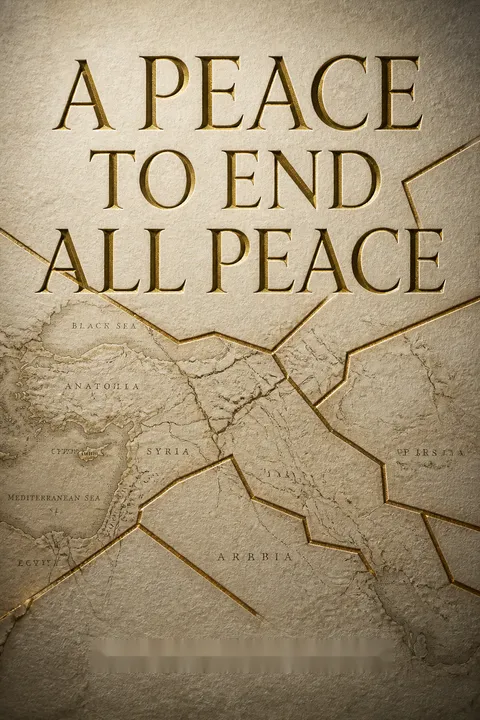


Key Takeaways
Trace the modern Middle East to choices made under wartime pressure
A world in transition. Fromkin opens with a 1912 Mediterranean cruise aboard a lavish British yacht. Prime Minister Herbert Asquith and the young Winston Churchill admire ancient ruins while Britain still seems unassailable. Within a few years, war will upend that confidence and draw European powers into remaking Ottoman lands. The book follows the decisions that helped shape the region between 1914 and 1922, emphasizing strategy, rivalry, miscalculation, and competing promises more than a straightforward story of national liberation.
The central argument. Britain’s leaders were often not trying to design a settlement around the region’s peoples. For Kitchener and Mark Sykes, the pressing question was where French and Russian power would stop. The later borders and political arrangements grew from those calculations.
What's striking is the contrast between the cruise's serene confidence and the political upheaval that follows. The opening makes imperial power feel historical rather than permanent: even leaders who inherit vast systems can mistake dominance for durability. The decision-centered approach also has a cost. It clarifies how European policy worked, but places Middle Eastern people largely outside the room where the narrative's key decisions occur. That is revealing about imperial power, though it should not be mistaken for a complete account of local politics or agency.
An Ottoman empire in decay was not an empty map
A patchwork state. By 1914, the Ottoman Empire had lost much of its former territory and struggled to govern what remained. Its roughly 20 to 25 million inhabitants spoke different languages, followed different faiths, and often identified most strongly with a town, tribe, clan, or religious community. The central government’s reach was thin: the book estimates that independent tax farmers collected about 95 percent of taxes, while the government collected only 5 percent directly.
Reform intensified conflict. The Young Turks promised a modern, more unified state after restoring the constitution in 1908. But the Committee of Union and Progress increasingly favored Turkish-speaking Muslims over other groups. A country already held together unevenly faced a further problem: centralization could alienate the very populations it was meant to unify.
The distinction between weak administration and political emptiness matters. A state can lack reliable taxation or control outside cities while its inhabitants still possess dense loyalties, institutions, and political aims. That distinction guards against treating imperial collapse as a blank-page moment. At the same time, the book’s account of Ottoman society relies heavily on contemporary European categories and observers. Its description of fragmented identities is useful, but fragmentation does not mean that people lacked shared political projects or the capacity to build them.
The Great Game survived the 1907 deal that supposedly ended it
India shaped the map. For generations, British officials viewed the Middle East and Central Asia through the problem of protecting the road to India. The Great Game was the broader Anglo-Russian contest for influence across this region. Britain backed the Ottoman Empire and other Muslim rulers as buffers against Russian expansion, especially near the Dardanelles and Afghanistan.
An agreement did not erase fear. In 1907, Britain and Russia settled several Asian disputes. London’s political leaders treated Russia as a new partner, but officials stationed in Cairo and elsewhere continued to see it as a threat. When war revived questions about Ottoman territory, those older fears returned. Oil was not yet the main prize: in 1913, the United States produced about 140 times as much oil as Persia, then the region’s only significant producer besides Russia.
This is a useful example of how strategic habits outlive the agreements that supposedly resolve them. Headquarters can update a policy faster than distant institutions update their assumptions. In organizational terms, the same empire held multiple threat models at once: London saw allies, while some officials on the ground still saw rivals. The book also usefully resists reading early twentieth-century decisions backward from oil’s later importance. Yet strategic concern about routes and access should not obscure the commercial and political ambitions already present in the region.
Turkey sought a protector before Churchill's battleship seizure became its grievance
A search for survival. After defeats and territorial losses, the Young Turk government urgently sought a Great Power ally. In 1914 it approached Britain, France, and Russia before negotiating with Germany. The secret German-Ottoman alliance was made before Churchill’s seizure of the Ottoman battleships became a public grievance. This chronology complicates the familiar claim that Churchill simply drove Turkey into Germany’s arms.
A disputed offer. Fromkin highlights archival evidence that Enver and Talaat offered Germany the battleship Sultan Osman on August 1, even though Enver may already have known Britain had detained it. The author suggests the offer may have helped secure the alliance, but the episode remains an inference, not a settled explanation. Churchill’s action angered the Ottoman public and worsened relations, yet it did not create the Young Turks’ underlying search for protection.
The episode shows why chronology is more than bookkeeping. A dramatic act can become the accepted explanation for a political shift even when the parties were already moving in that direction. Fromkin's distinction between long-term motives and immediate grievances is persuasive, and his treatment of the ship offer models how archival discoveries can revise a familiar story. The proposed link between the offer and the treaty is less conclusive than the documented sequence itself. Keeping those two levels separate makes the argument stronger, not weaker.
Britain mistook Islam's diverse authority for a lever one ruler could pull
A single religious switch. Kitchener feared that the Ottoman Sultan, regarded by many Sunni Muslims as Caliph, could encourage revolt against British rule in India, Egypt, and Sudan. He therefore considered shifting the caliphate to an Arab ruler in Mecca, hoping to keep its influence within Britain’s reach. His plan assumed that a change of religious leader could redirect Muslim political allegiance.
The assumptions failed. The caliphate did not function like a centralized papacy, and Muslim communities differed sharply in belief and political loyalty. Ibn Saud’s Wahhabi followers, for example, were not likely to recognize the authority of Hussein of Mecca. Meanwhile, Kitchener’s message promising Arab independence was broadened by officials in Cairo into a wider promise of Arab emancipation. The proposal and the wording both risked promising more than British officials understood.
The plan illustrates a recurring error in governance: mistaking a symbolic office for a command center. Religious authority can matter enormously without being centralized, uniform, or politically obedient. Kitchener’s concern about India was strategically understandable, but his solution treated Muslim communities as instruments in a British security design. The episode also shows how administrative translation can change policy. A message drafted narrowly in London could acquire broader implications when interpreted and relayed by officials in Cairo.
Cairo, India, and London pursued incompatible empires under one flag
Rival offices, rival plans. Kitchener brought trusted officials such as Ronald Storrs, Gilbert Clayton, and Reginald Wingate into the center of Middle Eastern policymaking. They favored a British-led arrangement across Arab lands, potentially with nominal Arab rulers and a caliph based in Arabia. The Government of India took a different view: it preferred a weak, divided Arabia and opposed moves that might inflame Muslim opinion in India.
Local realities were misread. Cairo’s officials treated Hussein of Mecca as a promising partner, while India had established ties with Ibn Saud and other regional rulers. These leaders were not a ready-made coalition, and their ambitions conflicted. British offices disagreed over who should lead, which territories mattered, and how much independence to permit. Their shared flag concealed a contest over the shape and ownership of postwar influence.
The bureaucratic conflict resembles a principal-agent problem: officials far from the capital exercise discretion, pursue local priorities, and present their own preferences as practical expertise. Kitchener’s prestige made that discretion unusually powerful. The result was not simply a clash between London and the colonies, but competition among imperial institutions with different maps of danger. A further caution is needed: local leaders were not merely pieces in that contest. Their rivalries and choices shaped what outside powers could plausibly achieve.
A naval attack became a land war through optimism and commitment
Early victories misled. Ottoman commanders Enver and Djemal launched badly planned offensives against Russia and across the Suez Canal. Enver’s winter campaign in the Caucasus lost about 86 percent of its forces. These disasters encouraged British leaders to underestimate Ottoman military resistance, even as the empire’s soldiers showed endurance and the government began to mobilize more effectively.
The Dardanelles widened the commitment. Britain first pursued a naval attack on the straits, hoping to reach Constantinople and alter the war’s course. Kitchener initially refused to divert troops, but changed his position after doubts arose about the naval-only plan and the attack became public. He then promised the 29th Division and possible reinforcements from Egypt. The operation had shifted from a limited naval venture toward a much larger military campaign.
The Dardanelles decision captures the danger of escalation by commitment. Public announcements, sunk costs, and reputational pressure can make leaders deepen a plan precisely when they should reassess it. The campaign also exposes a mismatch between tactical confidence and logistical preparation: British officials had poor information about the region, while the Ottoman defense was not as negligible as early failures suggested. The book’s focus on individual decisions is compelling, though institutional incentives and incomplete intelligence help explain why those decisions seemed reasonable at the time.
The 1922 settlement organized territory around imperial bargains, not local consent
A plan took shape. In 1915, Asquith created the de Bunsen Committee to advise Britain on its goals in Ottoman territory. Kitchener placed Mark Sykes on it as his personal representative, giving Sykes a central role in outlining Britain’s postwar aims. The inquiry came after the government had begun to accept that the Ottoman Empire might be partitioned and that Britain should secure a share.
The introduction shows the outcome. Fromkin describes a cluster of arrangements formalized around 1922: British authority in Iraq and Palestine, French rule in Syria and Lebanon, new Arab monarchies, and lines that helped define later states such as Iraq and Jordan. He argues that the settlement reflected Great Power strategy more than the preferences of the peoples affected. Britain entered this project as its public was turning against further imperial commitments.
The settlement is presented not as a single mapmaking moment but as a chain of bargains, mandates, appointments, and shifting promises. That framing helps explain why borders and institutions can carry the imprint of negotiations among outsiders. It also raises a useful analytical distinction: a boundary may be administratively convenient without creating political solidarity. Fromkin’s critique is strongest when it identifies whose interests drove the decisions. A complete account would also need to examine how local actors adapted, resisted, or made use of the structures imposed on them.
Analysis
Fromkin’s method is to make imperial decision-making legible by following people, rival offices, and concealed negotiations rather than treating borders as inevitable. Churchill gives the narrative a vivid center, but the more consequential character is often the British state itself: divided among the Foreign Office, India, the War Office, and officials in Cairo, each with different assumptions and incentives. That fragmentation helps explain how ambitious policy could emerge without a coherent account of local society or a settled public mandate.
The strongest analytical thread is the gap between strategic intention and political consequence. Britain’s officials seek buffers, access, and influence; they describe these aims through promises of Arab freedom, religious leadership, or protection. These are not merely cynical disguises. Some officials appear to believe their own accounts, while others understand that the promises serve imperial interests. Either way, language creates expectations that policy cannot reliably satisfy.
The book’s decision-centered lens also narrows its field of vision. Arab, Turkish, Kurdish, Jewish, Armenian, and other actors appear chiefly when Europeans encounter them, and the opening explicitly acknowledges that imbalance. That is valuable evidence about who held formal power, but it can make local political life look more passive and fragmented than it was. The account is best read as a history of how European powers planned and administered intervention, not as a complete social history of the region.
Its larger warning is about the confidence of planners. Officials extrapolate from partial intelligence, mistake symbolic authority for practical control, and treat a short-term military opening as permission to redesign a vast political landscape. The resulting order is neither pure accident nor a fully executed master plan. It is a settlement assembled from strategic bargains, institutional rivalry, and promises whose meanings differed among the people making and receiving them.
Review Summary
A Peace to End All Peace is highly praised for its comprehensive and detailed account of the formation of the modern Middle East following World War I. Readers appreciate Fromkin's thorough research, engaging writing style, and ability to explain complex historical events. The book is considered essential reading for understanding current Middle East conflicts. Some note its focus on British perspectives and occasional difficulty following numerous names and events. Overall, it's regarded as an illuminating and important work on a pivotal period in history.
People Also Read

Glossary
Great Game
Anglo-Russian regional rivalryThe long contest between Britain and Russia for influence across Central Asia and the Middle East. In Fromkin’s account, British leaders sought to protect the routes to India by keeping Russia away from key positions, including Afghanistan and the Ottoman Straits. The term describes a broad strategic rivalry, not only espionage or covert operations.
Committee of Union and Progress
Young Turk ruling organizationThe political organization commonly associated with the Young Turks. It helped restore constitutional government in the Ottoman Empire in 1908 and later became the dominant force in government. Fromkin emphasizes its internal factions as well as its drive to centralize authority and strengthen Turkish-speaking Muslim predominance within a diverse empire.
Capitulations
Foreign legal and commercial privilegesAgreements and practices that gave foreign nationals special legal and economic status within the Ottoman Empire. They could place foreigners under their own consular jurisdiction and limit Ottoman authority over them. Ottoman leaders resented these privileges as an infringement on sovereignty, and the Young Turk government sought to abolish them.
Caliphate
Leadership of the Muslim communityThe institution associated with the Caliph, understood as a successor to the Prophet Muhammad and, in Sunni political tradition, a leader of the Muslim community. Fromkin describes British officials’ effort to influence who held this position. Their plan rested on a mistaken expectation that religious authority was centralized and could be transferred to redirect political loyalty.
de Bunsen Committee
British postwar policy inquiryAn interdepartmental British committee established in 1915 to advise the government on its aims in Ottoman territory after the war. Chaired by diplomat Maurice de Bunsen, it brought together officials from relevant government departments. Kitchener appointed Mark Sykes as his personal representative, giving Sykes influence over the discussion of Britain’s regional objectives.
FAQ
What's A Peace to End All Peace about?
- Historical Context: The book examines the fall of the Ottoman Empire and the creation of the modern Middle East, focusing on the decisions made by the Allies during and after World War I.
- Key Figures: It highlights significant personalities such as Winston Churchill, Lord Kitchener, and leaders of the Young Turks, detailing their roles in shaping the region's fate.
- Political Dynamics: The narrative delves into nationalism, imperialism, and the geopolitical strategies of Great Powers like Britain, France, and Russia.
Why should I read A Peace to End All Peace?
- In-depth Analysis: David Fromkin provides a comprehensive examination of historical events that led to current Middle Eastern conflicts, essential for understanding contemporary issues.
- Engaging Narrative: The book combines rigorous scholarship with compelling storytelling, making it accessible to both historians and general readers.
- Lessons from History: It offers insights into the consequences of political decisions, emphasizing how past mistakes continue to influence modern geopolitics.
What are the key takeaways of A Peace to End All Peace?
- Impact of Decisions: The book illustrates how decisions made at the Paris Peace Conference had long-lasting effects on the Middle East, often leading to instability and conflict.
- Role of Nationalism: It emphasizes the rise of nationalism among various ethnic groups and how this was manipulated by external powers for their own interests.
- Complexity of Alliances: The narrative shows the intricate web of alliances and betrayals, particularly between the Ottoman Empire and the Great Powers.
What are the best quotes from A Peace to End All Peace and what do they mean?
- "Peace to end Peace": This quote reflects the irony of peace treaties meant to resolve conflicts but instead sowed seeds for future wars.
- "Broad scope of the Middle East": Highlights the geographical and political significance of the Middle East in global politics.
- "Gradual revelation of truths": Underscores the slow unveiling of historical truths as archives open, allowing for a more accurate understanding of past events.
How does A Peace to End All Peace explain the creation of modern Middle Eastern states?
- Post-War Treaties: Discusses how treaties like Sykes-Picot and the Balfour Declaration laid the groundwork for modern states like Iraq, Syria, and Israel.
- Colonial Interests: Highlights how colonial powers shaped borders without regard for ethnic or religious divisions, leading to ongoing conflicts.
- Legacy of Decisions: Argues that the arbitrary nature of these borders has contributed to the region's instability and violence today.
What role did Winston Churchill play in the events described in A Peace to End All Peace?
- Key Decision-Maker: Churchill is portrayed as a significant figure in British policy regarding the Middle East, especially during his tenure as First Lord of the Admiralty.
- Seizure of Warships: Details his controversial decision to seize Ottoman warships, escalating tensions and contributing to Turkey's entry into the war.
- Vision for the Region: Churchill's views on imperialism and strategic thinking influenced British actions and policies in the Middle East during and after the war.
How does A Peace to End All Peace address the concept of imperialism?
- Imperial Ambitions: Discusses how Great Powers, particularly Britain and France, sought to expand their empires at the expense of the Ottoman Empire.
- Consequences of Imperialism: Illustrates the negative impacts on local populations, leading to resentment and conflict that persists today.
- Critique of Policies: Critiques the short-sightedness of imperial policies that ignored the complexities of local identities and governance.
What specific events does A Peace to End All Peace cover?
- Fall of the Ottoman Empire: Details the decline of the Ottoman Empire leading up to and during World War I, including key battles and political maneuvers.
- Paris Peace Conference: Covers the negotiations and treaties that followed the war, particularly how they redrew borders and created new nations in the Middle East.
- Rise of Nationalism: Explores the emergence of nationalist movements among Arabs, Turks, and other ethnic groups, influenced by external powers.
How does A Peace to End All Peace explain the fall of the Ottoman Empire?
- Military Failures: Details the military blunders of Ottoman leaders, particularly Enver Pasha, which weakened the empire's defense during World War I.
- Political Miscalculations: Discusses how the Young Turks' centralizing policies alienated various ethnic groups, leading to internal dissent.
- External Pressures: Emphasizes the role of external forces, including British and Russian interests, in exacerbating the empire's decline.
What role did nationalism play in the events described in A Peace to End All Peace?
- Emergence of Arab Nationalism: Illustrates how the collapse of the Ottoman Empire fueled nationalist sentiments among Arab populations.
- Conflict with Imperial Powers: Nationalism often clashed with the interests of imperial powers, particularly Britain and France.
- Legacy of Nationalism: Discusses how nationalist movements initiated during this period laid the groundwork for future conflicts.
How does A Peace to End All Peace relate to current events in the Middle East?
- Historical Context: Provides a historical framework for understanding the roots of contemporary conflicts, including the Israeli-Palestinian conflict.
- Legacy of Treaties: Emphasizes how early 20th-century treaties and decisions continue to affect political dynamics and national identities.
- Lessons for the Future: Serves as a cautionary tale about the importance of considering local contexts and histories in international relations.
What are the implications of the decisions made during World War I as discussed in A Peace to End All Peace?
- Long-term Regional Instability: Argues that decisions made during the war have had lasting effects on the political stability of the Middle East.
- Creation of New States: Discusses how post-war treaties and agreements led to the creation of new states, often without regard for ethnic and religious divisions.
- Influence on Modern Conflicts: The decisions of the early 20th century continue to influence modern geopolitical dynamics, making historical context essential for understanding current events.
Download PDF
Download EPUB
.epub digital book format is ideal for reading ebooks on phones, tablets, and e-readers.








