

Key Takeaways
Treat a beachhead as a supply problem before it becomes a battle
An unready division. Guadalcanal was not a polished opening move. The First Marine Division arrived fragmented, many Marines had less than a year in uniform, and Major General Alexander Vandegrift had only 24 days to assemble 19,000 men, load supplies, and plan an amphibious assault. Maps and aerial photographs were missing or outdated. Intelligence came from old charts, returned missionaries, planters, and a risky reconnaissance flight. Even the island’s terrain was largely unknown.
Improvisation under pressure. On August 7, 1942, the Marines landed and captured a nearly finished Japanese airfield, later named Henderson Field. The Japanese labor force had fled, but the Marines still had to unload supplies and establish defenses in unfamiliar jungle. The landing succeeded not because preparation was adequate, but because training, experienced noncommissioned officers, and command judgment helped compensate for what planners had not known.
What's striking is that the book treats improvisation as a product of preparation, not its opposite. The division could adapt because it had trained leaders and a shared military language, even when its maps and plans failed. That distinction matters in any high-stakes organization: flexibility is not simply freedom to improvise. It depends on people who understand the mission well enough to make sound choices when instructions and information run out. The story also cautions against romanticizing crisis management. Vandegrift's adaptability mattered, but the rushed preparation imposed real risks on young troops.
Control the sea and air lanes, or an invasion can become a siege
The fleet disappears. The Marines took Guadalcanal’s airfield, but the naval defeat at Savo Island on August 9 sank four Allied cruisers and forced the American transports and their escorts away. The Marines were left with limited supplies, no reliable resupply, and an enemy able to approach by sea and attack from the air. Holding territory was not enough. The island’s value depended on keeping the airfield usable and the sea routes open.
Air power changes the balance. Henderson Field became the base for the Cactus Air Force, the informal name for the mixed force of Marine, Navy, and Army aircraft operating there. These planes attacked Japanese ships and helped defend the perimeter. As American naval forces returned and Japanese shipping suffered, the balance shifted. The campaign shows that a beachhead is sustained by routes, fuel, aircraft, and ships, not simply by the troops who first capture it.
The account makes logistics visible as combat rather than background administration. Ships and runways determine whether frontline courage can be reinforced, fed, and evacuated. This is a useful corrective to histories that credit victory mainly to battlefield decisions. The same principle applies to any complex system: a frontline component can perform brilliantly while the larger operation remains fragile. The caveat is that sea and air control did not eliminate the need for ground combat. Henderson Field mattered because Marines held the perimeter around it, and air power could not capture or defend the island by itself.
Judge military doctrine by results, not by the courage it demands
Courage without coordination. Japanese commanders repeatedly underestimated American numbers and firepower. In August 1942, Colonel Kiyono Ichiki sent roughly 900 men against the Marine line at the Tenaru River, expecting a quick victory. Marines had machine guns, artillery, and a prepared defense. More than 700 Japanese were killed, while 34 Marines died. Ichiki burned his unit’s colors and killed himself. Later attacks, including the assault on Bloody Ridge, again sent large forces against concentrated American fire.
A costly miscalculation. The book does not deny Japanese bravery. It shows how commanders converted that bravery into predictable, costly attacks by treating spiritual resolve as a replacement for firepower and planning. American commanders also made errors, including committing forces piecemeal at the Matanikau. The lesson is not that one side was invariably wiser, but that courage cannot repair bad intelligence, poor coordination, or a flawed plan.
The distinction between courage and effectiveness is essential. Courage describes a person's conduct under danger; doctrine determines whether that conduct serves a coherent purpose. Leckie's examples make the cost of confusing the two brutally clear. At the same time, the story is strongest when it identifies particular command failures rather than turning Japanese persistence into a cultural caricature. American forces also suffered from poor intelligence and fragmented attacks. Military judgment is best assessed through decisions, conditions, and consequences, not through broad claims about national character.
Turn battlefield failures into doctrine before the next landing
Tarawa exposes the problem. At Betio, Japanese defenses survived the bombardment, and the low tide left landing craft stranded on the reef. Marines had to wade hundreds of yards through fire while many of the amtracks that were meant to carry them ashore were knocked out. The four-day battle cost 991 Marines killed and 2,311 wounded. The catastrophe revealed that forecasts about tides, bombardment, and landing vehicles could decide whether an assault force reached the beach intact.
Planning becomes more precise. The book traces changes in equipment and procedure, including improved landing craft, underwater demolition teams, artillery placed on nearby islets, and closer coordination between ships, aircraft, and infantry. Tinian shows how reconnaissance and deception could exploit narrow, lightly defended beaches. The landing succeeded with far fewer casualties than Tarawa. The improvement was neither automatic nor complete, but lessons from one assault shaped the next.
This sequence reads as a history of organizational learning under pressure. The important change is not simply acquiring better equipment. It is connecting reconnaissance, tides, demolition, naval fire, and the needs of infantry into one plan. That resembles the way complex organizations improve after failure: useful lessons must travel across units and become standard practice. Still, no procedure can guarantee an easy landing. Tinian's favorable conditions and deception helped, while Tarawa's defenses and reef made the assault unusually punishing. Learning reduces avoidable risk, but it cannot make war predictable.
Bypass enemy strongholds when cutting their support matters more than capturing them
Isolate the fortress. The American advance did not require a direct assault on every Japanese base. After the Marines established an airfield at Torokina on Bougainville, aircraft could strike Rabaul, a major Japanese base, from closer range. The Americans damaged its air power and shipping without invading the fortress itself. Truk, once treated as an impregnable naval base, was likewise devastated by carrier raids after the Japanese fleet had withdrawn.
Move past what remains. The campaigns used island airfields and anchorages to extend American reach, while leaving some Japanese positions cut off from useful support. That denied Japan the ability to use those bases effectively and preserved American forces for other objectives. The point was not that every bypassed garrison became harmless. It was that a base matters because of what it can do. If its planes, ships, and supply routes are neutralized, occupying it may add little to the larger campaign.
The strategic logic here is more subtle than a steady march from island to island. The objective is to change what the enemy can do, not to color every location on a map. This is a useful distinction between possession and control: a force may hold a base yet be unable to project power from it. The approach also has limits. Bypassed troops still require monitoring, and the choice to leave them behind depends on whether they can threaten later operations. The book presents neutralization as an operational calculation, not a universal shortcut.
Prepare for an enemy who adapts after every defeat
The defense moves underground. At Peleliu, Colonel Kunio Nakagawa’s forces did not rely mainly on stopping Marines at the waterline. They fortified the Umurbrogal ridges with hundreds of caves, tunnels, and mutually supporting positions. Marines could believe a position was destroyed, advance past it, and then be fired on from a hidden entrance. The campaign, expected by one commander to last four days, continued for weeks. The First Marine Division suffered 6,526 casualties.
Iwo intensifies the model. Lieutenant General Tadamichi Kuribayashi prepared roughly 1,500 caves and connected defenses across Iwo Jima. His troops avoided wasteful mass charges and used concealed guns to inflict losses from prepared positions. Marines eventually took the island, but 5,885 were killed and more than 17,000 wounded. The Japanese had learned from earlier defeats. American firepower could help, but infantry still had to find and clear each position.
Peleliu and Iwo mark an important shift in the contest: the Japanese defense becomes less visible, less centralized, and harder to erase with a bombardment. The enemy's adaptation turns time and terrain into weapons. This also clarifies why victory counts alone can mislead. A captured island may serve a strategic purpose while costing far more than planners expected. Leckie's emphasis on Japanese learning complicates any simple story of inevitable American superiority, although the narrative's focus on Marine experience leaves some strategic questions, such as the cost and necessity of particular operations, less fully examined.
Count the human cost beyond the casualty tables
Numbers miss the condition of survivors. Guadalcanal’s Marines endured disease, hunger, rain, and more than three months in an exposed perimeter. By November, many had lost substantial weight and thousands had been stricken with malaria. When the First Marine Division finally left, some men were so weak that sailors had to help them aboard. The official totals of 621 dead and 1,517 wounded did not record the exhausted bodies or the strain of expecting another attack each night.
Small acts hold the line. Leckie also records moments of mutual care, including Harry Dunn’s effort to rescue a wounded Marine, Jack Morrison, after an ambush. Dunn stayed with him through a night and day, then dragged him toward safety. Such stories do not cancel the violence. They show how survival depended not only on weapons and orders, but also on people protecting one another when rescue was dangerous.
The stories of rescue and endurance give scale to statistics without pretending that sacrifice makes the war noble or clean. They also reveal a form of military cohesion built from local trust: one person stays because another cannot move alone. That is an important counterweight to narratives centered on famous commanders and medal citations. The book's emphasis on heroism can sometimes make suffering seem purposeful by default. A more complete reading keeps both truths in view: solidarity can be profound, and the conditions that demand it remain devastating.
Expect terrain to blunt superior weapons and numbers
Okinawa turns into a grinding fight. The landing on April 1, 1945, initially met little resistance, but the Japanese 32nd Army had withdrawn into fortified positions around Shuri. Caves, ridges, and reverse slopes limited what ships and aircraft could destroy. At Sugar Loaf, Marines faced fire from several mutually supporting heights, while rain turned roads and fields into deep mud. The struggle for the small hill complex cost the Sixth Marine Division 2,662 killed and wounded, with another 1,289 incapacitated by battle fatigue.
Victory requires close work. Tanks, artillery, ships, and aircraft helped, but infantry still had to advance through caves and ridges, often under fire from positions they could not see. The battle lasted 83 days. Japanese air attacks also hit the fleet, while the battleship Yamato was sunk before reaching Okinawa. Superior resources shaped the outcome, but they did not make the ground campaign quick or painless.
Okinawa is the book's clearest demonstration that technological advantage and tactical progress are different things. Ships can destroy a battleship, and aircraft can reach targets quickly, yet neither can reliably remove defenders hidden in a cave system. The mud adds another operational constraint: even supplies and armor depend on usable routes. The battle also cautions against measuring strength only by the forces deployed. Numbers matter, but terrain, concealment, weather, and the ability to sustain forward troops determine how much of that strength can be used.
The island campaign prepared an invasion that surrender made unnecessary
A long route to Japan. From Guadalcanal onward, Marines and other American forces seized airfields, anchorages, and positions that brought the war closer to Japan. The campaign was not a single advance: it combined assaults, defensive stands, air and naval battles, and the isolation of bases that could no longer support Japanese operations. Okinawa, only a few hundred miles from Japan, was the final major ground battle in Leckie's account.
The ending changes the plan. Hiroshima was bombed on August 6, 1945, and Nagasaki on August 9. Japan announced its surrender days later. On August 30, Marines landed in Tokyo Bay to accept the surrender of Japanese forces, not to fight for the homeland as invasion planners had anticipated. The closing scene gives the campaign its final irony: years of amphibious preparation culminated in a landing where the fighting was over.
This ending resists a tidy victory narrative. The island campaign demonstrated how American forces could project power toward Japan, but the final invasion never took place. The outcome followed the atomic bombings and the Soviet entry into the war, not a final Marine assault on the home islands. That distinction matters because preparation and outcome are not the same as proof that every preceding operation was necessary. Leckie closes on the contrast between a war built around landings and a final landing made possible by surrender.
Analysis
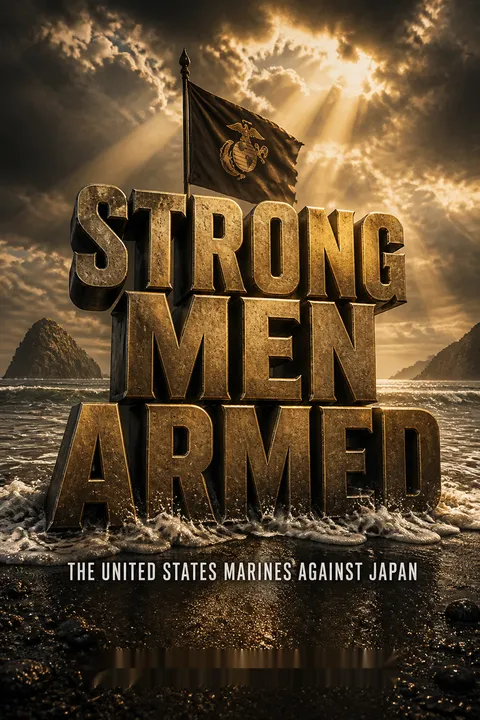
Strong Men Armed is a narrative military history organized as a campaign rather than a single battle. It begins with Guadalcanal, where a fragmented division must improvise under poor intelligence, then follows the Marines through an expanding series of island operations to Okinawa. Its central subject is not simply courage. It is the changing relationship between fighting men, weapons, logistics, terrain, and command decisions. The book's strongest argument emerges through contrast: early assaults expose weak planning and fragile supply, while later operations reflect accumulated knowledge about reconnaissance, amphibious equipment, naval support, and air-ground coordination.
Leckie's storytelling makes institutional change legible through individual experience. A radio operator, a machine gunner, a corpsman, or a tired rifleman can reveal what a map or casualty table conceals. Humor and slang are not decorative touches. They show how Marines created a social world capable of absorbing fear, boredom, and exhaustion. The cost is that episodic heroism can dominate the reader's attention. The cumulative effect may make sacrifice appear more coherent or meaningful than it felt to the people who endured it.
The book also resists a simple story of one-sided competence. American commanders make serious mistakes, including inadequate preparation, faulty intelligence, and piecemeal attacks. Japanese forces initially repeat costly frontal assaults, then adopt concealed, interlocking defenses that make Peleliu and Iwo Jima far more difficult. That evolution complicates any claim that industrial superiority alone determines victory. Firepower matters, but the work of locating and dislodging defenders remains human, local, and perilous.
Leckie's Marine-centered perspective is both the book's power and its boundary. Army operations and broader strategic debates receive less attention than the Marine experience. The reader sees the war from the beach, the ridge, the foxhole, and the ship. Across that landscape, the title's armed strength belongs not only to weapons, but to an organization that learns, adapts, and keeps supplying its front. The final surrender makes the story's achievement and its limits visible at once: the forces that prepared to invade Japan never had to make that last assault.
Review Summary
Strong Men Armed receives high praise for its vivid, detailed account of Marine combat in the Pacific during WWII. Readers appreciate Leckie's firsthand experience, balanced perspective, and poetic writing style. Many consider it a definitive work on the subject, praising its mix of strategic overview and personal narratives. Some find the level of detail overwhelming, while others note dated language. Overall, reviewers commend Leckie's ability to convey the brutal realities of war and the heroism of Marines, making it a compelling read for military history enthusiasts.
People Also Read



Glossary
Tokyo Express
Japanese nighttime resupply runsThe Marines' name for Japanese destroyers and other vessels that traveled down the Solomon Islands at night to bring troops and supplies to Guadalcanal. The ships used darkness to reduce the risk of American air attack, then returned north before daylight. The repeated runs sustained Japanese forces and exposed how control of sea and air routes shaped the campaign.
Cactus Air Force
Aircraft defending GuadalcanalThe informal name for the mixed American air force operating from Henderson Field on Guadalcanal. It included Marine, Navy, and Army aircraft. Its fighters defended the airfield, while its bombers and torpedo planes attacked Japanese ships and supply efforts. The name came from the Allied code word for Guadalcanal, Cactus.
amtrack
Tracked amphibious landing vehicleThe Marines' term for the LVT, a tracked vehicle able to travel through water and across reefs or swampy terrain. Amtracks carried troops and supplies from ships toward shore, and could provide fire support. Their performance proved crucial at places such as Tarawa, where landing craft could not cross the reef at low tide.
Banzai charge
Massed, often suicidal assaultA direct attack in which Japanese troops charged American positions, often at night and with cries intended to encourage their own troops and unsettle defenders. The book shows these attacks on Guadalcanal, Saipan, and elsewhere. When Marines were prepared and could concentrate machine guns, artillery, and other weapons, the charges often produced severe Japanese losses.
Pistol Pete
Nickname for Japanese howitzersThe Marines' collective nickname for Japanese 150-millimeter howitzers that fired on Henderson Field and Marine positions during the Guadalcanal campaign. The guns threatened the airfield and perimeter, and their ammunition was difficult to replace. Attacks by American aircraft and naval forces gradually reduced their effectiveness.
kamikaze
Japanese suicide aircraftA Japanese aircraft whose pilot deliberately crashed into an enemy ship, usually carrying explosives. The attacks grew into an organized part of Japanese strategy late in the war. At Okinawa, waves of kamikaze struck American ships, causing heavy losses and damage, although Japanese claims about the number of ships sunk were greatly exaggerated.
Download PDF
Download EPUB
.epub digital book format is ideal for reading ebooks on phones, tablets, and e-readers.








