

Key Takeaways
Build a thousand devoted customers before chasing a million strangers.
Loyalty can scale. Pat Flynn’s first superfan, Jackie, bought his LEED exam guide, passed her test, earned a promotion, and recommended the guide inside her firm. More than twenty-five colleagues eventually bought it. One person had become a channel for trust and referrals, not just a single sale.
Small can be viable. Kevin Kelly’s “1,000 True Fans” idea offers a simple illustration: if a thousand devoted customers each generate $100 in annual profit, that is $100,000 before expenses and taxes. Flynn calls this goal the “super 1,000.” The arithmetic is not a business guarantee, but it reframes success: a creator may need a modest, committed audience, not celebrity-sized reach.
The example captures a network effect that raw audience counts conceal: trust travels through relationships. In economic terms, a small group of repeat buyers can lower acquisition costs and make revenue more predictable. But the thousand-person figure is a planning heuristic, not a universal threshold. A business with thin margins, expensive delivery, or customers who cannot afford repeat purchases will need different economics. The useful question is not simply how many fans exist, but whether their enthusiasm leads to sustainable revenue, referrals, and a product worth recommending.
Treat fandom as a relationship journey, not a traffic funnel.
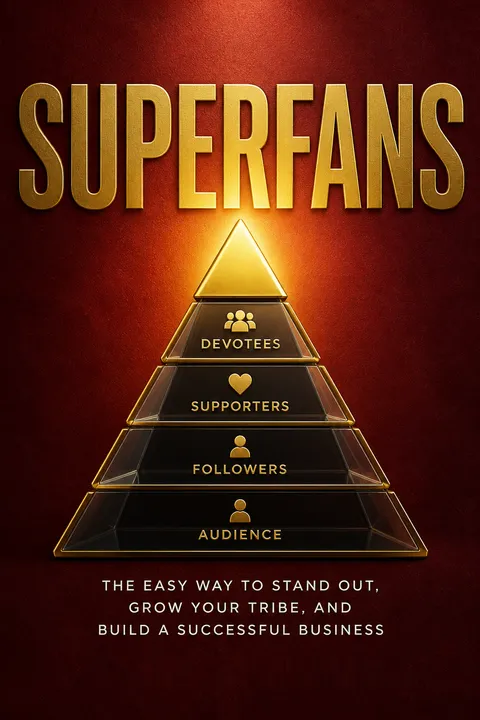
Four stages describe the climb. The Pyramid of Fandom maps an audience from casual visitors, to active followers, to a connected community, and finally to superfans. Casual visitors may arrive through search or recommendations. Active followers opt in to hear more. Community members also interact with one another. Superfans invest emotion, time, and money, and may advocate for the brand.
The path is built from moments. Flynn contrasts this with a sales funnel, which tracks movement toward purchase but can reduce people to conversion rates. The pyramid asks what experiences help someone feel understood, included, and eager to return. People do not advance in a perfectly orderly way, and not everyone becomes a superfan. The model is a guide for designing better relationships, not a machine for manufacturing devotion.
The model usefully adds a social dimension that transactional funnels often miss: customers can become connected to one another, not only to the seller. That distinction matters because peer relationships can persist even when a platform or product changes. It also resembles a service blueprint, where each contact point is treated as part of a larger experience. The caution is that a pyramid can imply every person should move upward. Some customers want a helpful answer and nothing more. Respecting that preference is part of earning trust.
Use your audience’s own words to show that you understand the problem.
Listen before you write. Flynn calls this “Learn the Lyrics”: discover how people describe their needs, then use that language in content and products. His wife April became devoted to the Backstreet Boys after a familiar song suddenly matched her heartbreak. The band’s words felt specific to what she was experiencing, making her feel understood.
Research beats guessing. Flynn suggests reading discussions in relevant online groups, asking people open-ended questions, and holding short conversations. In 2014, he asked his email audience about its biggest business challenge and received more than 7,000 responses. The answers revealed three different stages of business experience, helping him tailor communication and offerings to each group.
This is customer research in its most practical form: learn the vocabulary people use before translating their needs into a solution. It echoes user-centered design, where observing people’s actual tasks often exposes needs they would not describe in abstract survey language. The ethical boundary matters, though. Mirroring a customer’s words can signal understanding, but it can also become a sales trick if the product does not deliver. Listening should change what a business builds, not merely make its advertising sound more intimate.
Give newcomers a small, useful result before asking them to commit.
Progress earns attention. Flynn calls an immediate, manageable result a “small, quick win.” He became a reader of Ramit Sethi’s blog after following a short script that lowered his cable bill by 20 percent in about ten minutes. The practical payoff made him explore more of Sethi’s work and later buy his products.
Make the first step tangible. A new subscriber’s first email, a getting-started page, or a short challenge can help someone act rather than merely consume information. Flynn’s 100 Email Challenge, for instance, breaks a daunting audience-building goal into a three-day effort to reach the first hundred subscribers. The win should create useful momentum, not just provide a flashy teaser for a later sale.
A quick success can strengthen perceived competence, a central ingredient in motivation research: people are more likely to persist when they can see evidence that action works. It also reduces uncertainty about whether a creator’s advice is practical. The risk is optimizing for a tiny dopamine hit rather than durable learning. A good first win should connect naturally to the larger task, while a misleading or trivial payoff can feel like bait. Measure whether newcomers make progress, not only whether they click or subscribe.
Let people meet the person behind the brand, then answer their first hello.
Connection needs a human signal. At a conference, Flynn’s conversation with Harris moved beyond routine introductions when they discovered they were both new fathers. Shared experience created an opening for an ongoing friendship. Flynn applies the same idea to a brand: share genuine interests and relevant personal details so people can connect with a person, not just a stream of useful content.
Respond to the first reach-out. A comment or message is a handshake; leaving it unanswered can make a new visitor feel ignored. As his audience grew, Flynn could no longer reply to everything himself, so he hired an assistant and created a response system. The aim is not unlimited access to the founder. It is making sure people know a real, attentive team stands behind the brand.
Personal detail can create what social psychologists call perceived similarity: a small point of common ground makes an unfamiliar person easier to approach. Responsiveness then confirms that the relationship is not entirely one-way. The approach is strongest when disclosure is voluntary and proportionate. Constant access to a founder is neither necessary nor healthy, and oversharing can blur boundaries or expose private information. A business can be warm without making its owner permanently available; thoughtful systems preserve both human care and sustainable attention.
Give followers real choices, not just more chances to watch.
Participation creates ownership. LEGO’s online Ideas platform lets fans submit designs and vote on proposals. Designs that reach 10,000 votes become eligible for possible production, and creators may receive royalties if a set is made. The company draws on ideas beyond its own staff, while fans can see that their contributions may shape the products they love.
Small decisions count. Flynn also asked followers to choose between design options for a website and book cover. These modest votes made the audience part of the process and gave him feedback. The broader principle is co-creation: inviting customers to contribute ideas, preferences, or work to something a business may develop. The business still makes the final call, but it should explain how input will be used.
Choice supports autonomy, the sense that people have some meaningful influence over what happens. It can also improve product-market fit by surfacing preferences before a company commits resources. LEGO’s threshold gives participation a visible route from suggestion to possible outcome, which is more credible than asking for opinions that disappear into a void. Still, crowdsourced enthusiasm is not the same as broad market demand. The most vocal participants may not represent quieter customers, so voting should inform judgment rather than replace it.
Turn participation into a shared challenge with a beginning, an end, and support.
A goal can gather people. Simple Green Smoothies runs free 30-day programs that send recipes and shopping lists while staff members encourage participants and answer questions in real time. The shared deadline helps people make a change together rather than attempting it alone. The team chose live engagement over fully automating the experience, even though automation might have been more convenient.
Make the effort achievable. A challenge can last days or weeks, but it needs a clear task, practical guidance, and a place for people to encourage one another. National Novel Writing Month, for example, gives writers a month-long goal and online forums for support. A challenge works best when success is possible and participation creates connection, not when the deadline is merely a pressure tactic.
Challenges combine goal-setting with social accountability. A visible commitment can help people persist, while a community makes setbacks feel less isolating. This is especially useful when the task has a clear endpoint and participants can notice progress. Yet the live support that makes a challenge feel personal can also consume substantial labor. Businesses should design around their actual capacity and avoid promising intensive attention they cannot sustain. A smaller, well-supported cohort may create more value than a huge event with no meaningful interaction.
Build belonging through shared names, gatherings, and moments of mutual recognition.
A community needs more than followers. Flynn distinguishes an audience that listens to a creator from a community whose members also meet and interact. Naming a group can give members a shared identity. The Trekkies campaign illustrates the force of that identity: fans organized letter-writing efforts to help save Star Trek, and more than 116,000 letters reached NBC between late 1967 and early 1968.
Create places to connect. A live event, a small meetup, or an online gathering gives members a reason to meet each other. At one dinner Flynn hosted for his audience, a guest told him she had come mainly to meet other entrepreneurs. That clarified the value: the host may convene the group, but members often stay because they find people who understand them.
Shared identity can turn an assortment of individuals into a group willing to coordinate. That resembles social identity theory, in which belonging to a group becomes part of how people understand themselves. But a catchy label alone cannot create trust; repeated interaction and mutual help do the deeper work. The Star Trek campaign also shows that community power can exceed commercial promotion: members may organize around the cultural object itself. Brands should welcome that agency rather than assume every group action exists to increase sales.
Put customers on the stage and invite the most devoted onto the team.
Recognition helps people belong. The YouTuber Stampy Cat featured fan art in a section of his Minecraft world, giving contributors a public place in the show. Clothing company Chubbies built much of its social media presence around customer photographs, even hiring customers as models. These examples make the audience visible and offer relatable evidence of what the community is like.
Turn devotion into contribution. Flynn describes active community members becoming moderators, volunteers, or employees. One group member began as a volunteer administrator and later took a paid role helping manage the community. The best candidates had already shown sustained care and sound judgment. Responsibilities should be clear, and volunteer contributions should be fairly recognized and compensated when the work grows.
Public recognition meets a basic human need for status and competence, while peer stories can make success seem attainable to newcomers. Inviting committed members into operational roles can also improve a business’s knowledge of its community. The selection process deserves care: enthusiasm alone does not establish skill, reliability, or fit. Nor should emotional attachment be used to justify unpaid labor indefinitely. Recognition is meaningful when it accompanies genuine agency, fair terms, and a role that benefits both the person and the group.
Make loyalty personal with remembered details and access worth sharing.
Attention beats generic rewards. As a waiter, Flynn learned a regular customer’s name, usual meal, and preference for exactly three lemon wedges. Remembering those details made the service feel personal, and the customer eventually became a regular who tipped more generously. The point is not to memorize trivia for profit, but to show that an individual is more than an order or account number.
Surprise people thoughtfully. ConvertKit used short welcome videos for new customers; the employee Flynn interviewed reported that roughly half replied, and the company saw churn fall by more than 12 percent over nine months. Special access can also deepen loyalty. At a Walking Dead fan convention, VIP guests received priority entry and other experiences, but the basic event still needed to be worthwhile for everyone.
Personalization works because it signals attention, while exclusive experiences can create stories people want to share. The strongest version is relational rather than merely tiered: the memorable detail or access says, “This was considered for you.” But the ConvertKit figure is an observed business result, not proof that welcome videos alone caused lower churn. VIP design also requires fairness. If premium perks make ordinary attendees feel deliberately neglected, status-building can damage the broader community it is meant to reward.
Protect trust and personal safety as your audience grows.
Devotion raises the stakes. Flynn describes six risks: entitlement, fame-driven behavior, poorly planned promotions, another person’s misconduct, the impossible expectation of answering everyone, and burnout. His own promotion emails became too frequent because he had not considered their combined effect on subscribers. A content calendar helped reveal the pattern. When a business partner admitted falsifying figures, Flynn also learned that someone else’s dishonesty could damage his reputation.
Set boundaries before pressure arrives. Delegate communication without having staff impersonate the founder, and protect time for sleep and support. Keep home details out of business records where possible, use domain privacy, delay location posts, and check images for addresses or license plates. The goal is to build close relationships without making private life or personal health the price of visibility.
This is a useful corrective to growth narratives that treat attention as an unqualified good. A devoted audience can provide feedback and advocacy, but it can also intensify scrutiny and create expectations that no individual can meet. In organizational terms, trust depends on governance: calendars, delegated roles, privacy practices, and clear boundaries are part of the product experience. The advice is necessarily general, since legal and safety needs vary by location and business structure. Operational policies should be reviewed with appropriate professionals when exposure or risk is significant.
Analysis
Superfans reframes growth as the design of meaningful relationships. Its central distinction is between acquiring attention and earning attachment. A search visitor becomes more valuable not merely by subscribing, but by receiving a useful first result, recognizing a human voice, finding peers, and gaining a credible role in the community. The progression from audience to connected group to advocate is therefore both a marketing model and a theory of participation.
The book’s strongest evidence is concrete and varied: Jackie’s recommendation generated customers inside her firm; LEGO invited fans to help shape products; challenge participants worked toward goals together; and customers became visible contributors or team members. These stories make the method portable across solo creators and larger companies. They also illustrate a broader design principle: loyalty grows when people gain competence, agency, recognition, and belonging, rather than when they are merely exposed to more promotional messages.
The framework is most persuasive as a set of design questions, not as a predictive formula. The pyramid implies direction, but actual relationships are uneven. Some customers want a one-time answer, some communities flourish without a formal name, and a famous customer story cannot establish that one tactic caused a business outcome. The book’s numerical examples, including the thousand-fan calculation and reported churn change, are useful prompts for thinking, not guarantees.
Its ethical core is also its practical advantage. Personalization can become surveillance, VIP access can become exclusion, and community labor can become unpaid work if boundaries are ignored. The warnings about privacy, burnout, and over-automation matter because a relationship-based business consumes real human attention. Systems should preserve responsiveness without pretending the founder is infinitely available. The durable lesson is not to make every follower a superfan. It is to create honest experiences that help the right people feel understood and connected, while respecting those who prefer a lighter relationship.
Review Summary
Superfans receives mostly positive reviews, with readers praising its practical advice on building engaged communities and loyal customers. Many find Pat Flynn's writing style accessible and his examples relatable. Critics note that some content feels basic or outdated, and the frequent references to external resources can be distracting. Overall, readers appreciate the actionable strategies for cultivating superfans, though opinions vary on the book's depth and originality. The audiobook narration by Flynn is well-received.
People Also Read









Glossary
Pyramid of Fandom
Audience relationship stagesFlynn’s model for describing a brand audience in four broad groups: casual visitors, active followers, connected community members, and superfans. Each group has a different relationship with the brand, from initial discovery to emotional investment and advocacy. The model helps a business plan experiences that encourage deeper engagement, while recognizing that people may move unevenly or not advance at all.
Superfan journey
Path toward deep loyaltyThe sequence of experiences through which a person may move from discovering a brand to following it, joining its community, and becoming a highly committed supporter. The journey depends on repeated moments of usefulness, personal connection, participation, and recognition. It is a planning concept rather than a guaranteed or strictly linear path.
Super 1,000
A small loyal customer baseFlynn’s adaptation of Kevin Kelly’s idea of 1,000 true fans. It suggests that a creator may build a meaningful business through a relatively small group of dedicated supporters who return, purchase, and recommend the work. The example of 1,000 customers generating $100 each in annual profit is illustrative, not a promise of income.
Learn the Lyrics
Use customers’ own languageA research practice of learning how an audience describes its problems, hopes, and needs, then using that understanding to guide communication and offerings. Methods include observing relevant online discussions, asking open-ended questions, and speaking directly with customers. The goal is to demonstrate genuine understanding and build solutions around the audience’s actual concerns.
Break the Ice
Reveal the person behindA technique for making a brand feel more human by sharing appropriate personal interests, experiences, or vulnerabilities. These details give people possible points of connection with the creator beyond the core subject matter. The approach depends on authenticity and boundaries, not on manufacturing a persona or sharing every part of private life.
Small, quick win
An immediate useful resultA manageable action that gives a newcomer visible progress soon after encountering a brand. Examples include a practical tip, a short starter task, or a brief challenge. The early success helps someone see that improvement is possible and gives them a reason to continue engaging. A quick win should provide real utility rather than function as empty bait.
co-creation
Customers help shape offeringsA process in which customers or community members contribute ideas, preferences, designs, or feedback that can influence a product or service. LEGO Ideas is one example: fans submit designs and vote, and proposals that reach a specified threshold may be considered for production. The company remains responsible for decisions and should make clear how contributions will be used.
Let Them Take A Shot
Invite audience responsesA participation technique that asks an audience to answer a question, offer an explanation, or share a point of view. Steve Spangler used prompts beneath science videos to encourage viewers to explain how an experiment worked. The method gives people a voice and can create discussion among audience members, rather than limiting engagement to passive viewing.
Create a Challenge
Organize effort around a goalA structured activity with a defined task, time frame, and means for participants to receive guidance and support. Challenges can help people make progress together and give a community a shared reason to engage. Examples in the book include a 30-day smoothie program and National Novel Writing Month. The format works best when goals are achievable and support is credible.
Remember the Lemons
Recall individual preferencesA service technique based on remembering a customer’s name, preferences, or other relevant details and using that knowledge in a thoughtful interaction. The name comes from Flynn’s restaurant story about remembering a regular’s request for three lemons. The broader point is to show personal attention, not to collect details for manipulation.
Make Them Shine
Recognize community contributionsA technique for featuring customers or community members, their work, or their progress in a brand’s public spaces. Examples include sharing fan art, customer photographs, and member success stories. Recognition can help contributors feel included and provide relatable examples to others. It should focus on the person’s experience and obtain appropriate permission.
Platinum access
Meaningful VIP experiencesA premium or special-access experience offered to highly engaged supporters, such as early entry, an intimate Q&A, exclusive merchandise, or a small-group gathering. It can reward devoted fans and give others something to aspire to. The standard experience should still be valuable, and the premium tier should provide real benefits rather than status without substance.
FAQ
What's "Superfans" by Pat Flynn about?
- Focus on superfans: "Superfans" by Pat Flynn is about building a dedicated and loyal audience for your business by creating superfans who will support and promote your brand.
- Long-term business success: The book emphasizes the importance of cultivating superfans as a strategy for long-term business success, regardless of changes in technology or platforms.
- Creating meaningful connections: It provides strategies for creating meaningful connections with your audience, turning casual followers into engaged community members and ultimately superfans.
- Practical advice and examples: The book is filled with practical advice, real-life examples, and actionable steps to help you build a community of superfans.
Why should I read "Superfans" by Pat Flynn?
- Build a loyal audience: The book offers insights into building a loyal audience that will support your business through thick and thin.
- Future-proof your business: By focusing on superfans, you can create a future-proof business that thrives regardless of external changes.
- Actionable strategies: Pat Flynn provides actionable strategies and exercises that you can implement immediately to start building your own superfans.
- Learn from an expert: As a successful entrepreneur and podcaster, Pat Flynn shares his personal experiences and lessons learned in building a community of superfans.
What are the key takeaways of "Superfans" by Pat Flynn?
- Focus on experiences: Creating memorable experiences for your audience is crucial in turning them into superfans.
- Engagement over numbers: It's more important to have a smaller, engaged audience than a large, passive one.
- Personal connections matter: Building personal connections with your audience can lead to stronger loyalty and advocacy.
- Superfans drive growth: Superfans are the catalysts for your brand's growth, as they will promote and defend your business.
How does Pat Flynn define a "superfan"?
- Beyond casual fans: Superfans are more than just casual fans; they are deeply invested in your brand and will go out of their way to support it.
- Emotional connection: They have an emotional connection to your brand and feel like they are part of a community.
- Active promoters: Superfans actively promote your brand to others, often without being asked.
- Loyal and engaged: They are loyal and engaged, providing valuable feedback and support to help your business grow.
What is the "Pyramid of Fandom" in "Superfans"?
- Audience hierarchy: The Pyramid of Fandom is a model that represents the different levels of audience engagement, from casual followers to superfans.
- Four stages: The pyramid consists of four stages: casual audience, active audience, connected community, and superfans.
- Progression strategy: The book provides strategies for moving people up the pyramid, increasing their level of engagement and loyalty.
- Focus on connection: The goal is to create meaningful connections at each stage to foster a deeper relationship with your audience.
What are some strategies from "Superfans" to create superfans?
- Learn the lyrics: Understand the language and needs of your audience to connect with them on a deeper level.
- Break the ice: Share personal stories and interests to create a more relatable and human connection.
- Create quick wins: Provide small, quick wins for your audience to build trust and engagement.
- Offer platinum access: Give your most dedicated fans special access and experiences to strengthen their loyalty.
How does Pat Flynn suggest using challenges to engage your audience?
- Create a sense of community: Challenges bring people together and create a sense of community and shared purpose.
- Provide structure and support: Offer guidance and support throughout the challenge to help participants succeed.
- Encourage participation: Challenges encourage active participation and engagement from your audience.
- Build excitement: Limited-time challenges create excitement and anticipation, motivating people to join and participate.
What role do live events play in building superfans according to "Superfans"?
- Create memorable experiences: Live events provide unique and memorable experiences that strengthen the connection between your brand and your audience.
- Foster community: They bring people together, fostering a sense of community and belonging among your audience.
- Personal interaction: Live events offer opportunities for personal interaction, allowing you to connect with your audience on a deeper level.
- Amplify engagement: They amplify engagement and excitement, turning casual fans into superfans.
What are the "6 Hidden Traps of Building Superfans" mentioned in "Superfans"?
- Chip on your shoulder: Avoid letting success go to your head and stay humble and grounded.
- Fame and money: Don't let fame and money overshadow your core values and mission.
- Unintended consequences: Plan carefully to avoid unintended negative consequences of your actions.
- Others' actions: Be mindful of who you associate with, as their actions can reflect on you.
- Responding to everyone: Recognize that you can't respond to everyone as your audience grows.
- Burnout: Take care of yourself to avoid burnout and maintain your passion and energy.
How does Pat Flynn recommend handling unwanted recognition and staying safe?
- Separate home and business: Use a separate business address to protect your privacy and safety.
- Be cautious with location sharing: Be mindful of sharing your location on social media and set rules for when and how you do it.
- Avoid revealing personal details: Be careful not to accidentally reveal personal details like your home address or license plate in photos or videos.
- Stay grounded: Enjoy the attention from fans but stay grounded and don't let it get to your head.
What are some of the best quotes from "Superfans" by Pat Flynn and what do they mean?
- "Fans are important, but superfans are everything." This quote emphasizes the importance of cultivating superfans who will support and promote your brand.
- "You don’t need to change the entire world to build a successful business; you just need to change someone’s world." This highlights the power of making a meaningful impact on individuals to build a successful business.
- "People don’t become superfans the moment they find you. They become superfans because of the magical moments you create for them over time." This underscores the importance of creating memorable experiences to turn casual fans into superfans.
- "With great fans comes great responsibility." This quote reminds us of the responsibility that comes with having a dedicated audience and the importance of serving them well.
About the Author


Download PDF
Download EPUB
.epub digital book format is ideal for reading ebooks on phones, tablets, and e-readers.








