Key Takeaways
1. Supermoney: The Real Currency of Wealth
Instinctively people know that they are not going to get rich working for a salary; part of the reason they drift toward the securities markets is that they know that is where the Supercurrency lives.
Beyond green bills. "Supercurrency" is a term coined to describe capitalized income, the real wealth generated when earnings or profits are run through markets, primarily stocks. Unlike regular currency (M1, M2) from paychecks or savings, Supercurrency represents a multiplier effect, transforming modest business earnings into vast fortunes through market valuation. This fundamental difference creates a significant gap between wage earners and capital owners.
Capitalizing dreams. The allure of Supercurrency drives small business owners to "go public" or merge with larger entities, converting their family enterprises into highly valued, publicly traded shares. This process, exemplified by companies like Pepperidge Farm trading for Campbell's Soup stock or Avis becoming part of ITT, allows founders to "cash in" for a superior currency that can be easily diversified and leveraged. The market's readiness to capitalize an income stream, often at high multiples, is the engine of this wealth creation.
Societal implications. The existence of Supercurrency profoundly impacts societal wealth distribution, creating a skewed income pattern where a select few accumulate immense fortunes far beyond what earned income could provide. While tax reforms often focus on income loopholes, Supercurrency operates on a different plane, embedded in the very structure of wealth, trusts, and corporate entities. This means that for the vast majority, catching up to Supercurrency holders through traditional means is nearly impossible, as their earnings lack the capitalization mechanism.
2. The Market's Irrational Dance: Bubbles and Psychology
This battle of wits to anticipate the basis of conventional valuation a few months hence . . . does not even require gulls amongst the public to feed the maws of the professional; it can be played by the professionals amongst themselves.
Human nature's influence. Despite the numerical precision of financial markets, human behavior and psychology—emotions like hope, greed, and fear—are powerful drivers of market outcomes, often overriding rational economic principles. The "Go-Go" years of the 1960s and the later "New Economy" bubble of the late 1990s serve as stark reminders of eras where perception triumphed over fundamental reality, leading to widespread speculative madness.
The "Snap" game. Investing often devolves into a "game of Snap, of Old Maid, of Musical Chairs," where participants, including professionals, try to "beat the gun" and pass depreciating assets to the next player before the music stops. This constant battle of wits, fueled by the desire for quick gains, leads to increasingly shorter and more violent market swings, detached from underlying economic truths. The market's movements are less about objective news and more about the collective perception and psychological climate.
Historical amnesia. The recurring nature of speculative bubbles highlights a collective amnesia, where each new generation forgets the lessons learned by its predecessors. As Santayana warned, "those who cannot remember the past are condemned to repeat it." The euphoria of rising prices, often amplified by institutional participation, leads investors to rationalize dubious "concepts" and "trends," only to face a painful reckoning when reality inevitably reasserts itself, causing market collapses.
3. Accounting: A Roulette Wheel of Corporate Fiction
How my profession can tolerate such fiction and look the public in the eye is beyond my understanding . . . financial statements are a roulette wheel.
The crisis of language. The pursuit of Supercurrency has led to a crisis in financial language, where corporate numbers often serve to construct the most favorable picture rather than accurately mirroring economic activity. This flexibility allows companies to present a "neat stepladder earnings pattern" even when underlying performance is weak, deceiving investors who rely on these figures for decision-making.
Manipulating the numbers. Companies employ various "financial trickery" to inflate reported earnings, often with the tacit approval of accounting firms. These methods include:
- Changing depreciation methods (e.g., from accelerated to straight-line)
- Adjusting inventory valuations
- Modifying pension fund charges
- Capitalizing research instead of expensing it
- Deferring project costs until revenues materialize
Such practices are typically driven by the desire to boost stock prices and executive stock options, rather than reflecting true economic reality.
The accountant's dilemma. Accountants, though tasked with independent verification, face pressure from clients who "shop for accounting principles" to find more cooperative auditors. This environment led to a period where "generally accepted accounting principles" became a flexible framework, allowing for significant discrepancies and even "take-a-bath accounting" where all bad news is lumped into a single poor year. The ultimate authority, the SEC, struggles to police all of American business, leaving investors to navigate a landscape where "accounting as a mirror of activity is dead."
4. Wall Street's Near-Misses: The Liquidity Crises of 1970
It was an interesting, at times, a highly exciting experience.
The June 1970 banking crunch. In June 1970, the U.S. banking system faced a severe liquidity crisis, a "near miss" that could have triggered a worldwide depression. Decades of under-financed wars (Vietnam), inflation psychology, and an insatiable demand for credit had pushed the financial system to its breaking point. The collapse of Penn Central, the nation's sixth-largest enterprise, threatened to trigger a cascade of defaults on commercial paper, freezing credit markets and potentially bringing down other major corporations.
The Fed's intervention. The Federal Reserve, acting as the "lender of last resort," intervened decisively over a critical weekend. Through frantic phone calls and policy changes (like suspending Regulation Q), the Fed instructed banks to lend freely and promised to back them with reserves. This unprecedented, behind-the-scenes effort prevented a systemic collapse, recycling billions of dollars and averting a panic that few outside the financial elite even realized was unfolding.
The September 1970 brokerage crisis. Just months later, Wall Street itself teetered on the brink of collapse due to its own mismanagement. A "veritable explosion in trading volume clogged an inadequate machinery for the control and delivery of securities," leading to billions in "fails to deliver" and widespread clerical errors. Undercapitalized brokerage firms, many of which had expanded recklessly during the "Go-Go" years, faced insolvency. The New York Stock Exchange, with the help of figures like Felix Rohaytn and Ross Perot, orchestrated shotgun mergers and bailouts to prevent a run on brokers and mutual funds, which would have necessitated closing the exchange and fundamentally altering American capitalism.
5. The Unimpressive Performance of Professional Money Managers
Virtually all the published government and academic studies have indicated that the investment performance of mutual funds in the aggregate is not very different from that of the stock market as a whole.
Mediocre results. Despite the perception of superior skill and the high fees charged, numerous studies, including those from the Wharton School of Finance and the SEC, consistently show that the aggregate performance of professional money managers, such as mutual funds, is "not very different from that of the stock market as a whole." In many cases, they perform worse than statistically random portfolios, especially after accounting for sales commissions.
No consistency in performance. A critical finding is the lack of correlation between past and future performance. A fund that performs exceptionally well in one period is unlikely to repeat that success in subsequent periods. This means that investors who chase "hot" funds based on recent records often end up with unusually poor returns, as exemplified by the dramatic declines of funds like Gerry Tsai's Manhattan Fund after its initial boom.
The beta cult's rise. The realization of widespread underperformance led to intense self-questioning among money managers and the rise of "beta theory." This academic concept attempted to quantify market risk through the variability of returns, aiming to refine portfolio comparisons and potentially replace human judgment with mathematical formulas. However, even beta theory faced skepticism, with critics arguing that it oversimplified risk and could lead to "self-destructing" investment strategies if universally adopted.
6. Lessons from the Master: Value Investing with Ben Graham and Warren Buffett
Never count on making a good sale. Have the purchase price be so attractive that even a mediocre sale gives good results.
The Dean's wisdom. Benjamin Graham, the "Dean of all security analysts," laid the foundation for value investing, emphasizing the importance of intrinsic value, a "margin of safety," and ignoring market fluctuations. His philosophy, detailed in "Security Analysis" and "The Intelligent Investor," advocated buying stocks at reasonable levels, ideally for no more than two-thirds of their intrinsic value, to protect against permanent capital loss.
Buffett's consistent application. Warren Buffett, Graham's most famous disciple, applied these principles with "absolute consistency" from Omaha, Nebraska, achieving an unparalleled 31% compounded growth rate over 13 years without a single losing year. Buffett's approach involved:
- Investing based on value, not popularity.
- Minimizing the risk of permanent capital loss.
- Ignoring market noise and focusing on the underlying business.
- Buying "undervalued" companies, often with strong franchises (e.g., American Express, Disney).
Patience and perspective. Graham and Buffett's success underscores the power of long-term compounding and the futility of short-term speculation. They viewed the market as a "manic-depressive" Mr. Market, offering opportunities to buy low when depressed and sell high when euphoric. This patient, disciplined approach, though often dismissed as "old stuff" by performance-chasers, consistently delivered superior returns by focusing on fundamental business value rather than fleeting market sentiment.
7. The Fading Ethic: Work, Consumption, and Societal Shifts
For many, the traditional motivations of job security, money rewards, and opportunity for personal advancement are proving insufficient.
Erosion of the work ethic. The traditional "Protestant Ethic"—emphasizing hard work, thrift, and deferred gratification as virtues—is undergoing significant erosion in modern society. This shift is evident in changing attitudes towards factory work, increased absenteeism, and a general disinterest in "busting one's ass" for traditional rewards. The younger generation, in particular, seeks a "balanced life" and "non-anxious working life," prioritizing personal fulfillment and intimate relationships over relentless career advancement.
Schizophrenic capitalism. Society's messaging has become schizophrenic: while the workplace demands industriousness and frugality, advertising constantly exhorts immediate consumption and pleasure. This creates a cultural tension where the "Man in the Gray Flannel Suit" is expected to be a diligent producer by day and a hedonistic consumer by night, a dichotomy difficult for an entire society to sustain. The focus has shifted from saving and production to spending and instant gratification.
New motivations. Traditional incentives like job security and monetary rewards are proving insufficient for many workers, especially in highly automated or repetitive factory environments. This suggests a deeper societal change where individuals are seeking more meaningful engagement and a better integration of work with their overall life goals. The challenge for industry is to adapt to these evolving motivations, as the old exhortations of "virtue and duty" no longer resonate as they once did.
8. The Hidden Debt to Nature: Ecology's Impact on Economic Reality
Environmental degradation represents a crucial, potentially fatal, hidden factor in the operation of the economic system.
The cowboy economy's end. Humanity has long operated under a "cowboy economy" mindset, assuming "illimitable plains" of resources and infinite dumps for waste. However, the earth is a finite "spaceman economy," requiring a shift to "circular" consumption and continuous recycling. This fundamental change reveals a massive, previously unacknowledged "debt to nature"—a liability on the balance sheet that traditional accounting has ignored.
The true cost of "progress." Economic growth, as conventionally measured, has often come at the expense of "biological capital." Industries have adopted newer, more profitable technologies that are also more polluting, leading to environmental degradation. While conventional capital accumulates, the value of biological capital declines, pushing the entire system towards "bankruptcy." This means that many past "profits" were illusory, failing to account for the true, long-term costs of ecological damage.
A call for re-evaluation. Addressing this hidden debt requires massive investment in new, less polluting technologies and systems, estimated at hundreds of billions of dollars. Such expenditures, while essential for survival, do not necessarily increase traditional productivity or profitability. This forces a re-evaluation of what "good" means in economic terms, moving beyond mere profit maximization to include "harmony between mankind and nature." The challenge is to compel corporations and societies to bear these costs, as the immediate financial incentives often favor continued exploitation.
9. The Enduring Challenge for the Individual Investor
The odds against a superior performance by an individual investor have to be considered to have gone up markedly since the people who are seven feet tall with their hands up have come onto the scene.
Uneven playing field. The investment landscape has dramatically shifted, with institutional investors now dominating trading markets. The days of individual investors quietly trading with each other are largely gone, replaced by a field where "seven feet tall" institutions, with their vast research, computers, and staff, create significant disadvantages for the "five-ten" individual. This makes achieving superior performance through traditional means increasingly difficult.
Strategies for the individual. Despite the challenges, individuals can still navigate the market successfully by:
- Passive investing: Opting for safety and a passive return, as the gap between aggressive and passive returns has narrowed.
- Long-term holding: Buying "great companies" and holding them for generations, accepting short-term volatility for long-term gains (e.g., University of Rochester's portfolio).
- Front-running institutions: Identifying smaller, growing companies before they become institutional favorites, then selling to institutions when they get bigger. This requires diligent, independent work and a keen sense of common sense.
The power of common sense. Ultimately, skepticism and common sense remain the individual investor's best defense against market hype and accounting deceptions. Questioning whether a company's reported earnings make sense, understanding its financial strength, and identifying a unique competitive edge are crucial. While the market may be complex, focusing on fundamentally sound businesses with clear growth prospects, even if unexciting, offers a path to success, proving that "you only need one for real success."
Last updated:
Review Summary
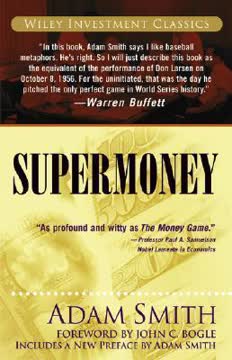
Supermoney by George Goodman (writing as Adam Smith) examines the late 1960s stock bubble and its collapse. Reviewers praise Goodman's intelligent, hilarious writing style that remains remarkably relevant decades later. The book explores "supermoney" (capitalized income from stock trading), the go-go era, and notably includes an early profile of Warren Buffett and Ben Graham's value investing philosophy. The final chapter addresses capitalism, sustainability, and economic limits. While some found it technical or disorganized, most consider it an entertaining, insightful look at financial history with timeless lessons about speculation and market psychology.
Similar Books