

Key Takeaways
Find stock ideas in familiar places, then verify them with serious homework.
Start with what you know. In 1990, seventh graders at St. Agnes School built a model portfolio from companies whose products they understood. Their 14-stock portfolio gained 70 percent over two years, compared with 26 percent for the S&P 500. They investigated earnings and the businesses behind the products, rather than buying solely because a stock sounded exciting. Their one conspicuous imitation of adults was IBM, which performed poorly during the exercise.
Use familiarity as a lead. The lesson is not that liking a product proves its stock is attractive. It is that customers, workers, and local observers may notice a company’s popularity before professional investors do. The students still had to check the numbers and explain what each business did.
What's striking is how the classroom project turns investing from an abstract contest into a question of observation: what do people actually buy, and why? That is a useful antidote to status-driven faith in professional expertise. But a two-year model portfolio is not proof that young investors can reliably beat markets with real money. A small portfolio can be lucky, and familiar products can become objects of affection rather than analysis. The stronger principle is to treat firsthand knowledge as a source of questions, then test those questions against financial evidence.
Own productive businesses long enough to let compounding outlast the headlines.
Stocks represent businesses. Lynch argues that investors seeking long-term growth should favor stocks over bonds and cash, while recognizing that stocks can fall sharply and stay weak for years. In the historical figures he cites, a $100,000 investment in the S&P 500 from 1926 to 1989 grew to about $25.5 million, compared with about $1.6 million in long-term government bonds. Stocks also offered a chance to share in rising company profits and dividends, while bond payments were fixed.
Keep the horizon honest. Those figures describe a particular historical period, not a promise about future returns. The case for stocks depends on being able to withstand downturns and leave money invested long enough for business growth to matter.
The argument connects ownership to productive capacity: a bond promises specified payments, while a shareholder can benefit as a company expands and distributes more earnings. That distinction helps explain why a long investment horizon matters. Yet historical U.S. returns do not settle how much stock any particular person should own. Someone needing cash soon, or unable to tolerate a severe decline, faces a different problem from a long-term investor. The book is most persuasive when it challenges reflexive fear of stocks, not when its return comparisons are treated as a universal allocation rule.
Study the business, balance sheet, and price before trusting a stock story.
Make the story testable. Before buying, Lynch looks for evidence that sales and earnings can grow, a reasonable price relative to that growth, and a balance sheet strong enough to survive trouble. He also asks what caused past growth and whether those causes can continue. His research combines annual reports, conversations with company representatives, visits to stores and facilities, and notes recording why a stock first seemed promising.
Spread the uncertainty. The National Association of Investors Corporation's Rule of Five is a practical portfolio heuristic: own several growth companies because some will meet expectations, one may disappoint, and one may do unexpectedly well. It is not a guarantee. The purpose is to avoid making one uncertain forecast carry the entire result.
This method resembles good investigative work: establish a claim, seek independent evidence, and keep track of what would disprove the claim. The balance sheet matters because an attractive business can still fail if it cannot meet its obligations. The Rule of Five also recognizes that forecasts are noisy, so outcomes should not depend on identifying the single perfect company. A limitation is that management conversations can be polished sales pitches. Their value rises when claims are checked against filings, operating data, and what customers or competitors reveal.
Expect market drops, and build a plan that keeps panic from choosing.
Make volatility ordinary. Lynch counts 40 market declines of at least 10 percent over roughly 70 years, including 13 declines of about 33 percent. He argues that investors who sell whenever frightening headlines appear often abandon stocks near the point of maximum fear. Regular investing can reduce the temptation to time every turn. In a theoretical example from the book, investing $1,000 in the S&P 500 each year for 52 years produced about $3.55 million; adding money after declines of 10 percent or more raised the hypothetical result further.
Separate discipline from bravado. These historical calculations do not remove the risk of loss, and they assume an investor can keep contributing. A sensible plan must account for cash needs and the ability to stay invested during a downturn.
The behavioral insight is powerful: people often feel most confident after prices rise and most doubtful after they fall, which can invert good investing behavior. Scheduled contributions impose a decision rule before emotions peak. Still, regular buying is not a shield against every risk, and the book's long historical example should not be mistaken for a forecast. A household with near-term expenses cannot simply ignore market declines. The useful lesson is to decide in advance how to respond to volatility, rather than letting alarming news dictate a new strategy each week.
Choose funds by strategy, not by last year's leaderboard.
Compare like with like. Lynch distinguishes funds by what they own and how they invest: growth, value, smaller companies, broad stock selection, or special situations. A value fund should be judged against other value funds, not against a growth fund during a period when growth stocks lead. He also recommends spreading investments across several approaches instead of betting everything on one manager or style.
Past winners mislead. In the historical data he discusses, index funds beat the average managed equity fund in eight of the ten years from 1981 to 1990, while managed funds held a slight cumulative advantage across a much longer 1960 to 1992 period. Chasing the most recent winner often meant buying a style after it had become popular. Fees and taxes, along with performance, belong in the comparison.
The advice anticipates a core problem in performance evaluation: a manager can look brilliant when the manager's preferred style is in favor, then appear inept when the market's leadership changes. Comparing funds by strategy is more informative than comparing raw returns alone. An index fund also provides a useful low-complexity benchmark. The figures here are historical and cannot identify tomorrow's best manager. A diversified selection of styles may smooth the experience, but it also risks owning overlapping portfolios, so the underlying holdings and total costs still deserve attention.
Look where fear is loudest, then test whether the business is truly broken.
Read past the headline. During the early 1990s real-estate panic, Lynch noticed that the reported median home price had risen in 1989, 1990, and 1991, despite stories suggesting a nationwide collapse. He investigated Pier 1 Imports, whose share price had fallen sharply, and found a retailer reducing debt, controlling inventory, opening stores carefully, and still making money in a recession. Its stock looked inexpensive relative to expected earnings and growth.
Check the repair work. The same search led him to Sunbelt Nursery and General Host, which were investing in store improvements and trying to strengthen operations. Such cases are not automatic bargains: bad industries can deteriorate further. The key is to find evidence of survival, manageable debt, and a plausible path to better results, not merely a low share price.
Contrarian investing works best when it is an evidence-based response to excessive pessimism, not a performance of courage. The distinction between a depressed price and a broken business is crucial. In behavioral terms, vivid stories about collapse can make scattered evidence feel like proof of a universal disaster. Yet one reassuring statistic, such as a rising median home price, cannot settle every local market's condition. The investor needs multiple checks: the company's finances, customer demand, inventory, and competitive position. That mix of skepticism and curiosity is more useful than simply buying whatever has fallen most.
Separate sound thrift operators from frauds before dismissing the entire S&L sector.
Inspect the institution. Lynch separates failed savings and loans into fraudulent operators, lenders ruined by reckless expansion, and conservative neighborhood thrifts he calls Jimmy Stewart S&Ls. These last institutions focused on deposits and ordinary residential mortgages rather than speculative development. A central screening measure is the equity-to-assets ratio, which compares the institution's shareholder cushion with its assets. Lynch preferred a ratio of at least 7.5, alongside few delinquent loans and limited risky commercial lending.
The conversion opportunity. When a mutually owned thrift sold shares to the public, the proceeds generally stayed in the institution, increasing its equity. That could make the shares attractive, but not risk-free: poor loans or weak management could still destroy the apparent bargain. The book's examples show why a sector-wide scandal should prompt careful distinctions, not blind dismissal.
The useful idea is classification. A scandal can cause investors to treat every institution as equally compromised, even when business models and balance sheets differ sharply. Equity provides a buffer, while lending standards and deposit stability illuminate how that buffer might be tested. The conversion story also raises a governance question: who benefits when a mutual institution becomes public? Screening for insider advantages is essential, as is recognizing that accounting ratios cannot reveal every loan's true quality. The framework rewards diligence, but it does not make thrift investing simple or suitable for every investor.
Read cyclical stocks through supply, demand, and timing, not low P/E alone.
Earnings move in cycles. A cyclical company's low price-to-earnings ratio can signal peak profits just before business weakens. A high ratio can appear near the bottom, when current earnings are depressed but recovery is possible. Lynch tracks operating conditions instead of assuming that a low multiple means a stock is cheap. For autos, he uses units of pent-up demand: the gap between actual vehicle sales and an estimated trend. Sales fell about 7 million units below trend from 1980 to 1983, then ran about 7.8 million above trend from 1984 to 1989.
Follow the commodity. In copper, Phelps Dodge produced about 1.1 billion pounds a year. A one-cent increase in copper's price per pound meant roughly $11 million more in pretax earnings. That leverage can make a cyclical stock move dramatically, in either direction.
Cyclical analysis is a lesson in denominator risk: a multiple can look low because earnings are temporarily high, or high because earnings are temporarily low. Looking at the industry cycle helps prevent those figures from being read in isolation. The auto-sales comparison and copper calculation make operating leverage tangible. But trend estimates and commodity prices are uncertain, and a correct industry view does not guarantee the right company choice. Debt, production costs, and competitive strength determine which firms survive long enough to benefit from a recovery.
Protect time for family before investing success turns into another full-time job.
Notice the tradeoff. Lynch left Magellan in 1990 after 13 years managing the fund. The work had grown so consuming that he missed most of his daughter's soccer games, neglected family routines, and spent more time with company names than with the people at home. He declined offers to manage a smaller fund because he believed it would recreate the same workload.
Money has a purpose. His departure reframes investing success: wealth is not an unlimited score to accumulate at any cost. The decision does not imply that ambition is wrong, or that every demanding job should be abandoned. It asks investors to notice when a means of improving life has begun to crowd out the life it was meant to support.
This personal account gives the book a human measure of success that portfolio returns cannot capture. Attention is finite, and family time cannot be stored for later use in the way money can. That makes the tradeoff unusually concrete. The story also has limits: Lynch had achieved substantial financial security and could choose to leave, a freedom many workers do not have. Even so, the underlying question travels well: what is the point of financial progress if the process consumes the relationships and experiences it was supposed to protect?
Recheck the company's changing story, not merely its stock quote.
Update the thesis. Lynch's six-month checkup asks whether the business remains attractively priced and whether the reasons for owning it still hold. Fannie Mae illustrates why. He first treated it as a volatile interest-rate bet, then noticed its shift toward packaging mortgages into securities and reducing its exposure to rate swings. He began with a tiny position, increased it as the business changed, and eventually made it one of Magellan's largest holdings. Over five years, the fund earned about $500 million from the stock.
Price is a prompt. A falling quote may signal a better entry, or it may reveal that the business has deteriorated. Revisit earnings, debt, demand, and management's actions before adding, holding, or selling. The task is to revise the investment case when facts change, not to defend the original decision out of pride.
This is disciplined updating rather than loyalty to a ticker. The Fannie Mae example shows how a company can change its economics enough to deserve a different assessment, even when investors remain anchored to its troubled past. A written record of the original thesis makes that revision easier because it distinguishes new evidence from hindsight. The danger runs both ways: investors can cling to a stale story, or invent a fresh justification for a deteriorating business. Periodic review is valuable when it tests the thesis rather than merely reassuring its owner.
Analysis
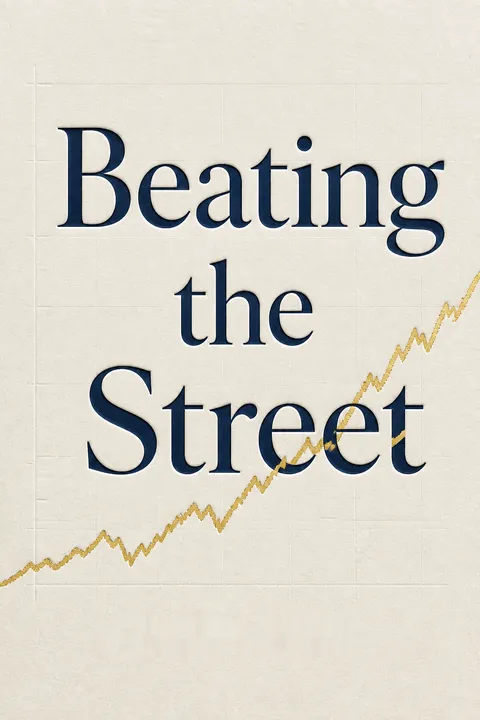
Beating the Street is part investing manual, part working memoir, and part casebook. Its structure follows Lynch from the small, shrinking Magellan Fund he inherited to a giant portfolio, then shifts into detailed investigations of individual stocks. That movement matters: the book's method is not presented as a sealed formula but as a set of habits tested against mistakes, missed opportunities, and changing company stories.
Its strongest contribution is a model of practical attention. Lynch looks at products, stores, loan portfolios, balance sheets, and the incentives of managers. He treats ordinary experience as a source of leads, then insists that the lead be checked. The St. Agnes students, the mall visits, the troubled utilities, and Fannie Mae all support the same idea: investment research can begin outside Wall Street, but it cannot end with intuition.
The book also distinguishes the investor's task from prediction. Lynch repeatedly mocks confident forecasts about markets and economies, while still making judgment calls about industries and interest rates. That tension is productive. A company-focused investor can avoid some macroeconomic guesswork, but cyclical cases show that rates, commodities, and regulation still shape results. No analytical style eliminates uncertainty.
The historical evidence requires care. Return figures, market conditions, named funds, and institutions belong to the period covered, and they should not be treated as current recommendations. The extraordinary examples also risk survivorship bias: a successful retailer or thrift is vivid, while failed lookalikes receive less narrative space. Lynch's counterweight is attention to debt, operating facts, and the possibility of being wrong. The book is most useful as a disciplined way to ask better questions, not as a catalog of stocks to buy or a promise that amateurs will outperform professionals.
Review Summary
Beating the Street received mostly positive reviews, with readers praising Lynch's investment advice and accessible writing style. Many found the book informative and inspiring, particularly for beginners. Some readers noted that the examples are outdated, but the core principles remain valuable. Critics felt the book was repetitive or less relevant for modern investors. Overall, readers appreciated Lynch's emphasis on understanding companies, investing in what you know, and his practical approach to stock picking.
People Also Read






Glossary
Rule of Five
A five-stock growth portfolioA portfolio heuristic associated with the National Association of Investors Corporation. It assumes that among five selected growth companies, several may perform roughly as expected, one may disappoint, and one may greatly exceed expectations. The purpose is to spread uncertainty across multiple businesses while keeping the portfolio small enough for an individual to research.
mortgage-backed securities
Tradable bundles of mortgagesInvestments created by grouping many individual mortgages into a package that can be sold to banks, insurers, funds, and other investors. In Lynch's account, Fannie Mae buys or guarantees mortgages, packages them, and earns fees, allowing lenders to recover capital and make additional loans. The packaged securities also shift some mortgage ownership and interest-rate exposure to investors.
master limited partnership
Publicly traded partnershipA publicly traded business organized as a partnership rather than a conventional corporation. Lynch describes these partnerships as distributing their earnings to investors and often paying unusually high yields, with some distributions treated as a return of capital. Investors may face additional tax paperwork, and the specific partnership agreement and tax treatment matter.
equity-to-assets ratio
Equity divided by assetsA measure of a financial institution's capital cushion, calculated by comparing its equity with its total assets. A higher ratio generally means the institution has more capacity to absorb losses before its obligations exceed its resources. Lynch uses it when comparing savings and loans, while also checking loan quality, delinquencies, and risky commercial exposure.
Jimmy Stewart S&Ls
Conservative neighborhood thriftsLynch's label for savings and loans that resemble the modest institution portrayed in the film It's a Wonderful Life. These thrifts rely on local deposits and focus mainly on ordinary residential mortgages, avoiding speculative development and costly corporate excess. The label distinguishes them from fraudulent or overly aggressive institutions, but does not guarantee safety.
units of pent-up demand
Deferred vehicle purchasesLynch's way of describing the gap between actual auto and truck sales and an estimated trend based on factors such as prior sales and vehicle replacement needs. When sales remain below trend for several years, purchases may have been postponed, creating potential demand. The measure is an estimate, not a precise forecast of when buyers will return.
troubled utility cycle
Utility recovery in four stagesA pattern described by utility analysts in which a company suffers a major setback, cuts costs and spending, stabilizes its finances, and later resumes earning for shareholders. The process can follow a failed nuclear project, a fuel-price shock, or another large loss. Recovery depends in part on regulators, lenders, and the utility's ability to keep operating.
FAQ
What's "Beating the Street" about?
- Investment Strategies: The book outlines Peter Lynch's approach to investing, focusing on how individual investors can outperform the market.
- Personal Experiences: Lynch shares his experiences managing the Magellan Fund, providing insights into his decision-making process.
- Stock Picking: It emphasizes the importance of thorough research and understanding the companies you invest in.
- Practical Advice: The book offers practical tips for both novice and experienced investors to improve their investment strategies.
Why should I read "Beating the Street"?
- Proven Success: Peter Lynch is one of the most successful mutual fund managers, and his insights are valuable for any investor.
- Practical Insights: The book provides actionable advice that can be applied to real-world investing.
- Educational Value: It serves as a great educational resource for understanding the stock market and investment strategies.
- Inspiration: Lynch's passion for investing and his success story can inspire readers to take control of their financial future.
What are the key takeaways of "Beating the Street"?
- Do Your Homework: Lynch emphasizes the importance of researching and understanding the companies you invest in.
- Invest in What You Know: He advocates for investing in industries and companies you are familiar with.
- Long-Term Perspective: The book encourages a long-term investment approach rather than short-term speculation.
- Diversification: Lynch discusses the importance of diversifying your portfolio to manage risk.
What is Peter Lynch's investment philosophy?
- Growth at a Reasonable Price (GARP): Lynch focuses on finding companies with strong growth potential that are undervalued.
- Bottom-Up Approach: He believes in analyzing individual companies rather than focusing on macroeconomic trends.
- Scuttlebutt Technique: Lynch suggests gathering information from various sources, including employees and customers, to assess a company's potential.
- Simplicity: He advocates for keeping investment strategies simple and avoiding overly complex financial instruments.
How does Peter Lynch suggest picking stocks?
- Understand the Business: Lynch stresses the importance of understanding how a company makes money and its competitive advantages.
- Look for Growth: He advises looking for companies with strong growth prospects and a track record of earnings growth.
- Evaluate the Management: Assess the quality and track record of a company's management team.
- Check the Valuation: Ensure that the stock is reasonably priced relative to its growth potential.
What are some of the best quotes from "Beating the Street" and what do they mean?
- "Invest in what you know": This quote emphasizes the importance of investing in industries and companies you understand.
- "The person that turns over the most rocks wins the game": It highlights the need for thorough research and exploration in stock picking.
- "Time is on your side when you own shares of superior companies": This suggests that holding quality stocks over the long term can lead to significant gains.
- "Know what you own, and know why you own it": It underscores the importance of understanding your investments and having a clear rationale for holding them.
What is the "Tenbagger" concept in "Beating the Street"?
- Definition: A "tenbagger" is a stock that increases in value tenfold.
- Significance: Lynch popularized this term to describe the potential for significant gains in the stock market.
- Finding Tenbaggers: He suggests looking for companies with strong growth potential and a competitive edge.
- Long-Term Focus: Achieving a tenbagger often requires patience and a long-term investment horizon.
How does Peter Lynch view market fluctuations?
- Ignore Short-Term Volatility: Lynch advises investors not to be swayed by short-term market movements.
- Focus on Fundamentals: He emphasizes the importance of focusing on a company's fundamentals rather than market noise.
- Opportunity in Downturns: Market downturns can present buying opportunities for undervalued stocks.
- Stay the Course: Maintaining a long-term perspective is crucial for investment success.
What role does diversification play in Lynch's strategy?
- Risk Management: Diversification helps manage risk by spreading investments across different sectors and companies.
- Avoid Over-Diversification: Lynch warns against over-diversifying, which can dilute potential returns.
- Balanced Portfolio: A well-diversified portfolio balances growth stocks with more stable investments.
- Sector Knowledge: Understanding different sectors can help in making informed diversification decisions.
How does Peter Lynch suggest dealing with investment mistakes?
- Learn from Mistakes: Lynch encourages investors to analyze their mistakes and learn from them.
- Cut Losses Early: He advises selling underperforming stocks before losses become too large.
- Stay Rational: Avoid emotional decision-making and stick to your investment strategy.
- Continuous Improvement: Use mistakes as opportunities to refine and improve your investment approach.
What is the "PEG Ratio" and how does Lynch use it?
- Definition: The PEG ratio is the price/earnings ratio divided by the company's earnings growth rate.
- Valuation Tool: Lynch uses it to assess whether a stock is overvalued or undervalued relative to its growth potential.
- Comparison: A PEG ratio below 1.0 is often considered attractive, indicating potential undervaluation.
- Growth and Value Balance: It helps balance growth potential with valuation, aligning with Lynch's GARP strategy.
How does "Beating the Street" address the psychology of investing?
- Emotional Discipline: Lynch emphasizes the importance of maintaining emotional discipline in investing.
- Avoid Herd Mentality: He warns against following the crowd and making impulsive decisions.
- Confidence in Research: Trusting your research and analysis can help withstand market pressures.
- Long-Term Mindset: A long-term perspective can help mitigate the psychological impact of market volatility.
About the Author

Download PDF
Download EPUB
.epub digital book format is ideal for reading ebooks on phones, tablets, and e-readers.








