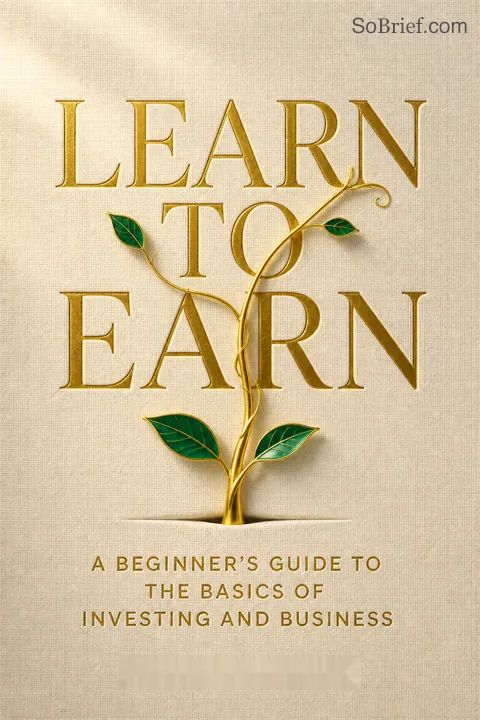


Key Takeaways
Own a stake in businesses that make things people value
Ownership funds activity. A company can raise money by selling shares. Investors become part owners, while the business can use the funds to build, hire, and expand. Incorporation also limits shareholders’ liability, generally protecting their other assets from company debts and lawsuits. That protection helps make public investment possible for people who could not afford to shoulder unlimited risk alone.
A long-running bargain. The book traces this system from early stock markets, where investors financed voyages and settlements, to modern companies woven into daily life. Its argument is that saving and investing can benefit both the saver and the businesses receiving capital. A share is not merely a changing market price. It is a small claim on a company’s future performance.
The civic framing is useful: investing connects household choices to the financing of production, rather than treating markets as a casino detached from everyday life. It also makes limited liability legible as institutional design, not just legal fine print. Still, the social benefits are not automatic. A company can create jobs and useful goods while imposing costs on workers, communities, or the environment. Ownership gives investors a stake in those outcomes, but the book’s optimistic chain from capital to shared prosperity needs scrutiny in each real-world case.
Protect competition, because unchecked winners can become toll collectors
Markets need rivals. Adam Smith’s Invisible Hand is his metaphor for prices and competition coordinating decisions without a central planner. If too many firms produce hats, falling prices make hat-making less attractive, encouraging some resources to move elsewhere. The process can steer production toward what buyers want, while competition pressures businesses to improve products and prices.
Power can break the mechanism. The book recounts how John D. Rockefeller’s Standard Oil Trust came to control most U.S. oil refining and could squeeze rivals and influence prices. Antitrust laws and court action later broke up major trusts. Earlier financial manias, including the Mississippi Company and South Sea Company bubbles, show a different failure: investors bought into persuasive claims without reliable information, then found few buyers when confidence collapsed.
The distinction between decentralized coordination and concentrated power is central to modern political economy. Competition can improve efficiency, but it does not ensure fair outcomes when a dominant firm controls access, information, or essential infrastructure. The history of antitrust also shows that markets depend on rules and enforcement, not merely on voluntary exchange. The book’s confidence in self-correction is strongest where entry is possible and consumers can switch. It is weaker in industries with high barriers, network effects, or costs that businesses can shift onto the public.
Give small savings decades to compound before chasing bigger paychecks
Time multiplies contributions. Compounding means that returns can themselves earn returns. The book illustrates the effect with someone saving $500 each year in an account earning 5 percent. After ten years, the balance reaches about $6,603, including roughly $1,603 generated beyond the $5,000 contributed. The gains are modest at first, then build on a larger base.
Begin where costs are low. Young people living with family may have fewer expenses and can invest small, regular amounts before rent, children, or other bills crowd the budget. The underlying lesson is not that early investors need large sums. It is that years in the market give even modest savings more time to grow. Returns are uncertain, but lost time cannot be deposited later.
Compounding is a mathematical advantage, but also a behavioral one: automatic, repeated contributions reduce reliance on bursts of motivation. The idea resembles skill acquisition, where early practice creates a base for later gains. The crucial qualification is that compound growth depends on the return actually earned, and higher expected returns usually come with greater risk. A 5 percent savings example is predictable arithmetic, not a promise about stocks. Starting early helps, but it cannot compensate for every low income, emergency, or structural barrier to saving.
Pay off costly consumer debt before asking investments to outrun it
Interest reverses the advantage. Money invested can generate returns; unpaid credit-card balances make the borrower pay interest instead. The book gives an example of an item costing $400 on a card charging 18 percent: the first year’s interest alone is $72, and slow minimum payments can make the final cost approach twice the purchase price.
A car can consume future capital. One comparison follows a young worker financing a $20,000 sports car, paying about $26,000 including loan interest, then owning a vehicle worth roughly $5,000 after five years. A peer buys cheaper transportation and invests $400 monthly, building an account worth nearly $30,000 over the same period. The point is opportunity cost: spending today can forfeit money that might otherwise grow.
This is a practical application of present-bias research: immediate rewards feel vivid, while distant costs are easy to discount. Recasting debt as the opposite of saving makes that cost easier to see. The comparison is deliberately stark, however. A car can be necessary for work or caregiving, and investment returns are not guaranteed to match a tidy illustration. The durable principle is to compare the full cost of borrowing with the value received, especially when financing an asset that tends to lose value.
Know whether you own a company or merely lend it money
Stocks confer ownership. A shareholder can benefit when a business grows its earnings, raises dividends, or becomes more valuable. But the company does not promise a particular return, and its stock price can fall sharply or become worthless.
Bonds are loans. A bond records money lent to a government or company, usually in exchange for scheduled interest and repayment at a specified date. The lender generally does not share in extraordinary company growth. Bonds can also lose value if sold early, if the issuer defaults, or if inflation erodes what the payments can buy. The book’s historical comparison reports that U.S. stocks outperformed bonds over much of 1945 to 1994, but that past record does not remove stock risk or guarantee future results.
The owner-versus-lender distinction clarifies why stocks and bonds behave differently. A bond’s fixed claim can be valuable when stability matters, while stock ownership provides participation in uncertain growth. This is a question of matching risk to purpose and time horizon, not of declaring one investment universally superior. Inflation is particularly important because a nominal promise can be met while purchasing power still shrinks. The book’s return comparisons are instructive as history, but they should not be mistaken for a forecast or a complete portfolio recommendation.
Stay invested through crashes, because market timing misses recovery days
Selling locks in a price. The book argues that investors often buy after enthusiasm pushes prices high, then sell during a decline when fear takes over. It cites a five-year period in the 1980s when stock prices gained 26.3 percent annually, but says missing the 40 most profitable sessions among 1,276 trading days reduced the return to 4.3 percent. A market timer is an investor trying to predict short-term price movements and move in or out accordingly.
Build for patience. The book recommends investing only money that can remain untouched for many years and contributing on a schedule. Regular purchases can reduce the pressure to guess the perfect entry point. They do not prevent losses, and a long horizon cannot rescue every company. The case for patience is strongest when the investment is diversified and the underlying businesses remain sound.
The missed-best-days example captures an important asymmetry: a small number of sharp advances can account for a large share of long-run returns, and they are hard to identify in advance. Behavioral finance helps explain why investors nonetheless try, since losses feel more urgent than gains. The caution is that staying invested is not a command to ignore evidence. A broad market decline and a company’s deteriorating finances are different problems. Patience works best when paired with diversification, liquidity for near-term needs, and a clear reason for owning each asset.
Follow company results, not the mood of its stock quote
The business is the story. Nike’s sales, earnings, and future orders weakened in 1986 and early 1987. By its final report for that fiscal year, future orders had turned upward. The next report showed sales up 10 percent and earnings up 68 percent. After the 1987 market crash, Nike shares fell to about $7, even as its business improved. Over the following five years, the stock rose to about $90.
Separate evidence from emotion. Investors who read company reports could distinguish the broader market panic from Nike’s improving prospects. The book makes the same point with Johnson & Johnson: its reported earnings and sales were strong while health-care policy fears depressed its stock price. A falling quote can be a warning, but by itself it does not explain what is happening inside a company.
This approach resembles causal reasoning: a price is an observation, not an explanation. Investors are better placed to judge a business when they track evidence such as orders, sales, and profitability rather than treating every price move as a verdict. Yet the company story can be wrong, incomplete, or already reflected in the price. Reports arrive periodically, while markets incorporate many expectations continuously. The method is therefore not a shortcut to certainty. It is a way to ask more useful questions before reacting to a frightening headline.
Check earnings and price together before calling a company a bargain
Profitability gives price context. The price-earnings ratio, or P/E, divides a share price by the company’s earnings per share. It helps compare what investors pay for each dollar of earnings, though sensible ratios differ across industries and growth prospects. A $100 share is not automatically expensive: the answer depends partly on the earnings behind it and the expectations embedded in its price.
Read beyond the headline. In its 1993 annual report, Johnson & Johnson showed a decade of rising earnings, investment in new products, and share buybacks. Its projected 1995 P/E was about 11, compared with about 16 for the average stock at the time. A balance sheet is a snapshot of what a company owns, owes, and retains as equity. Earnings matter, but so do debt, cash, investment needs, and whether profits are being used wisely.
The emphasis on earnings counters the seductive idea that a low share price automatically means a bargain. Ratios help organize comparisons, but they depend on accounting choices and estimates of future profit. A company can report earnings while cash is tied up in unpaid customer bills or unsold inventory, which is why multiple financial statements matter. Valuation also reflects uncertainty, not just arithmetic. The useful habit is to treat each metric as a clue, then test it against the company’s business model, balance sheet, and competitive position.
Treat each company as a life story, not a permanent champion
Businesses change with age. A young company may grow quickly but face a high chance of failure. The book says about half of new businesses disappear within five years and warns that startups often run short of cash. Apple began in a garage, attracted an early investor, and went public only after its products had begun to sell. An initial public offering is a company’s first sale of shares to the public, usually to raise expansion capital.
Past glory can mislead. Mature firms may be more stable, but growth can slow; older companies can also lose their edge. U.S. Steel was once a market leader, yet its share price in 1995 was below its 1959 level. IBM and General Motors likewise struggled when competitors and customer preferences shifted. A famous name is not proof that a business will keep winning.
The life-cycle lens is a useful antidote to static labels such as blue chip or growth stock. It asks whether a company’s current strengths fit the market it now faces. The historical examples also illustrate survivorship bias: celebrated winners are remembered, while many failed firms disappear from view. Company age alone is not a forecast, however. Some mature businesses keep adapting, and some young ones never establish a viable model. The decision should turn on evidence of resilience, cash needs, competition, and management’s response to change.
Invest in a broad fund unless you can research companies consistently
Funds spread the exposure. A mutual fund pools investors’ money to hold shares in many companies, with a manager choosing the investments. This gives a beginner diversification without requiring enough money to buy many individual stocks. Fees matter: the book describes annual expenses ranging from about 0.5 to 2 percent, which reduce what investors keep.
Make the method fit the investor. An index fund aims to match a chosen market index by holding its constituent stocks, usually with less active trading and lower management costs. Investors who pick individual shares should study the business, observe products and customers, read company reports, and check the numbers. The book suggests practicing with imaginary portfolios before risking money. Tips and short-term contests are poor substitutes for learning how companies earn and spend.
The choice between fund investing and stock selection is partly a choice about time, skill, and temperament. A low-cost index fund can provide diversification without requiring an investor to outperform professionals. Subsequent evidence from fund-performance research has repeatedly found that many actively managed funds lag broad benchmarks after fees over long periods. Individual research can still be intellectually rewarding, but conviction should not be confused with an edge. The strongest lesson is to choose a process that can be followed consistently, and to count costs as part of performance.
Analysis
Learn to Earn is both an investing primer and a popular history of American business. Its organizing move is to connect household money to the life of a company: savings finance activity, shares distribute ownership, earnings determine business value, and competition shapes which firms endure. Stories make that chain memorable. The Pilgrims’ tangled financing turns colonial history into a lesson about incentives; Apple’s garage origins make corporate finance feel accessible; Nike and Johnson & Johnson illustrate how a company’s operating record can diverge from its share price.
The book’s greatest strength is its insistence that investing begins with understanding businesses, not decoding market noise. It gives beginners a usable vocabulary for stocks, bonds, earnings, reports, and company growth, while treating patience as an intellectual discipline rather than passive optimism. Its historical view also resists two common errors: assuming capitalism has always existed in its modern form, and imagining that famous firms remain successful indefinitely.
Its central weakness is the breadth of its defense of capitalism. The account often treats private profit as a reliable route to broad social benefit, although the book itself recounts monopolies, unsafe conditions, and worker conflict. Markets can coordinate information and reward useful innovation, but they do not automatically price pollution, protect vulnerable workers, or provide essential goods to people without purchasing power. Those outcomes depend partly on law, public institutions, and bargaining power.
The financial data and examples are anchored in the 1990s. In particular, the historical stock returns are not current forecasts, and the argument for choosing stocks over bonds assumes long horizons and tolerance for large losses. A modern reader should distinguish the case for investing from the case for picking individual companies. The lasting contribution is not a promise that markets always rise, but a practical framework: save, understand what is owned, evaluate the business as well as its price, diversify where appropriate, and resist decisions driven solely by panic or fashion.
Review Summary
Learn to Earn is highly recommended for beginners, providing a solid foundation in investing basics and capitalism history. Readers appreciate its simple language and engaging style. The book covers stock market mechanics, company analysis, and financial concepts. While some find it too basic or outdated, many value its insights for young investors. Criticisms include its strong pro-capitalist stance and focus on American companies. Overall, it's considered an essential read for those new to investing, though more experienced readers may find limited new information.
People Also Read






Glossary
Invisible Hand
Market coordination through pricesAdam Smith’s metaphor for how many separate choices by buyers and sellers can coordinate production without a central planner. Prices respond to supply and demand, giving businesses incentives to expand, reduce output, or change what they offer. The idea describes a tendency in competitive markets, not a guarantee that markets are fair or always work well.
Market timer
Short-term market predictorAn investor who tries to forecast near-term rises and falls in stock prices and shifts investments in response. The book argues that this is difficult to do consistently because important market advances can occur on a small number of unpredictable days. Repeatedly moving in and out can mean missing gains as well as avoiding declines.
Price-earnings ratio
Share price relative to earningsThe price-earnings ratio, often abbreviated P/E, compares a company’s share price with its earnings per share. It indicates how much investors are paying for each dollar of reported or estimated earnings. P/E ratios vary across industries and growth expectations, so the figure is most useful when compared with relevant companies or the company’s own history.
Balance sheet
Snapshot of assets and obligationsA financial statement listing a company’s assets, liabilities, and shareholders’ equity at a particular date. Assets include items such as cash, inventory, and equipment; liabilities include debts and bills owed; equity represents the residual claim after liabilities. The statement helps investors assess financial resources and obligations, but it does not by itself explain profitability or cash movement.
Initial public offering
First public sale of sharesAn initial public offering, or IPO, is the first time a privately owned company sells shares to public investors. The company generally works with investment banks to set terms, market the offering, and distribute the shares. An IPO can raise money for expansion and allow early owners to sell some holdings, while bringing public reporting and scrutiny.
Mutual fund
Pooled portfolio of investmentsA mutual fund combines money from many investors to buy a portfolio of securities, such as stocks or bonds. Investors own shares in the fund rather than selecting every underlying investment themselves. A manager may choose holdings actively, or the fund may follow a specified strategy. Management expenses and other fees reduce returns.
Index fund
Fund tracking a market indexAn index fund seeks to match the performance of a selected market index by holding the securities represented in that index, or a sample of them. Since it does not aim to outperform through frequent individual stock selection, it can require less trading and management. It still bears the market risks of the investments it holds.
FAQ
What's Learn to Earn about?
- Beginner's Guide: Learn to Earn by Peter Lynch is an introductory guide for those new to investing and business, simplifying complex financial concepts.
- Capitalism and Stock Market: It explains the role of capitalism and the stock market in economic progress and personal financial growth.
- Practical Strategies: The book offers practical advice on starting to invest, emphasizing the importance of understanding companies and long-term strategies.
Why should I read Learn to Earn?
- Accessible for Beginners: The book is designed for novice investors, making it a great resource for understanding the stock market.
- Financial Literacy: It aims to fill the gap in financial education, providing knowledge to make informed investment decisions.
- Engaging Examples: Lynch uses relatable examples and anecdotes to make the content engaging and applicable to everyday life.
What are the key takeaways of Learn to Earn?
- Start Early: Emphasizes the importance of starting to invest early to benefit from compounding interest.
- Understand Companies: Stresses the need to research and understand the companies behind the stocks.
- Long-Term Strategy: Advocates for a long-term investment perspective to mitigate risks associated with market volatility.
What are the best quotes from Learn to Earn and what do they mean?
- "Investing is fun. It’s interesting.": Encourages viewing investing as an engaging activity and a way to participate in economic growth.
- "The best time to get started investing is when you’re young.": Highlights the benefits of starting early to maximize compounding interest.
- "The natural-born investor is a myth.": Suggests that investing skills can be developed with education and practice.
How does Learn to Earn define a corporation?
- Legal Entity: A corporation is a separate legal entity from its owners, protecting shareholders from personal liability.
- Formation Process: Involves filing paperwork and paying a fee to gain legal rights and protections.
- Public vs. Private: Distinguishes between public companies, which sell shares to the public, and private companies, owned by a small group.
What investment strategies does Peter Lynch recommend in Learn to Earn?
- Start Small and Regularly: Advises using dollar-cost averaging to mitigate market volatility.
- Focus on Quality: Encourages investing in high-quality companies with strong fundamentals.
- Stay Disciplined: Emphasizes maintaining a disciplined strategy, especially during market downturns.
How does Learn to Earn address the importance of patience in investing?
- Long-Term Focus: Successful investing requires a long-term perspective, allowing investments to grow.
- Avoid Emotional Decisions: Warns against impulsive decisions based on short-term market fluctuations.
- Compounding Benefits: Highlights the power of compounding returns over time, making patience crucial.
What is the role of the stock market according to Learn to Earn?
- Economic Importance: The stock market is crucial for raising capital and supporting business growth.
- Market Dynamics: Operates as a continuous auction, creating opportunities for buying and selling shares.
- Impact on Society: Affects everyone by influencing job creation, economic stability, and financial health.
How does Peter Lynch suggest picking stocks in Learn to Earn?
- Do Your Homework: Research companies' business models, financial health, and market positions.
- Look for Growth: Seek companies with strong growth prospects and solid fundamentals.
- Use Stock Screens: Filter potential investments based on criteria like earnings growth and debt levels.
What are the different types of brokers mentioned in Learn to Earn?
- Full-Service Brokers: Offer personalized advice and a range of services, charging higher commissions.
- Discount Brokers: Provide fewer services at lower costs, executing trades based on client instructions.
- Deep-Discount Brokers: Charge minimal fees, catering to self-directed investors confident in their decisions.
What is the significance of dividends in Learn to Earn?
- Reward for Shareholders: Dividends provide a steady income stream and can be reinvested or used as cash flow.
- Indicator of Stability: Paying and increasing dividends often signals a company's financial health.
- Long-Term Strategy: Dividend-paying stocks can offer both income and capital appreciation over time.
What are some common mistakes investors make according to Learn to Earn?
- Emotional Decision-Making: Warns against decisions based on emotions like fear or greed.
- Neglecting Research: Stresses the importance of understanding companies before investing.
- Timing the Market: Cautions against trying to predict short-term market movements, advocating for long-term growth.
About the Author
Other books by Peter Lynch


Download PDF
Download EPUB
.epub digital book format is ideal for reading ebooks on phones, tablets, and e-readers.








