

Key Takeaways
Notice when an exaggerated cue steers an instinct past its purpose.
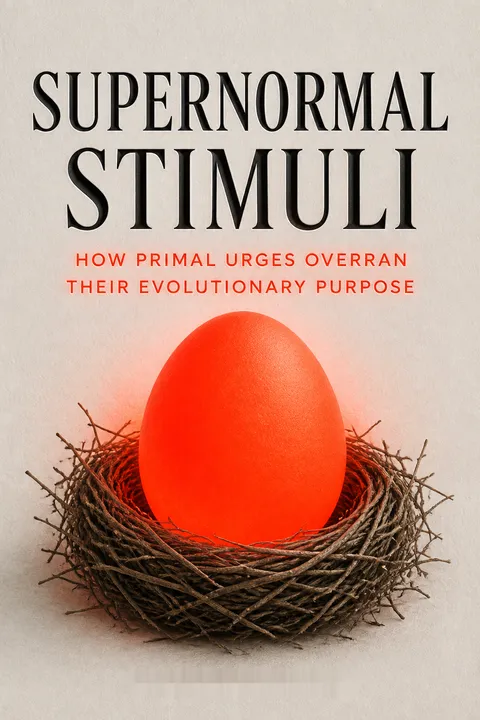
A cue can overpower reality. A supernormal stimulus is an exaggerated imitation of a natural signal that triggers a stronger response than the original. Zoologist Niko Tinbergen demonstrated this with birds that abandoned their own eggs for oversized, vividly colored dummies. Male sticklebacks attacked red models that looked little like fish, and geese strained to retrieve objects larger than any egg. The same pattern appears in the cuckoo, whose conspicuous chick can draw more attention from foster parents than their own young.
The human version is handmade. We produce concentrated foods, idealized bodies, cute mascots, and threatening images that push ancient attention and reward systems. Barrett’s point is not that instinct is foolish, but that a response suited to one setting can misfire in another. Recognizing the mismatch gives people a chance to pause rather than obey.
What's useful here is the distinction between a signal's original function and its current effect. A bright cue may once have helped an animal find food or a mate; its intensity alone does not make it valuable now. This resembles a design problem: systems built for a sparse world can behave badly when inputs become abundant and amplified. The concept is a strong diagnostic lens, though not a complete explanation for every modern habit. People also learn preferences, follow social norms, and make deliberate choices. Instinct can bias judgment without determining it.
Treat sexual media as amplified signals, not reliable models of intimacy.
Media magnifies selected traits. Barrett applies the supernormal-stimulus idea to pornography, cosmetics, digitally altered beauty images, and romance fiction. The book describes men’s sexual media as emphasizing visible physical cues, while women’s popular fantasies often center on a devoted, desirable partner and an emotionally charged relationship. Romance novels, for example, commonly construct a hero who is unusually tall, confident, protective, and wholly focused on the heroine.
The ideal is not the average. The book also discusses research suggesting that facial symmetry and average proportions can contribute to attractiveness, alongside a few exaggerated traits associated with sexual maturity. Its practical point is to recognize the artificial selection involved in media images, rather than treating them as ordinary standards. Barrett cautions that pornography’s harms are debated: she notes evidence against claims that its availability straightforwardly causes sexual violence, while warning that compulsive use can displace time and real relationships.
The useful distinction is between a stimulus that captures attention and a relationship that can sustain mutual care. Media can make desire vivid while removing negotiation, vulnerability, and the other person's independent perspective. That does not make fantasy inherently damaging; fiction and erotic material can be pleasurable without replacing everyday intimacy. The section is strongest when it treats media as an amplifier, not as a single cause of sexual behavior. Its gender contrasts are more sweeping than the evidence presented can settle, and individual preferences are more varied than a binary account suggests.
Question what your response to cuteness is asking you to care for.
Baby features invite protection. Cuteness draws on traits common in young animals: large heads and eyes, small noses, rounded bodies, and dependent behavior. The response helps bring adults to care for infants, but it can also attach to animals, toys, and commercial characters. Barrett describes the leopard Legadema carrying and tending a baby baboon after killing its mother, an extraordinary response she interprets as maternal care activated by infant cues.
The cue travels beyond its job. Neoteny means retaining juvenile features or behavior into adulthood. In Dmitry Belyaev’s fox experiment, breeding only the friendliest foxes produced increasingly tame animals; over generations, many also developed traits such as floppy ears and spotted coats. The same appeal shapes teddy bears and cartoon characters. Cuteness can sell products and absorb attention, so Barrett asks readers to notice when affection is being directed toward an object rather than a person who needs care.
Cuteness shows how an emotional response can be both valuable and exploitable. The impulse to protect a helpless infant is not a mistake; the challenge is that familiar cues can appear on toys, brands, and screens without any vulnerable being behind them. This makes the chapter relevant to attention and consumer choice as much as parenting. Still, an attachment to animals or objects is not automatically wasted: it can bring comfort or encourage care for other species. The important question is not whether the feeling is authentic, but whether its object and consequences deserve the resources it attracts.
Make concentrated food less routine than the cravings it exploits.
Scarcity shaped appetite. Barrett argues that human preferences for sugar, salt, and fat once helped people find rare, energy-rich foods. Modern food processing makes these ingredients cheap, concentrated, and easy to consume in large amounts. The book traces the shift from varied hunter-gatherer diets toward agriculture built around a few starchy crops, then to refined flour, added sugar, and processed fats. Its central claim is that food companies did not invent these cravings, but learned to build products that intensify them.
The body can be pushed off balance. The book describes how highly refined carbohydrates can drive sharp changes in blood glucose and insulin, while studies in rats linked repeated sugar or high-fat feeding with changes in reward and appetite systems. In the period Barrett describes, one-third of American children ate fast food daily, averaging 187 additional calories a day compared with other children. These dated figures illustrate the environmental scale of the problem, not a timeless estimate.
This account shifts attention from individual weakness to the design of the food environment. That is a meaningful correction: choices are harder to make well when highly rewarding options are cheap, visible, and ubiquitous. The evolutionary-mismatch idea also helps explain why a preference can persist after its original context disappears. But it should not collapse nutrition into a simple story of ancestral food versus modern food. Food access, income, culture, stress, and medical conditions shape eating too. The practical implication is to reduce exposure to the most tempting defaults while avoiding the claim that biology or history alone explains every person's diet.
Build food habits that do not require a fresh act of willpower.
Turn deliberate choices into routines. Barrett recommends recording food and activity, noticing the cues that prompt overeating, and challenging automatic justifications. Cognitive behavioral therapy can help make eating less automatic by asking people to track what they consume and examine the thoughts around it. She also describes hypnosis as a possible aid for some people, using imagined healthy choices and future benefits to reinforce new behavior.
Change the surroundings, too. The book favors vegetables, lean protein, fruit, and minimally processed foods, while arguing for limits on refined sugar, white flour, and trans fats. It also calls for measures such as healthier school food, restrictions on junk-food advertising to children, and subsidies that make nutritious ingredients more accessible. Barrett’s central practical distinction is that awareness may begin change, but repeated behavior and supportive surroundings make it easier to maintain.
Habit is the bridge between knowing what is beneficial and actually doing it. Tracking makes a vague pattern observable, while changing defaults reduces how often a person must make a difficult decision. This connects individual behavior to public design: a cafeteria or grocery store can either support a routine or continually undermine it. The section also rightly resists treating willpower as the only lever. Its specific dietary prescriptions are more categorical than a short summary can justify for every individual, however. A workable plan needs room for health needs, culture, affordability, and professional guidance.
Interrupt retaliation before each side mistakes escalation for fairness.
Threats feel larger than their odds. Barrett argues that human danger-detection is especially responsive to threats that seem deliberate, sudden, morally charged, and immediate. In her examples, people fear terrorism more intensely than more common hazards such as traffic deaths. She also describes an experiment in which paired participants tried to apply equal pressure to one another’s fingers, yet typically returned about 40 percent more pressure than they had received. Each person felt the other was escalating.
Groups can turn fear into war. A pseudospecies is a group treated as if it were a separate kind of human, making outsiders easier to distrust or dehumanize. Barrett links this process to territorial claims, propaganda, and cycles of revenge. She notes that distance in modern warfare can hide the suffering and surrender signals that might restrain a face-to-face fight. Her proposed counterweight is to expose people to the humanity and perspectives of those cast as enemies.
The escalation experiment captures a powerful asymmetry: people experience their own reasons more vividly than the harm they cause, while others' actions are easier to see than their motives. That gap can make retaliation seem self-defense on both sides. The idea of group boundaries adds a political dimension, showing how identity can narrow the circle of empathy. Yet conflict cannot be reduced to distorted perception alone; real threats and unequal power also matter. The insight is most useful as a warning against automatic certainty, not as a demand that people treat every danger as imaginary.
Do not let simulated activity replace the movement and company you need.
Screens capture attention by design. The orienting response is the automatic turn toward a sudden sound or visual change. Television edits, camera movement, and abrupt sounds repeatedly trigger it. Barrett cites research in which television viewing lowered energy use compared with simply lying in bed, and describes Canadian communities that received broadcast television and then spent less time in sports and other active leisure. The book argues that familiar programs can also imitate friendship, adventure, and family life without providing reciprocal relationships.
Watching sports is not playing. Spectators can feel involved in competition while remaining physically inactive; organized youth sports may also leave many children waiting on the sidelines. Barrett contrasts these experiences with spontaneous movement and play. She also reviews evidence linking exercise with improved mood and cognitive functioning. Her practical test is simple: ask whether a screen is helping someone learn, connect, or move, or merely keeping attention fixed while real-world needs wait.
The chapter separates content from format. Even harmless programming can absorb attention through repeated novelty, and a vicarious experience can feel satisfying enough to displace an activity that requires effort. This distinction remains useful in an era when screens offer social contact, games, and information as well as television. The answer is not to dismiss every digital interaction: a screen can help people organize an outing or stay connected across distance. The better measure is what it enables outside itself. Claims about television's long-term cognitive effects deserve care, since correlation and causation can be difficult to separate.
Use curiosity deliberately, rather than letting every puzzle choose your priorities.
The mind seeks problems. Barrett calls intellectual interests another arena for supernormal attraction. Puzzles, games, scientific questions, and artistic challenges can command attention even when they have no immediate survival value. She points to the rapid popularity of crosswords and the long history of games such as chess, then notes that curiosity also shapes careers: people often pursue work because its problems fascinate them, not only because of pay or practical use.
Interesting is not always important. The same pull can direct enormous effort toward challenges that are absorbing but socially marginal. Barrett uses investment strategy and particle physics as examples of intellectual pursuits whose appeal may exceed their practical contribution. She also raises a caution about genetic engineering: technical ingenuity can serve inherited goals such as beauty or strength, rather than reconsidering which desires are worth intensifying. Her closing advice is to notice when a compelling stimulus is consuming resources without serving a considered purpose.
Curiosity is not merely a distraction; it is also a source of discovery, art, and adaptive learning. The question is therefore not whether to follow interest, but how to judge its value alongside other needs. A puzzle's reward is immediate and legible, while public benefits can be distant or difficult to measure. That mismatch can make basic but consequential work seem dull beside glamorous problems. Barrett's warning about engineering is especially useful as a question of ends: technical capability does not decide which traits deserve amplification. The argument should not imply that abstract research lacks value simply because its applications are uncertain.
Analysis
Barrett’s central contribution is a memorable bridge between animal behavior and modern life: an instinct can remain functional while the environment changes so radically that its triggers become misleading. Tinbergen’s experiments make the idea concrete. The book’s most persuasive applications are those where the mechanism is visible, such as vivid food cues, infantile features in toys, or television’s rapid edits repeatedly capturing attention. In each case, the reader is encouraged to ask what response a cue activates, what that response once helped accomplish, and whether acting on it now serves the same purpose.
The framework also has limits. Evolutionary explanations can sound more certain than the available evidence warrants. A contemporary behavior may have several causes, including learning, social context, economics, and deliberate choice. Calling a stimulus supernormal can identify an amplification without proving that it is harmful, or that an ancestral environment supplies a simple standard for good behavior. The book’s claims about sex differences and prehistoric life are particularly vulnerable to overgeneralization. Its 2010 statistics and some scientific interpretations should be read as historically situated rather than as current consensus.
The strongest practical reading is therefore not that modernity has made instinct obsolete. Instincts still guide attention, attachment, appetite, and threat detection, but they are not reliable verdicts about what deserves action. Barrett’s emphasis on environmental change matters as much as her appeal to self-control: routines, product design, media systems, and public policy can either intensify automatic responses or make considered choices easier. This is a more humane model than blaming individuals for every consequence of their surroundings, while still preserving personal agency.
The book’s durable question is simple: when a cue feels urgent, what is it asking the person to do, and does that action meet the underlying need? That question applies to eating, media, conflict, and even intellectual ambition. It converts evolutionary psychology from an explanation of human nature into a practical habit of scrutiny. Its value lies less in claiming that every modern problem has one biological cause than in teaching readers to notice when a useful reflex has been recruited for a different purpose.
Review Summary
Supernormal Stimuli receives mixed reviews, with an average rating of 3.68/5. Some praise its exploration of how exaggerated stimuli affect human behavior, while others criticize the author's tone as judgmental and the lack of scientific rigor. Readers appreciate the book's interesting concepts but find fault with its broad scope and perceived agenda. Many note that the content could have been condensed into a shorter format. Despite these criticisms, some readers find the book thought-provoking and relevant to modern life.
People Also Read








Glossary
supernormal stimulus
Exaggerated instinct-triggering cueAn artificial or exaggerated version of a natural signal that provokes a stronger response than the original. Tinbergen demonstrated the effect when birds preferred unusually large or vivid model eggs to their own. Barrett extends the term to human-made cues, including highly concentrated foods, idealized images, and media that intensify attention or desire.
instinct-releaser
Cue that starts a behaviorA recognizable feature or signal that triggers an innate behavioral pattern. In Tinbergen and Lorenz’s animal studies, an egg outside a nest could start a goose’s retrieval movements. The response could continue even if the egg was removed, showing that a specific cue can initiate a largely automatic sequence.
neoteny
Retention of juvenile traitsThe retention of physical or behavioral characteristics associated with youth into adulthood. Barrett uses the term to discuss human flexibility and prolonged learning, as well as the juvenile appearance of domesticated animals and popular characters. In her account, traits such as large eyes, playfulness, and dependence can sustain nurturing responses.
orienting response
Automatic attention to noveltyA brief, involuntary shift of attention toward a new or sudden stimulus. The response helps an organism assess potentially important events. Barrett applies the concept to television, whose edits, movement, and abrupt sounds repeatedly draw the viewer’s eyes and ears, potentially keeping attention on the screen without producing deep learning.
pseudospecies
Group treated as separate humanityErik Erikson’s term for a human group that sees itself as uniquely distinct or superior, even though its members belong to the same species as outsiders. Barrett uses it to explain how national, religious, or ideological identities can strengthen belonging while encouraging prejudice, dehumanization, and violence against other groups.
home range
Area used without defendingA geographical area that an animal or group regularly uses but does not consistently defend against others. It differs from a territory, which is actively defended. Barrett uses the distinction to question the assumption that fixed borders and private property are timeless human instincts, contrasting them with nomadic patterns and overlapping ranges.
FAQ
1. What is "Supernormal Stimuli: How Primal Urges Overran Their Evolutionary Purpose" by Deirdre Barrett about?
- Core Concept: The book explores the idea of "supernormal stimuli," exaggerated artificial triggers that hijack our primal instincts, leading us to act in ways that are maladaptive in the modern world.
- Evolutionary Mismatch: Barrett argues that many of our current problems—obesity, addiction, aggression, and media overconsumption—stem from instincts evolved for a very different environment than today's.
- Interdisciplinary Approach: The book draws on evolutionary psychology, ethology, neuroscience, and cultural analysis to explain how and why our instincts are manipulated.
- Practical Implications: Barrett discusses how recognizing and understanding supernormal stimuli can help us override these instincts and make better choices in modern life.
2. Why should I read "Supernormal Stimuli" by Deirdre Barrett?
- Understand Modern Problems: The book provides a compelling framework for understanding why so many modern issues—like overeating, addiction, and media obsession—are so pervasive and difficult to solve.
- Actionable Insights: Barrett offers practical advice on how to recognize and resist supernormal stimuli, empowering readers to make healthier, more conscious decisions.
- Engaging Storytelling: The book is rich with fascinating animal studies, historical anecdotes, and cultural observations that make complex scientific ideas accessible and memorable.
- Broader Perspective: It encourages readers to "make the ordinary seem strange," fostering critical thinking about everyday behaviors and societal norms.
3. What are the key takeaways from "Supernormal Stimuli" by Deirdre Barrett?
- Supernormal Stimuli Defined: Artificial exaggerations of natural triggers can override our evolved instincts, often leading to maladaptive behaviors.
- Modern Mismatch: Our brains and bodies are adapted for a hunter-gatherer environment, not the abundance and complexity of modern society.
- Examples Across Life: Supernormal stimuli affect everything from food (junk food), sex (pornography), cuteness (toys, pets), aggression (war, media), to intellectual pursuits (puzzles, games).
- Override Instincts: Humans have the unique capacity to recognize when instincts are being hijacked and to consciously override them using our advanced brains.
4. How does Deirdre Barrett define "supernormal stimuli" in "Supernormal Stimuli"?
- Origin of the Term: Coined by Nobel laureate Niko Tinbergen, "supernormal stimuli" refers to exaggerated artificial cues that elicit stronger instinctive responses than the natural objects they mimic.
- Animal Examples: Birds preferring to sit on oversized, brightly colored eggs rather than their own; male fish attacking redder dummies over real rivals.
- Human Examples: Candy sweeter than fruit, pornography more stimulating than real partners, and media more engaging than real-life social interactions.
- Key Mechanism: These stimuli exploit the fact that instincts are coded for a few traits, and amplifying those traits can easily fool both animals and humans.
5. What are some real-world examples of supernormal stimuli in human life, according to Barrett?
- Food: Highly processed foods with excessive sugar, fat, and salt are more appealing than natural foods, leading to overeating and obesity.
- Sex and Romance: Pornography, advertising, and digitally altered images create unattainable standards and can be more stimulating than real relationships.
- Cuteness: Toys, cartoons, and pets are designed with exaggerated infantile features to trigger nurturing instincts.
- Media and Entertainment: Television, video games, and social media provide hyper-stimulating versions of social and adventure experiences, often replacing real-life engagement.
6. How does "Supernormal Stimuli" by Deirdre Barrett explain the obesity epidemic?
- Evolutionary Roots: Our ancestors evolved to crave rare, calorie-dense foods, but in today's world, these foods are abundant and artificially enhanced.
- Refined Foods: Modern food processing creates supernormal versions of natural foods, making them more addictive and less nutritious.
- Habit Formation: Repeated exposure to junk food changes brain chemistry and eating habits, making it harder to resist.
- Societal Factors: The food industry exploits these instincts, and government policies often reinforce unhealthy choices through subsidies and marketing.
7. In what ways does "Supernormal Stimuli" discuss the impact of media and technology on human behavior?
- Hijacking Attention: Television and digital media use rapid cuts, bright colors, and novel stimuli to trigger our orienting response, making them hard to ignore.
- Passive Consumption: Excessive screen time leads to reduced physical activity, lower mood, and impaired cognitive development, especially in children.
- Vicarious Socialization: Media provides artificial social experiences that can replace real interactions, leading to loneliness and social skill deficits.
- Addictive Qualities: The structure of media content (cliffhangers, endless scrolling) is designed to keep us engaged far beyond what is beneficial.
8. How does Deirdre Barrett use animal research and evolutionary psychology to support her arguments in "Supernormal Stimuli"?
- Tinbergen’s Experiments: The book details Niko Tinbergen’s classic studies with birds, fish, and insects to illustrate how instincts can be fooled by artificial exaggerations.
- Comparative Analysis: Barrett draws parallels between animal behaviors and human responses to modern supernormal stimuli.
- Evolutionary Mismatch: She explains that many of our instincts are outdated, having evolved for environments very different from today’s world.
- Ethology and Psychology: The book integrates findings from animal ethology, sociobiology, and evolutionary psychology to build a comprehensive framework.
9. What solutions or advice does "Supernormal Stimuli" by Deirdre Barrett offer for overcoming the negative effects of supernormal stimuli?
- Conscious Override: Barrett emphasizes the importance of using our advanced brains to recognize when instincts are being hijacked and to consciously override them.
- Habit Change: She discusses strategies like cognitive behavioral therapy and hypnosis to help individuals change unhealthy habits.
- Environmental Engineering: The book advocates for societal changes—like healthier food policies, urban design for more physical activity, and media literacy—to reduce exposure to supernormal stimuli.
- Critical Awareness: Encourages readers to "make the ordinary seem strange" and question everyday behaviors and cultural norms.
10. How does "Supernormal Stimuli" by Deirdre Barrett address aggression, war, and group conflict?
- Instincts for Defense: Barrett explains that instincts for territoriality and defense, once adaptive, are now amplified in crowded, complex societies.
- Pseudospecies Concept: She discusses how humans create "pseudospecies"—in-groups defined by nationality, religion, or ideology—which can lead to dehumanization and conflict.
- Media and Propaganda: Modern media and political leaders exploit these instincts, using supernormal stimuli to whip up fear and aggression.
- Potential for Peace: Barrett suggests that recognizing these patterns and using technology for empathy and understanding can help override destructive instincts.
11. What role does "cuteness" play in "Supernormal Stimuli" by Deirdre Barrett, and how is it exploited?
- Nurturing Instincts: Cuteness is defined as a set of infantile features that trigger nurturing responses in adults, an adaptation for offspring survival.
- Exaggerated Cuteness: Toys, pets, and media characters are designed with supernormal cute features (big eyes, round faces) to hijack these instincts.
- Cultural Phenomena: The book explores how cultures like Japan have developed entire industries around "kawaii" (cuteness), sometimes diverting resources from real human needs.
- Potential Downsides: While generally less harmful than other supernormal stimuli, the overemphasis on cuteness can lead to misplaced nurturing and consumerism.
12. What are the best quotes from "Supernormal Stimuli" by Deirdre Barrett and what do they mean?
- "Our modern skulls house a stone age mind." — This quote, borrowed from evolutionary psychologists, encapsulates the book’s central thesis that our instincts are mismatched to the modern world.
- "The exaggerated imitation can exert a stronger pull than the real thing." — Highlights how supernormal stimuli can override natural preferences, leading to maladaptive behaviors.
- "The key to most of our modern crises lies in 'making the ordinary seem strange.'" — Encourages readers to critically examine everyday behaviors and question their origins and consequences.
- "We are the one animal that can notice, 'Hey, I’m sitting on a polka-dotted plaster egg' and climb off." — A metaphor for our unique human ability to recognize and escape the traps set by supernormal stimuli.
Download PDF
Download EPUB
.epub digital book format is ideal for reading ebooks on phones, tablets, and e-readers.








