


Key Takeaways
Turn what happens to you into inquiry, not a closed story about yourself.
Experience can sharpen thought. When Sontag learned she had cancer, she examined not only her fear and pain but also the assumptions surrounding sickness. She describes a friend who, after discovering his wife’s affair, returned to Proust’s writing on jealousy with a new understanding. The experience did not make his suffering less real. It gave him a way to think through it.
Stay connected to the world. Sontag rejects the idea that reflection means retreating into one’s head. A writer, in her view, attends to what is happening, including personal experience, without pretending that the self is the whole world. Her illness prompted questions about how doctors spoke, what patients believed, and what treatment they received.
What's valuable here is the model of reflection as a way to become more present, not less. In fields such as clinical humanities, personal testimony can expose how institutional language shapes what patients notice and ask for. But one person’s experience cannot stand in for everyone’s: illness varies by diagnosis, resources, and culture. The strongest version of Sontag’s approach joins first-person attention to inquiry beyond the self. Experience supplies a question; it does not, by itself, settle the answer.
Treat illness as biology before treating it as a message.
Metaphors can mislead. Sontag argues that illness is often burdened with moral and psychological stories. Tuberculosis, for example, was once romanticized as a sign of heightened feeling, while cancer became a figure for evil and invasion. Such associations can make a disease seem like a verdict on someone’s character rather than a physical condition requiring care.
History changes the story. Tuberculosis offers a revealing case: its cause was identified in 1882, but an effective cure did not arrive until 1944. In the gap, cultural explanations flourished. Sontag also discusses syphilis as a link between the romantic image of tuberculosis and the later division between cancer as bodily evil and mental illness as psychological depth. Medical knowledge can displace these fantasies, even before it can cure a disease.
The argument resembles a central concern in medical sociology: explanatory stories affect treatment, stigma, and the distribution of responsibility. Calling a disease a moral message can make patients feel guilty and distract from effective care. Yet metaphor is not always harmful. People use figurative language to communicate fear or uncertainty, and clinicians may use it to make complex experiences discussable. The key distinction is between metaphor as a tool for expression and metaphor mistaken for a cause. Sontag’s warning is most persuasive when it protects material facts without forbidding people their own language.
Claim agency where choice exists; refuse blame where it does not.
Responsibility has boundaries. Sontag often prefers to take responsibility for the choices she made in relationships. She finds that stance more useful than casting herself as powerless, because it leaves room to make different decisions. But she draws a firm line between choices and events outside a person’s control. Getting hit by a car or developing a physical illness is not proof of a hidden personal failure.
Agency should guide action. Sontag objects to theories that make people responsible for causing their own illness through their thoughts or attitudes. Such claims can replace medical treatment with guilt. Her practical distinction is clear: take responsibility where action can change the situation, and direct effort toward rational treatment when biology is at work. Self-determination is not the same as control over everything that happens.
This distinction anticipates a common problem in popular accounts of agency: the leap from ‘some choices matter’ to ‘everything that happens is your fault.’ The first claim can support learning and change; the second mistakes control for virtue and often punishes people facing illness or bad luck. A useful test is whether a proposed responsibility gives someone a realistic next step. If it offers only blame, it is not empowering. Sontag’s account is strongest when agency remains practical and proportionate, rather than becoming an all-purpose theory of human outcomes.
Let art reach the senses before analysis claims to explain it.
Attention before decoding. Sontag argues that art can be diminished when critics treat the visible work as a disguise for some supposedly deeper message. Her alternative is an “erotics of art,” an approach that attends to the work’s texture, form, rhythm, and sensory force before reducing it to an explanation.
Beauty does not erase ethics. Sontag’s own thinking about Leni Riefenstahl’s Nazi films shifted. She first emphasized their formal power, then examined how their visual style served propaganda. The change illustrates a tension central to her work: aesthetic experience matters, but it does not excuse political content. A viewer can register beauty and ask what that beauty is doing, rather than pretending one response cancels the other.
This approach has a useful analogue in perception research: sustained attention can reveal formal details that a quick label obscures. It also offers a check on criticism that treats artworks as mere symptoms of a political or psychological theory. Still, sensory force is not politically innocent. Propaganda often works precisely because its images feel compelling before a viewer has analyzed them. The productive sequence is therefore not sensation instead of judgment, but sensation followed by judgment. First notice what the work makes possible; then examine whom that effect serves.
Use photographs to notice the world, while remembering they also possess it.
A camera changes looking. In Sontag’s account, photography can make familiar scenes newly visible, but taking a picture also turns part of the world into something collected and kept. A photograph may preserve a moment while separating it from the people and events around it. It is a fragment, not the whole experience.
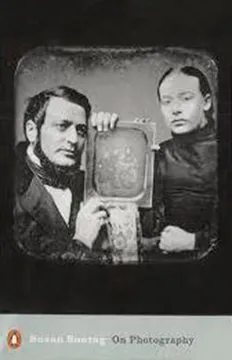
The image can point back at itself. Sontag chose a cover image showing two people holding an earlier photograph, alongside a cartoon of photographer Félix Nadar taking an aerial picture of Paris from a balloon. The images suggest that photography does not simply record reality; it also shapes how reality appears as an image. Her claim is not that cameras invented appropriation, but that picture-taking makes possession of the visible world feel ordinary.
The distinction between recording and possessing remains useful in an era when images circulate far beyond the moment or relationship in which they were made. Visual literacy asks not only what a photograph shows, but who made it, what it leaves out, and what happens when it travels. At the same time, photography can document events that might otherwise be ignored, and a still image can prompt careful attention rather than consumption. The ethical question is not whether images are inherently exploitative. It is whether viewers mistake a framed fragment for complete knowledge.
Keep the intellectual 'but'; complexity is a defense against demagoguery.
Qualifiers keep thought honest. Sontag challenges programs that tell people to eliminate words such as “but” and “either.” For her, qualification is not weakness: thinking requires comparing possibilities, revising claims, and recognizing that more than one thing can be true. Removing those moves can turn confidence into oversimplification.
Judge impulses, not labels alone. Sontag sees authoritarian and anti-intellectual tendencies in several political and cultural settings, including parts of the New Left, while resisting the claim that an entire movement is fascist. She makes a similar distinction with Nietzsche: his ideas could be used to support Nazism, but that does not make every part of his work identical to Nazi ideology. Complex scrutiny means tracing how an idea works, not excusing it or condemning it by association.
The defense of qualification resembles the habits of good scientific reasoning: claims remain open to revision, and evidence can complicate an attractive explanation. It is also a guard against political language that turns opponents into a single, easily dismissed category. There is a risk, however, that complexity becomes a refuge from judgment. Nuance is not neutrality toward harm. Sontag’s method is strongest when it preserves distinctions while still naming the real consequences of an idea or movement.
Challenge age and gender scripts by widening real choices and power.
Categories can shrink a life. Sontag objects to the assumption that age or sex dictates what a person can do. She recalls women at a seminar apologizing to a male guest for being seated among five women, as if their company were a burden. The moment exposes how stereotypes can survive even among educated people who support equality in principle.
Access matters more than a separate lane. Sontag favors women entering existing institutions and gaining equal power, rather than being assigned a separate “feminine” style or cultural role. She also resists the idea that women must write from a distinct female sensibility. These arguments come from a 1978 conversation, and some of her claims, including her reading of one writer’s prose as maternal, show how difficult it is to escape the very stereotypes she opposes.
The durable insight is that inclusion involves more than symbolic recognition: it concerns access to decision-making, work, and public authority. Contemporary debates about identity add an important complication. A person can reject restrictive stereotypes while still finding meaning in a gendered community or tradition. Sontag’s insistence on shared institutions protects against being confined to a niche, but her suspicion of gender-specific expression can understate why such spaces matter to some people. The useful question is whether a category expands someone’s agency or narrows what they are permitted to become.
Protect room for unpopular lives and serious work beyond cultural fashion.
Pluralism needs space. Sontag argues that a good society should allow people to live outside its standard script. She defends marginal people and unconventional ways of living, while noting that not everyone needs to choose them. Freedom means keeping options open, not making nonconformity compulsory.
Take popular culture seriously. Her own intellectual life crossed boundaries that many people treated as opposites. She loved rock and roll, recalling Bill Haley and the Comets as a force that helped her imagine leaving academic life, while also defending writers such as Dostoyevsky and experimental filmmakers. She criticizes anti-intellectual movements that attack professional skill, arguing that trying to do work well is not automatically a surrender to conformity. A culture can value popular pleasure and difficult art at once.
This pluralism avoids two familiar traps: treating popular taste as intellectually empty, and treating elite culture as automatically superior. It also makes room for subcultures without turning them into universal prescriptions. The harder question is material: who can afford to live marginally, and whose unconventional choices are punished? Celebrating freedom without attending to those conditions risks making nonconformity sound easier than it is. Sontag’s defense is most useful when social permission is paired with practical access to time, livelihood, and public space.
Read across cultural borders, and let new influences unsettle your taste.
Reading changes with experience. Sontag began reading very young and moved among European literature, poetry, art history, popular music, and political thought. She describes returning to novels that meant little to her as a teenager and finding them newly powerful as an adult. A book is not a fixed dose of wisdom; the reader’s history changes what becomes legible.
Use influences, then move beyond them. Sontag says she absorbed some writers so thoroughly that rereading them no longer gave her what she needed. Instead of treating influence as a debt that must be repaid through imitation, she looked for unfamiliar forms and writers whose work challenged her established taste. She also defended modernist art when fashionable opinion turned against it, resisting the idea that a period’s experiments become worthless simply because the next generation rejects them.
This is a strong account of intellectual development as both continuity and departure. Readers often need early models to acquire a vocabulary, then need distance from those models to discover what their own questions are. The idea also aligns with the way expertise changes perception: knowledge can make previously opaque work newly rewarding. Yet novelty is not automatically growth. Returning to a familiar writer can be more fruitful than seeking constant stimulation. The standard is not whether a taste is new, but whether it makes attention more precise and judgment more alive.
Let suffering deepen solidarity without pretending it is ennobling.
Pain can widen recognition. Sontag says her experience of cancer made her more responsive to people who were ill, disabled, or helpless. She also warns against turning that response into a universal rule: illness can produce bravery and generosity, but it can also coexist with selfishness or cruelty. Suffering is not a moral improvement program.
Witness requires presence. The book’s preface recalls Sontag’s visits to besieged Sarajevo, where she directed a production of Beckett’s Waiting for Godot with local actors during the war. The performances took place amid shelling and were attended by people facing the siege directly. Along with her earlier visit to Hanoi, this work shows her effort to make attention public and practical, not merely an inward exercise.
The distinction between compassion and romanticization matters in both caregiving and political witness. Personal contact can disrupt the abstraction that lets distant suffering remain easy to ignore. But witnessing is not the same as owning another person’s experience, and the presence of an outsider can shape what gets represented. Ethical attention requires humility about that asymmetry as well as willingness to act. Sontag’s account is most compelling when suffering creates an obligation to notice and respond, not a claim that pain itself confers wisdom.
Analysis
This interview is not a conventional argument with a stable sequence of premises. It is a portrait of thinking in motion. Cott’s questions repeatedly connect Sontag’s books, habits, and experiences, while Sontag accepts some connections, revises others, and occasionally resists the interviewer’s framing. That conversational form matters: her intellectual signature is less a closed doctrine than a repeated effort to catch false simplifications before they harden into common sense.
The strongest through-line is attention to reality in its resistance to convenient meaning. Illness is not a moral confession; a photograph is not the whole event; an artwork is not reducible to its message; a political tendency is not identical to every movement that contains it. This method is not relativism. Sontag makes judgments, but tries to keep them proportionate to what can actually be known. Her insistence on qualification is therefore ethical as well as intellectual: careless categories can harm patients, narrow lives, or excuse propaganda.
The interview also reveals productive tensions rather than resolving them. Sontag values the autonomy of the writer, yet recognizes that attention to other people can transform the work. She wants to preserve sensory pleasure while scrutinizing the politics that organize it. She argues against gendered expectations, but some of her own readings of gender and writing risk reproducing them. These contradictions are not incidental flaws in an otherwise tidy framework. They show why her method requires continuing self-criticism.
A reader should not take every opinion as timeless authority. The conversation reflects its 1978 moment, and Sontag’s broad claims about sexuality, mental illness, and gender are sometimes speculative. Its enduring value lies in the practice it models: resist blame disguised as explanation, test attractive metaphors against material facts, and remain willing to revise a position when attention reveals what it missed. For Sontag, thinking is not a final answer but a way to stay answerable to the world.
Review Summary
"Myśl to forma odczuwania" is a thought-provoking interview with Susan Sontag that readers find inspiring and intellectually stimulating. Many praise Sontag's intelligence, curiosity, and ability to articulate complex ideas. The book covers a wide range of topics, including literature, art, feminism, and philosophy. Readers appreciate Sontag's non-conformist thinking and her capacity to challenge stereotypes and dichotomies. While some disagree with certain points, most find the conversation engaging and a great introduction to Sontag's work. The book is seen as a valuable resource for both newcomers and those familiar with her writings.
People Also Read

Glossary
erotics of art
sensuous attention to artSontag’s preferred orientation toward art, emphasizing close attention to form, texture, rhythm, and sensory effect rather than reducing a work to a hidden message. It does not prohibit interpretation or ethical judgment. It asks that viewers first encounter what the work does as an experience, then consider what its forms and meanings imply.
Against Interpretation
resistance to reductive readingsSontag’s critical stance against treating an artwork as a surface that must be translated into a supposedly deeper meaning. The point is not to forbid explanation, but to resist interpretations that replace the work itself with a single abstract message. Her approach favors attention to the work’s formal and sensory presence alongside thoughtful criticism.
Illness as Metaphor
critique of disease symbolismSontag’s inquiry into the stories and moral meanings attached to diseases, especially tuberculosis and cancer. She argues that romantic, punitive, or psychological explanations can burden patients and confuse cultural associations with medical causes. The title also names her larger concern with how figurative language can shape a person’s experience of illness and treatment.
fascist sensibility
authoritarian aesthetic impulseSontag’s term for a cluster of impulses she sees recurring across different cultural and political settings: attraction to force, spectacle, submission, brutality, and anti-intellectual resentment. She uses it to identify tendencies, not to declare every work or movement containing one of them fascist. The term calls for examining how such impulses operate within otherwise complex cultural forms.
active notion of neutrality
compassionate view beyond divisionSontag’s idea of neutrality as an engaged capacity to see more than the divisions separating opposing people or groups. It is not simple refusal to take a position. It involves attention and compassion, making it possible to understand competing perspectives without pretending that their differences or consequences do not matter.
Download PDF
Download EPUB
.epub digital book format is ideal for reading ebooks on phones, tablets, and e-readers.








