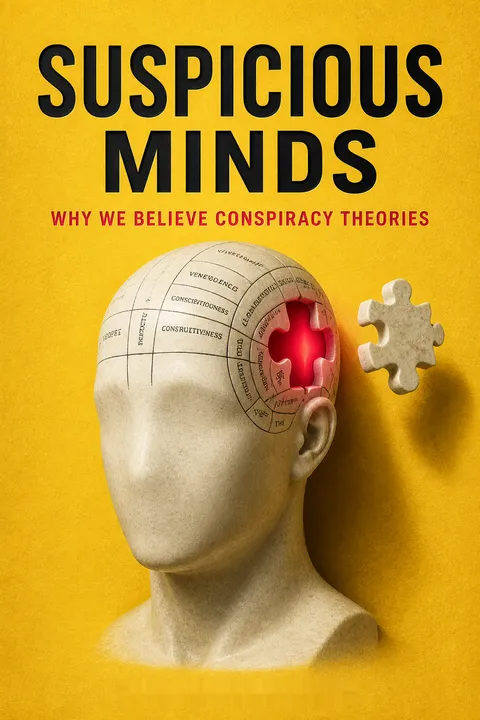


Key Takeaways
Treat conspiracism as ordinary cognition, not a fringe illness
Not just a fringe. Conspiracy beliefs appear across age, gender, education, and income groups. Polls cited in the book found that roughly half of Americans suspected the government was hiding the truth about 9/11, while large minorities accepted other conspiratorial claims. The numbers vary with how questions are worded, but the pattern is clear: suspicion is common, not confined to a caricatured handful of cranks.
Older than the internet. A study of more than 100,000 New York Times letters to the editor, spanning 1890 to 2010, found conspiracy talk remained broadly stable rather than surging with television, the internet, or major modern crises. The deeper point is psychological: unconscious processes shape judgments, often without people realizing it.
What's striking is how this reframes the question. Instead of asking what makes conspiracy believers a strange group, it asks what ordinary mental habits make some claims feel plausible to many people. That shift lowers the temptation to diagnose or ridicule, and makes self-scrutiny possible. The historical evidence also cautions against blaming new technology for an old impulse. A stable background of suspicion can become more visible when communication changes, but visibility is not the same as prevalence. Polls still measure responses to particular questions, not a fixed population of believers.
Evaluate a conspiracy claim by its logic, not its label
A distinctive style. A conspiracy theory is not simply any account of secret coordination. Watergate involved a real conspiracy, but its plot was exposed, investigated, and brought to an end. Conspiracist explanations, by contrast, often present a hidden plot as ongoing: the public is deceived, apparent evidence may be staged, and gaps or odd details become clues. The alleged plotters are portrayed as both extraordinarily powerful and deeply malicious.
Hard to disprove. This logic can absorb almost any response. Evidence against the claim may be called part of the cover-up, while missing evidence is treated as proof that the cover-up works. These features do not prove a claim false. They do signal that ordinary standards of evidence may not be able to settle it, and that the label itself should never substitute for examining the case.
This distinction protects two important ideas at once: real conspiracies happen, and some conspiracy claims are structured to evade correction. That is more useful than treating the phrase as an insult. It also exposes a challenge for investigators: secrecy can make genuine misconduct hard to document, but unfalsifiability makes false claims equally hard to dislodge. The practical test is whether a theory specifies what evidence would count against it, and whether its supporters apply that standard consistently. A theory that can explain every possible outcome risks explaining none.
When control slips, an enemy can feel safer than randomness
Order under threat. Psychologists use the term compensatory control for efforts to restore a sense of order when personal control feels weak. In one experiment, people made ambivalent about a subject were more likely to see patterns in meaningless images. Tidying a cluttered desk reduced that tendency, as if restoring order in the room eased the urge to find it in the pictures.
A plot can explain rejection. In another experiment, people imagining that they had been denied a promotion were more likely to suspect a scheming colleague than people who had not been placed in that situation. A conspiracy offers a person or group to blame, replacing unpredictable bad luck with an intentional cause. That explanation may be wrong, but it can feel more manageable than accepting that events sometimes have no clear author.
This account connects conspiracy belief to a broad human need for agency. A named adversary can be frightening, yet also makes a chaotic situation seem legible: motives can be studied, and an enemy can in principle be resisted. The desk experiment is especially helpful because it suggests that pattern-seeking responds to context, not only to a fixed personality. Still, laboratory tasks do not establish why any particular person believes a particular theory. When uncertainty rises, restoring practical control and tolerating incomplete answers may be more useful than arguing over a premature explanation.
Use heroic-underdog stories to spot conspiracy's emotional pull
A familiar plot. Many conspiracy narratives follow the shape of an overcoming-the-monster story: an innocent public faces a powerful villain, a brave few uncover the danger, and exposing the secret promises a return to safety. David Icke's account of hidden reptilian rulers is an extreme example, but the underlying structure is familiar from stories such as Beowulf and Jaws.
The believer becomes the hero. Conspiracy movements often cast a lone researcher or silenced expert as an underdog fighting a corrupt institution. Supporters of Andrew Wakefield, whose vaccine-autism claims were discredited, presented him as a courageous dissenter under attack. This framing can make rejection by experts seem like evidence of heroism rather than a reason to check the work. The story's emotional force is real, but it is not evidence that the story is true.
Narratives help people organize complicated events into memorable roles, which is why a villain-and-hero account can travel farther than a technical explanation. The underdog frame also makes social rejection feel meaningful: the believer can see themselves as part of a small, morally serious group. That can be empowering when institutions truly dismiss legitimate grievances. It can also blur the difference between principled dissent and weak evidence. A useful check is to separate the appeal of a person’s story from the quality of the evidence that person offers.
Remember that fabricated plots can become warrants for real violence
A lie with consequences. The Protocols of the Elders of Zion was a forged text claiming that Jewish leaders secretly planned world domination. It was exposed as a plagiarism, yet it continued to circulate. In 1922, a German nationalist assassinated foreign minister Walther Rathenau after interpreting a remark about powerful businessmen as proof that Rathenau belonged to the supposed conspiracy. Hitler later praised the forged text, and Nazi propaganda turned its allegations into justification for persecution and genocide.
Harm can be quieter. The book also traces how false vaccine claims contributed to falling vaccination rates and outbreaks of preventable disease. Not every conspiracy believer becomes violent, and the author notes that most oppose political violence. But conspiracy claims can direct fear toward vulnerable targets, erode trust in protective institutions, or discourage civic participation.
The lesson is not that every mistaken belief is equally dangerous. It is that a story about hidden enemies can change what people consider permissible, especially when it singles out a vulnerable group or demands urgent action. The history of the Protocols shows how a fabricated explanation can become a political instrument, not merely a private error. A careful response should assess both truth and consequence: Is the evidence sound, and what actions does the claim encourage? That approach avoids both panic about every rumor and complacency about claims that license harm.
Check the causal link before connecting two striking events
Patterns are guesses. The brain actively constructs what it sees, filling gaps and finding shapes in ambiguous information. In the Zapruder film of Kennedy's assassination, an umbrella held nearby looked suspicious to some viewers. Its owner, Louie Steven Witt, later explained that he had used it to heckle Kennedy, not signal an assassin. A curious detail had become a sinister clue because a conspiracy made it fit a larger story.
Timing is not proof. Vaccine fears often begin with a child becoming ill after an injection. The sequence is real, but that alone does not establish cause. In the MMR-autism case, independent studies involving large numbers of children found no link, despite the persistence of the suspicion. Coincidences can point toward questions worth investigating; they cannot, by themselves, answer those questions.
Pattern detection is an asset: without it, people could not learn from experience or notice meaningful regularities. The trouble is that the mind registers a connection before it has tested whether the connection is causal. The Umbrella Man demonstrates how a detail can acquire meaning through a narrative, while vaccine fears show how emotionally powerful timing can outweigh population-level evidence. A sound inquiry asks what else could produce the same pattern, and what evidence would distinguish those explanations. Personal testimony deserves attention, but it cannot establish a general medical cause on its own.
Ask whether evidence shows intention, or merely invites you to imagine it
Intent comes naturally. The intentionality bias is the tendency to assume that events were deliberate unless a person actively considers accidental explanations. In a classic experiment, people watched a simple animation of a circle and two triangles moving around a rectangle. Nearly everyone described characters with goals and motives, even though the screen showed only shapes.
Suspicion can be projected. Research described in the book found that people who more readily attributed intentions to ambiguous actions also tended to endorse more conspiracy claims. Another study found that people more willing to imagine themselves faking the moon landing were more likely to believe that the landing had been faked. These findings do not establish that believers are secretly dishonest. They suggest that judgments about others can be colored by our intuitive assumptions about what people intend.
The mind-reading capacity that makes social life possible also encourages people to infer motives from sparse evidence. That is useful when a person’s actions matter, but hazardous when the explanation requires coordinated intent among many people. The distinction between an outcome and a plan is crucial: an event may benefit someone without having been arranged by that person. The book’s experiments make this bias visible, though they do not show that motive judgments alone create conspiracy beliefs. Asking what observable evidence supports a particular intention can keep speculation from masquerading as fact.
Do not demand a cause as large as a tragedy
Big effects, big explanations. The proportionality bias is the tendency to expect important outcomes to have equally important causes. Experiments found that people were more likely to suspect a conspiracy when a fictional assassination led to a president's death or a major political crisis than when the consequences were minor, even if the cause was otherwise unchanged.
History turns on small hinges. The book contrasts John Hinckley's failed attempt to kill Ronald Reagan, which attracted few conspiracy theories, with Lee Harvey Oswald's successful assassination of John F. Kennedy, which generated a vast catalog of suspects and plots. It also recounts how Gavrilo Princip found an unexpected opportunity to kill Archduke Franz Ferdinand after the motorcade took a wrong turn. A small event can have enormous consequences without an equally enormous cause.
This bias explains why momentous events invite elaborate explanations: the scale of the consequence feels like evidence about the scale of its cause. But consequences do not reliably measure the planning or power behind an event. The useful response is not to assume that small causes are always right, but to treat the size of an outcome as a prompt for investigation rather than a verdict. The assassination of Franz Ferdinand is a reminder that accidents and contingencies can redirect history. Equally, real large-scale causes exist, so the evidence must decide between them.
Try to disprove your hunch before you collect proof for it
Search for a no. In psychologist Peter Wason's number game, people saw the sequence 2-4-6 and tried to discover the hidden rule. Most tested more sequences that fit their first guess, such as 6-8-10. They rarely tried examples that could disprove it. The actual rule was simply three numbers in ascending order, so repeated confirming answers made the wrong guess feel increasingly secure.
Opposition can harden belief. People often interpret mixed evidence in ways that support what they already think. In a study about Kennedy's assassination, participants on both sides found their own preferred arguments more convincing. Corrections can also fail when people treat the correction as part of a cover-up. Skeptics are not immune: the same habit can protect a conventional explanation from fair scrutiny. Confidence is not a substitute for testing alternatives.
A deliberate search for counterevidence is a practical defense against the mind's tendency to gather confirming examples. It resembles good scientific practice: a hypothesis earns credibility by surviving attempts to challenge it, not by accumulating anecdotes that fit. But the method depends on standards being shared and applied symmetrically. A skeptic who dismisses every anomaly while demanding perfect proof from critics is also protecting a conclusion. The aim is not permanent neutrality. It is to make confidence responsive to evidence, including evidence that complicates a favored account.
Treat confidence as a poor measure of how much you understand
Familiarity feels like expertise. In a bicycle-drawing exercise, about half of participants made basic mistakes about how the frame, pedals, and chain fit together, despite believing they understood bicycles. Psychologists call this illusion of explanatory depth: people mistake a general sense of familiarity for detailed knowledge of how a system works.
A little information can inflate certainty. People initially unsure how to judge nanotechnology became more willing to state strong opinions after reading only a few brief, limited descriptions. The book connects this tendency to the cultic milieu, a loose environment where unconventional ideas circulate and offer people an alternative to deference toward established experts. Independent inquiry matters, but searching online is not the same as acquiring expertise. One useful test is to explain the mechanism step by step and notice where the explanation runs out.
Intellectual humility is not the same as blind trust in experts. It is an honest account of what a person knows, what remains uncertain, and which skills are needed to evaluate a claim. The bicycle exercise works because it turns vague confidence into a concrete performance that can reveal gaps. At the same time, expertise should not be treated as infallible; the book's history includes real institutional failures. The balance is disciplined independence: ask questions, inspect evidence, and recognize when a topic requires knowledge beyond a quick search.
Analysis
The book's strongest contribution is not a catalogue of bizarre beliefs, but a change in perspective: conspiracy thinking is treated as a set of ordinary mental tendencies intensified by uncertainty, narrative, and social context. Pattern detection, motive inference, preference for proportionate causes, and confirmation bias are not exclusive defects of a conspicuous minority. They are shortcuts that usually help people navigate an incomplete world. The same mental tools can generate insight or false certainty, depending on how they meet the evidence.
That framing is ethically valuable. Ridicule can turn a disagreement about evidence into a fight over identity, while psychological explanation can make room for correction without treating believers as a separate species. The book also resists the opposite mistake: real conspiracies and institutional abuses exist, so suspicion cannot simply be dismissed as irrational. Its accounts of the forged Protocols, the Tuskegee study, and the failures around 9/11 show why trust must be earned and why historical memory matters.
The main caution is methodological. Experiments involving ambiguous pictures, hypothetical promotions, or fictional disasters reveal tendencies, not the full causes of particular beliefs. A person may accept a conspiracy claim because of lived experience, political identity, strategic misinformation, or a real institutional failure, not merely because of a cognitive bias. Likewise, a bias-based explanation cannot determine whether an allegation is true. Each claim still requires evidence assessed on its own merits.
The most useful synthesis is a two-part discipline: scrutinize the allegation and scrutinize the process of judgment. Ask what would count against the claim, whether the evidence is independently corroborated, and whether the explanation depends on assumptions of near-perfect coordination. Then ask whether a preference for hidden intent, dramatic causes, or a heroic opposition is doing more work than the facts. This preserves warranted skepticism while making room for uncertainty, fallibility, and accountability.
Review Summary
Suspicious Minds explores the psychology behind conspiracy theories. Readers praise Brotherton's compassionate approach, explaining how everyone is susceptible to conspiratorial thinking due to cognitive biases. The book examines historical examples and psychological studies to illuminate why people believe in conspiracies. While some found it repetitive or lacking depth in certain areas, most reviewers appreciated the insights into human psychology and critical thinking. The book's relevance to current events and its accessible writing style were also highlighted as strengths.
People Also Read


Glossary
Conspiracist style
Pattern of hidden-plot explanationA way of explaining events by proposing a concealed, ongoing plot, often treating public accounts as deliberate deception. Typical versions emphasize secret coordination, powerful and malicious plotters, suspicious anomalies, and evidence that is difficult to disprove. The features are useful clues, not a strict checklist, and do not by themselves establish whether a particular conspiracy claim is true.
Compensatory control
Restoring order when control faltersA psychological response to feeling that personal control has weakened. People may seek order through belief in a powerful ally, institution, or adversary. A hidden enemy can make randomness feel less threatening because an intentional force seems more understandable and potentially resistible than chance.
Intentionality bias
Assuming events were deliberateThe tendency to interpret actions and events as intentional by default, then use effort or knowledge to recognize accidents and involuntary causes. It appears even when people interpret simple moving shapes as characters with goals. The bias can encourage people to infer a hidden plan where the evidence establishes only that something happened.
Proportionality bias
Matching cause size to outcomeThe tendency to expect the scale of a cause to match the scale of its consequences. A dramatic event can therefore make a grand plot seem more plausible than a small or accidental cause, even when the event's magnitude does not provide evidence about how it began.
Confirmation bias
Favoring evidence that fitsThe tendency to seek, notice, and remember information that supports an existing belief while neglecting or discounting information that challenges it. It can make a speculative idea feel well supported, and can affect believers and skeptics alike. Deliberately seeking evidence that could disprove a claim is one way to counter it.
Biased assimilation
Filtering evidence through prior beliefsThe tendency to evaluate ambiguous or mixed evidence in ways that favor a person's existing position. People on opposing sides can examine the same information and each find their own view strengthened. This helps explain why adding evidence does not automatically produce agreement or revise a strongly held belief.
Illusion of explanatory depth
Mistaking familiarity for understandingThe tendency to overestimate how well one understands a system or process until asked to explain it in detail. People may recognize the parts of a bicycle, for example, yet struggle to describe how those parts work together. The gap becomes visible when confidence is tested against a specific explanation.
Cultic milieu
Network of unconventional beliefsA broad, loosely connected environment in which ideas rejected by mainstream institutions circulate and overlap, including alternative science, spiritual claims, and conspiracy theories. It is not limited to formal cults. Its appeal includes intellectual independence and the sense that important truths lie outside accepted accounts.
FAQ
1. What is Suspicious Minds: Why We Believe Conspiracy Theories by Rob Brotherton about?
- Exploration of conspiracy thinking: The book investigates why people believe conspiracy theories, focusing on the psychological mechanisms and cognitive biases that make such thinking appealing and widespread.
- Interdisciplinary approach: Brotherton combines insights from psychology, history, and cultural studies to show that conspiracism is a universal human trait, not just a fringe phenomenon.
- Real-world examples: The book uses famous cases like the JFK assassination, vaccine controversies, and UFO sightings to illustrate how conspiracy theories form, persist, and impact society.
- Societal impact: It discusses the consequences of conspiracy thinking, from political disengagement to public health risks.
2. Why should I read Suspicious Minds by Rob Brotherton?
- Understanding belief mechanisms: The book provides a scientific and psychological perspective on why conspiracy theories are so compelling, helping readers understand their own and others’ beliefs.
- Critical thinking tools: Brotherton exposes common cognitive illusions and biases, equipping readers to scrutinize conspiracy claims and avoid misinformation.
- Balanced and nuanced view: The author neither dismisses all conspiracy theories nor endorses them, encouraging readers to approach the topic with empathy and skepticism.
- Societal relevance: It highlights the real-world consequences of conspiracism, making it essential reading for anyone interested in current events, media, or psychology.
3. What are the key takeaways from Suspicious Minds by Rob Brotherton?
- Conspiracism is universal: Conspiracy thinking is a natural part of human cognition, not limited to extremists or the uneducated.
- Cognitive biases at play: Our brains are wired for pattern recognition, intention detection, and confirmation bias, all of which fuel conspiracy beliefs.
- Storytelling appeal: Conspiracy theories often follow archetypal narratives that simplify complex events into good vs. evil stories.
- Real-world consequences: Conspiracy thinking can lead to violence, public health risks, and political disengagement, making it important to understand and address.
4. What are the best quotes from Suspicious Minds by Rob Brotherton and what do they mean?
- “We are all conspiracy theorists.” This quote emphasizes that conspiratorial thinking is a universal human trait, not just a fringe pathology.
- “Our brains are really good at connecting the dots, but sometimes they connect dots that shouldn’t be connected.” Brotherton highlights the cognitive tendency to find patterns, even where none exist.
- “Conspiracy theories are not the preserve of the paranoid or the uneducated.” The author debunks stereotypes, showing that belief in conspiracies is widespread and not limited to any one group.
- “We should scrutinize our own intuitions and biases.” Brotherton calls for self-awareness and critical thinking in evaluating conspiracy claims.
5. How does Rob Brotherton define a conspiracy theory in Suspicious Minds?
- Unanswered questions: Conspiracy theories offer explanations for events that remain mysterious or unproven, suggesting hidden truths.
- Distrust of official accounts: They assume that official narratives are false or misleading, portraying the world as full of deception and cover-ups.
- Competent and evil conspirators: Theories often depict conspirators as highly capable and malevolent, orchestrating events with sinister motives.
- Irrefutability: Conspiracy theories are structured so that no evidence can definitively disprove them, creating a self-sealing logic.
6. What is the “conspiracy mindset” according to Suspicious Minds by Rob Brotherton?
- Stable psychological trait: Being conspiracy minded is a worldview that influences how a person interprets events, making them more likely to believe in multiple conspiracy theories.
- Interconnected beliefs: People who accept one conspiracy theory often accept others, even contradictory ones, due to a general suspicion of official narratives.
- Lens of suspicion: This mindset assumes widespread deception and hidden forces at work, shaping how information is interpreted.
- Not limited to the fringe: Brotherton emphasizes that conspiracy mindedness is found across the general population, not just among extremists.
7. What psychological concepts and cognitive biases does Suspicious Minds by Rob Brotherton explain?
- Pattern recognition: Our brains are wired to find connections and patterns, sometimes seeing meaningful links where none exist.
- Intention detector: Humans have a hyperactive tendency to attribute intentionality to events, assuming things happen because someone meant them to.
- Confirmation bias: Once a belief forms, people seek out information that confirms it and dismiss contradictory evidence, reinforcing conspiracy theories.
- Proportionality bias: People expect big events to have big causes, making simple explanations for major occurrences unsatisfying.
8. How does Suspicious Minds by Rob Brotherton explain the appeal of conspiracy theories as stories?
- Archetypal narratives: Conspiracy theories often follow classic story structures, such as the "overcoming the monster" plot, with clear villains and heroes.
- Moral clarity: These stories simplify complex events into a battle between good and evil, making them emotionally compelling.
- Underdog appeal: Conspiracy theorists and their heroes are cast as underdogs fighting against overwhelming odds, appealing to our sense of justice.
- Emotional engagement: The narrative structure provides fascination and satisfaction, even when the villains are implausible.
9. What is the “illusion of understanding” and how does it contribute to conspiracy beliefs in Suspicious Minds by Rob Brotherton?
- Overestimating knowledge: People often believe they understand complex topics better than they actually do, leading to overconfidence in their beliefs.
- Unknown unknowns: We have blind spots in our knowledge and fill these gaps with superficial or incorrect information, fueling conspiracy beliefs.
- “University of Google” effect: Easy access to information online can create a false sense of expertise, making people more susceptible to conspiracy theories.
- Dunning-Kruger effect: Those with limited knowledge are often unaware of their ignorance, increasing their vulnerability to conspiratorial thinking.
10. How does confirmation bias reinforce conspiracy theories according to Suspicious Minds by Rob Brotherton?
- Selective evidence gathering: People seek out information that supports their existing beliefs and ignore or discount evidence that contradicts them.
- Strengthening false beliefs: This bias can make individuals more confident in conspiracy theories, even when presented with mixed or contradictory evidence.
- Backfire effect: Attempts to correct misinformation can sometimes reinforce false beliefs, as people interpret corrective facts through their prior convictions.
- Entrenched worldviews: Beliefs tied to identity or worldview are especially resistant to change, making conspiracy thinking persistent.
11. What is the “intention detector” and how does it relate to conspiracy thinking in Suspicious Minds by Rob Brotherton?
- Automatic attribution of intent: The intention detector is a cognitive tool that infers purpose behind actions, often over-attributing intentionality even to accidents or random events.
- Hyperactive bias: Brotherton explains that this detector is "a little too good," leading people to see conspiracies where none exist.
- Projection: People project their own intentions onto others, assuming conspirators think and act like themselves, which fuels belief in secret plots.
- Reinforcement of conspiracism: This bias makes it easier to believe that major events are the result of deliberate, coordinated action.
12. What are the potential harms of conspiracy theories discussed in Suspicious Minds by Rob Brotherton?
- Real-world violence: Some conspiracy theories have inspired violent acts, such as assassinations and terrorist attacks, by fueling extremist ideologies.
- Public health risks: Vaccine conspiracy theories have led to decreased vaccination rates and outbreaks of preventable diseases.
- Political disengagement: Belief in conspiracy theories can erode trust in democratic institutions, leading to lower voter turnout and apathy.
- Distraction from real issues: Conspiracy theories often divert attention from genuine problems, hindering effective social and political action.
Download PDF
Download EPUB
.epub digital book format is ideal for reading ebooks on phones, tablets, and e-readers.








