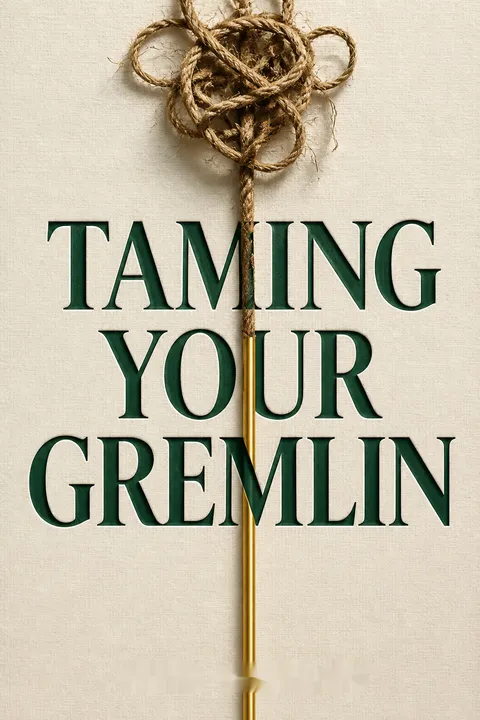


Key Takeaways
Name the inner heckler so its predictions stop masquerading as facts
Meet the gremlin. Carson calls the mind’s persistent narrator the gremlin. It interprets events, replays old hurts, and predicts future disasters, often while claiming to protect you. The term is a metaphor for the force that generates self-limiting messages, not simply the messages themselves. Naming it creates a little distance between a thought and the person having it.
Notice the pattern. One client, Katrina, was caught in a cycle of strict food rules, a lapse, and then an all-or-nothing binge. She began recognizing the voice that turned one dessert into proof she could never change. As she observed that pattern, she could eat sweets without the same spiral. The point is not to blame an imaginary creature, but to see the mental habit before it runs the show.
The gremlin metaphor makes a useful distinction: a thought can be loud and familiar without being a reliable report. In cognitive therapy, a related skill is cognitive defusion, learning to notice a thought as a mental event rather than automatically treating it as fact. A characterful name can make that shift memorable, especially when self-criticism feels fused with identity. The metaphor has limits, though. It should not turn ordinary inner conflict into a literal enemy or imply that every painful thought has one source. Used lightly, it invites curiosity rather than another round of self-judgment.
Observe your reaction before ordering yourself to become different
Attention before correction. Carson’s first move is simply noticing: paying attention to what is happening without immediately analyzing why or forcing it to stop. He contrasts this with strain, the tense effort to make an experience conform to a demand. A childhood football story makes the distinction vivid. One player tried to run faster by stomping harder; the extra effort only made him slower.
Change through seeing. The book’s Zen-inspired principle is that recognizing a restrictive pattern as it happens can loosen its grip without a fight. If anger appears, notice what it does to breathing, posture, and speech before deciding what to do. This is not passivity. It is a pause that gives choice a chance to replace reflex.
The practical strength here is the order of operations. People often add a second struggle to a difficult feeling by insisting that they must stop feeling it immediately. Observational attention can interrupt that escalation and improve awareness of what actually happened. Mindfulness-based approaches use a similar distinction between noticing an experience and judging it. Still, awareness alone does not solve every problem: an unsafe situation may require immediate action, and a persistent pattern may benefit from structured therapy. Noticing is best understood as an entry point to wise response, not a complete substitute for one.
Return to breath and senses when your mind starts screening disaster
Use the present as home base. Carson describes awareness as a spotlight that can land on bodily sensations, the surrounding world, or thoughts and memories. The mind can help with planning, but imagined scenes can begin to feel like current facts. When that happens, briefly notice breathing, the feel of clothing, sounds nearby, or the boundary of your skin. These sensations reconnect attention with what is happening now.
Try a short reset. The book suggests sitting quietly, following a few comfortable breaths, noticing the skin, and gently returning attention when it wanders. Carson treats breathing as both a clue to tension and a way to settle attention. A shallow breath may accompany fear, but it is not proof that danger is present. The aim is relaxed attention, not perfect breathing or a special state.
This approach resembles grounding practices used in mindfulness and trauma-informed care: sensory detail can orient attention when mental imagery becomes overwhelming. The emphasis on returning gently matters, since treating distraction as failure can become another source of pressure. Breath is accessible, but it is not comfortable for everyone, especially during panic or respiratory distress. A sound, a visible object, or contact with a chair can serve the same anchoring purpose. The larger lesson is flexible attentional control, not a rule that bodily focus is always superior to thought.
Let emotions register without letting them dictate your next move
Feel before acting. Carson groups anger, joy, sadness, sexual feeling, and fear as experiences people often learn to suppress or judge. He argues that an emotion can be fully felt without being expressed impulsively. Anger might show up as a clenched jaw or tight shoulders; sadness might bring tears and a changed breath. Noticing those signals can reveal a habitual response, such as smiling through anger or treating fear as proof of failure.
Separate feeling from behavior. Fear can point to a real threat, as when a charging bull requires escape, or arise from an imagined catastrophe. In a less urgent situation, Carson recommends distinguishing known facts from predictions and considering possible responses. He also distinguishes sadness from depression, but these are not interchangeable clinical categories. The useful practice is to make room for feeling while choosing actions with care.
The distinction between emotion and action is a strong bridge between acceptance-based therapy and practical self-regulation. A feeling can carry information without issuing an unquestionable command. That makes room for both emotional honesty and consideration of consequences. The book’s broad contrast between sadness and depression needs caution: depression is a complex clinical condition, not simply blocked sadness, and people should not be led to blame themselves for it. Emotional awareness can support well-being, but severe or persistent distress may call for professional care as well as personal practice.
Treat old identities as performances, not permanent descriptions of who you are
Notice the act. Carson calls a socially shaped role an act: a way of behaving to win approval, protection, or belonging. The role may be useful, but it is not the whole person. In a high-school story, Carson worked to look like a confident athlete by flexing his neck around a girl he liked. When she noticed his tense pose, embarrassment made him perform even harder. The act crowded out the warmth he actually felt.
Make room for contact. The same pattern can appear in families and partnerships, where people protect each other’s preferred image instead of speaking honestly. Carson argues that intimacy requires some willingness to let the person beneath the performance be seen. This does not mean every social role is false or harmful. It means a role should remain something a person can use, adjust, or set aside, rather than a definition they must obey.
The story captures how impression management can become self-defeating: the harder someone works to appear natural, the less available they may be for genuine contact. Social roles also serve real purposes, helping people coordinate, show respect, and meet obligations. The useful distinction is not authentic versus fake, but flexible versus compulsory. A person can choose professionalism at work or reserve private feelings for trusted relationships without losing a stable sense of self. Carson’s framing is most helpful when it invites more choice, not when it treats all performance as dishonesty.
Turn inherited rules into present-day choices you can revise
Question the old rule. Family life and early experiences can leave durable ideas about who may show anger, whether sadness is acceptable, or what makes someone lovable. Carson asks readers to bring these concepts into awareness rather than assume they still fit. A behavior that once protected a child may limit an adult in a different setting.
Restore agency with language. When a thought says you cannot speak up, Carson suggests asking whether the more accurate statement is that you have chosen not to, at least so far. Likewise, replacing a rigid should with a considered choice can reveal what you actually want. This does not mean every limit is imaginary. Some are imposed by health, money, power, or risk. The point is to distinguish real constraints from inherited predictions before deciding what to do.
This is a practical form of updating beliefs: a person checks whether an old rule still serves the current situation instead of treating it as permanent truth. The language shift can make agency visible, much as motivational interviewing invites people to describe their own reasons for change. But choice-centered language should not erase coercion or structural barriers. Someone may genuinely lack a safe option, and calling that a choice can sound like blame. Its value lies in clarifying the options that do exist, while honestly naming the limits that do not disappear through reframing.
Stop feeding the same frightening thought with endless courtroom arguments
Recognize the mental loop. Carson warns that trying to defeat every troubling thought can keep attention trapped in it. He illustrates this with John, whose wife mentioned finding a mutual friend attractive. John began imagining betrayal and repeatedly questioned his wife, even after she reassured him. The repeated analysis did not settle him; it strained the relationship and kept the fear in circulation.
Choose whether to engage. Carson recommends noticing the thought and returning attention to present experience rather than treating each imagined scene as evidence. If deliberate reflection seems useful, he suggests setting a brief time limit before beginning, then stopping and re-centering. That is different from being pulled into rumination without choosing it. The distinction matters: practical problem-solving can address a real concern, while repeating the same unanswerable question often produces more distress than clarity.
John’s story resembles a reassurance loop: anxiety prompts checking, checking briefly soothes, and the doubt soon returns. Research-informed approaches to obsessive worry often distinguish productive problem-solving from repetitive mental review, though the book does not offer a clinical account of those conditions. Its advice to limit engagement can help restore attention, but it should not become a command to suppress unwanted thoughts. Suppression can make some thoughts more persistent. The more useful aim is to notice the loop, decide whether new information or action is needed, and stop rehearsing once neither is available.
Test a different response briefly instead of making change another command
Experiment, do not vow. Carson encourages trying a new response for a moment rather than promising to behave differently forever. A person who usually hides anger might try describing it calmly; someone who shrinks from praise might pause long enough to receive it. Other experiments include allowing an emotion to be felt, exaggerating a familiar gesture to see it more clearly, or imagining a desired outcome and then planning practical steps toward it.
Set boundaries on action. Carson calls a consciously chosen limit on behavior a behavioral parameter. It can prevent an experiment from becoming reckless without requiring a person to forbid a thought or feeling. For instance, someone can allow anger while choosing not to insult or threaten another person. The result is practice with options, not a new rule about what a good person must always do.
Small, reversible trials are closely related to behavioral experiments in cognitive behavioral therapy. Instead of debating whether a feared outcome is certain, a person gathers experience by testing a manageable action and observing what happens. Carson’s playful framing may make experimentation less punitive than a rigid self-improvement plan. The safeguard is essential: openness is not the same as indiscriminate risk-taking. Boundaries, consent, and consequences still matter. Experiments should be scaled to the situation, and imagined positive outcomes need to be paired with realistic planning rather than treated as guarantees.
Recover your balance without making another person's behavior its gatekeeper
Do not outsource every feeling. Carson tells of driving peacefully until another motorist honked, insulted him, and sped away. His anger surged, along with an urge to retaliate. He noticed how quickly the encounter had taken over his attention, then returned to the music and the road rather than waiting for the other driver to admit fault.
Regulate without surrendering. Carson’s point is that calm need not depend entirely on getting other people or circumstances into the preferred arrangement. He recommends grounding attention, breathing, and loosening the urge to defend one’s image. This is not an instruction to tolerate danger or injustice. Changing an external situation may be necessary. The distinction is between taking useful action and making inner peace contingent on controlling another person’s response.
The episode illustrates an important distinction between control and influence. A person cannot reliably govern another driver’s motives, but can decide whether to pursue, retaliate, or let the encounter occupy the rest of the day. That resembles emotion-regulation strategies that change attention or reinterpret an event. Still, an inside-focused approach can become victim-blaming if applied to abuse, discrimination, or preventable harm. Self-regulation is not a replacement for boundaries, accountability, or collective action. It is a resource for responding without handing the steering wheel to provocation.
Treat contentment as a practice, not a prize for perfect circumstances
There is no final fix. Carson presents gremlin-taming as an ongoing practice, not a one-time cure. The inner narrator may return, and circumstances will keep changing; the task is to notice, choose a response, and begin again. He calls the deeper experience beneath passing moods true love. In his account, this is not romantic attachment or a burst of excitement, but a steady inner source of contentment that can be felt when attention is less captured by fear.
Use the idea practically. A reader need not accept a spiritual explanation to understand the point: well-being can sometimes be accessed in the present rather than postponed until every problem is solved. Goals and external change still matter. The practice is to pursue them while making room for moments of satisfaction along the way, instead of treating happiness as a reward for finally getting life perfectly arranged.
The book’s refusal to promise a permanent victory is one of its most psychologically realistic features. Skills such as attention-shifting and emotional acceptance require repetition because minds and circumstances keep moving. Its language of true love supplies a spiritual interpretation of that experience, but it is not a claim that can be established for every reader. A secular reader might understand it as a name for stable moments of connection or ease. Either way, the central value is practical: meaningful change need not wait until life becomes frictionless.
Analysis
Taming Your Gremlin is a practical psychology book organized around a memorable metaphor and a repeated cycle: notice the inner commentary, recover the ability to choose, and treat change as ongoing practice. Its most useful move is not positive thinking but a shift in relationship to thought. A harsh prediction can be heard without being obeyed, and an old behavior can be examined without turning the examination into another accusation. The stories make this approach concrete: the athlete who strains and slows down, the teenager whose self-protective pose blocks intimacy, and the jealous husband whose attempts to settle uncertainty keep it alive.
The method’s strength is also its main risk. Carson emphasizes personal response and inner steadiness, which can help people avoid making every emotion dependent on other people’s approval. Yet that emphasis may understate the force of material circumstances, trauma, illness, and unequal power. Choice is real but not unlimited. The book is strongest when its language of agency means finding available responses, not assuming that every hardship is self-created or easily changed.
Its account of emotions also needs careful translation. Letting feelings be noticed is different from expressing every feeling, and sadness is not a substitute explanation for clinical depression. Likewise, physical tension can be a useful cue to pause, but it does not establish that a medical symptom is psychological. Those qualifications do not cancel the core exercise. They make it safer and more precise.
The book’s enduring contribution is a compact form of metacognition: notice what the mind is doing, distinguish a prediction from a fact, and choose a response in the present. It gives readers memorable language for a skill that can otherwise sound abstract. Its spiritual account of an underlying source of love will resonate differently across readers, but its behavioral counsel does not depend on adopting that metaphysics. The result is less a promise to eliminate inner criticism than a way to stop granting it automatic authority.
Review Summary
Taming Your Gremlin receives mostly positive reviews, praised for its accessible approach to mindfulness and self-improvement. Readers appreciate the book's user-friendly format, practical exercises, and unique concept of personifying negative thoughts as a "gremlin." Many find it helpful for managing anxiety, self-doubt, and intrusive thoughts. Some criticize the book for being simplistic or outdated, while others consider it a life-changing read. The gremlin metaphor resonates with most readers, though a few find it gimmicky. Overall, it's seen as a valuable tool for self-awareness and personal growth.
People Also Read








Glossary
Gremlin
Inner source of limiting messagesCarson’s name for the persistent inner narrator that interprets experience, promotes restrictive beliefs, and predicts danger or failure. He distinguishes the gremlin from any single negative thought: it is the metaphorical source of such messages. The gremlin is not presented as a literal creature, but as a way to observe mental habits without identifying completely with them.
Gremlin-Taming Method™
Observe, choose, and continueCarson’s ongoing practice for relating differently to self-critical commentary and habitual behavior. It involves noticing what is happening, experimenting with possible responses rather than obeying rigid rules, and accepting that the work continues across changing situations. Its aim is increased choice and contentment, not the permanent elimination of difficult thoughts or emotions.
Simply Noticing
Attend without immediate judgmentA deliberate form of attention to present experience, including bodily sensations, surroundings, emotions, habits, and thoughts. Carson distinguishes it from analyzing why a person is a certain way or struggling to force an experience to change. The practice creates distance from automatic reactions so a person can decide how to respond.
The Natural You (The Observer)
The noticing perspectiveCarson’s term for the aspect of a person that can observe thoughts, beliefs, roles, and bodily changes without being identical to them. He presents it as a deeper, more trustworthy self than one’s changing personality or self-concept. Readers can use the term as a practical perspective for noticing inner activity, whether or not they accept its spiritual implications.
Spotlight of Awareness
Chosen focus of attentionCarson’s metaphor for attention, which can be directed toward the body, the surrounding world, or the world of thought, memory, and imagination. He argues that consciously shifting this focus can bring a person back to immediate experience when mental scenarios begin to dominate. The metaphor emphasizes that attention can be guided, though not always perfectly controlled.
Zen Theory of Change
Awareness loosens restrictive patternsCarson’s label for the idea that recognizing a self-limiting pattern while it is happening can begin to free a person from it. Rather than trying to force change through struggle, the person observes the present process clearly. The term expresses the book’s central emphasis on awareness as a precondition for choice.
Behavioral Parameter
Chosen limit on actionA boundary a person deliberately places on behavior while allowing thoughts and feelings to be noticed. It can make experimentation safer, such as allowing anger to be felt while deciding not to act aggressively. Carson distinguishes this from trying to prohibit an emotion internally, which he believes can intensify inner conflict.
Being in Process
Ongoing practice, not completionCarson’s term for treating self-understanding and emotional steadiness as continuing activities rather than achievements secured once and for all. Inner commentary and changing circumstances remain part of life, so the practice is renewed in each situation. The concept resists the idea that contentment must wait until a person or life is perfected.
FAQ
What's "Taming Your Gremlin" about?
- Self-Help Focus: "Taming Your Gremlin" by Rick Carson is a self-help book that provides a method for overcoming self-sabotaging thoughts and behaviors.
- Gremlin Concept: The book introduces the concept of the "gremlin," which represents the negative inner voice that undermines self-confidence and happiness.
- Practical Method: It offers a practical, step-by-step method to recognize, confront, and tame this inner gremlin to improve one's quality of life.
- Inner Peace Goal: The ultimate goal is to achieve greater inner peace and enjoyment of life by reducing the influence of negative self-talk.
Why should I read "Taming Your Gremlin"?
- Simple Method: The book offers a surprisingly simple method for dealing with self-sabotage, making it accessible to anyone.
- Practical Exercises: It includes practical exercises and interactive activities that help readers apply the concepts in real life.
- Improved Self-Awareness: By reading the book, you can gain a deeper understanding of your own thought patterns and how they affect your behavior.
- Enhanced Well-Being: The techniques can lead to increased self-confidence, reduced stress, and a more fulfilling life.
What are the key takeaways of "Taming Your Gremlin"?
- Simply Noticing: The first step is to simply notice your gremlin without judgment, which helps in recognizing negative thought patterns.
- Choice and Options: The book emphasizes the importance of choosing and playing with options to change habitual responses.
- Being in Process: It encourages seeing life as an ongoing process, where contentment is a moment-to-moment experience rather than a static state.
- True Love: The essence of the natural self is described as true love, which is always available and can guide you towards fulfilling experiences.
How does Rick Carson define a "gremlin"?
- Inner Critic: The gremlin is described as the inner critic or negative voice that undermines your self-worth and happiness.
- Persistent Presence: It is a constant presence that interprets experiences negatively and tries to control your actions through fear and doubt.
- Source of Negativity: The gremlin is not just negative thoughts but the source of them, using past experiences to create self-limiting beliefs.
- Goal of Misery: Its ultimate goal is to make you miserable by keeping you from experiencing the natural, vibrant you.
What is the "Gremlin-Taming Method"?
- Three Steps: The method consists of three steps: Simply Noticing, Choosing and Playing with Options, and Being in Process.
- Awareness and Choice: It focuses on increasing awareness of the gremlin's influence and making conscious choices to counteract it.
- Practical Application: The method includes practical exercises to help integrate these steps into daily life.
- Progressive Improvement: With practice, the method becomes more effective, allowing for quicker and easier application in challenging situations.
What are some common gremlin strategies mentioned in the book?
- "You Can't" Strategy: Convincing you that you are incapable of achieving certain goals or handling situations.
- "You Should" Strategy: Using shoulds, oughts, and musts to trap you in rigid, habitual responses.
- "You Don't Deserve" Strategy: Making you feel unworthy of happiness, success, or love.
- "Fantasy is Reality" Strategy: Encouraging you to live based on assumptions and fears rather than reality.
How does "Simply Noticing" help in taming your gremlin?
- Awareness Tool: Simply noticing is about becoming aware of your gremlin's presence and its effects without judgment.
- Detachment from Gremlin: It helps create a sliver of light between you and your gremlin, reducing its control over you.
- First Step: It is the first and most crucial step in the Gremlin-Taming Method, setting the stage for further action.
- Non-Analytical: The process involves observing rather than analyzing, which prevents getting entangled in the gremlin's chatter.
What role does "True Love" play in "Taming Your Gremlin"?
- Essence of Self: True love is described as the essence of the natural you, underlying many emotions and experiences.
- Beyond Emotions: It is not an emotion but a fundamental experience that provides contentment and peace.
- Guiding Force: True love can guide you towards fulfilling experiences and help you select positive influences in your life.
- Always Available: It is always present within you, waiting to be tapped into once the gremlin is tamed.
What are some practical exercises included in "Taming Your Gremlin"?
- Centering Practice: Exercises to help you center yourself and establish the here and now as your home base.
- Breathing Techniques: Techniques to use breathing as a barometer and regulator of your internal experience.
- Visualization: Activities that involve visualizing your gremlin to better understand and confront it.
- Self-Reflection: Exercises that encourage self-reflection on habits, concepts, and the influence of the gremlin.
What are the "Basics of Pleasure" according to Rick Carson?
- Centering Priority: Making being centered and feeling good a top priority in life.
- Inside Job: Recognizing that achieving contentment is primarily an inside job.
- Awareness Control: Establishing the here and now as a home base from which to direct your awareness.
- Relaxation and Breathing: Using relaxation and breathing techniques to maintain a state of calm and contentment.
What are the best quotes from "Taming Your Gremlin" and what do they mean?
- "I free myself not by trying to be free, but by simply noticing how I am imprisoning myself in the very moment I am imprisoning myself." This quote emphasizes the power of awareness in breaking free from self-imposed limitations.
- "Your life is your life. It’s not your mother’s life, your father’s life, your spouse’s, your employer’s, or your child’s. It’s your life." It highlights the importance of taking ownership of your life and decisions.
- "Feeling good is primarily an inside job." This underscores the idea that true contentment comes from within, not from external circumstances.
- "The natural you is the source of simple satisfaction." It suggests that embracing your true self leads to genuine happiness.
How can "Taming Your Gremlin" improve my daily life?
- Increased Self-Awareness: By recognizing and understanding your gremlin, you can become more aware of negative thought patterns.
- Better Decision-Making: The method encourages conscious choices, leading to more thoughtful and beneficial decisions.
- Reduced Stress: Taming your gremlin can lead to reduced stress and anxiety by minimizing the influence of negative self-talk.
- Enhanced Relationships: Improved self-awareness and emotional regulation can lead to healthier and more fulfilling relationships.
Download PDF
Download EPUB
.epub digital book format is ideal for reading ebooks on phones, tablets, and e-readers.








