

Key Takeaways
Treat life as a return from countless forms to their shared source.
A map, not the territory. Taoism centers on the Tao, the elusive source and underlying reality of existence. It is not a creator deity standing apart from the world. The tradition’s cosmology describes Wu Chi, undifferentiated origin, giving rise to yin and yang, then the Five Elements and the “ten-thousand-things,” a phrase meaning all the many forms of existence. The reverse movement, from multiplicity toward unity, is the path of return.
Experience completes the teaching. Texts can point toward the Tao, but cannot contain it. Practices such as meditation, qigong, and attentive time in nature are ways to test the ideas in lived experience. Taoist immortality, in its deepest sense, means recognizing one’s inseparability from the Tao, not necessarily keeping the body alive forever.
The distinction between a description and an experience is useful well beyond religion. A map of a coastline can guide a traveler, but it cannot substitute for salt air, weather, or the actual route underfoot. Taoism applies that limit to language itself: concepts orient attention, yet can also be mistaken for reality. This stance does not require rejecting scholarship or careful thought. It asks that explanation remain provisional and that a person notice when the label has replaced the thing it was meant to reveal.
Stop demanding one side of life without its changing counterpart.
Opposites depend on each other. Yin and yang describe complementary forces and the way distinctions arise together. Darkness is intelligible beside light; rest gains meaning beside activity. The familiar circular symbol, with a small mark of each color inside the other, suggests that neither side is pure or permanent. In Taoist thought, this is not just a theory about nature. It is a way to see how our judgments divide a world that remains interconnected.
Let change revise your preferences. If a person insists on having only success, comfort, or certainty, the arrival of failure, discomfort, or doubt can feel like a violation. Taoism instead treats these conditions as related phases, not sealed-off worlds. The point is not to celebrate hardship or erase real differences. It is to loosen the expectation that one half of life can be kept while its counterpart is banished.
This perspective resembles systems thinking: a property often makes sense only through its relation to other properties, and a system can change when one part changes. It can also soften rigid self-categories, such as strong versus weak, by showing how context alters what a quality means. The caution is important: complementarity should not become a reason to flatten moral distinctions. Interdependence does not make cruelty equivalent to kindness. The useful move is to question absolutist expectations, not to pretend every contrast is harmless.
Practice carefully, then let skill respond without force.
Effort can mature into ease. Wu-wei is action that is not driven by anxious self-assertion. It is sometimes translated as non-action, but the book emphasizes responsive action that fits the situation without needless struggle. Tzu Jan, or “self-so” naturalness, describes things unfolding according to their own character rather than being forced into an imagined ideal. Neither term means laziness or acting on every impulse.
Training makes spontaneity possible. Chuang Tzu illustrates this through skilled workers, including a butcher whose practiced movements become fluid rather than clumsy or strained. The same pattern appears in the book’s comparison to athletes and musicians: years of deliberate learning can recede from awareness while the trained person responds in the moment. The practical lesson is to develop capacity, notice the actual conditions, and avoid confusing unfiltered reactivity with freedom.
The account offers a valuable correction to the idea that authenticity means doing whatever feels immediate. Expertise often looks effortless from outside because preparation has made perception and action more coordinated. In this sense, wu-wei is not the opposite of discipline; it is one possible fruit of discipline. Still, skilled flow is not automatically ethical. A capable person can act smoothly toward destructive ends. The Taoist test is not simply whether action feels natural, but whether it responds to conditions without the distortions of compulsion and rigid self-interest.
Make room for emptiness; usefulness often depends on what is absent.
Absence can enable function. Taoist emptiness is not despair or a claim that nothing matters. It is the open space that lets a form be useful: a vessel needs room to hold, a dwelling needs interior space to shelter, and a wheel needs an opening for its axle. The visible structure matters, but so does the space it leaves available. The same idea applies inwardly: a quieter mind may respond more clearly because it is less crowded by fixed assumptions.
Try shifting your attention. The book suggests noticing the spaces around objects, then attending to the pauses between thoughts. This simple change of focus can reveal that attention is not limited to what occupies the foreground. Taoist emptiness is therefore active potential, not blankness. It invites a person to reduce needless mental and material clutter, while remaining open to what may emerge.
Designers, architects, and musicians all work with the productive role of negative space. A room is not merely the walls that enclose it, and a melody depends on intervals as well as notes. This analogy makes Taoist emptiness concrete without reducing it to a metaphor: attention can be organized around space, possibility, and restraint. There is also a useful qualification. Emptying the mind should not mean suppressing difficult thoughts or avoiding practical problems. Space is valuable when it permits clearer engagement, not when it becomes an excuse to disengage.
Choose a Taoist practice that matches your temperament and commitment.
There is no single doorway. Taoism includes approaches as different as public ritual, divination, martial and healing arts, inner alchemy, imaginative visualization, meditation, and free wandering. The I Ching uses changing hexagrams to reflect on a situation; feng shui considers how a place’s arrangement affects the flow of ch’i. Ceremonial practitioners may chant, make offerings, or work with deities, while other practitioners emphasize solitude and contemplation.
Fit matters, and guidance matters too. Someone drawn to movement might explore t’ai chi or qigong; someone drawn to contemplation might begin with meditation; someone who values community may seek a temple. The book recommends finding a teacher for practices that require specialized training, including inner alchemy, magic, and divination. These paths are not interchangeable hobbies. Their techniques, assumptions, and demands differ, so curiosity should be paired with care.
A menu of paths respects a basic fact about learning: the same method does not motivate or serve every person equally. Choice can support sustained practice when it reflects genuine interest rather than prestige or novelty. At the same time, a broad menu can blur the difference between a living tradition and a collection of techniques detached from their context. Teachers, communities, and historical study help prevent that flattening. The strongest starting point is not necessarily the most exotic practice, but one that can be approached consistently and responsibly.
Let compassion, simplicity, and patience shape how wisdom appears.
Three virtues orient daily life. The Tao Te Ching presents compassion, simplicity, and patience as central treasures. Compassion means benevolence that includes oneself as well as others. Simplicity includes moderation and fewer entangling desires. Patience carries humility and a willingness not to force oneself to the front. Together, these qualities describe an everyday ethic, not just an abstract spiritual ideal.
Rules have a place, but not the last word. Classical Taoist texts often suggest that virtue is most complete when it arises naturally from alignment with the Tao, rather than from anxious rule-following. Yet organized Taoist communities also developed ethical codes and rituals of repentance and purification. The distinction is not that rules are always bad. Structured guidance can help beginners and communities, while mature judgment requires more than mechanical compliance.
This view connects ethics to character formation: repeated attention to compassion and restraint can shape the kind of person who makes decisions, rather than merely supplying a checklist after the fact. It also avoids a false choice between spontaneity and norms. Rules can protect people and coordinate communities, especially when power is unequal. But no code anticipates every situation, and rules can be followed without care. Taoism’s challenge is to cultivate judgment that remains humane without becoming either rule-bound or self-excusing.
Read Taoism as a many-layered tradition, not one founder’s philosophy.
The origin story is uncertain. Lao Tzu is traditionally associated with the Tao Te Ching, a compact text of 81 chapters, but the book notes that scholars generally regard its composition as collaborative and gradual. Chuang Tzu, who lived later, used stories and paradoxes to challenge conventional ambition. In one famous episode, he refuses a government post by asking whether an honored dead tortoise would prefer ceremonial respect or life in the mud. His answer favors freedom over status.
A religion took shape over time. Lao Tzu and Chuang Tzu did not found a formal organization. The first organized Taoist community, the Way of the Celestial Masters, emerged in 142 CE. Later lineages developed distinct practices, and Taoism also interacted with Confucianism and Buddhism. Its history includes state support, political movements, and severe repression during China’s Cultural Revolution.
The layered history matters because modern readers often encounter Taoism as a handful of aphorisms, detached from institutions and communities. The history resists that simplification: texts are debated, practices change, and traditions borrow from one another. The uncertainty around authorship is not a defect that dissolves the teachings. It shifts attention from the lone genius to transmission, interpretation, and collective memory. At the same time, legendary stories should not be treated as straightforward historical evidence. Their value may be literary or spiritual, which is different from factual reliability.
Use the body and natural world to experience interdependence firsthand.
The person is not separate from nature. Taoist thought treats the human body as a small-scale expression of the wider cosmos. Breath, water, food, and the elements that compose the body connect it continuously to the surrounding world. Ch’i, also spelled qi, is the life-force or vital energy that Taoist practices describe as moving through existence and the body. In inner alchemy, practitioners work with three Treasures: ching, or essence; ch’i, or vitality; and shen, or spirit.
Practice can begin with attention. The book offers accessible exercises such as observing the natural breath, noticing bodily sensations, walking without a fixed destination, or turning awareness toward awareness itself. More specialized inner-alchemy methods aim to refine and circulate the Three Treasures. These concepts belong to Taoist cosmology and practice; they should not be mistaken for established scientific descriptions of physiology.
The body-centered approach counters the modern habit of treating the body as an object to manage rather than a lived relationship with the world. Breath and food make dependence visible in ordinary experience, while walking or stillness can sharpen attention to surroundings. This ecological framing is compelling because it links personal well-being to the conditions that sustain life. Its limits should remain clear: ch’i is a traditional explanatory concept, not a substitute for medical evidence. Contemplative value and scientific validation are different kinds of claims.
Begin simply, stay curious, and seek experienced guidance where needed.
Start with a practice you can sustain. Taoist entry points include reading several translations of the Tao Te Ching, meditating, spending time outdoors, or taking a qualified class in qigong or t’ai chi. The book encourages beginners to remain open to learning and unlearning, rather than treating early understanding as mastery. For intricate ritual, divination, or inner-alchemy work, finding a knowledgeable teacher is especially important.
Adaptation brings both opportunity and loss. Since the 1980s, Taoist practice has reappeared in China after periods of suppression and has spread in the West. Western audiences have often embraced the classical philosophy and health-related practices while overlooking ceremonial Taoism, with its temples, priests, deities, and public rites. Some teachings are also blended with newer beliefs. Learning the tradition’s range helps distinguish thoughtful adaptation from an incomplete picture.
Beginner’s openness is more than a pleasant attitude: it protects a learner from turning a partial map into a totalizing identity. The recommendation to seek teachers is also a practical safeguard, since specialized practices can carry technical and cultural assumptions that a book cannot fully convey. Cross-cultural adaptation is not inherently a betrayal; traditions survive by being interpreted in new settings. The key question is whether adaptation stays transparent about what it changes, preserves, or leaves out.
Analysis
This book’s central work is orientation. Taoism is presented not as a single doctrine to memorize, but as a broad territory where philosophical texts, ritual religion, bodily disciplines, divination, and contemplative practice coexist. That breadth is both its strength and its central summarizing difficulty. A reader may meet Taoism through a line from the Tao Te Ching, a temple ceremony, a qigong class, or a family of Chinese medical practices, and mistake one entrance for the whole tradition.
The adaptation’s most durable insight is its account of practice as a movement between deliberate cultivation and unforced response. Wu-wei is not an argument against effort: the examples of skilled action show how training can become fluid, while the warnings against impulsiveness prevent “naturalness” from becoming a license for carelessness. This pairing makes the book more useful than a simple celebration of spontaneity.
Its cosmology also supplies a practical lens. Yin and yang teach readers to question the fantasy of permanent one-sided conditions, while emptiness draws attention to the enabling role of what is not immediately visible. Together, these ideas make change and interdependence easier to notice in ordinary experience. The book’s exercises translate that stance into attention to breath, space, and bodily sensation.
A critical distinction is needed between spiritual language and empirical claims. Ch’i, inner alchemy, and immortality have meanings inside Taoist traditions, but presenting them in the vocabulary of energy or health does not itself establish scientific evidence. Likewise, the book’s broad dietary suggestions should not be treated as medical guidance. The strongest reading appreciates Taoism’s contemplative and cultural contributions without confusing its metaphysical account with biomedical fact. Its historical discussion provides a further corrective: Taoism is neither solely an ancient philosophy nor a uniform religion, but a changing tradition shaped by communities, political pressures, and exchange with other teachings.
Review Summary
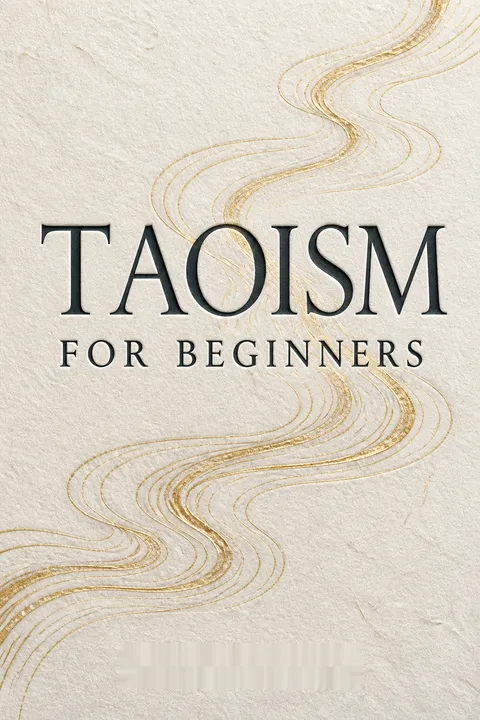
Taoism for Beginners receives mixed reviews, with an average rating of 3.91/5. Many readers find it a helpful introduction to Taoism, praising its clarity and comprehensive coverage of history, concepts, and practices. Some appreciate the practical exercises and meditation techniques included. However, critics argue it's too basic or focuses too much on history rather than philosophy. A few reviewers express concerns about the author's diet and medical advice. Overall, most agree it's a good starting point for those interested in learning about Taoism.
People Also Read


Glossary
Tao
source and wayThe indefinable source of existence and the way of living in accord with its patterns. Tao is not presented as a separate creator deity. Because it cannot be fully captured by language or ordinary perception, Taoist texts point toward it through paradox, images, and practices rather than a complete definition.
Wu Chi
undifferentiated originThe timeless, unmanifest origin in Taoist cosmology, often represented as an empty circle. Wu Chi is closely related to Tao. In the account described in the book, yin and yang emerge from this undifferentiated source, followed by the Five Elements and the many forms of the world.
Yin-yang
interdependent complementary forcesA Taoist model of paired forces and distinctions that arise in relation to each other. Yin and yang are not isolated, fixed substances or simple moral opposites. Each contains the potential of the other, and their interaction represents the changing patterns from which phenomena emerge.
Wu-wei
unforced responsive actionA mode of acting that responds to circumstances without needless assertion or strain. Often translated as non-action, it does not mean inactivity, laziness, or impulsiveness. Taoist teaching associates it with skilled, flexible action that can emerge after learning and effort have become deeply integrated.
Tzu Jan
natural self-so unfoldingOften translated as “self-so” or “that which is naturally so,” Tzu Jan describes the quality of things developing and changing without artificial forcing. In Taoist practice, it is closely related to wu-wei: a person acts in keeping with actual conditions rather than imposing a rigid idea of how events should unfold.
Ch’i
vital life-force energyA Taoist concept translated in the book as vital energy, life-force energy, or breath energy. Ch’i is understood within the tradition as permeating existence and the human body. It is central to practices such as qigong, martial arts, Chinese medicine, and inner alchemy. This traditional concept is not equivalent to a scientifically established physical substance.
Three Treasures
virtues or inner energiesThe book describes two Taoist sets with this name. One set consists of compassion, simplicity, and patience, virtues presented in the Tao Te Ching. The inner-alchemy set consists of ching, ch’i, and shen, understood as essence, vitality, and spirit. The context determines which set is meant.
Inner alchemy
cultivating internal energiesA Taoist practice, also called neidan, that works with the Three Treasures of essence, vitality, and spirit. Practitioners use techniques involving attention, breathing, and imagery to cultivate and transform these energies. The book presents inner alchemy as supporting bodily well-being and spiritual realization, culminating in a return to the Tao.
Shou Yi
holding to the OneA Taoist practice translated as holding, embracing, or keeping to the One. It describes a path of returning toward the nondual source of existence. The book outlines a progression from intentional techniques, through receptivity and unlearning, to a realization in which the perceived boundary between self and world dissolves.
Tao Tsang
Taoist textual canonThe collection of texts associated with the Taoist tradition. It includes scriptures and philosophical works as well as commentaries, histories, rituals, hymns, diagrams, and instructions for meditation and inner alchemy. The book describes four historical compilations, with the current version assembled during the Ming dynasty in 1444.
Download PDF
Download EPUB
.epub digital book format is ideal for reading ebooks on phones, tablets, and e-readers.








