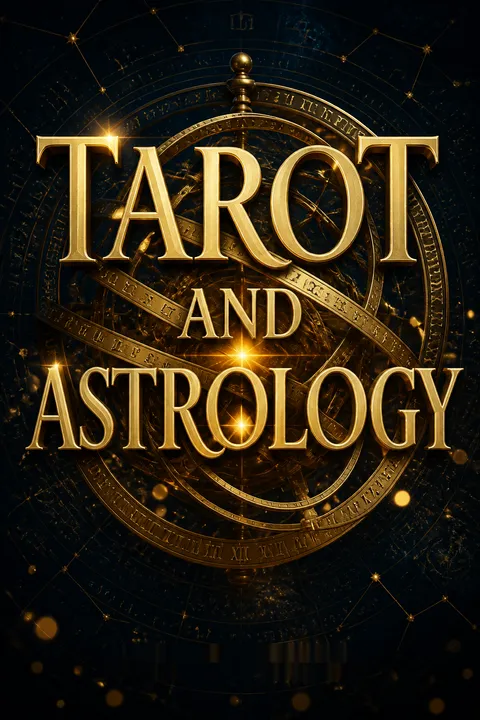


Key Takeaways
Read tarot and astrology as one symbolic language, not two separate systems.
One shared vocabulary. Kenner’s central idea is to combine tarot imagery with astrology’s planets, signs, and houses. A card can make an astrological idea easier to picture; astrology can add layers to a card’s interpretation. The book presents the two practices as connected traditions, not as unrelated tools placed side by side.
A modern synthesis. Tarot decks included celestial images early on, but formal astrological correspondences developed much later. In 1785, occultist Jean-Baptiste Alliette proposed a full system. The late nineteenth-century Hermetic Order of the Golden Dawn then brought tarot, astrology, numerology, and Qabalah into a more unified scheme, influencing later decks such as Rider-Waite and Thoth. The book teaches readers to use that shared symbolic vocabulary in practical readings.
The system’s appeal lies in translation: an abstract planet becomes a figure, and an image becomes a prompt for interpretation. That resembles the way maps turn complicated terrain into a navigable model. Such models can organize attention without proving that the map describes external forces. Keeping that distinction clear lets readers appreciate the tradition’s symbolic richness while treating its predictions as interpretations rather than established facts.
Use the Major Arcana for life-scale themes and the Minor for daily experience.
Two scales of experience. The 78-card deck divides into 22 Major Arcana cards and 56 Minor Arcana cards. The Majors depict large, consequential patterns, such as upheaval, transformation, or a new beginning. The Minors bring those themes down to ordinary matters: feelings, conversations, work, and material needs.
A practical reading key. The Minor Arcana has four suits, each with ten numbered cards and four Court Cards. The suit indicates the area of life, while the number suggests a stage of development. An Ace can signal potential or a beginning; a Ten can suggest completion. The same number therefore has different implications in different suits. A Ten of Wands concerns spiritual drive or effort, while a Ten of Pentacles concerns material life.
This two-scale structure resembles the distinction between a broad narrative and its daily scenes. A major change rarely explains itself; routines, relationships, and practical constraints determine how it is lived. The framework encourages readers to ask both what larger theme is present and where it shows up concretely. Its usefulness depends on avoiding rigid labels: a single card should not be mistaken for a complete account of someone’s life.
Pair each planet or sign with its Major Arcana image to make meanings memorable.
Symbols become characters. In Kenner’s correspondence system, planets and zodiac signs have matching Major Arcana cards. Mercury, associated with communication and quick thinking, corresponds to the Magician. Venus, associated with attraction and beauty, corresponds to the Empress. Among the sign pairings, Gemini links to the Lovers, Cancer to the Chariot, and Scorpio to Death, understood as transformation rather than a literal forecast of dying.
Keep the pairings distinct. A sign and its ruling planet can have different cards. Aries corresponds to the Emperor, while its ruling planet, Mars, corresponds to the Tower. That difference matters: the Emperor suggests leadership and initiative, while the Tower emphasizes forceful disruption or release. A Sun-sign exercise pairs the Sun card with the Major Arcana card for the person’s sign, then asks how their images agree or conflict.
The pairing method is a mnemonic with interpretive depth: the card gives the abstract astrological keyword a face, a scene, and an emotional tone. That is close to how narrative learning makes information easier to retrieve. The method also invites comparison rather than rote memorization. A useful safeguard is to treat an apparent match as a question to explore, not evidence that a birth sign has produced a fixed personality.
Start Minor Arcana readings with the suit’s element and area of life.
Four elemental lenses. Wands correspond to fire and spiritual drive, inspiration, and passion. Cups correspond to water and emotional life, relationships, and intuition. Swords correspond to air and thought, communication, and conflict. Pentacles correspond to earth and physical or material concerns, including money, possessions, and practical security. These associations offer a first reading before every card meaning is memorized.
Notice how elements interact. The book adapts the old elemental model to compare cards in a spread. Fire and air can support one another, while water can frustrate fire; other combinations may reinforce or clash depending on the reading. Kenner’s Elemental Dignities Spread gives each element a position and compares its relationship with the others. The point is to read the cards not only one by one, but as interacting forces.
The element system works like a compact classification scheme: it helps a reader sort a complex situation into domains such as feeling, thought, action, and material conditions. Its relational layer is especially valuable because real problems rarely belong to one domain alone. Still, elemental compatibility is a symbolic rule, not a measurement of actual behavior. It is most useful when it prompts concrete questions about how competing needs support or obstruct one another.
Use the Tree of Life to connect card numbers, suits, and the deck’s larger design.
A map of creation. The Qabalistic Tree of Life is a diagram of ten stages, or spheres, through which creative energy moves from potential toward physical reality. Kenner connects the ten spheres to the numbered cards of each Minor Arcana suit. Aces represent the first sphere and pure possibility; Tens represent the tenth sphere, completion in the material world.
Two kinds of paths. The four suits also correspond to four worlds: Wands to inspiration, Cups to gestation and creation, Swords to thought and form, and Pentacles to material manifestation. The Tree’s 22 connecting paths correspond to the 22 Major Arcana cards. In this scheme, the Majors guide movement between stages, while the Minors show how energy develops within a particular realm. Qabalah supplies the architecture behind many Golden Dawn correspondences.
This layer explains why the book treats tarot as more than a collection of independent definitions: it is a designed cosmology, where number, element, and image reinforce one another. Systems thinking offers a useful parallel, since the meaning of a component depends partly on its place in a larger structure. The correspondence is a historical and spiritual framework, not a neutral description of the universe. Readers benefit most when they can distinguish its internal logic from claims about objective reality.
Locate numbered cards on the zodiac’s 36 decans to add astrological detail.
A calendar beneath the cards. A decan is a 10-degree section of a zodiac sign. Each of the 12 signs contains three decans, creating 36 in total. The 36 numbered Minor Arcana cards from Twos through Tens are assigned one apiece. The suit follows the sign’s element: fire signs align with Wands, water with Cups, air with Swords, and earth with Pentacles.
Number follows season. The sign’s mode determines which number group it receives. Cardinal signs take Twos, Threes, and Fours; fixed signs take Fives, Sixes, and Sevens; mutable signs take Eights, Nines, and Tens. Each decan also has a planetary subruler, assigned through a classical system called the Chaldean order. For example, the first decan of Aries maps to the Two of Wands and Mars. The dates are approximate.
The decan scheme turns a large deck into a repeatable coordinate system. A reader can derive a card’s astrological associations from suit, sign, number, and planetary subruler rather than memorize 36 isolated pairings. The distinction between the book’s classical subrulers and modern planetary rulerships is essential; mixing them creates apparent inconsistencies. The structure makes the tradition teachable, though its elegance should not be confused with astronomical evidence for the meanings it assigns.
Read Court Cards as blended elemental personalities moving through the seasons.
Each rank has an elemental role. Pages represent the four elements in physical form and often suggest a student, messenger, or beginning. Knights combine fire with their suit’s element and are linked to mutable signs, giving them a mobile, questing quality. Queens combine water with their suit and correspond to cardinal signs, which begin seasons. Kings combine air with their suit and correspond to fixed signs, associated with the middle of seasons.
The court forms a calendar. The Golden Dawn arrangement places the royal cards around the zodiac. Each Knight, Queen, or King governs the first 20 degrees of its sign and reaches back into the final 10 degrees of the previous sign. A Court Card can represent a person, a part of the reader’s personality, or a style of action. Its suit and rank show what kind of energy is being expressed.
The elemental blends create a flexible alternative to treating Court Cards as literal people. A Queen of Swords, for instance, combines emotional receptivity with intellectual clarity, a pairing that can describe a decision-making style as readily as an individual. This psychological use can make readings less dependent on guessing who a card represents. The framework also carries conventional gender coding, so a contemporary reader may find it more useful to read the elemental qualities than to assign them rigidly to men or women.
Read horoscope houses as life settings, with planets acting in signs.
A chart has three layers. A horoscope is a circular map of the sky at a particular time and place. In Kenner’s analogy, planets are the actors, signs are the costumes they wear, and houses are the settings. The twelve houses describe life areas: the first concerns appearance and first impressions, the fourth home and family, the seventh partnerships, and the tenth career and public standing. Tarot cards help make the signs and planets visible within those settings.
Begin with the anchors. For a birth chart, the book recommends starting with the Sun, Moon, and Ascendant, then considering the chart ruler, the four angles, planets in houses, patterns, and aspects. Birth time matters especially for the Ascendant and house placements because the rising sign changes roughly every two hours. Empty houses still have a sign ruler and can be considered; they are not automatically inactive.
The actor, costume, and setting analogy is a clear way to prevent three astrological layers from collapsing into one another. It also gives a tarot reader a practical route into chart reading: identify the life area, the planet’s function, and the sign’s style. Birth-time dependence highlights a broader issue in interpretive systems: precision in inputs does not by itself establish precision in conclusions. A chart can organize reflection without guaranteeing a reliable forecast.
Turn spreads into structured questions about projects, choices, and life domains.
Give each card a job. Kenner’s spreads translate astrological structures into tarot layouts. In the Phases of the Moon Spread, a significator represents the project, while cards for the New Moon, waxing Moon, Full Moon, and waning Moon describe its beginning, development, peak, and completion. A shop owner planning a podcast used the cards to consider finding an experienced guide, expanding distribution, making the program appealing, and adding a co-host.
Use houses for breadth. The twelve-house spread assigns one card to each life area, from identity and possessions to partnerships, career, groups, and hidden concerns. A simpler three-card method assigns cards to planet, sign, and house, creating a compact symbolic story. In every layout, positions constrain the question enough to make interpretation more focused and practical.
A spread is a form of structured attention. Its positions can break an overwhelming question into phases, domains, or roles, much as project planning separates a goal into stages. That can help a reader generate options and notice neglected issues. The benefit does not require supernatural accuracy: reflective prompts can be useful on their own. To avoid treating a card as an instruction from outside oneself, each interpretation can be translated into a testable next step or question.
Treat correspondences as interpretive prompts, not fixed verdicts about fate.
The system allows alternatives. The book describes both tropical astrology, which aligns the zodiac with the equinoxes, and sidereal astrology, which tracks the current positions of the stars. Their reference points differ, yet Kenner presents both as usable traditions. Tarot meanings also depend on the deck, its imagery, and the reader’s chosen correspondences; the book notes that titles and some card associations vary across decks.
Interpret with context. A card should not be read in isolation from its position, question, neighboring cards, and the person’s circumstances. In a sample reading, a creative block is explored through the Fool’s themes of initiation, play, and resistance to constraint, then followed by a practical suggestion to reduce distractions and make room for enjoyable work. The method is strongest when it opens inquiry rather than claiming certainty.
This is the crucial boundary between symbolic practice and factual prediction. Open-ended images can help people articulate conflicts that are difficult to name, but they can also encourage confirmation bias, the tendency to notice evidence that supports an existing belief. Multiple astrological systems and deck traditions make interpretive choice visible rather than eliminating it. A careful reader can preserve the book’s imaginative method by asking what a reading reveals about current concerns, while checking consequential claims against ordinary evidence.
Analysis
Kenner’s book is best understood as a practical bridge between two symbolic traditions. Its central achievement is not a single prediction technique, but a layered grammar: Major Arcana cards map to planets and signs; Minor Arcana suits map to elements; numbers and decans place cards around the zodiac; Court Cards combine elemental qualities; and houses locate those symbols within life domains. Qabalah gives this arrangement a historical and cosmological rationale. The result is a system that can be learned progressively, from a simple Sun-sign comparison to a full horoscope-based reading.
The strongest instructional move is structural compression. Instead of asking readers to memorize 78 unrelated meanings, the book offers reusable relationships. A reader can infer a card’s broad domain from its suit, stage from its number, and astrological tone from its decan. Visual stories, such as the Moon’s cycle or the Tower’s sudden disruption, make abstract correspondences easier to recall. The sample readings also demonstrate how an interpretation can move from symbol to practical question.
The main limitation is epistemic. The book uses astrology’s vocabulary of influence and prediction, but its correspondences are symbolic conventions, not demonstrated causal laws. Its own presentation of tropical and sidereal zodiac systems, as well as differing deck traditions, shows that interpretation depends on chosen frameworks. Readers should therefore distinguish internal consistency from empirical validation. The method can still have reflective value: a well-framed spread may help someone examine a decision, surface assumptions, or imagine alternatives. Its most responsible use is as an interpretive prompt, with real-world decisions grounded in evidence, conversation, and context.
Review Summary
Tarot and Astrology receives mostly positive reviews, praised for bridging the gap between tarot and astrology. Readers appreciate its comprehensive approach, clear explanations, and accessibility for beginners. The book is commended for its in-depth coverage of minor arcana and astrological associations. Some criticize the use of a specific deck for illustrations and occasional inaccuracies. Overall, it's considered a valuable reference for those interested in combining tarot and astrology, though some suggest it's better suited for readers with prior knowledge in either field.
People Also Read

Glossary
Major Arcana
Big-picture tarot cardsThe 22 cards in a tarot deck associated with large themes, archetypal figures, and consequential experiences. In Kenner’s system, they correspond to the planets and zodiac signs. They provide broad symbolic context, while the Minor Arcana addresses how larger themes appear in everyday life.
Minor Arcana
Everyday tarot cardsThe 56 cards divided into four suits: Wands, Cups, Swords, and Pentacles. Each suit has ten numbered cards and four Court Cards. The suits represent spiritual drive, emotion, intellect, and material life. Their numbers, elemental associations, and astrological placements add layers of interpretation.
Decan
Ten-degree zodiac segmentOne of three 10-degree sections within a zodiac sign. Twelve signs therefore contain 36 decans. In the Golden Dawn correspondences used by Kenner, the 36 numbered Minor Arcana cards from Two through Ten are assigned to these segments, with each decan also receiving a planetary subruler.
Elemental Dignities
Elemental card relationshipsA method of interpreting how elemental cards in a spread support, weaken, or oppose one another. Fire, water, air, and earth are compared through traditional symbolic relationships. Kenner’s Elemental Dignities Spread gives cards positions representing the elements and their qualities, helping readers consider the spread as an interacting whole.
Tree of Life
Qabalistic map of creationA diagram in Qabalah showing ten spheres, or stages, through which creative energy moves toward physical existence, linked by 22 paths. Kenner relates the spheres to the numbered Minor Arcana cards and the paths to the Major Arcana. The four worlds of the diagram also correspond to the four tarot suits.
Natural horoscope
Idealized zodiac chartA teaching model that assigns each of the twelve houses to its corresponding zodiac sign and ruling planet, beginning with Aries in the first house. Actual birth charts do not generally place every sign and planet in its natural position. The model remains a reference for interpreting a house’s traditional themes.
Essential dignities
Planetary strength by signA traditional system for assessing how comfortably a planet functions in a zodiac sign. A planet is in domicile, or dignity, in a sign it rules; exalted in a sign that supports it; in detriment opposite its domicile; and in fall opposite its exaltation. These categories shape interpretations of planetary placements.
Phases of the Moon Spread
Project stages by lunar phaseA tarot layout for considering a project through four lunar positions: New Moon for its starting point, waxing Moon for growth, Full Moon for its fullest potential, and waning Moon for completion. A significator card represents the project itself. The spread adapts lunar symbolism into a planning framework.
FAQ
What's Tarot and Astrology: Enhance Your Readings with the Wisdom of the Zodiac about?
- Integration of Disciplines: The book explores the connections between tarot reading and astrology, presenting them as intertwined practices rather than separate fields.
- Practical Guidance: Corrine Kenner provides techniques, spreads, and examples to effectively combine these two metaphysical arts.
- Historical Context: It delves into the historical relationship between tarot and astrology, enriching the reader's understanding of both practices.
Why should I read Tarot and Astrology by Corrine Kenner?
- Comprehensive Learning: The book serves as a guide for deepening understanding of tarot and astrology, accessible for all levels.
- Enhanced Readings: Integrating astrological symbolism into tarot readings adds depth and nuance to interpretations.
- Practical Exercises: Includes exercises and spreads for immediate application, encouraging active engagement with the material.
What are the key takeaways of Tarot and Astrology?
- Card and Sign Correspondences: The book outlines specific correspondences between tarot cards and astrological signs, enhancing interpretative power.
- Astrological Influences: Readers learn how planets influence tarot card meanings, providing richer context for interpretations.
- Practical Spreads: Offers tarot spreads incorporating astrological elements, aiding in real-life application of knowledge.
What are the best quotes from Tarot and Astrology and what do they mean?
- "Tarot and astrology have always been connected.": Emphasizes the historical and symbolic relationship between the two practices.
- "Every time you deal the cards, you’re creating a new reality.": Highlights the transformative power of tarot readings.
- "The Major Arcana cards are forceful and dramatic.": Underscores the significance of Major Arcana in representing major life events.
How does Tarot and Astrology explain the Major Arcana?
- Overview: The Major Arcana consists of 22 cards representing significant life events and archetypes.
- Astrological Correspondences: Each card is associated with specific astrological signs and planets, enhancing meanings.
- Life Lessons: Conveys life lessons or themes, guiding personal growth and understanding.
What is the significance of the Minor Arcana in Tarot and Astrology?
- Everyday Life Representation: Consists of 56 cards divided into four suits, representing everyday experiences and challenges.
- Astrological Decans: Linked to astrological decans, allowing nuanced interpretation based on astrological influences.
- Practical Application: Provides insights into using the Minor Arcana in readings, emphasizing their importance in daily life.
How can I combine tarot and astrology using techniques from Tarot and Astrology?
- Astrology-Based Spreads: Introduces tarot spreads incorporating astrological elements, like the Sun Sign Spread.
- Card Correspondences: Encourages pulling cards corresponding to astrological placements for personalized readings.
- Practical Exercises: Includes exercises for integrating astrological insights into tarot practice.
What are the four elements and their significance in Tarot and Astrology?
- Elemental Associations: Fire, earth, air, and water are fundamental to understanding the suits of the Minor Arcana.
- Fire (Wands): Represents passion, inspiration, and spiritual energy.
- Water (Cups): Symbolizes emotions, relationships, and intuition.
How does Tarot and Astrology address the relationship between tarot and Qabalah?
- Qabalistic Framework: Explains how Qabalah provides a framework for understanding tarot through the Tree of Life.
- Spheres and Paths: Each tarot card corresponds to a sphere on the Tree of Life, with Major Arcana representing paths.
- Integration of Concepts: Offers a holistic approach by integrating Qabalah with tarot and astrology.
How can I use astrology to enhance my tarot readings according to Tarot and Astrology?
- Astrological Timing: Suggests using astrological timing to choose the best moments for readings.
- Understanding Influences: Recognizing astrological influences during a reading provides more insightful interpretations.
- Incorporating Decans: Encourages incorporating zodiac decans into readings for nuanced understanding.
What is the significance of the Major Arcana in relation to astrology in Tarot and Astrology?
- Archetypal Symbols: Represents significant archetypes and life lessons, each linked to astrological signs and planets.
- Deep Spiritual Insights: Provides deeper spiritual insights and guidance, reflecting themes of personal growth.
- Planetary Associations: Each card is linked to a ruling planet, influencing its interpretation and energies.
What are some practical tarot spreads mentioned in Tarot and Astrology?
- Past, Present, Future Spread: Enhanced by incorporating astrological correspondences for richer interpretation.
- Decan Spread: Focuses on zodiac decans, exploring specific themes and influences.
- Houses of the Horoscope Spread: Utilizes the twelve houses of astrology for comprehensive readings.
Download PDF
Download EPUB
.epub digital book format is ideal for reading ebooks on phones, tablets, and e-readers.








