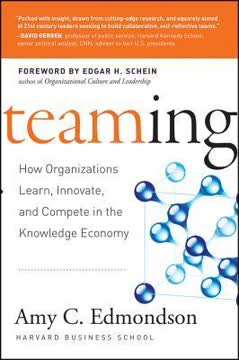
Key Takeaways
1. Teaming is a Dynamic Verb, Not a Static Noun
Teaming is a dynamic activity, not a bounded, static entity.
Fluid collaboration. In today's fast-paced, complex environments, the traditional concept of a "team" as a stable, fixed group is often outdated. Instead, "teaming" emphasizes the active process of coordinating and collaborating, often without the luxury of stable team structures or extensive practice. It's teamwork "on the fly," where individuals must quickly adapt, share crucial knowledge, and make small adjustments to weave different skills together.
Beyond static structures. Many operations, from emergency rooms to temporary project groups, require staffing flexibility that makes stable team composition rare. Teaming blends relating to people, listening to diverse viewpoints, coordinating actions, and making shared decisions. This dynamic approach is essential for organizations to respond to opportunities, solve problems, and continuously improve.
Engine of learning. Ultimately, teaming is the engine of organizational learning. When individuals learn, it doesn't automatically translate into organizational change. Teaming provides the vehicle for collective learning, enabling groups to absorb, create, and apply new knowledge to improve products and services. It requires developing both affective (feeling) and cognitive (thinking) skills to navigate rapid collaboration.
2. The Shift from Execution to Learning is Imperative
The managerial mindset that enables efficient execution actually inhibits an organization’s ability to learn and innovate.
Outdated mindset. For over a century, organizations have been built on an "organizing to execute" mindset, emphasizing control, efficiency, and conformance, largely influenced by pioneers like Henry Ford and Frederick Winslow Taylor. This approach worked well when processes were predictable and knowledge was stable, but it stifles the experimentation and reflection vital for success in today's uncertain, knowledge-based economy.
The learning imperative. Companies like General Motors, once titans of industry, faltered because they were slow to shift from execution to learning. The world is now too complex and multicultural for individual managers to know enough to make all decisions. Expertise is a moving target, requiring lifelong learning and continuous adaptation. Organizations must become "complex adaptive systems" that learn and self-regulate, rather than rigid, controlled machines.
New way of thinking. "Organizing to learn" is a leadership mindset that encourages critical teaming behaviors to promote collective learning. It supports collaboration, solicits employee knowledge, applies it to new challenges, and analyzes outcomes. This means:
- Hiring problem solvers, not just conformers.
- Learning from doing, not just before doing.
- Integrating expertise, not separating it.
- Using variance to analyze and improve, not driving it out.
3. Execution-as-Learning Integrates Action and Continuous Improvement
Execution-as-learning means getting the work done while simultaneously working on how to do it better.
Seamless integration. Execution-as-learning is a way of operating where continuous, systematic learning is built directly into day-to-day work. It's akin to "reflection-in-action" for groups, where learning isn't a separate, time-consuming activity, but an inherent part of delivering products or services. This approach allows organizations to adjust, improvise, and innovate while maintaining high performance.
A winning formula. Organizations like Toyota, Intermountain Healthcare, and Southwest Airlines exemplify execution-as-learning. They consistently outperform competitors by:
- Building continuous improvement into their production systems (Toyota's Andon Cord).
- Developing protocols based on medical research and clinician feedback (Intermountain).
- Empowering employees to find and implement improvements (Southwest's fast turnarounds).
Swimming upstream. This approach is challenging because it requires fighting against the natural human desire for certainty and the organizational tendency to punish anything less than perfection. It demands relentless discipline to keep people aware of current imperfections and eager to discover new, better ways of working. It also means accepting that "nothing fails like success," as complacency can block awareness of evolving needs.
4. Context Dictates the Approach to Teaming and Learning
Where one’s work, department, or entire organization sits along the spectrum has implications for achieving a match between the nature of the work and how learning can be optimized.
The Process Knowledge Spectrum. Not all work is the same, and therefore, the approach to teaming and learning must be tailored to the specific context. The Process Knowledge Spectrum categorizes work based on the maturity of cause-effect relationships, ranging from routine to complex to innovation operations.
Three operational contexts:
- Routine Operations: Process knowledge is well-developed and codified (e.g., assembly lines, call centers). Learning focuses on improvement and efficiency.
- Complex Operations: Some knowledge is mature, but many situations are unpredictable (e.g., tertiary care hospitals, global supply chains). Learning focuses on problem solving and risk reduction.
- Innovation Operations: Little is known about how to achieve desired results; experimentation is key (e.g., pharmaceutical research, product design). Learning focuses on discovery and generating new possibilities.
Avoiding mismatch. A common pitfall is applying a management approach suited for one context to another where it's inappropriate. Telco's disastrous DSL rollout, for instance, occurred because a new, complex service was managed with an "organizing to execute" mindset designed for routine telephone service. Thoughtful diagnosis of the operational context is crucial for effective execution-as-learning.
5. Psychological Safety is the Bedrock of Effective Teaming
In psychologically safe environments, people believe that if they make a mistake others will not penalize or think less of them for it.
Freedom to contribute. Psychological safety describes a climate where individuals feel free to express relevant thoughts and feelings without fear of being penalized or humiliated. It's a shared belief that the group won't embarrass, reject, or punish someone for speaking up, asking questions, seeking feedback, or admitting mistakes. This trust and respect are vital for genuine collaboration.
Overcoming interpersonal fear. Most people instinctively manage "interpersonal risk" to protect their image, especially in hierarchical workplaces. This leads to silence, where good ideas are withheld, and problems go unaddressed. Psychological safety counteracts this by:
- Encouraging speaking up, even with tentative concerns.
- Enabling clarity of thought by reducing fear-induced cognitive impairment.
- Supporting productive conflict, allowing direct but respectful disagreement.
- Mitigating failure by making it safe to report and discuss errors.
- Promoting innovation by encouraging novel ideas.
- Increasing accountability by fostering a climate where people take necessary risks for high standards.
Local phenomenon. Psychological safety is not a personality trait but a feature of the workplace climate, varying from department to department. It's shaped by local leaders' frames and behaviors, and daily interactions among peers. Leaders must actively cultivate it, as it cannot be mandated from the top.
6. Leaders Must Actively Frame for Learning
Leaders seeking to facilitate teaming as an essential activity in organizational learning must frame the work in a way that motivates people to collaborate.
Shaping perception. Framing is a crucial leadership action that helps people interpret ambiguous signals positively and understand new performance expectations. Leaders exert primary influence on whether a project is seen as a "learning opportunity" (right for new problems) or mere "execution" (right for routine tasks). This involves deliberately presenting the situation to encourage teamwork and mutual respect.
Three dimensions of framing:
- Leader's Role: Frame oneself as an interdependent team leader (fallible, needing input) rather than an individual expert (order-giver).
- Team Members' Roles: Frame others as empowered partners (vital to success) rather than skilled support staff (mere doers).
- Project Purpose: Communicate an aspirational purpose (compelling goals for patients/hospital) rather than a defensive purpose (necessary burden, keeping up with competitors).
The learning frame in action. In a study of cardiac surgery teams adopting new technology, successful teams had leaders who adopted a learning frame. They explicitly communicated their dependence on others, empowered team members, and articulated an inspiring purpose. This fostered intellectual and emotional commitment, leading to greater collaboration and successful implementation.
7. Embrace Failure as a Learning Opportunity
The simple truth about failure: it is sometimes bad, sometimes good, and often inevitable.
Beyond blame. Most organizations view failure as unacceptable and learning from it as straightforward: identify what went wrong, blame, and avoid repeating. However, this misguided approach ignores the complexity of failure and the psychological barriers to admitting it. Effective teaming requires a new paradigm that recognizes some failures are inevitable and that successful organizations learn from them quickly.
Three types of failures:
- Preventable Failures: Process deviations in well-understood domains (e.g., a mistake on an assembly line). These are "bad" and should be systematically identified and corrected (e.g., Toyota's Andon Cord).
- Complex Failures: System breakdowns due to inherent uncertainty in complex operations (e.g., a medical error from multiple interacting factors). These are "inevitable" and require vigilance and rapid response to prevent escalation.
- Intelligent Failures: Unsuccessful trials from thoughtful experiments in frontier endeavors (e.g., a failed drug in clinical trials). These are "good" because they provide valuable data for innovation (e.g., IDEO's "Fail often to succeed sooner").
Strategies for learning from failure:
- Detection: Embrace the messenger, gather data, reward detection (e.g., Ford's color-coded reports).
- Analysis: Convene interdisciplinary groups, analyze data systematically (e.g., Children's Hospital's blameless reporting).
- Experimentation: Reward experimentation, use precise language (e.g., "unsuccessful trials" instead of "errors"), design intelligent failures (e.g., pilots designed to reveal flaws).
8. Span Boundaries to Unlock Diverse Knowledge
Only through teams—or teaming, as Edmondson rightly argues—can we hope to learn across boundaries and tackle the problems we face today.
Hidden hurdles. Teaming is often thwarted by communication failures at the boundaries between professions, organizations, and other groups. These boundaries are not just physical (different locations, time zones) but also invisible, stemming from taken-for-granted assumptions, specialized jargon, and different mindsets within identity groups (e.g., engineers vs. marketers).
Three types of boundaries:
- Physical Distance: Geographic separation (e.g., virtual teams across continents). Overcome by:
- Periodic face-to-face meetings to build trust.
- Emphasizing shared goals.
- Using knowledge management systems and "Knowledge Marketplaces" (Danone).
- Status: Hierarchical differences (e.g., doctors vs. nurses). Overcome by:
- Leadership inclusiveness, actively inviting and appreciating diverse views.
- Creating psychological safety for lower-status individuals to speak up (Children's Hospital).
- Knowledge: Differences in expertise or organizational membership (e.g., different companies on a building project). Overcome by:
- Sharing expertise-based knowledge and establishing collective identity.
- Using "boundary objects" (drawings, prototypes) to facilitate shared understanding.
- Colocation and cross-functional teams (Autodesk, Water Cube).
The Chilean mine rescue. This extraordinary event showcased successful boundary spanning across physical, organizational, cultural, geographic, and professional divides. Leaders committed publicly, sought global expertise, and fostered rapid-cycle learning, demonstrating that coordinated teaming across boundaries can achieve the seemingly impossible.
9. Cultivate Curiosity and Openness to Overcome Conflict
There are always tensions that come up. Part of working is dealing with tensions. If there’s no tension, then you’re not serious about what you’re doing.
Inevitable tensions. Teaming, by its nature, brings people with different perspectives, skills, and goals together, inevitably leading to disagreement and conflict. The challenge isn't to avoid conflict, but to manage it productively, transforming tensions into creativity and sharpened ideas.
Cognitive barriers to productive conflict:
- Naïve Realism: The unshakable conviction that one's own perception of reality is objective, leading to the conclusion that others who disagree are unreasonable or irrational.
- Fundamental Attribution Error: Tendency to blame others' shortcomings on their personality/ability, while attributing one's own to external circumstances.
Cooling hot topics. Conflicts often "heat up" when controversial data, high uncertainty, and high stakes are present, especially when values or interests differ. Leaders can cool conflict by:
- Identifying the Nature of Conflict: Distinguishing between productive task conflict and counterproductive relationship conflict.
- Modeling Good Communication: Combining thoughtful statements with genuine questions to understand underlying rationales.
- Identifying Shared Goals: Realigning around a common purpose to overcome personal differences.
- Encouraging Difficult Conversations: Fostering authentic dialogue about emotions, values, and personal struggles behind disagreements.
10. Leadership Makes Execution-as-Learning Happen
The most successful leaders in the future will be those who have the ability to develop the talents of others.
The leader's evolving role. In the knowledge economy, leaders are no longer just "answer providers" or "controllers." They are "chief scientists" or "principal investigators" who set direction, cultivate curiosity, and design environments where people can learn, experiment, and innovate. This involves empowering, rather than controlling; asking the right questions, rather than providing all the answers; and focusing on flexibility, rather than rigid adherence.
Tailored leadership. Effective leadership adapts to the operational context:
- Routine Operations (Simmons): Leaders inspire teams to continuously improve existing processes, focusing on efficiency and quality through structured skill development and measurable goals (e.g., Zero Waste).
- Complex Operations (Children's Hospital): Leaders act as "coinvestigators," creating self-organizing learning systems to identify and solve novel problems, emphasizing psychological safety for error reporting and systemic analysis (e.g., Patient Safety Initiative).
- Innovation Operations (IDEO): Leaders foster a fertile environment for exploration and experimentation, encouraging rapid prototyping, embracing intelligent failures, and expanding expertise into new realms (e.g., Phase Zero services).
Contagious learning. When organizations operate with an execution-as-learning mindset, sharing across boundaries becomes natural. This fosters a "contagious learning" effect, where companies like Toyota and Intermountain actively teach their systems to others. This shift moves the focus from fighting over pieces of the pie to increasing its overall size and quality, addressing global challenges that transcend single organizations or sectors.
Last updated:
Review Summary
Teaming receives mixed reviews, with an average rating of 3.93/5. Readers appreciate its insights on effective teamwork, psychological safety, and learning from failure. Many find it valuable for leaders and managers. However, some criticize it as repetitive, academic in tone, and lacking practical application. Positive reviews highlight the book's research-based approach and relevance to modern organizations. Negative reviews mention redundancy and difficulty in reading. Overall, readers find the core concepts useful but opinions vary on the book's execution and readability.
Similar Books