

Key Takeaways
Read the gait, appetite, and behavior as an animal’s testimony.
Animals speak through patterns. A symptom is a sensation a patient can report; a clinical sign is something a clinician observes, such as weakness, vomiting, or an abnormal heartbeat. Animals cannot explain a twinge or describe when it began, so diagnosis depends on reading changes in their bodies and behavior, then testing the owner’s account with care.
Barron’s walk told the story. The German shepherd seemed to hop like a kangaroo, and his family blamed a fall on ice. Watching him exercise revealed that his weakness worsened with activity. What the family called vomiting was actually regurgitation, a clue to megaesophagus, an enlarged, poorly functioning food tube. A medication briefly restored his normal gait, confirming myasthenia gravis, a disease that weakens muscles. He also had aspiration pneumonia, leaving a poor outlook.
The case resembles Bayesian reasoning: each observation changes the likelihood of competing explanations, rather than magically revealing one answer. The apparent injury was a compelling story, but it did not fit the longer pattern. Repeated observation, including watching Barron move, produced more useful evidence than accepting the first explanation. The method also demands restraint. Owners can mislabel what they see without being careless or dishonest. Asking precise, nonjudgmental questions improves the record while preserving trust.
Take a calculated surgical risk when a real path to recovery remains.
Sage’s clock was running. The German shepherd arrived with gastric dilatation and volvulus, or GDV: a swollen stomach had twisted, cutting off blood supply and threatening the heart and lungs. The book notes that mortality can reach 60 percent. Sage had several poor signs, including an abnormal heart rhythm, removal of her spleen, and damaged stomach tissue. In surgery, Nick Trout removed dead tissue and fixed the stomach to the abdominal wall to reduce the risk of another twist.
The decision stayed uncertain. The repair left a small leak that later allowed bacteria into her abdomen. Rather than assume the worst, Trout reopened the incision, found the leak, repaired it, and confirmed the remaining stomach tissue looked viable. Sage’s treatment was not a victory secured by confidence. It was a series of judgments made while the outcome remained unclear.
High-stakes medicine rarely offers a clean choice between bravery and caution. The stronger question is whether a plausible route to benefit remains, and whether suffering can be controlled along that route. Sage’s case shows why prognosis should guide a decision without pretending to dictate it. A good clinician must distinguish a low chance from no chance, explain the uncertainty, and be prepared to stop if the patient’s welfare changes. That is disciplined risk-taking, not optimism for its own sake.
Use the internet as a question list, not a verdict.
Research can empower owners. Mrs. Stonewall arrived with a thick folder of online material about her Great Dane’s worsening hind-leg problems. Her research did not make her an adversary; it showed how afraid she was of losing the dog. Trout argues that informed owners can improve care, and that clinicians should welcome useful corrections rather than protect their pride.
But search results distort risk. A study cited in the book examined websites about canine arthritis and judged 77 percent incomplete, questionable, or of little value. Online discussion of the pain drug Rimadyl reduced a complicated safety record to the claim that it killed Labradors. The book reports that about 16 million dogs had received the drug, with adverse reactions reported to the FDA below 0.2 percent, most involving digestive upset. Low risk, however, offers little comfort to the rare owner whose pet is harmed.
Digital health information redistributes authority, but access to information is not the same as expertise in interpreting it. A vivid personal account can feel more persuasive than a denominator or a careful comparison of risks, especially when fear is already high. The right response is neither automatic deference to the internet nor dismissal of the owner. Clinicians can ask what the owner found, identify reliable sources, and make uncertainty legible. The figures here are from the book’s 2008 context, not a current drug-safety guide.
Make every costly test earn its place in a decision.
Diagnosis has a price. Animals cannot point to the painful joint or describe their symptoms, so finding a problem can require several tests. The book gives examples of the era’s costs: about $2,000 for a spinal MRI and $5,000 for a hip replacement. These costs make veterinary care different from many human medical visits, where insurance can hide much of the bill from the patient.
Money changes the available choices. A cited study found 73 percent of pet owners would go into debt for treatment. Todd spent nearly $35,000 on repeated operations for Callaghan, whose intestines kept leaking after he swallowed a leash. The dog recovered after one more surgery. Such devotion is real, but it does not mean every family can spend without limit. Tests should be chosen for how their results could change treatment, not simply because more data are possible.
This is a version of financial toxicity, the strain that medical costs place on patients and families. In veterinary care, the animal bears the illness while the owner bears the bill, creating a moral decision that human health systems often soften or obscure. The clinician’s responsibility is to make options and tradeoffs explicit, including the cost of uncertainty. Spending more is not proof of greater love, and choosing less expensive care is not proof of indifference. Transparency lets families decide without shame.
State what you know, what you suspect, and what you cannot promise.
Certainty can cause harm. Intern Elliot saw a small bump on a young golden retriever’s palate and told the owners it was probably cancer, possibly requiring radical surgery. Trout recognized the bump as an incisive papilla, a normal anatomical structure that can be more prominent in some dogs. The costly tests had not been needed, and the owners had been frightened by a diagnosis unsupported by the evidence.
A clear correction matters. Trout advised Elliot to tell the owners that the feature appeared normal and to monitor it rather than operate. In another consultation, a Chihuahua’s tongue lump required a biopsy before its cause could be known. Trout would not guarantee the dog’s survival under anesthesia, but could promise to do his best. These conversations distinguish observed facts, working theories, and outcomes no clinician can guarantee.
Good communication is a form of calibration: confidence should rise or fall with the strength of the evidence. Elliot’s mistake was not that he knew too little, but that he converted a plausible worst-case possibility into an apparent conclusion. The correction protects both patient and owner while preserving the trainee’s ability to learn. Informed consent is not a recital of every imaginable disaster. It is a truthful account of what is likely, what is uncertain, and what decisions depend on that uncertainty.
Measure success by the life the animal can still experience.
More time is not always more welfare. Palliation means easing the effects of disease when a cure is unavailable. Trout draws on veterinary ethicist Bernard Rollin’s argument that animals cannot understand a future benefit well enough to knowingly trade present suffering for a longer life. Jacob, a Bernese mountain dog with bone cancer, prompted this question when his owner sought surgery to remove tumors from his lungs. Hundreds of photos showed him lying down or propped on his chest, never standing.
The opposite error is possible too. A fifteen-year-old poodle named Noodle had melanoma and severe knee pain, yet her owner chose surgery. Despite a grim expected survival, Noodle lived another two years with a playful, pain-free life. Trout urges owners to identify the small behaviors that mean an animal is well, then use those as reference points. Age alone is not a reason to refuse treatment, and longevity alone is not a reason to continue it.
Quality of life is more concrete when judged against an individual animal’s ordinary pleasures, mobility, appetite, and relationships, rather than a generic scale of good or bad. The book’s contrast between Jacob and Noodle resists both reflexive intervention and reflexive pessimism. Still, an owner’s list of favorite behaviors can change under illness, and no checklist removes the emotional burden of judgment. Its value is not certainty. It gives a family and clinician shared evidence when hope begins to outrun the patient’s daily experience.
A humane death is care when treatment only prolongs suffering.
Euthanasia requires judgment and skill. The word means a good death, in the author’s account: ending suffering humanely, with death as the means rather than the purpose. Trout’s first attempt with Peanut, a frail twenty-two-year-old poodle, failed because the injection only anesthetized him. After the owner left, Trout had to complete the procedure by injecting the heart. The memory shows that compassion cannot substitute for technical preparation.
The decision belongs to a family in grief. When elderly Woody collapsed and a suspected cancer made recovery unlikely, his owner faced the choice with her young children. Trout helped explain what would happen, arranged support, and guided them through saying goodbye. He also describes the emotional weight on veterinarians, citing a report that UK veterinarians died by suicide at nearly four times the national rate. The work needs humane care for clinicians, too.
Euthanasia places two responsibilities in tension: protecting the animal from suffering and respecting the owner’s attachment and judgment. There is no universal timetable that can resolve every case, but clear explanations and practical support can prevent a family from facing the moment alone. The story of Peanut also broadens the idea of compassion. A merciful intention must be matched by reliable technique, preparation, and consent. For professionals, repeated exposure to death is not evidence of emotional immunity; it is a reason to take support seriously.
Let trainees act inside a safety net, not outside responsibility.
Skill grows through supervised action. Dr. Keene had learned the facts about GDV but had never led the operation. Trout guided her through Sage’s surgery, helping her use enough force to untwist the stomach and allowing her to remove the dead spleen. When she accidentally punctured the stomach while preparing the fixation, he did not seize the instruments. They flushed the abdomen, changed tools, and repaired the small tear.
The supervisor still owns the risk. Trout made the critical choice about how much damaged stomach to remove, while Keene performed much of the procedure. He also planned to discuss the error privately, both to teach her and to prevent shame from replacing learning. A trainee needs room to build judgment, but the senior clinician remains accountable for the patient and must intervene when the risk becomes unacceptable.
This is the logic of apprenticeship at its best: responsibility is shared, but never ambiguous. A trainee learns more from a real task than from watching, while the experienced clinician provides a boundary against catastrophic harm. The distinction between coaching and abandonment lies in active supervision, timely feedback, and a culture where errors can be disclosed. That culture matters beyond the operating room. When people hide small mistakes to avoid humiliation, teams lose the chance to correct conditions before they cause larger ones.
Own complications honestly, then improve the system that produced them.
Bad outcomes are not all the same. Toto, a cat who fell from a seventh-floor apartment, had multiple fractures. Trout tried to repair her badly damaged hind leg, but the bone failed to heal and the metal plate eventually came through the skin. Amputation, the option he had hoped to avoid, was ultimately necessary. Toto adapted well, but the attempt had not succeeded as planned.
Responsibility includes communication. A greyhound named Fly escaped when a staff member lost control of his leash. Trout told the owner the truth, joined the search, and recognized that security procedures needed attention. He argues that complications may arise without negligence, but the veterinarian remains responsible for explaining what happened and caring for the patient. The book cites estimates that poor communication is involved in up to 80 percent of legal actions against veterinarians.
Safety science distinguishes an adverse outcome from a culpable act, while still asking how training, supervision, and routines shaped the event. That distinction permits accountability without reducing every failure to a villain or every apology to an admission of negligence. The practical test is whether the team can describe what happened, disclose what matters to the owner, and make a change that reduces recurrence. Candor cannot guarantee forgiveness, but evasion turns a complication into a breach of trust.
Treat attachment as a clinical fact, not sentimental excess.
The relationship changes the medical stakes. Sage’s owner, Mr. Hartman, had lost his wife, and the dog had become his closest companion. His daughter saw the expense and the risk of surgery; he saw the friend his wife had left him. During a hospital visit, he sat beside Sage and stroked her ear, sharing a quiet moment that mattered even though the dog was sedated and could not eat the turkey he brought.
The bond crosses species and circumstance. The book also describes Q, a goose raised by hand whose owners paid for surgery after a dog shattered his wing. They called him their child. Trout’s point is not that every treatment is justified by affection. It is that a pet’s role in a family is part of the real clinical situation, and should be understood rather than mocked or ignored.
Attachment is not merely a feeling layered over treatment. It shapes daily care, grief, willingness to accept risk, and the meaning of recovery. Recognizing this can help a clinician understand why a decision that looks irrational from outside may be coherent within a family’s history. The necessary counterweight is the animal’s welfare: love cannot make painful or futile treatment ethical by itself. Good care attends to both sides of the bond without treating either the pet as property or the owner as incapable of judgment.
Analysis
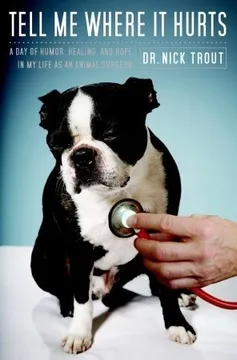
The book is a memoir of veterinary surgery arranged as a single, exhausting workday. Its clock-based structure gives the cases momentum, while Sage’s emergency at 2:47 a.m. supplies a continuing test of judgment, hope, and accountability. The author says the stories draw on decades of encounters compressed into one day, so the structure is a narrative device, not a literal case history. This lets clinical puzzles, family crises, comic mishaps, and professional reflection accumulate as parts of one vocation.
Its most valuable insight is that veterinary medicine is never only technical. The patient cannot explain pain, the owner must interpret signs and finance care, and the clinician must make decisions under uncertainty while managing the relationship among all three. The chapters repeatedly expose how a technically correct procedure can still be poor care if the animal’s lived experience is ignored, and how a reasonable risk can still end badly without proving the decision was careless. The book’s strongest scenes make that tension visible rather than resolving it with a tidy moral.
Humor is essential to the method. An absurdly large cat, an escaped greyhound, and a turtle’s reproductive surgery keep the book from turning grief into solemn spectacle. The humor also emphasizes how broad the work is, from dogs and cats to unusual companion animals. At the same time, the book is an individual surgeon’s account, not a representative study of veterinary practice. Its statistics and drug-safety claims belong to the period and sources available around publication in 2008; they should not be mistaken for current guidance. The owners’ stories are filtered through the surgeon’s perspective, even when interviews add their voices. Read with those limits in mind, the book offers a humane portrait of expertise as a combination of knowledge, manual skill, honest conversation, and willingness to live with imperfect outcomes.
Review Summary
People Also Read

Glossary
Clinical sign
Observable evidence of diseaseA clinical sign is a measurable or observable change that may indicate illness, such as weakness, a fever, or an abnormal gait. It differs from a symptom, which is a sensation or change the patient can report. Because animals cannot describe their experience verbally, veterinary diagnosis depends heavily on interpreting signs and the owner’s observations.
Gastric dilatation and volvulus
Twisted, swollen stomach emergencyGastric dilatation and volvulus, often shortened to GDV and commonly called bloat, occurs when a dog’s stomach expands and twists. The twist can obstruct the stomach’s contents and impair its blood supply, while also affecting breathing and circulation. It is a life-threatening emergency that usually requires rapid stabilization and surgery.
Gastropexy
Surgical stomach fixationA gastropexy is an operation that attaches the stomach to the abdominal wall. In the book, it is performed after correcting GDV to reduce the chance that the stomach will twist again. The surgeon creates and secures a section of stomach tissue to the abdominal muscle, rather than relying only on stitches to hold the organ in place.
Myasthenia gravis
Disorder causing muscle weaknessMyasthenia gravis is a disorder that disrupts communication between nerves and muscles, causing weakness that can worsen with activity. In Barron’s case, the hind-leg weakness became obvious after walking and briefly improved after a diagnostic medication test. The disease may also affect the esophagus, making swallowing and moving food to the stomach difficult.
Megaesophagus
Enlarged, weak food tubeMegaesophagus is an abnormal enlargement and loss of effective muscular movement in the esophagus, the tube carrying food from the throat to the stomach. Food may collect and come back up without the forceful abdominal contractions associated with vomiting. In dogs, this can lead to aspiration pneumonia if food or liquid enters the airway.
Linear foreign body
String-like swallowed obstructionA linear foreign body is a length of material, such as thread, dental floss, or shoelace, swallowed by an animal. It can become anchored in the digestive tract while the intestines gather along it, causing injury, obstruction, or perforation. Surgery may be needed to remove it, and the material’s source is not always obvious to the owner.
Palliation
Relief without a curePalliation is treatment intended to reduce the effects of disease or discomfort when a cure is unavailable or is not the goal. It can extend an animal’s life while managing pain or other symptoms. The ethical question is whether the relief and time gained justify the burdens the animal experiences during treatment.
Iatrogenic
Caused by medical careIatrogenic describes a problem caused by a clinician’s activity, treatment, or procedure. The term identifies an origin, but does not by itself establish negligence or intent. A complication can be iatrogenic and still be an unintended risk of care. The clinician remains responsible for addressing the problem and communicating honestly about it.
Euthanasia
Humane ending of sufferingIn the book, euthanasia is understood as a deliberate medical act intended to end an animal’s discomfort or suffering humanely. Death is the result of the intervention, while relief is its purpose. Deciding when it is warranted requires clinical judgment, attention to the animal’s condition, and sensitive communication with the owner.
Download PDF
Download EPUB
.epub digital book format is ideal for reading ebooks on phones, tablets, and e-readers.








