

Key Takeaways
Read smoke as evidence, not as a harmless seasonal backdrop.
The warning was visible. For weeks, smoke and ash hung over northeastern Minnesota. People noticed the haze, the smell, and unusually orange moons, but summer fires were familiar enough to seem ordinary. The Hinckley Enterprise had reported nearby fires and warned about the heat, yet daily life kept its hold. In Phillips, Wisconsin, a devastating fire in July had already shown how quickly a town could be trapped, but its warning faded with the smoke.
The measurements were stark. By September 1, the area had endured thirty days above 90 degrees, compared with six in a typical year. Sandy Lake had received only 3.28 inches of rain since May, against a normal 15.72. Dry air and dry vegetation had made the landscape ready to ignite. The danger was not invisible. It was misread as routine.
What's striking is how danger can become part of the scenery. When a warning repeats without disaster, people learn to treat it as background noise, a pattern sometimes called normalization of risk. That response is understandable, not a failure of intelligence: attention is limited, and ordinary life must continue. But the Hinckley story shows why repeated signals need interpretation, not just observation. A useful question is not simply, “Is this familiar?” but, “What has changed in its intensity, frequency, or context?”
Logging waste turned ordinary drought into a landscape primed to burn.
The forest became fuel. Timber companies cleared Minnesota's white pine at extraordinary speed, leaving branches, brush, and broken saplings where trees had fallen. The waste dried in the sun. Settlers sometimes burned it to clear farmland, while locomotive sparks and mill activity added more ignition risks. By the 1890s, logging had helped turn a forest into a patchwork of stumps, slash, dry marsh, wooden buildings, and sawdust.
Hinckley stored the risk. The Brennan mill's yard held roughly 28 million board feet of lumber, stacked outdoors through the hot summer. Dry weather made the wood more vulnerable, but the quantity and arrangement of fuel reflected choices about how the region's resources were used. General Christopher Columbus Andrews had argued for managed forests and cleanup of logging waste. His warning met little political response while timber profits remained the priority.
This is a clear case of a hazard being amplified by the way a landscape is organized. Environmental history often asks who receives the benefits of extraction and who bears its costs. Here, timber wealth helped build towns and jobs, while combustible waste and stripped land left residents exposed. That does not mean every fire can be prevented through better management, or that local people controlled every risk. It does mean that what looks like a natural disaster may also be the delayed consequence of economic decisions.
When two fires merged, the fire began making its own weather.
The fires changed character. Two separate fires, probably started near Quamba and Beroun, advanced toward Hinckley in heat and wind. As they grew, they reached the tops of trees and generated rising columns of hot air. A convection column is the upward flow created as fire-heated air rises and draws surrounding air toward the flames. The shifting winds fed the fires, while burning embers and fire whirls started new blazes ahead of them.
Their merger made a mass fire. As the two fronts converged near Hinckley, they joined into a moving firestorm, no longer an ordinary forest fire. The fire generated intense winds, spread flaming debris, and ignited fuel across a vast area. It burned more than 300,000 acres and killed more than 400 people in Minnesota. The conditions that made the disaster so extreme were produced by both the weather and the fires themselves.
The firestorm is best understood as a coupled system: weather shapes fire, and sufficiently intense fire reshapes local weather. That feedback helps explain why familiar expectations about a fire's speed or direction failed so badly. It also cautions against treating the event as a simple sum of two fires. Still, the book's reconstruction of their precise origins and convergence is necessarily inferential. The broad mechanism is clearer than every detail of how the flames first joined.
In unfamiliar emergencies, familiar routines can become dangerous instructions.
People followed their scripts. The book calls the expectations people carry about how a situation should unfold “internal scripts.” In Sandstone, residents saw smoke, heard reports of fire, and watched a train arrive full of desperate refugees, yet many stayed behind to protect belongings or finish ordinary tasks. In Partridge, residents also declined a train's offer to evacuate. A firestorm did not fit their picture of what a local fire could do.
The pattern is not unique to Hinckley. The book describes people at a 1995 stadium fire in Bradford who kept trying to leave through the familiar exits, even as those routes clogged and a safer escape lay nearby. At Hinckley, some residents mistook the approaching roar and strange sky for a tornado or other familiar danger. Habit and social roles helped people make sense of events, but also delayed action.
What's important here is the difference between panic and patterned inaction. People do not always freeze; sometimes they calmly keep doing what the setting seems to demand. Cognitive psychology describes this as reliance on schemas, mental templates that make complex scenes easier to interpret. In a crisis, those templates can be useful, but only if they are revised when evidence changes. The account argues for clear, credible warnings and rehearsed alternatives, rather than assuming that individuals will spontaneously invent the right response under extreme stress.
Break procedure when survival depends on human judgment, not the timetable.
The trains became lifelines. Engineer Bill Best backed his train out of Hinckley with nearly 500 people aboard after holding it so more residents could climb on. Jim Root's train reached the fire and escaped only after stopping at Skunk Lake, where passengers sheltered in the water. Both crews faced uncertainty about burning bridges, orders, and the danger of stopping or moving.
Courage took different forms. John Blair, a Black porter on Root's train, helped passengers board, calmed them, and guided people toward the lake. Root's fireman, Jack McGowan, revived him after he collapsed at the controls. The railroad men had just seen workers punished after the Pullman strike, so disobeying orders or disrupting schedules carried real employment risks. Their decisions were not neat examples of a single heroic script. They were improvisations under pressure, with lives depending on them.
The episode highlights the value of discretion in systems built around rules. Schedules and orders coordinate complex work, but in a fast-changing emergency they can lag behind reality. Best's delay created time for passengers, while Root's decision to stop at the lake offered a possible refuge. Neither choice was risk-free, and the book preserves disagreement about the train crews' conduct. That uncertainty matters: honoring courageous action need not turn difficult, contingent decisions into flawless legends.
No refuge was safe by itself; geography and timing decided who survived.
There was no universal shelter. In Pokegama, many people survived by entering the millpond. At Mission Creek, residents lay in furrows in a potato patch as flames passed around them. People at Sandstone escaped into the Kettle River, while passengers from Root's train waded into Skunk Lake. Each refuge worked because of its particular depth, location, timing, and relation to the fire.
Some intuitive shelters failed. At Sandstone, people crowded into root cellars that became hot, oxygen-poor traps. Others sheltered in wells, sometimes surviving, sometimes suffocating. The bridge over the Grindstone River, which seemed like a route out, burned above people huddled in shallow water below. These outcomes were not a simple matter of bravery or good sense. A few feet, minutes, or changes in wind could separate shelter from danger.
The variation in outcomes resists easy survival advice. A place that protects against radiant heat may expose someone to smoke or lack of oxygen; a route that looks open may be overtaken by the fire's shifting fronts. Disaster planning therefore depends on local knowledge, multiple options, and changing conditions, not a single universal rule. The narrative is powerful partly because it refuses to make survival a moral scorecard. Luck, terrain, and timing matter alongside judgment.
Survival did not end the disaster for burned and traumatized survivors.
Injury continued after the flames. Severe burns caused fluid loss, swelling, shock, and infection. In 1894, doctors had few effective ways to treat these complications, and many injured people died after being rescued. At Sandstone, rescuers carried badly burned survivors down to the river, across it, and up a steep bluff before they could reach a train. Even basic evacuation demanded strenuous labor and caused pain.
The psychological wounds also lasted. Survivors lost family members, homes, and whole communities. The book connects their reactions to what is now called post-traumatic stress disorder, which can involve nightmares, intrusive memories, avoidance, and hyperarousal. Brown's grandfather, nine during the fire, sometimes woke screaming decades later. That inherited memory helped motivate the book. The rescue story, then, is also a story of damage that could not be seen from the train platform.
The distinction between immediate rescue and recovery is essential. Modern emergency narratives often emphasize the dramatic moment of extraction, while chronic pain, grief, and psychological symptoms receive less attention. The Hinckley account makes those aftereffects part of the event itself. At the same time, a retrospective diagnosis should be handled carefully: survivors in 1894 did not have today's clinical language, and individual reactions varied. Naming a pattern can clarify suffering without reducing a person's whole life to a diagnosis.
Neighbors moved faster than officials, but relief still judged the poor.
Help began locally. In Pine City and Duluth, residents opened homes, churches, and public buildings, collected food and clothing, and organized meals and medical care. The Duluth Ladies' Relief Society eventually distributed more than 22,000 garments and 1,500 pairs of shoes. Neighbors and volunteers were already acting before the state had organized a full response.
Aid was not always impartial. The State Relief Commission evaluated survivors' requests using judgments about their character and reputation. One young woman was denied support after an examiner labeled her morally unworthy, while other applicants received help based partly on personal connections. The book also records that Native American victims were left without a proper burial by white relief officials. Generosity was real, but the institutions distributing aid carried the prejudices of their time.
Spontaneous mutual aid can move quickly because it is close to immediate need. Formal relief can provide scale and coordination, but its rules also determine who counts as deserving. This section makes both sides visible, avoiding the comforting idea that compassion automatically produces fairness. A sound relief system needs accountable criteria, access for people who face language barriers, and attention to groups whose losses may go unreported. The book's examples show how easily administrative judgment can reproduce the inequality that made some people vulnerable in the first place.
The fire exposed the cost of treating forests as disposable inventory.
Rebuilding could not restore the old economy. Hinckley returned from ash as a town, but the forest that had supported its mills was largely gone, and much of the burned land was poor for farming. James J. Hill moved major railroad facilities to Sandstone, shifting the region's economic center. The town could rebuild houses and shops; it could not quickly replace the landscape that had sustained them.
Reform came slowly. Minnesota passed limited forest-use laws in 1895 and appointed Christopher Columbus Andrews as chief fire warden, but his budget was only $6,000 and he had no staff. More destructive fires in 1908, 1910, 1918, and 1925 helped force stronger conservation and fire-protection measures. By then, vast stands of pine were already gone, and some burned soil could no longer support forest. The disaster exposed a system, not just a moment of bad luck.
The ending complicates the language of resilience. A community can rebuild buildings and routines while losing the ecological base that made its economy viable. That distinction is familiar in contemporary climate adaptation: recovery of visible infrastructure does not necessarily restore livelihoods, ecosystems, or political power. The book also shows that catastrophe alone does not guarantee reform. Laws remained weak until repeated losses shifted incentives and public attention. Remembering the fire therefore means remembering both its victims and the extractive choices that narrowed their future.
Analysis
The book's central achievement is to join three scales that are often separated: the intimate, the institutional, and the ecological. A child loses his family; railway workers decide whether to obey orders; a lumber economy leaves millions of board feet and acres of slash exposed to extreme weather. The minute-by-minute narrative makes those scales collide. The catastrophe is not framed as nature suddenly attacking a town, nor as a story in which individual courage can overcome every structural risk. It is a human disaster produced by an unstable combination of weather, industrial land use, limited scientific knowledge, and decisions made under pressure.
Its method also matters. The narrative assembles survivor accounts, newspapers, relief records, technical studies, and family history into a coherent sequence, while sometimes acknowledging that a precise origin or location can only be inferred. That balance between reconstruction and uncertainty is crucial in disaster history. A vivid account can create an illusion of certainty, especially when it follows people through a tightly timed sequence. The underlying records are fragmentary, and the book's most convincing claims are those that distinguish documented events from plausible explanation.
The story further resists the tidy division between hero and victim. Bill Best's delay helps people board, but the decision is dangerous. Root's train enters the fire, yet becomes a route to survival. John Blair's work is extraordinary, while the public recognition he receives is constrained by the racial climate around him. Relief is generous and also discriminatory. These tensions give the book its moral force: good actions occur inside systems that can be indifferent, unequal, or simply unprepared.
Finally, the family frame turns historical memory into an ethical practice. The author's grandfather survives, but the missing great-grandfather remains part of the story. The cemetery and town are not merely settings for a past event; they are evidence of what communities remember, rebuild, and leave unspoken. The book asks readers to see catastrophe not as an isolated spectacle, but as a chain of choices and consequences whose effects continue after the flames are gone.
Review Summary
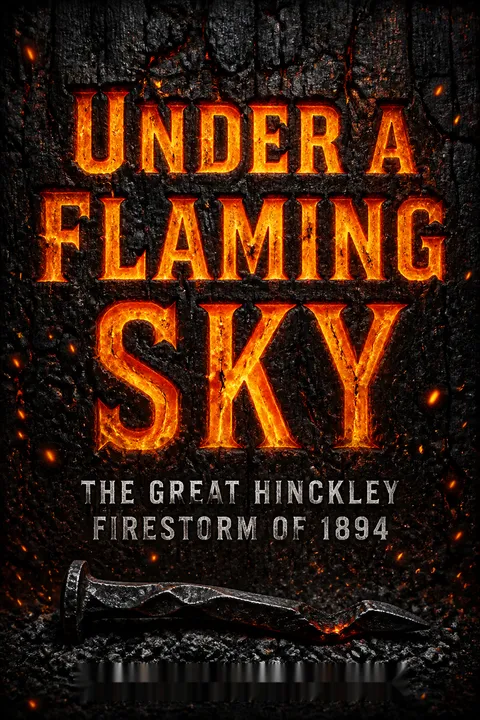
Under a Flaming Sky receives strong praise from readers, averaging 4.13 out of 5 stars. Most reviewers commend Daniel James Brown's ability to blend personal narratives with scientific explanations of fire behavior, creating a gripping, emotionally intense read. Many highlight the vivid, unflinching descriptions of the 1894 Hinckley firestorm as both harrowing and educational. Some readers found the multi-character structure occasionally difficult to follow, and a few felt the post-fire chapters were anticlimactic. Overall, readers consider it a compelling, well-researched account of a lesser-known American disaster.
People Also Read


Glossary
mass fire
A fire beyond ordinary classesA fire that has grown beyond the usual categories of ground, surface, or crown fire. It may form when several fires or a main fire and its spot fires merge. A mass fire can generate powerful winds, a towering convection column, and rapidly spreading flames. A moving mass fire is described as a conflagration; a stationary one as a firestorm.
firestorm
A self-intensifying major fireA large, intense fire that generates its own powerful winds and atmospheric motion. In the terminology discussed in the book, a stationary mass fire is a firestorm, while a moving mass fire is a conflagration. The term also names the Hinckley disaster, where merging fires, extreme dryness, and abundant fuel produced a rapidly advancing wall of flame.
convection column
Rising fire-heated airA rising tower of hot gases and smoke created when a fire heats the air above it. As the heated air rises, surrounding air is drawn toward the fire to replace it. In a major fire, this circulation can create strong, complicated winds, help intensify the flames, and carry burning material high into the air.
fire whirls
Rotating columns of flameTornado-like rotations of flame and burning material that can form near an intense fire. They may move ahead of the main fire, knocking down structures and spreading embers that ignite new spot fires. The book describes them as one of several ways a mass fire can spread beyond a single, continuous flaming front.
internal scripts
Expected patterns of actionUnspoken expectations about what people should do and what is likely to happen in a particular setting. During an emergency, these expectations can shape behavior before people fully assess new evidence. Hinckley-area residents sometimes continued ordinary tasks, protected property, or waited for familiar signals because the approaching fire did not fit their expectations of danger.
fine fuels
Small, quick-drying fire fuelsLight vegetation and forest litter, including twigs, grasses, and pine needles, that lose moisture quickly as the surrounding air dries. The book explains that these fuels had been drying through the summer of 1894, making it easier for flames to spread rapidly. Larger materials, including logs, slash, and buildings, also became highly combustible in the extreme conditions.
post-traumatic stress disorder (PTSD)
A lasting trauma responseA psychological disorder that can follow exposure to severe trauma. The symptoms described in the book include intrusive memories or nightmares, avoidance, emotional numbing, dissociation, and heightened vigilance or startle reactions. The term helps explain why some fire survivors remained psychologically affected long after the immediate danger ended, though the people of 1894 did not have this clinical diagnosis.
About the Author


Download PDF
Download EPUB
.epub digital book format is ideal for reading ebooks on phones, tablets, and e-readers.








