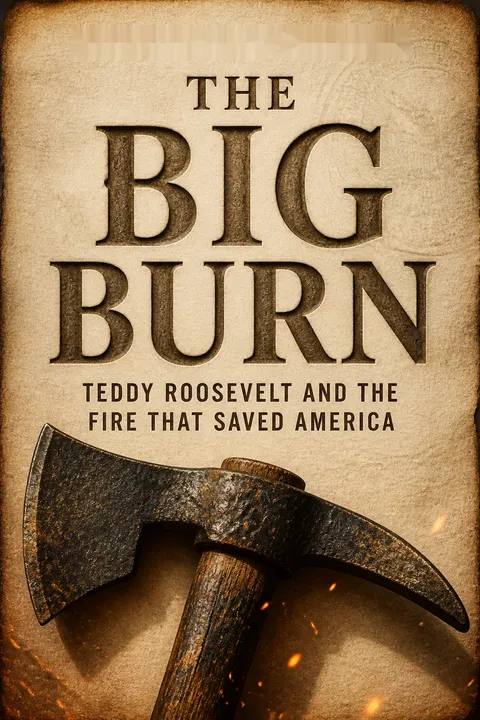


Key Takeaways
Treat public land as a democratic inheritance, not a private windfall
A public inheritance. Theodore Roosevelt and forester Gifford Pinchot argued that forests, rivers, and wildlife belonged to all Americans, including people not yet born. Their claim challenged a system that had given vast public lands to railroads and mining and timber companies. Roosevelt’s own attachment to wilderness had deep roots: after losing his mother and first wife on the same day, he sought refuge in the Dakota Badlands and carried that bond with him into politics.
Power made policy. With Roosevelt’s support, Pinchot helped create the Forest Service in 1905. Roosevelt eventually placed about 230 million acres in national forests, parks, and wildlife refuges. The fight was not simply about scenery. It asked whether private wealth or public responsibility would shape the American West.
The book frames conservation as a question of democratic ownership, not merely affection for beautiful scenery. That shift matters: people can defend a public resource even if they never visit it, because its value includes future options and shared access. The argument also exposes a tension in American land policy. A public inheritance can protect resources from private monopolies, yet it can still be created through federal decisions that sideline the people already living on that land.
Make conservation serve people without pretending nature is a machine
Use, with limits. Pinchot’s conservation meant managing natural resources for broad public benefit, rather than leaving them entirely untouched or allowing them to be exhausted for private profit. National forests were therefore working forests: logging and grazing could occur, but under rules intended to sustain the land and protect public access. This differed from John Muir’s stronger emphasis on preserving wilderness from human use.
A real disagreement. The divide sharpened over Hetch Hetchy Valley in Yosemite. Muir opposed damming it for San Francisco’s water supply; Pinchot supported the project as a public necessity. Both wanted nature protected, but they ranked its claims differently. The dispute shows that conservation is not a single answer. It is a continuing argument about which uses are justified, who benefits, and what should remain beyond development.
This disagreement gives conservation intellectual depth: protection and use are not interchangeable, and neither automatically serves the public. Pinchot’s approach makes room for material needs, while Muir’s reminds decision-makers that some losses cannot be repaired by efficient management. The hard question is who gets to define the public good. A dam may serve a city, while erasing a valley that has value beyond its utility. Good stewardship requires explicit choices, not the comforting claim that every use can be reconciled.
Build public institutions before emergencies expose how thin they are
A service under siege. The new Forest Service faced hostility from western politicians and wealthy interests that wanted land available for private development. Pinchot recruited young foresters, trained them in both technical work and survival, and sent them to patrol immense territories. They were nicknamed Little G.P.s after their chief. Many rode alone across roadless country, enforcing land rules and trying to prevent fires.
Capacity lagged behind ambition. By 1910, the service oversaw greatly expanded forests with too few staff, trails, telephones, tools, and funds. A ranger could be responsible for more than 300,000 acres. Salaries were poor, and some rangers paid emergency costs from their own savings. The agency’s promise to protect public land was much larger than the practical means Congress had given it.
The Forest Service’s early history illustrates a basic institutional problem: a mandate does not create the capacity to carry it out. Training and morale helped, but they could not replace roads, communications, equipment, or reliable funding. The rangers’ personal commitment made the agency look stronger than it was, which risked hiding the deficit from the public. Institutions built around heroic labor can endure for a while, but they should not require employees to subsidize their own mission.
A thousand manageable fires can become one uncontrollable event
A season of tinder. The summer of 1910 brought an exceptional drought to the northern Rockies. June and July together received less than one-tenth of an inch of rain in the Bitterroots. Lightning and sparks from coal-burning trains started fires across forests in Idaho, Montana, and Washington. By August, thousands of separate blazes were consuming exhausted crews and scarce supplies.
Then the weather changed. On August 20, a powerful Palouser, a hot wind from the southwest, drove flames into the dry timber. Fires merged, climbed from forest floor to treetops, and generated violent winds of their own. In roughly two days, the fire burned nearly 3.2 million acres, an area larger than Connecticut, and killed 85 people in the official count. Wallace and other towns faced firebrands raining from the sky.
The catastrophe is a lesson in nonlinear risk. A landscape can appear to contain many separate, limited problems until drought, wind, and accumulated fuel connect them into a system no local response can control. That is why preparedness cannot be judged only by how well an organization handles ordinary conditions. Yet the book also suggests that Pinchot’s claim that better funding could have prevented most of the destruction was politically useful, not a certainty. A stronger service could reduce risk without mastering extreme weather.
In a crisis, competence often comes from people elites dismiss
A diverse, improvised force. The Forest Service recruited thousands of workers, including immigrants, unemployed laborers, prisoners, and soldiers. Many had never fought a major wildfire. Italian miners Domenico Bruno and Giacomo Viettone came north hoping to earn money for their families. They died with other firefighters when a fallen tree trapped them in a small shelter.
Leadership under pressure. Ranger Ed Pulaski gathered about fifty men in the firestorm and forced them into a mine tunnel, threatening to shoot anyone who tried to flee. Forty-one survived, though Pulaski suffered severe burns and damage to his sight and lungs. Black soldiers of the 25th Infantry helped evacuate Wallace and Avery. Their orderly work, initially met with prejudice, earned praise from residents who had doubted them. Homesteader Ione Adair, known as Pinkie, also escaped by walking through the burning woods toward Avery.
The rescue stories challenge the assumption that authority and competence travel together. The people who kept others alive included a practical woodsman with little formal schooling, Black soldiers facing entrenched racism, immigrant workers, and a woman accustomed to surviving alone. In disasters, local knowledge and disciplined action can matter more than prestige. Still, hero narratives can make improvisation sound like an adequate plan. The firefighters’ courage should sharpen attention to why so many were sent into danger without preparation or dependable support.
Turn catastrophe into accountability, but do not confuse blame with causation
A political opening. After the fire, Pinchot blamed Congress, especially Senator Weldon Heyburn, for starving the Forest Service of staff and equipment. He argued that better patrols, trails, and communications might have reduced the loss. His case helped turn the rangers’ ordeal into a public argument for a stronger agency. Roosevelt praised their service and used the disaster to renew his campaign for public ownership and conservation.
Policy changed. The fire helped defeat proposals to strip burned land from the national forests. Congress increased Forest Service funding for roads and trails, and the 1911 Weeks Act enabled federal purchase of eastern forestland. More than twenty million acres were eventually added. The crisis also helped force Interior Secretary Richard Ballinger from office. The fire did not create conservation, but it gave the movement urgency and political force.
Political storytelling can convert suffering into institutional change. Pinchot’s account gave the dead and injured a public meaning, while making neglect visible as a policy choice rather than an unfortunate accident. That is a powerful form of accountability. But the distinction between preventable vulnerability and preventable disaster matters. Better resources could have improved detection, evacuation, and survival; they could not necessarily have stopped a wind-driven fire of this scale. Honest advocacy is strongest when it makes that distinction clear.
Honor public-service heroes by supporting them before and after danger
The rescue did not end at the fireline. The government struggled to pay firefighters and cover medical care. Injured workers were left with serious burns and lasting lung damage. Patrick Sullivan, wounded during the fire, was discharged from the hospital when funds ran out and died months later. The families of Bruno and Viettone waited years for compensation; Bruno’s family eventually received $200, while no settlement for Viettone is recorded.
Pulaski paid personally. He returned to work despite blindness in one eye, damaged lungs, and painful burns, because he needed the income. He received no government compensation for his injuries. He also tended the graves of the dead and pressed for a memorial. The agency later honored him as a hero, but recognition did not provide the medical care or financial security he had needed.
The gap between public praise and practical care is one of the book’s sharpest institutional criticisms. Heroism is often celebrated because it is emotionally legible; compensation systems, medical budgets, and worker protections are less dramatic, but they determine whether service is treated as a shared obligation. The immigrants’ deaths make the imbalance especially stark: their labor supported a national project, while their families struggled to obtain even modest relief. Commemoration has value, but it cannot substitute for material responsibility.
Fire policy can preserve forests on paper while damaging them in practice
A defeat became a doctrine. After 1910, Forest Service leaders increasingly treated fire suppression as the agency’s central mission. In 1935, the ten o’clock rule required a newly spotted fire to be controlled by ten the next morning. This policy grew from fear of another Big Burn, but it ignored the role of fire in forest renewal. Some trees, including lodgepole pine, depend on heat to open their cones and begin a new generation.
The mission shifted. Chief forester William Greeley promoted aggressive suppression and greater timber access, arguing that industry could help maintain forests. Pinchot objected that this partnership turned public land toward corporate use. The book links decades of suppression to forests burdened with dry fuel and warns that stopping every fire can make later fires more dangerous.
This is a striking example of policy lock-in: an exceptional disaster becomes the template for ordinary conditions. The rule is understandable as a response to loss, yet it treats fire as an enemy rather than an ecological process with varied effects. Suppression can protect towns and workers, while blanket suppression can alter the conditions that shape future fires. The key distinction is not simply fighting fires or allowing them to burn. It is matching decisions to place, weather, fuel, and human risk.
Keep conservation’s democratic purpose visible after its founding story hardens
A contested legacy. The 1910 fire secured the Forest Service’s survival and helped expand public forests, but its heroic origin story also strengthened a policy of total suppression. The agency’s priorities later shifted toward industrial logging, a direction Pinchot opposed when he toured western forests in 1937 and saw clear-cut mountainsides. Some rangers, including Elers Koch, believed the fire had exposed the limits of the Forest Service, not proved its mastery.
The land outlasted the boom. Railroads and rough towns such as Taft and Grand Forks vanished, while forests recovered unevenly. By 2005, about 35 million acres of Forest Service land had been designated wilderness, where roads, logging, and development were prohibited. The book ends by returning to the remote St. Joe country, where public land remained a place for future visitors, rather than a short-term prize.
Institutions inherit both their founding ideals and the emergency habits formed under pressure. A memorial can keep a story alive, but it can also simplify it into a tale of agency triumph and hide the policy mistakes attached to that triumph. The book’s strongest closing move is to measure conservation by what remains available to future people, not by the fame of its founders. That measure also invites scrutiny of whose histories and claims are included when land is described as belonging to everyone.
Analysis
The Big Burn is a history of public land told through two interlocking crises: a political fight over who controls the West, and a wildfire that overwhelms the people charged with protecting it. Its central paradox is that the fire nearly destroyed the Forest Service, yet helped save the agency by making its neglect undeniable. The tragedy becomes politically productive, but the resulting institutional lesson is not wholly sound. Pinchot’s campaign helped secure funds and land protection, while the Forest Service’s later insistence on suppressing every fire converted a rare catastrophe into a permanent operating principle.
Egan’s narrative gains force by moving between national leaders and workers who had little power: Roosevelt and Pinchot argue over a democratic inheritance, while immigrant laborers, Black soldiers, local rangers, and homesteaders face immediate bodily danger. Their experiences make conservation more than an abstract dispute about trees. They reveal the human cost of an agency expected to protect land without adequate tools, pay, or medical support. The scenes of Wallace’s evacuation and Pulaski’s tunnel rescue also show that leadership is practical and situational, not simply a product of rank or education.
The account’s framing deserves one important qualification. Public ownership is not the same as universal consent. The story notes that the Coeur d’Alene reservation was opened to settlers and that Indigenous people had used and shaped the landscape through practices including deliberate burning. Yet the conservation debate largely centers Roosevelt, Pinchot, corporations, and federal agencies. The idea of land as a shared national inheritance can therefore obscure prior claims and unequal power over who defines the public.
The book’s lasting contribution is to show that good intentions do not guarantee good institutions. A conservation agency can resist private plunder, then become captive to its own fear of fire or to commercial interests. The relevant test is not whether an agency preserves its founding legend, but whether it learns from ecological limits, treats workers fairly, and keeps public benefit ahead of both corporate extraction and bureaucratic self-preservation.
Review Summary
The Big Burn receives mostly positive reviews, with readers praising Egan's storytelling and historical research. The book explores the 1910 wildfire that ravaged the Northwest, while also delving into the creation of the U.S. Forest Service and the conservation efforts of Theodore Roosevelt and Gifford Pinchot. Some readers found the narrative compelling and informative, while others felt it lacked focus or oversimplified certain aspects. Many appreciated the book's relevance to current environmental and political issues, as well as its portrayal of the heroic efforts of early forest rangers.
People Also Read


Glossary
Conservation
Public-benefit resource managementIn Pinchot’s usage, conservation means managing forests and other natural resources for broad public benefit over time. It rejects both unrestricted private exploitation and the idea that all land must remain untouched. The term connects resource policy to democratic ownership: the public, including future generations, should benefit from the land.
working forests
Forests managed for public usePinchot’s term for national forests that could support regulated logging, grazing, and other practical uses rather than being preserved entirely from human activity. The guiding aim was to sustain the forest while serving the public. The concept distinguished national forests from parks and wildlife refuges, though debates over its limits continued.
Little G.P.s
Pinchot’s young forestersA nickname for the young Forest Service foresters trained and recruited under Gifford Pinchot. Many were sent west to survey land, patrol national forests, enforce rules, and fight fires. The name captures both their loyalty to Pinchot’s conservation project and the agency’s early reliance on a small, idealistic workforce.
Palouser
A powerful southwest windA warm wind from the southwest, named for the Palouse region of eastern Washington. In the 1910 fire, a particularly violent Palouser pushed flames through dry forests and helped turn many separate fires into a vast firestorm. The wind’s force was intensified by the terrain and by the heat generated by the burning forest.
backfiring
Fire used against fireA firefighting tactic in which crews deliberately ignite vegetation ahead of an advancing fire, after clearing a line to bare soil. The smaller controlled burn consumes fuel so the main fire may have less to burn when it arrives. The method depends on judging wind and terrain correctly and can become dangerous if conditions change.
ten o’clock rule
A deadline for fire controlA Forest Service policy adopted in 1935 that called for any newly discovered fire to be under control by ten o’clock the following morning. It expressed the agency’s post-1910 commitment to rapid suppression. The book presents the rule as an example of how fear of another catastrophe hardened into a broad policy that neglected fire’s ecological role.
Pulaski
Combined ax and digging toolA hand tool developed by ranger Ed Pulaski after the 1910 fire. It combines an ax blade for cutting with a hoe-like blade for digging and scraping fire lines. The design became widely used by wildland firefighters. Its name also keeps alive the memory of Pulaski’s leadership during the firestorm, when he led a crew into a mine tunnel to survive.
About the Author
Other books by Timothy Egan
Download PDF
Download EPUB
.epub digital book format is ideal for reading ebooks on phones, tablets, and e-readers.








