

Key Takeaways
Replace random promotions with a one-page customer journey
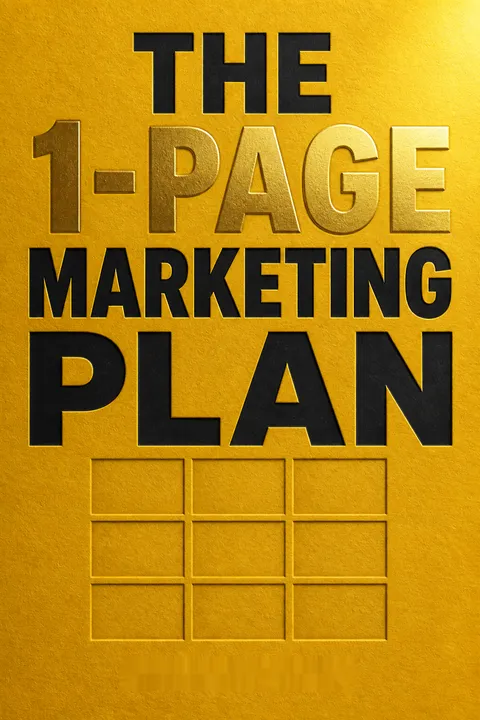
Plan before tactics. Dib’s central tool compresses marketing into nine prompts on one page. They trace a person from unfamiliar prospect to interested lead to paying customer, then consider how to deliver well, earn repeat business, and generate referrals. The goal is not to make marketing tiny, but to make a useful plan simple enough to finish and revisit.
Keep it alive. Dib describes first producing a cumbersome business plan that gathered dust, while the marketing-planning process itself helped shape his company. The shorter plan is meant to be a working document, not a ceremonial report. Its sequence also guards against choosing a fashionable channel before deciding whom to reach and what response to seek. The 80/20 idea is a prioritization heuristic here, not a promise that every business gets the same results.
The strength of this format is behavioral as much as strategic: a plan that fits on a page is easier to discuss, assign, and revise. It resembles a service blueprint, which maps what a customer experiences alongside the work a company must perform. That connection helps prevent marketing from becoming a detached advertising exercise. The compression has a limit, though. A one-page plan can clarify choices, but it cannot replace research, cash-flow forecasts, or operational planning. Its value comes from serving as the visible steering wheel, not pretending to be the whole vehicle.
Choose customers you can serve profitably, not everyone
Focus makes relevance. A niche is a defined segment with a particular need, not simply a small market. A photographer might promote wedding work differently from corporate photography, since the buyer, concerns, and desired outcome differ. A general ad listing every service is likely to feel relevant to none of them. Concentrating on one segment gives a small business a better chance to be noticed and to compete on expertise rather than price.
Score the segments. Dib’s PVP index rates each customer group on personal fulfillment, value to the marketplace, and profitability. His photographer example favors family portraits because that segment scores well across those measures. Customer research should go beyond age and location: interviews, observation, and a vivid customer avatar can reveal frustrations, priorities, vocabulary, and how a buying decision gets made.
This advice joins market segmentation with a practical form of job design: the best customer is not necessarily the biggest account, but one whose needs fit the company’s strengths and economics. An avatar can help a team write and make decisions consistently, provided it remains a hypothesis informed by real customers. A vivid fictional profile can otherwise harden into stereotype. Narrow targeting is also a starting move, not a permanent border. Businesses should test whether a segment is large enough and whether serving it creates value without excluding customers arbitrarily.
Sell a specific result, not a list of services
Lead with the outcome. A unique selling proposition, or USP, gives a prospect a clear reason to choose one provider over another. It need not rely on a novel product. A printer, for example, can investigate what a business wants its printed materials to accomplish, then advise on the solution rather than merely quote for business cards. That shifts the comparison from identical commodities toward a specific problem solved.
Make the next step obvious. Dib argues for one main objective per ad, a clear call to action, and an offer built around what the target customer values. Useful education, proof, a guarantee, or relevant extras can reduce hesitation. A deadline or limited supply belongs only when it is real and explainable. The message should use the customer’s language and address a practical pain, not bury the benefit in company history or jargon.
Outcome-led messaging is persuasive because buyers often care more about the change they want than the technical object sold. It also gives marketing a testable proposition: does this promised result matter to this segment? Strong guarantees can sharpen that promise, but they must match what the business can reliably deliver. Emotional language is not automatically manipulation; it becomes exploitative when it hides costs, invents urgency, or magnifies fear beyond the evidence. Clear positioning works best when the operational experience fulfills the claim.
Track profit per customer before scaling any advertising
Measure economics, not applause. Dib contrasts broad brand advertising with direct response marketing, which asks a defined audience to take a measurable action. In his example, a campaign costs $300, produces two buyers, and therefore has a customer acquisition cost of $150. If each first sale yields $100 in profit, the campaign loses money; if it yields $600, it earns money. Response rate alone cannot settle the question.
Count the relationship. Customer acquisition cost is the cost of gaining a buyer. Customer lifetime value includes the profit earned across the relationship, not just the first purchase. Repeat purchases may make an initially unprofitable campaign worthwhile, but only if the business can substantiate that future value. Dib also warns against relying on one channel or platform. Email lists and other assets a company controls can reduce dependence on a social network’s changing rules.
The focus on unit economics makes advertising more accountable: spending can grow when each acquired customer produces a credible return. This is especially useful for small firms that cannot afford vague awareness campaigns. Yet attribution is rarely perfect. A customer may encounter several channels before buying, and quick-return metrics can undervalue brand trust or long sales cycles. The sound practice is not to worship a single number, but to combine acquisition cost, contribution margin, repeat behavior, and channel evidence. Diversification also protects the business from platform risk, though managing many channels can dilute attention.
Capture interest before asking for the sale
Build a pipeline. Dib describes lead capture as collecting contact details from people who have shown interest so the business can follow up. A useful free resource, which he calls an ethical bribe, might be a guide that helps a couple evaluate wedding photographers. Requesting it identifies a more relevant prospect than an untargeted audience, while giving the prospect something useful in return.
Do not mistake a model for a law. The book presents an illustrative buying-readiness split: 3 percent ready now, 7 percent open to buying, and 30 percent interested but not ready. It argues that a lead-generating ad can engage more of that audience than an ad demanding an immediate purchase. Those percentages are a marketing model, not a universal finding. The practical point is to offer a low-friction next step and record the lead in a system the business can manage.
This approach resembles permission-based communication: the prospect chooses to receive something relevant, giving the company a legitimate opening for continued contact. The exchange works only if the promised resource is genuinely useful and the follow-up respects consent. A form submission signals interest, not purchase intent, so treating every lead as sales-ready can quickly damage trust. The readiness percentages make the opportunity easy to picture, but businesses should measure their own audience rather than assume the same proportions. Lead volume matters only when quality and later conversion justify it.
Follow up with useful education until buying makes sense
Be a welcome contact. Salesman Joe Girard, whom Dib cites, sold cars by keeping in touch with customers through personalized monthly greeting cards. Over time, repeat buyers made up a large share of his sales. His example illustrates why one unanswered inquiry is not always a lost opportunity: a prospect may need time, information, or a better moment to act.
Nurture without pestering. A CRM, or customer relationship management system, can store prospect interactions and prompt email, phone, or mail follow-up. The content should help prospects understand a problem, compare options, or avoid a poor decision, with offers appearing as appropriate. By the time a sales conversation happens, the business should have established relevance and credibility. If a seller must rely on pressure to force a decision, the earlier education or qualification may have missed the mark.
Regular follow-up addresses a familiar failure in organizations: a useful conversation begins, then disappears because no one owns the next step. Automated reminders can fix that coordination problem, while educational content makes persistence more valuable than mere repetition. The important distinction is between helpful continuity and unwanted contact. Permission, frequency, and relevance shape how the same message is received. Girard’s story is compelling, but it cannot establish that greeting cards caused all his results. Its durable lesson is to create a reliable relationship process instead of depending on memory or charisma.
Document repeatable delivery so the owner stops being the bottleneck
Make good service reproducible. A remarkable promise is worthless if delivery varies wildly. Dib recommends documenting recurring work with procedures and checklists, so customers receive consistent treatment even when a particular employee is absent. He groups essential systems into marketing, sales, fulfillment, and administration. A company that excels at its technical work but neglects marketing and follow-through may never give enough customers the chance to experience that quality.
Remove friction. Technology should make the next step easier, whether that means paying, getting support, or receiving a timely response. The book’s examples range from a restaurant that kept an inconvenient payment process to businesses using memorable demonstrations to make ordinary products more engaging. Systems should protect the experience, not force customers to obey a clumsy process. They also reduce the company’s dependence on the owner’s undocumented knowledge.
Documented routines connect service design to organizational resilience: a promise becomes more credible when the business can deliver it repeatedly, rather than through individual heroics. Checklists are especially useful for infrequent or high-consequence tasks, though they should support judgment rather than replace it. Technology deserves the same scrutiny. A new tool is not an improvement simply because it is modern; it should reduce effort or improve the customer’s outcome. The owner’s time is a real constraint, but delegation without training and feedback can merely move inconsistency to someone else.
Grow profit by improving existing-customer value, not just acquisition
Work the relationship. Dib identifies five routes to greater customer lifetime value: raise prices thoughtfully, offer relevant add-ons, move customers to higher-value options, increase purchase frequency, and invite inactive customers back. A subscription can make buying more convenient when customers use something repeatedly. These approaches should improve the customer’s result, not just extract another payment.
Watch the numbers and the fit. The book’s online-store example raises leads, conversion, and average transaction value by 10 percent each. In its simplified arithmetic, annual profit rises from $120,000 to about $517,000, a reported 431 percent increase. This is an illustration of compounding improvements, not a forecast for a typical firm. Dib also distinguishes healthy repeat customers from customers who consume disproportionate resources or are unlikely to stay. Revenue quality matters alongside revenue volume.
The underlying economics are compelling: an established customer already knows the business, so useful retention and expansion can be less costly than continually replacing buyers. Small improvements across a funnel can multiply because the measures interact. But the example assumes stable margins and operating costs, among other simplifications. Real firms should check refunds, service capacity, churn, and customer-level contribution before celebrating top-line gains. Segments that require unusual support may still be valuable, but the decision should be based on actual costs and strategic fit, not labels or irritation.
Engineer referrals instead of waiting for word of mouth
Make sharing easy. Satisfied customers may recommend a business, but passive hope is an unreliable acquisition system. Dib urges businesses to ask for introductions after delivering a good result and to give customers something useful to pass along, such as a referral voucher. The customer can then help a friend while sharing a service they trust. A request made before the customer has seen the promised value is far less credible.
Find partners around the customer. A pet-food retailer could work with a veterinarian who recommends a suitable product and gives new clients a store voucher. The arrangement creates value for the customer, the partner, and the retailer, provided the recommendation is honest and any customer information is shared with permission. Dib also treats brand equity as the preference earned through customers’ real experiences, not merely the awareness purchased through advertising.
Referral systems work best when they preserve the social reason people recommend things: helping someone else make a good choice while reflecting well on the person who made the introduction. A reward can prompt action, but an overly transactional incentive may weaken that signal. Partnerships extend the idea by reaching customers at a trusted point in their decision process. They require clear boundaries around claims, privacy, and compensation. The book’s emphasis on experience is crucial: a referral mechanism can amplify satisfaction, but it can amplify disappointment just as efficiently.
Analysis
The book’s most useful contribution is not a new theory of persuasion. It is an implementation architecture for small businesses that often confuse activity with marketing: a website, an occasional promotion, or a social account becomes a substitute for a system. Dib instead follows a customer relationship from first awareness through purchase, delivery, repeat business, and recommendation. That lifecycle makes acquisition and retention parts of one operating model rather than rival departments.
The model’s direct-response orientation has a practical strength. It asks businesses to make a clear offer, identify the audience, track response, and connect spending to customer economics. This can replace vague claims of exposure with decisions that owners can test. It also correctly treats the customer’s experience after purchase as marketing, because service quality shapes repeat purchases and referrals.
The framework is most persuasive as a management checklist, not a universal causal formula. The book uses striking percentages and simplified profit examples to motivate action, but business outcomes depend on margins, capacity, sales cycles, competition, and customer mix. Its own anecdotes and caveats sometimes signal this uncertainty. Owners should treat numerical examples as prompts to measure their own funnel, not as benchmarks or guaranteed returns.
A further limitation is the funnel metaphor. Customers do not always proceed neatly from prospect to lead to buyer; they compare, pause, return, and arrive through several channels. A one-page plan remains useful if it is updated with evidence and allows for these loops. Its strongest ethical interpretation is equally important: targeting should improve relevance, follow-up should honor consent, guarantees should be deliverable, and urgency should be real. Under those conditions, marketing becomes less a performance of persuasion than a disciplined way to match a worthwhile solution with people who need it, then make the experience reliable enough to earn another transaction.
Review Summary
The 1-Page Marketing Plan receives mostly positive reviews, with readers praising its practical approach to marketing for small businesses. Many find it easy to understand and implement, appreciating the step-by-step guide and actionable advice. Some critics argue it's too basic for experienced marketers or lacks scientific backing. The book's simplicity is seen as both a strength and weakness. Overall, readers value its focus on creating a concise marketing strategy and its insights into customer acquisition and retention.
People Also Read








Glossary
The 1-Page Marketing Plan
Customer journey planning toolA working marketing document that organizes nine planning prompts across three stages: reaching prospects, converting interested leads, and developing existing customers. It covers the audience, message, media, lead capture, follow-up, sales, delivery, repeat business, and referrals. Its purpose is to make a practical plan easy to complete, use, and revise.
PVP index
Market-segment scoring toolA way to compare customer segments using three dimensions: personal fulfillment, value to the marketplace, and profitability. A business rates each segment to identify which types of customers are satisfying to serve, value the work, and contribute financially. The index helps focus marketing, but does not prevent a business from serving other segments.
Unique selling proposition (USP)
Reason to choose youA clear distinction that explains why a customer should choose a particular business instead of a competitor. The difference may come from how a product is packaged, delivered, supported, or positioned, rather than from the product itself. A strong USP centers on a meaningful customer outcome and avoids unsupported claims such as simply being the best.
Direct response marketing
Measurable customer responseMarketing designed to prompt a defined action from a specific audience, such as requesting information, calling, or placing an order. It uses a clear offer and response mechanism, then tracks the resulting leads, sales, and costs. The approach lets a business compare campaign performance and allocate spending based on financial results rather than general exposure alone.
Ethical bribe
Useful resource for contact detailsA relevant free resource offered in exchange for a prospect’s contact information and permission for follow-up. Examples include an educational report or video that addresses a problem the target audience faces. The exchange is ethical when the resource delivers its promised value and the business handles contact details responsibly.
Customer relationship management (CRM)
Customer and lead tracking systemA system for organizing prospect and customer information, recording interactions, and coordinating follow-up. It may also automate reminders or messages based on an inquiry, purchase, or scheduled interval. In the book’s marketing process, a CRM helps ensure that interested people are not forgotten and that customer relationships do not depend only on an individual’s memory.
Shock and awe package
High-value physical follow-upA package sent to an interested prospect containing useful materials related to the business, such as a book, product sample, testimonials, or a personal note. It is intended to provide unexpected value, establish expertise, and help the prospect evaluate a purchase. Its cost should be assessed against the likely value of the prospect and the business’s customer economics.
Customer lifetime value
Value across the customer relationshipThe total financial value a customer contributes over the full period of doing business with a company, including repeat purchases after the initial sale. The concept helps businesses assess acquisition costs and identify the importance of retention, subscriptions, and additional relevant purchases. Reliable estimates require actual customer behavior and costs, not assumptions about future revenue.
Unequal dollar
Revenue quality distinctionThe idea that equal amounts of revenue can have very different value to a business. One customer may buy repeatedly, refer others, and require little extra support, while another may consume substantial resources, leave quickly, or create service problems. Evaluating revenue quality means considering profit, retention, customer impact, and the work required to serve each account.
FAQ
What's "The 1-Page Marketing Plan" about?
- Purpose and Focus: "The 1-Page Marketing Plan" by Allan Dib is about creating a simple, actionable marketing plan that fits on a single page. It aims to help small businesses grow quickly by focusing on direct response marketing.
- Three Phases: The book is structured around three phases of marketing: Before, During, and After. Each phase guides the reader on how to attract, convert, and retain customers.
- Implementation Breakthrough: Dib emphasizes that the book is not about new marketing concepts but about implementing proven strategies effectively. The goal is to simplify marketing for small businesses.
- Direct Response Marketing: The book focuses on direct response marketing, which is designed to evoke an immediate response and is trackable and measurable.
Why should I read "The 1-Page Marketing Plan"?
- Practical Guidance: The book provides practical, step-by-step guidance on creating a marketing plan that is easy to implement and manage.
- Focus on Results: It emphasizes strategies that lead to quick business growth and increased profitability, making it ideal for small business owners.
- Simplifies Marketing: By reducing the marketing plan to a single page, it simplifies the process, making it accessible even to those with little marketing experience.
- Proven Strategies: The book is based on proven direct response marketing strategies, ensuring that readers are applying methods that have been successful in the past.
What are the key takeaways of "The 1-Page Marketing Plan"?
- Target Market: Identifying and focusing on a specific target market is crucial for effective marketing. The book provides tools like the PVP index to help with this.
- Crafting a Message: Creating a compelling message that resonates with the target market is essential. The book offers strategies for crafting offers that stand out.
- Lead Capture and Nurturing: Capturing leads and nurturing them through a structured process is vital for converting prospects into customers.
- Customer Lifetime Value: Increasing the lifetime value of customers through upselling, cross-selling, and providing a world-class experience is a major focus.
How does the "1-Page Marketing Plan" work?
- Nine Squares: The plan is divided into nine squares, each representing a key component of the marketing process. These are split into the three phases: Before, During, and After.
- Step-by-Step Process: Each square guides the reader through a specific step, from selecting a target market to orchestrating referrals.
- Action-Oriented: The plan is designed to be filled out as the reader progresses through the book, ensuring that they have a complete, actionable marketing plan by the end.
- Living Document: The 1-Page Marketing Plan is meant to be a living document that can be refined and updated as the business grows.
What is the "Before" phase in "The 1-Page Marketing Plan"?
- Target Market Selection: This phase involves selecting a specific target market to focus marketing efforts on, ensuring that the message resonates with the right audience.
- Crafting the Message: It includes crafting a compelling message that addresses the needs and desires of the target market.
- Reaching Prospects: The phase also covers selecting the right advertising media to reach prospects effectively and efficiently.
What is the "During" phase in "The 1-Page Marketing Plan"?
- Lead Capture: This phase focuses on capturing leads through various methods and adding them to a database for future follow-up.
- Lead Nurturing: It involves nurturing leads by providing value and building trust, positioning the business as an authority in its field.
- Sales Conversion: The phase aims to convert leads into paying customers by creating enough trust and demonstrating enough value.
What is the "After" phase in "The 1-Page Marketing Plan"?
- Delivering a World-Class Experience: This phase emphasizes providing an exceptional customer experience to turn customers into raving fans.
- Increasing Customer Lifetime Value: It involves strategies to increase the lifetime value of customers through upselling, cross-selling, and repeat business.
- Orchestrating Referrals: The phase focuses on actively stimulating referrals to create a continuous flow of new business.
What are the best quotes from "The 1-Page Marketing Plan" and what do they mean?
- "The fastest path to the money." This quote emphasizes the book's focus on practical, results-oriented marketing strategies that lead to quick business growth.
- "Knowing and not doing is the same as not knowing." It highlights the importance of implementation, urging readers to take action on the strategies outlined in the book.
- "Marketing is the strategy you use for getting your ideal target market to know you, like and trust you enough to become a customer." This quote defines marketing in simple terms, focusing on building relationships with the target market.
How does Allan Dib suggest handling pricing in "The 1-Page Marketing Plan"?
- Positioning Indicator: Price is a critical positioning indicator and should reflect the value and quality of the product or service.
- Avoid Competing on Price: Dib advises against competing solely on price, as it can lead to a race to the bottom and erode profit margins.
- Value Over Discounts: Instead of discounting, businesses should focus on increasing the perceived value of their offerings through bundling and added services.
- Ultra High Ticket Items: Offering ultra high ticket items can attract affluent customers and make other products seem more reasonably priced by comparison.
What role does technology play in "The 1-Page Marketing Plan"?
- Reduce Friction: Technology should be used to reduce friction in the customer experience, making it easier for customers to do business with you.
- Automation: Automation tools can help manage lead capture, nurturing, and follow-up, freeing up time for more strategic activities.
- Professional Presentation: Technology can help small businesses present themselves as larger and more professional, leveling the playing field with bigger competitors.
- Efficiency and Scalability: Proper use of technology can improve efficiency and scalability, allowing businesses to grow without a proportional increase in resources.
How does "The 1-Page Marketing Plan" address customer retention?
- World-Class Experience: Delivering a world-class experience is key to retaining customers and turning them into raving fans.
- Regular Communication: Regular communication through newsletters, emails, and other channels helps maintain relationships and keep the business top of mind.
- Upselling and Cross-Selling: These strategies increase customer lifetime value by encouraging customers to purchase additional products or services.
- Feedback and Improvement: Actively seeking customer feedback and making improvements based on it helps ensure customer satisfaction and loyalty.
How can businesses stimulate referrals according to "The 1-Page Marketing Plan"?
- Active Process: Referrals should be actively orchestrated and stimulated rather than passively hoped for.
- Asking for Referrals: Businesses should not hesitate to ask satisfied customers for referrals, providing them with incentives or reasons to do so.
- Joint Ventures: Partnering with complementary businesses can create a steady stream of referrals and new customers.
- Building Brand Equity: Delivering exceptional experiences and building brand equity naturally leads to more referrals as customers become advocates for the business.
About the Author
Other books by Allan Dib
Download PDF
Download EPUB
.epub digital book format is ideal for reading ebooks on phones, tablets, and e-readers.








