

Key Takeaways
Treat the year as a rotating menu, not a permanent restriction
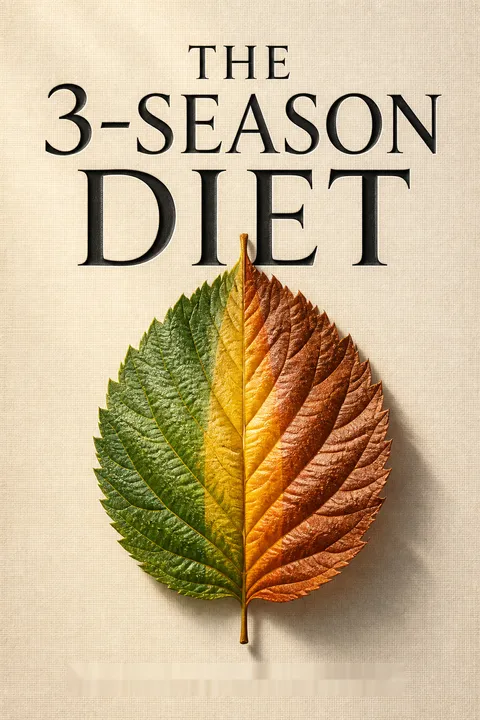
A seasonal framework. Douillard adapts Ayurvedic ideas into three eating seasons: a lighter, lower-fat spring; a fruit-and-vegetable-rich summer; and a more substantial, protein-and-fat-rich winter. He argues that each season supplies a different mix of foods, so no single restrictive diet should govern the whole year. His “seasons” are harvest patterns, not a rule to eat only food grown nearby: foods from other regions are assigned to the season whose qualities they are said to match.
Use the lists loosely. The book offers seasonal shopping lists and sample menus rather than calorie counting. Its practical invitation is to shift what takes up most of the plate as the year changes, while keeping protein, carbohydrates, and fat in the diet. The stated goal is a varied routine that feels sustainable, not a short-term campaign of deprivation.
The model’s memorable strength is its calendar: it replaces daily nutritional arithmetic with a simple prompt to vary food choices over time. Seasonal eating can also connect meals to local agriculture and make produce more varied. But the proposed seasonal nutrient ratios are not established requirements for human health, and global supply chains make harvest calendars less straightforward than the book suggests. The framework is most useful as a flexible way to broaden food choices, not as proof that bodies require a particular macronutrient pattern in each season.
A craving may signal chronic restriction, not weak character
The rebound cycle. The book portrays repeated restriction as a loop: a diet removes foods, hunger and cravings intensify, the person overeats the forbidden foods, then guilt prompts another diet. Douillard argues that this cycle can leave people feeling exhausted and preoccupied with food instead of teaching them a stable way to eat.
Jason’s case. Jason, a stressed executive with bipolar depression, had tried a high-protein diet and reported feeling constantly hungry and craving sweets and carbohydrates. His story illustrates the author’s central claim that weight, mood, stress, and eating habits can interact. Douillard interprets the cravings as a response to restriction and stress, not a character flaw. The case is an illustration, not evidence that diet can replace psychiatric care or prescribed treatment.
This reframing offers a useful alternative to moral judgment. Research on restrained eating and disinhibition broadly supports the idea that rigid food rules can make eating more psychologically charged, although it does not establish that every craving is a nutritional signal. The distinction matters: a craving can reflect habit, emotion, availability, or hunger. Jason’s story also demands care because bipolar disorder is a serious condition. Nutrition and routine may support wellbeing, but they cannot be treated as substitutes for clinical assessment or medication decisions.
Move your biggest meal toward midday and make evenings lighter
Feed the working day. Douillard recommends making lunch the most substantial meal and treating supper as a smaller, optional supplement. He reasons that people are more active during daylight and that a satisfying lunch may reduce afternoon cravings and the urge to eat heavily at night. The book cites traditional Mediterranean meal patterns, where lunch was often lengthy and dinner comparatively light, as an example of this rhythm.
A personal observation. Douillard recounts that an Ayurvedic physician advised him to eat a large, relaxed lunch after he reported high blood pressure. He says his readings later normalized, but this single-person account cannot establish that lunch caused the change. The practical experiment is to notice energy and hunger after different meal schedules, without assuming that one schedule suits everyone.
Meal timing is a more defensible and testable idea than the book’s larger claims about seasonal metabolism. Circadian biology shows that the body’s handling of food varies across the day, making earlier eating a plausible option for some people. Still, work shifts, family care, medication, appetite, and culture shape what is feasible. The lesson is not that dinner is inherently harmful, but that a skipped or rushed lunch can leave some people overly hungry by evening. Personal observation is helpful, while anecdotes should not be mistaken for clinical proof.
Give meals your attention instead of eating beside another task
Eating as an activity. The book argues that food is easier to enjoy when it is not competing with driving, television, paperwork, or a phone call. Douillard describes digestion as a process that begins with sensory cues: seeing, smelling, and tasting food prepare the body for eating. He recounts a meal of pizza eaten while driving that left him unusually tired, unlike similar food eaten calmly with colleagues.
Slow the experience. An Indian teacher’s advice to rest briefly after a large meal gives the chapter a practical ritual: pause, let the meal settle, and take a short walk if appropriate. The claim that distraction directly disrupts digestion is stronger than the anecdote can prove, but focused eating can make it easier to notice satisfaction and stop when full.
The useful insight here is attentional, not mystical. Mindful-eating approaches similarly ask people to notice taste, pace, and fullness rather than consuming food on autopilot. That can improve awareness without requiring elaborate rituals or special equipment. At the same time, a calm meal does not guarantee perfect digestion, and stress is not the explanation for every digestive symptom. The advice is best understood as a way to make eating more deliberate and pleasurable, rather than as a substitute for medical evaluation when discomfort persists.
Personalize seasonal eating, but treat body types as a heuristic
Three constitutions. Douillard classifies people as winter, summer, or spring types, or combinations of these. In his model, winter types are often cold and dry, summer types run hot, and spring types are heavier and retain more water. He links these descriptions to Ayurvedic concepts and to William Sheldon’s older somatotyping system, then suggests using a questionnaire to identify a dominant type.
Adjust, do not label. The proposed use is to fine-tune the seasonal food lists. A person who tends to feel hot might emphasize cooling choices during hot weather, while someone who feels cold might favor warmer foods. This is a traditional framework for observing patterns, not a validated diagnostic system. The book’s practical point is that people differ; the categories themselves should not be treated as precise biological facts.
Personalization is valuable when it means attending to appetite, tolerance, climate, and lived experience. The body-type system gives readers a vocabulary for those observations and resists one-size-fits-all diet rules. Its weakness is the leap from temperament or body shape to specific nutritional needs: Ayurveda’s seasonal constitutions and Sheldon’s somatotypes are not modern clinical tools for prescribing diets. The framework works best as a prompt for noticing patterns, then checking whether an adjustment actually helps, rather than as an explanation that overrides evidence or individual medical needs.
Make weight changes gradual enough to avoid turning dinner into punishment
A staged approach. The book’s weight-balancing program begins with a large, satisfying midday meal and progressively reduces evening food. Its first stage suggests soup, salad, or fruit at supper; the next limits evening intake to liquids; its most restrictive stage extends the gap between lunch and breakfast. Douillard says to advance only when the change feels easy, and to return to a less restrictive stage when it does not.
The 51 Percent Rule. This named principle says that following the routine more often than not is preferable to striving for perfect compliance. That can reduce all-or-nothing thinking. However, the advanced fasting and high-water-intake advice is not a safe universal plan. Prolonged fasting or excessive water consumption can pose risks, and significant dietary changes should be discussed with a qualified clinician, especially for people with health conditions or medications.
The strongest element is behavioral pacing: gradual changes are easier to evaluate and less likely to turn every meal into a test of willpower. The 51 percent idea also anticipates a central lesson of behavior change research: consistency matters more than flawless execution. The proposed fasting phase is a different matter. Hunger, health status, and medication needs vary, so an unsupervised fast should not be presented as a broadly suitable weight-loss tool. Readers can keep the gradual, non-punitive principle without adopting every protocol in the book.
Use breathing to pace exertion, not to promise automatic fat loss
The breath as a monitor. Douillard teaches “whole lung” breathing, using deep nasal inhalations and controlled exhalations while walking or exercising. His “Darth Vader breathing” adds a quiet throat sound during exhalation. He recommends slowing down when the breath becomes shorter or the mouth opens, then resuming at a comfortable pace. The method is meant to make exercise feel calmer and to help the person notice the boundary between manageable effort and strain.
The author’s explanation. He links lower-lung breathing to calming nervous-system activity and argues that lower-intensity exercise favors fat use as fuel. The breathing routine may help some people regulate pace, but it does not guarantee fat loss. The book also advises stopping if exercise causes pain or serious discomfort and consulting a physician about exercise concerns.
Breathing can be a practical feedback tool: if speech or nasal breathing becomes difficult, easing the pace is a sensible way to avoid turning every workout into a maximal effort. The book’s more dramatic physiology is less secure. The lungs do not contain a simple division in which upper regions create stress and lower regions create calm, and the fuel burned during one workout does not by itself determine long-term fat loss. The durable idea is to choose activity that can be repeated, monitor exertion, and avoid treating pain as proof of progress.
Align meals and movement with daylight, while respecting real schedules
A daily seasonal cycle. Douillard divides the day into repeating winter, spring, and summer-like periods. He recommends waking early, moving during the morning, eating the main meal around midday, and keeping evenings quieter with lighter food. He connects this schedule to circadian rhythms, the roughly 24-hour patterns in sleep, hormones, and other bodily processes.
A flexible routine. The book argues that late meals and late nights can leave people feeling sluggish the next morning. Its advice is to test a more daylight-aligned schedule and observe energy, appetite, and sleep. The exact clock times in the book are not universal biological deadlines: seasonal daylight, shift work, caregiving, and personal chronotype can all change what a workable routine looks like.
This is one of the book’s clearest bridges between traditional observation and contemporary biology. Light exposure and regular sleep timing help organize circadian rhythms, and meal timing may also interact with those rhythms. That supports experimentation with earlier routines, not a single mandatory bedtime or breakfast hour. The author’s daily-season map is evocative, but its precise time blocks should be treated as a metaphor rather than a proven physiological timetable. A routine that protects sleep and fits a person’s responsibilities is more useful than rigid adherence to a clock.
Choose seasonal whole foods you enjoy, not a flawless food identity
Make the plan livable. The seasonal lists and menus include fruits, vegetables, grains, beans, nuts, dairy, and meat in changing proportions. Douillard repeatedly recommends increasing foods associated with the current season rather than treating every out-of-season item as forbidden. He favors freshly prepared foods over heavily processed meals and encourages readers to choose organic produce and support local farmers when possible.
Pleasure is part of adherence. The Mediterranean example matters not only because of its ingredients, but because meals are treated as social, leisurely occasions. The author’s rule is pragmatic: a plan people dislike is unlikely to last. His concerns about food processing, pesticides, and agricultural practices reflect the book’s 2000 context; specific claims about food production and safety should be checked against current evidence and local standards.
Enjoyment and convenience are not frivolous extras. They influence whether a dietary pattern can be sustained, and shared meals can make eating less hurried and more social. The emphasis on whole foods also keeps the reader focused on food quality rather than a single nutrient villain. Still, “natural” and “seasonal” do not automatically mean safer or more nutritious, and organic food is not a guarantee of health. The sensible extension is to prioritize variety, taste, affordability, and trustworthy sourcing instead of building an identity around dietary purity.
Analysis
The book’s most coherent contribution is not its seasonal physiology, but its attack on the punitive logic of dieting. Its central character, Jason, arrives depleted by restriction, stress, and cravings. That case sets up the book’s recurring alternative: eat satisfying food, pay attention to timing, make changes gradually, and choose exercise that does not feel like punishment. The seasonal menus, large-lunch principle, and 51 Percent Rule translate that alternative into routines readers can test. The narrative is effective because it repeatedly connects abstract advice to patients, family meals, and the author’s own habits.
The evidence, however, needs to be separated from the practical ideas. Published in 2000, the book presents an Ayurvedic framework as if seasonal food categories map directly onto human metabolic requirements. That is a useful organizing metaphor, not an established nutritional law. Its claims that restrictive diets trigger a specific cortisol-insulin-fat-storage cycle, that lower-lung breathing directly induces fat burning, and that a particular seasonal diet prevents cravings simplify complex physiology. The argument about exercise also conflates which fuel is used during a workout with what determines weight change over time. Patient stories, including rapid weight loss and improved blood pressure, illustrate the author’s experience but do not prove causation.
The book is strongest when read as behavioral advice rather than medical prescription. Satisfying meals, less distracted eating, manageable exercise, and attention to sleep can support a healthier routine. Its prescriptive fasting phase, large water intake, and supplement recommendations require particular caution and should not be copied without clinical guidance. The author himself opens with a recommendation to consult a physician before starting a diet or exercise program. A modern reader can retain the humane message, stop treating every craving as moral failure, while questioning claims that rely on tradition or anecdote instead of robust evidence.
Review Summary
The 3-Season Diet receives mostly positive reviews, with readers praising its sensible approach to eating seasonally and incorporating Ayurvedic principles into Western lifestyles. Many found the book's ideas logical and experienced improved health, energy, and sleep after implementing its recommendations. Some readers appreciated the emphasis on relaxation and breathing techniques. Critics noted that the book could be repetitive and oversimplify complex ideas. Overall, readers found the book informative and practical for those interested in holistic health and nutrition.
People Also Read

Glossary
3-Season Diet
Seasonal eating frameworkDouillard’s eating plan organizes the year around three harvest periods rather than four conventional seasons. It emphasizes lighter, lower-fat foods in spring, more fruits and vegetables in summer, and more protein- and fat-rich foods in winter. The author presents the categories as a flexible pattern for varying foods across the year, not as a requirement to eat only locally grown produce.
Recommended Annual Allowance
Yearly nutrient balanceThe author’s phrase for the idea that nutritional needs should be considered across a year rather than measured only day by day. In the book, it supports the 3-Season Diet’s changing proportions of protein, fat, and carbohydrates. It is a rhetorical contrast with daily recommended allowances, not a formal medical standard or recognized nutritional guideline.
survival response
Stress-linked emergency reactionDouillard’s term for the body’s response to perceived starvation or stress. He describes it as a hormonal state in which the body releases stored sugar, increases cravings for quick energy, and favors storing fat. The book uses this model to explain why severe restriction may backfire. It is the author’s broad explanatory framework, not a complete or universally accepted account of weight regulation.
Hurricane Effect
Calm during exertionThe author’s name for the experience of maintaining a calm mental state while producing substantial physical effort. He associates it with deep nasal breathing and gradual exercise, using the image of a powerful storm organized around a calm center. The term describes an intended subjective experience and training goal, not a recognized medical condition or a proven mechanism for weight loss.
whole lung breathing
Deep, coordinated breathingDouillard’s breathing method emphasizes filling the lungs deeply through the nose and coordinating the diaphragm, rib cage, and abdomen. During exercise, the practitioner tries to preserve a slow, steady breathing rhythm and eases the pace when breathing becomes short or strained. The book distinguishes this from shallow upper-chest breathing and presents it as a way to remain calm under exertion.
Darth Vader breathing
Controlled throat exhalationA breathing variation the author names for the audible sound made during exhalation. The mouth remains closed while air is exhaled through the nose, with a gentle constriction at the back of the throat producing a low, respirator-like sound. Douillard uses it during exercise to encourage a controlled exhale. It is an optional technique, not necessary for ordinary breathing.
51 Percent Rule
Majority, not perfectionThe author’s principle that following the eating plan more than half the time is more useful than demanding perfect adherence. It is intended to make the program workable around family meals, work schedules, and occasional exceptions. The rule lowers the pressure to treat one deviation as failure and supports a focus on repeated habits rather than flawless compliance.
Oxygen Mask Principle
Meet needs before caregivingDouillard’s analogy for taking care of one’s own nutritional needs before trying to manage everyone else’s. Like the airplane instruction to secure an adult’s oxygen mask before helping a child, the principle suggests that a parent or caregiver who eats a satisfying meal may be calmer and more attentive at family dinner. It is a practical metaphor, not a nutrition technique.
Weight-Balancing Program
Phased meal-timing planThe book’s weight-loss program combines seasonal eating with a large midday meal and progressively lighter evening intake. It advances through stages, from soup, salad, or fruit at supper to more restrictive evening intake and an extended overnight fast. The author says to proceed only if the changes feel effortless. Its fasting and hydration directions are not appropriate for everyone and require medical caution.
Download PDF
Download EPUB
.epub digital book format is ideal for reading ebooks on phones, tablets, and e-readers.








