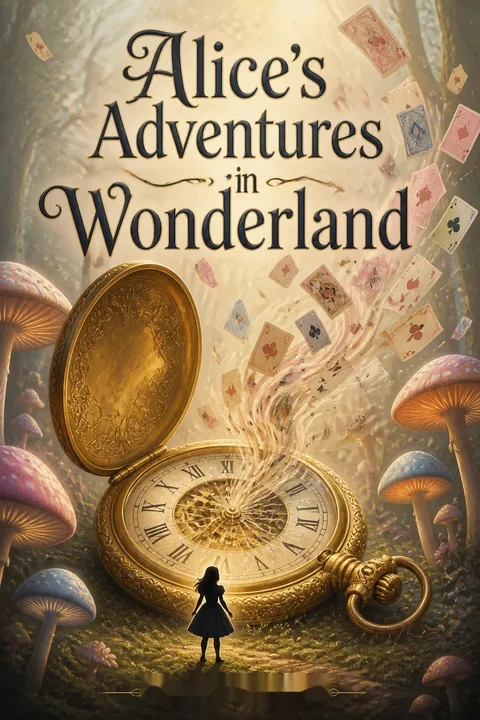


Plot Summary
The Rabbit-Hole Descent
Bored beside her sister on a warm afternoon, Alice follows a White Rabbit who hurries past with a watch and a sense of urgency. His burrow becomes a deep shaft lined with shelves, and Alice falls so slowly that she has time to speculate about geography, her cat Dinah, and what might await below. She lands unharmed, follows the Rabbit into a lamp-lit hall, and finds every door locked.
A tiny golden key opens a door too small for her to enter, though its garden beyond is irresistible. A bottle on a glass table shrinks her to a size that should fit. Then she discovers she has left the key out of reach, and a cake she eats brings no immediate change. Her curiosity has delivered her into a puzzle with no usable exit.
Alice's first decision is not a considered escape from ordinary life but a response to a small breach in it: a rabbit behaving like a hurried adult. The fall turns curiosity into physical vulnerability, while the hall transforms Wonderland into a problem of access. Alice can see the garden but cannot enter it, and every apparent solution depends on a body that will not hold still. Her practical habits remain active: she checks for poison, reasons through possible outcomes, and tries to advise herself. Yet familiar competence no longer guarantees control. The opening establishes the book's central tension between a child's confidence in rules and a world that keeps changing what those rules can accomplish.
A Pool Made of Tears
The cake makes Alice grow until she fills the hall, and the golden key remains uselessly small in her hand. When the White Rabbit returns, he mistakes her for his servant and flees after she tries to speak to him. Holding his fan makes Alice shrink again, and she drops it before she disappears altogether.
She slips into the pool formed by her earlier tears, where she meets a Mouse and other soaked animals. On shore, the Dodo organizes a pointless race and awards prizes to everyone, including Alice. She tries to hear the Mouse's history but misreads its story and drives it away. Her casual praise of Dinah as a hunter frightens off the birds as well, leaving Alice alone again in a strange landscape.
The pool gives Alice's feelings a literal consequence: tears become terrain she must swim through. Yet the episode does not make emotion a simple lesson in self-control. Alice repeatedly scolds herself for crying, then finds that sternness cannot restore the key, her size, or companionship. Her attempts to connect are equally unstable. She uses schoolroom French with the Mouse, misunderstands its story, and speaks of Dinah in terms that alarm the birds. The Dodo's race offers belonging without meaningful achievement, a comic counterpart to the hall's practical obstacles. Alice is learning that good intentions do not ensure understanding, and that social rules in Wonderland are as changeable as her body.
A Rabbit's Impossible House
The White Rabbit mistakes Alice for his housemaid and sends her to retrieve gloves and a fan. At his home, she drinks from an unlabeled bottle and grows until she is trapped inside the rooms. The Rabbit and his servants try the door, window, and chimney; when the lizard Bill is sent down the flue, Alice kicks him back out.
Pebbles thrown through the window turn into little cakes, and eating one finally shrinks her enough to escape. In the wood, an enormous puppy nearly tramples her during its playful pursuit of a stick, so Alice waits until it loses interest and runs on. Still unsure how to regain her proper size, she climbs a mushroom to inspect its top and meets a smoking Caterpillar.
The house episode turns Alice's earlier size changes into a problem that affects other bodies. The Rabbit's household treats her as a servant, then as an intruder to be removed, while Alice's accidental power makes the people outside look physically helpless. Her kick sends Bill flying, but she does not pursue harm; she uses the cakes to get free and leaves the household behind. The puppy sharpens this instability from another angle: its play is harmless by its own scale, yet dangerous to Alice. Wonderland's threats often arise from mismatched perspectives rather than deliberate cruelty. By the time she climbs the mushroom, Alice has gained experience improvising, but not a reliable method.
The Caterpillar's Mushroom
The Caterpillar challenges Alice to explain who she is, but her repeated changes in size and altered recitation of a familiar lesson leave her unable to give a stable answer. When she asks for help controlling her height, the Caterpillar points out that opposite sides of its mushroom will make her grow or shrink. Alice tests both pieces, first rising until her neck towers above the trees.
A Pigeon attacks, mistaking her long neck for a serpent's threat to its eggs. Alice insists she is a child, though even she finds that claim harder to defend after so many transformations. By nibbling the mushroom in turns, she brings herself back to her usual height, then reduces herself again when she finds a small house in the wood.
The Caterpillar refuses to treat Alice's confusion as a crisis, which frustrates her but also shifts the encounter away from reassurance. Its practical instruction does not answer the deeper question of identity; it gives Alice a way to manage one consequence of change. The Pigeon's fear shows how quickly appearance can overrule self-description. Alice's claim to be a girl depends on a shared category, but the Pigeon judges her by her neck and behavior. Her return to familiar size is therefore a modest achievement, not a final resolution. She can use the mushroom deliberately now, yet she still adjusts herself to fit the next place she wants to enter.
Pepper, Plates, and a Cat
At the Duchess's house, a Fish-Footman delivers the Queen's croquet invitation while a Frog-Footman treats the noisy kitchen as no reason to open the door. Inside, pepper fills the air, the Cook throws dishes, and the Duchess handles her shrieking baby roughly before handing it to Alice. As Alice carries it outside, its face and grunts reveal that it is becoming a pig, so she sets it down and lets it run into the wood.
A grinning Cheshire Cat appears in a tree and offers no map, only the point that Alice's direction depends on where she wants to go. It identifies the nearby homes of the Hatter and March Hare, then vanishes and reappears. Alice chooses the March Hare's house, lowering herself with the mushroom before approaching.
The kitchen brings Wonderland's nonsense close to bodily harm. The Duchess and Cook behave as if the baby's distress were ordinary, while Alice's instinct is to protect it. Her eventual decision to set it down is an act of recognition: she stops insisting that the creature remain a child once its body has changed. The Cheshire Cat, by contrast, makes no promise of rescue. Its response exposes a gap between movement and purpose: Alice can go somewhere without knowing what destination would satisfy her. The cat's disappearing body also makes uncertainty visible, but Alice is no longer startled by every impossible event. She has begun to treat strangeness as information, even when it gives her no clear answer.
Tea Without an Ending
At the March Hare's table, Alice finds the Hatter and a sleeping Dormouse crowded into an endless tea service. Their riddles, personal remarks, and shifting claims about meaning frustrate her, while the Hatter's watch tracks the day but not the hour. He explains that after a quarrel with Time, the clock has remained at six, forcing the company to keep moving around the table and reuse its cups.
The Dormouse's story about three sisters who live at the bottom of a well becomes another maze of literal questions and evasions. When the Hatter insults Alice's confusion, she leaves. A door in a tree returns her to the glass table and the garden passage. This time she uses the key and mushroom carefully, and finally enters the garden.
The tea party turns language into a social trap. Alice arrives expecting hospitality, but the hosts redefine courtesy whenever she challenges their claims. Their stalled clock gives physical form to the conversation: nothing progresses, and the same service must repeat. Alice's departure is a significant choice because she stops trying to earn a place at a table whose rules shift to keep her wrong. The route back to the hall rewards a different kind of learning. She remembers the key and mushroom, uses them in sequence, and reaches the garden without waiting for Wonderland to make itself intelligible. Her increased agency is practical rather than triumphant: she learns how to act amid confusion, not how to eliminate it.
The Queen's Croquet Court
Three card gardeners are painting white roses red because they planted the wrong tree and fear the Queen of Hearts will punish them. When the royal procession arrives, the Queen threatens Alice and the gardeners, but Alice refuses to accept her authority; she hides the gardeners in a flowerpot while the soldiers search.
The White Rabbit tells her that the Duchess is under sentence for striking the Queen. Croquet begins with live hedgehogs, flamingos, and soldiers serving as arches, so the game dissolves into quarrels and fresh execution orders.
The Cheshire Cat appears above the grounds, and the King demands its removal. Alice is asked to judge whether a head without a body can be beheaded. Before anyone can resolve the dispute, the Cat vanishes, and the court returns to its chaotic game.
The garden makes political authority theatrical: the gardeners repaint a mistake rather than confess it, and the Queen's procession treats punishment as routine. Alice's refusal to bow, followed by her protection of the gardeners, marks a sharper independence than her earlier self-corrections. Still, her courage is situational, not invulnerability; the croquet game surrounds her with arbitrary threats. The Cheshire Cat's head dispute exposes the court's dependence on categories it cannot consistently apply. The King, Queen, and executioner argue from incompatible assumptions, while Alice is expected to make the problem disappear. Her practical suggestion redirects them but cannot reform the institution. In this garden, power appears loud and absolute, yet repeatedly proves unable to make its own logic cohere.
The Duchess and the Turtle
The Duchess joins Alice and fills their walk with morals that change shape whenever Alice questions them. Their conversation ends when the Queen appears and threatens the Duchess, who immediately flees.
The Queen takes Alice back toward the croquet ground, where players are arrested for minor failures; the King quietly pardons them after the Queen leaves. The Queen then sends Alice with the Gryphon to meet the Mock Turtle. The Gryphon explains that the Queen's executions are threats, not completed killings, and introduces the turtle as a creature mourning an imagined past.
The Mock Turtle recalls his underwater schooling, where ordinary lessons and school subjects have been recast as sea-themed nonsense. Alice's questions repeatedly irritate both listeners, but she remains to hear how this strange education shaped him.
The Duchess's shifting morals parody the adult habit of turning every event into a lesson, even when the lesson does not fit. Alice resists by testing the logic rather than accepting the authority behind it. The Queen's entrance shows how quickly the Duchess's confidence collapses under real power. The Gryphon then revises the apparent danger of the court: executions dominate the Queen's speech, but the creatures are not actually being killed. That correction does not make the Queen harmless; it reveals that fear itself is part of her rule. The Mock Turtle's school memories recast education as both an institution and a vocabulary game. Alice listens, but her questions keep exposing the limits of the creatures' own explanations.
The Lobster Quadrille
The Mock Turtle and Gryphon demonstrate the Lobster Quadrille, a dance of lines, partners, thrown lobsters, and somersaults. Their exuberance quickly gives way to the Mock Turtle's sadness, and he explains sea life through puns that leave Alice trying to separate wordplay from fact.
At their request, she recounts the day's adventures, then attempts familiar school verses whose words come out changed. The Mock Turtle and Gryphon press her to explain each alteration, though she cannot. The Mock Turtle begins a song about soup, but a distant announcement interrupts it.
The Gryphon takes Alice by the hand and hurries her toward the Queen's court. The story she has spent the day trying to understand is now carrying her into a formal trial, where Wonderland's language games will become evidence.
This episode gathers the book's recurring mismatch between what words say and what bodies do. The dance requires energetic movement, but its description is built from verbal transformations; the Mock Turtle's sorrow returns as soon as the performance ends. Alice's altered recitations repeat her earlier difficulty with remembered lessons, now made explicit to the creatures who demand explanations from her. She has no authority over the changes, and she cannot produce a stable interpretation just because an audience requests one. The abrupt summons to court converts this problem into a new setting. Wonderland's wordplay will no longer be only social entertainment; the next scene will use it to decide guilt, despite the absence of reliable evidence.
A Verdict Made of Cards
The Knave of Hearts stands accused of stealing the Queen's tarts, but the King presides over a trial where jurors write down insults, the Hatter gives confused testimony, and the Cook refuses to answer questions. Alice grows larger as proceedings drag on and is called as a witness.
The King invents a rule to remove her, then treats an unsigned verse with no clear meaning as proof against the Knave. Alice points out that the poem establishes nothing, and rejects the Queen's demand for a sentence before a verdict.
When the Queen orders her execution, Alice has grown to full height and calls the court what it is: a pack of cards. They fly at her, and she wakes beside her sister on the riverbank. After hearing the dream, her sister imagines Alice grown up and sharing stories with children.
The trial is the book's clearest collision between authority and evidence. The King converts confusion into procedure, the Queen demands punishment before judgment, and the jurors record whatever they hear without evaluating it. Alice's growth changes her relation to the court physically and psychologically: she can no longer be managed by its invented rules. Naming the cards reduces their threat, and waking reveals the entire adventure as a dream without making its emotional texture disappear. The sister's closing imagination carries Alice's childhood forward into a possible future of storytelling. The ending does not solve Wonderland; it frames the dream as something that can be remembered, shared, and transformed into meaning by another listener.
Analysis
Alice's Adventures in Wonderland makes childhood uncertainty literal. Alice's body changes without warning, adults and animals misrecognize her, and familiar lessons return with their language scrambled. These disturbances do not simply mock a child's limited knowledge. They expose how much ordinary life depends on shared conventions: a name, a rule, a classroom subject, or a court procedure works only while other people agree to treat it as stable. Wonderland's inhabitants often insist on rules most forcefully when those rules serve their immediate convenience. The Queen orders punishment without proportion; the King invents procedure as the trial unfolds; the tea party's hosts invoke manners while refusing ordinary hospitality.
Alice's response is neither pure rebellion nor passive bewilderment. She continues to reason, correct, and ask questions, even when those habits fail to make her welcome. Her strongest moments come when she stops granting authority automatic legitimacy: she protects the gardeners, leaves the tea party, and challenges the court's interpretation of evidence. Yet her development is practical rather than triumphant. She learns to use the mushroom, remember the key, and adapt to changing scale, but she never gains a master rule for Wonderland. The book treats uncertainty as something to navigate, not something a clever child can permanently solve.
The dream ending gives that uncertainty a tender frame. Alice wakes, but her sister's imagination reanimates the creatures and carries them toward a possible future of shared storytelling. The adventure's meaning does not depend on deciding whether each episode was sensible. It depends on the attention Alice brings to it, and on the sister's willingness to listen. Carroll's comedy therefore has a serious edge: it asks who gets to define sense, whose explanations count, and what a child can do when the rules change. Alice's answer is to keep looking closely, speak when a claim is plainly wrong, and preserve the experience by telling it.
Review Summary
Alice's Adventures in Wonderland is a beloved classic that captivates readers with its imaginative world and quirky characters. Many praise Carroll's wit, wordplay, and logical absurdities, finding new layers of meaning with each read. Some view it as pure nonsense, while others see deeper themes of identity and growing up. The vivid illustrations are often highlighted as enhancing the reading experience. While some find Alice frustrating, most enjoy the whimsical journey through Wonderland and its enduring cultural impact.
People Also Read



Characters
Alice
Curious rule-testerAlice is an observant child whose curiosity is stronger than her caution, though she does try to apply lessons from home when danger appears. She reasons aloud, remembers schoolwork, and expects words to mean what they ordinarily mean. Wonderland repeatedly unsettles those habits through bodily changes, contradictory manners, and arguments that sound logical but lead nowhere. Alice can be impatient, proud of what she knows, and quick to correct others, yet she also tries to soothe the Mouse, protect the gardeners, and care for the Duchess's baby. Her defining resource is not mastery but adjustment: she keeps asking questions and revising her approach when familiar rules fail.
Alice's sister
Quiet waking-world anchorAlice's older sister sits with her beside the river, absorbed in a book without pictures or conversation. Her quiet presence frames Alice's adventure against an ordinary afternoon and offers a contrast to Wonderland's incessant demands. She is attentive and affectionate, though she does not enter Alice's dream or direct its events. Her imaginative response to Alice's account suggests that listening can extend a child's private experience rather than dismiss it. She represents a form of adult care that makes room for wonder without needing to explain it away.
White Rabbit
Harried heraldThe White Rabbit is an anxious, watch-checking creature whose hurry draws Alice away from the riverbank. He serves the Duchess and moves through Wonderland preoccupied with lateness, lost belongings, and royal business. His authority over Alice is accidental: he mistakes her for his housemaid, and she follows his instructions despite the error. At court he becomes a herald, trying to keep proceedings in order. The Rabbit's nervous deference shows how even minor officials can carry out a system they fear.
Dinah
Beloved pet catDinah is Alice's pet cat in the waking world, remembered for comfort and for hunting small animals. Alice thinks of her during the fall and mentions her while trying to make conversation in Wonderland. Dinah never appears in the adventure itself, but Alice's affection for her reveals a familiar attachment that persists through disorientation.
Mouse
Touchy storytellerThe Mouse swims through Alice's pool of tears and initially takes a leading role among the stranded animals. It is proud, sensitive to the subject of cats, and eager to have its history heard on its own terms. Alice's clumsy attempts at conversation repeatedly offend it, even when she means well. The Mouse's encounter with her shows how quickly a listener's assumptions can overtake another creature's experience.
Dodo
Ceremonial organizerThe Dodo takes charge when the animals struggle to dry off and invents a race with no clear start, finish, or winner. Its solemn manner gives an arbitrary activity the appearance of official procedure. The Dodo reflects Wonderland's taste for ceremonies that create participation without solving the problem that prompted them.
Caterpillar
Unhurried questionerThe Caterpillar sits on a mushroom smoking a hookah and demands that Alice explain who she is. It is terse, self-contained, and unmoved by Alice's distress about changing size. Rather than offer comfort, it gives her practical knowledge about the mushroom. Its questions force Alice to confront how little her usual labels help when memory, language, and body all seem unreliable.
Pigeon
Egg-guarding accuserThe Pigeon guards its eggs and sees Alice's long neck as evidence that she is a serpent. It is exhausted by the danger it believes surrounds its nest and reacts before listening carefully. Its fear makes Alice's altered appearance a social problem, not merely a private inconvenience.
Duchess
Volatile moralizerThe Duchess presides over a pepper-filled, disorderly household and speaks as though every event must yield a moral. Her manner shifts dramatically with her surroundings and with the people who hold power over her. She can be harsh toward the baby and ingratiating with Alice, while her stream of lessons often contradicts itself. Through her, the book makes moralizing feel less like wisdom than a performance that can disguise poor judgment.
Cheshire Cat
Vanishing guideThe Cheshire Cat appears in the woods and speaks to Alice in composed, teasing riddles. It does not choose her destination or promise to lead her safely, but it makes her examine what she wants before deciding where to go. Its ability to appear and disappear makes it difficult to treat as a stable guide. The cat is useful precisely because it offers perspective without pretending to offer certainty.
March Hare
Endless tea hostThe March Hare hosts the tea party with the Hatter and the Dormouse, where hospitality becomes a contest over manners and meaning. He is quick to challenge Alice's assumptions but does not offer a coherent alternative. His restless participation helps sustain the party's stalled routine. The Hare's behavior makes him both an antagonist to ordinary conversation and a willing partner in its absurdities.
Hatter
Clock-bound riddlerThe Hatter is a tea-party host whose watch, riddles, and conversation resist ordinary interpretation. He treats Alice's corrections as further opportunities to unsettle her and remains bound to a timekeeping problem of his own making. At court, his nervousness replaces his earlier confidence. His character connects verbal play with social power: he can unsettle others in conversation, but he is not secure when questioned by authority.
Dormouse
Sleepy captive listenerThe Dormouse is repeatedly used as a cushion by the Hatter and March Hare, then roused to contribute a story. It is drowsy, easily interrupted, and often treated as an object before it is treated as a conversational partner. Its unfinished tale mirrors the difficulty of getting a clear account from Wonderland's inhabitants.
Queen of Hearts
Punishment-hungry rulerThe Queen rules through anger, orders, and the constant threat of execution. She reacts to small mistakes as if they were attacks on her authority, and her court quickly adopts her temper as its operating principle. Her forceful presence frightens the other creatures, but her commands do not produce a stable or orderly world. She represents authority that demands obedience without offering consistent rules.
King of Hearts
Fumbling judgeThe King of Hearts sits beside the Queen and presides over the court's proceedings. He is eager to make rules and interpret evidence, but his reasoning bends to convenience and confusion. His attempts to sound authoritative reveal how procedure can continue even when nobody understands what it is meant to establish. He is less openly threatening than the Queen, yet he helps sustain the same arbitrary system.
Knave of Hearts
Accused courtierThe Knave is a royal servant brought before the court in chains. His position makes him vulnerable to a process controlled by the King and Queen, while the evidence surrounding him remains uncertain. He has little power to shape the proceedings and must watch others decide what his actions mean.
Mock Turtle
Melancholy storytellerThe Mock Turtle is a sorrowful creature who recalls an underwater education and speaks of school as both memory and wordplay. He wants an audience for his history, but his explanations often deepen Alice's confusion. His sadness persists even when the Gryphon treats it as theatrical. The character links nostalgia with the unsettling way familiar institutions can be remade through language.
Gryphon
Blunt escortThe Gryphon escorts Alice from the Queen to the Mock Turtle and later hurries her toward the trial. It is impatient with digressions and often interrupts the Turtle, but it also gives Alice practical context about the Queen's threats. Its directness offers a partial counterweight to Wonderland's evasions, though it remains impatient with questions that complicate its answers.
Bill the Lizard
Unlucky servantBill is a lizard employed by the White Rabbit's household and later appears among the court's jurors. Other creatures send him into dangerous situations or treat his difficulties as a spectacle. His recurring presence gives Wonderland's chaos a small, vulnerable human scale.
The baby
Distressed household childThe baby belongs to the Duchess and is surrounded by pepper, noise, and careless handling. Alice's concern for its welfare contrasts with the household's indifference. Its presence tests Alice's instinct to protect someone smaller and more helpless than herself.
Plot Devices
Changing food and mushroom
Unstable bodily scaleBottles, cakes, and pieces of mushroom alter Alice's height, repeatedly changing what she can reach, enter, or survive. The effects are not fully predictable at first, so Alice must learn through trial and error. The device converts abstract insecurity into a physical problem: her sense of self remains while her body changes around it. Later, she uses the mushroom more deliberately, showing practical learning without making the transformations fully safe or controllable.
The rabbit-hole and hall
Threshold into disorderThe White Rabbit's burrow carries Alice from an ordinary afternoon into Wonderland, while the dark hall and its locked doors establish the adventure's first concrete obstacle. The tiny garden door gives her a visible destination that she cannot initially reach. The hall later returns as a place Alice can navigate more effectively, turning the setting into a measure of what she has learned. Its repeated appearance links the book's fantastic episodes to Alice's continuing desire to find a way forward.
Unstable language
Logic turned sidewaysWonderland's inhabitants use riddles, literal readings, puns, altered lessons, and contradictory rules to unsettle ordinary communication. Alice's habit of taking words seriously lets her spot mistakes, but it also leaves her vulnerable when others change the meaning of a conversation midstream. The device shapes episodes from the Mouse's tale to the tea party and courtroom. It is not merely decoration: language becomes a means of excluding, confusing, and sometimes controlling Alice, while her questions keep testing whether any shared meaning remains.
The Queen's court
Authority without evidenceThe Queen's threats and the King's improvised legal procedures turn Wonderland's arbitrary power into a recurring social structure. At the croquet ground, mistakes invite execution orders; in court, jurors copy words before a case has been made and the King treats an obscure verse as evidence. These episodes build toward Alice's challenge to a process that puts punishment ahead of proof. The court device shows how rules can appear official while remaining inconsistent, and how fear can secure compliance even when authority cannot justify itself.
The dream frame
Wonderland held in memoryAlice's adventure takes place within a dream, which becomes clear when the playing cards fly at her and she wakes beside her sister. The frame gives the impossible changes a coherent boundary without reducing their emotional force. Alice can recount the experience, and her sister imagines its creatures and carries the story into a future where Alice may share it with children. The device connects solitary fantasy to listening and memory: the dream ends, but the act of telling keeps Wonderland available beyond the riverbank.
FAQ
Synopsis & Basic Details
What is Alice's Adventures in Wonderland about?
- A Curious Girl's Journey: Alice, a young girl, follows a White Rabbit down a rabbit hole and enters a fantastical world called Wonderland.
- Encountering the Absurd: She experiences a series of bizarre and illogical events, meeting strange creatures and navigating nonsensical situations.
- Quest for Understanding: Alice's journey is a quest to make sense of this new world, grappling with her own identity and the rules of Wonderland.
Why should I read Alice's Adventures in Wonderland?
- Timeless Imagination: The book offers a unique and imaginative world that continues to captivate readers of all ages with its whimsical characters and situations.
- Exploration of the Absurd: It challenges conventional logic and invites readers to embrace the nonsensical, offering a fresh perspective on reality.
- Themes of Identity and Growth: Alice's journey explores themes of identity, change, and the struggle to find one's place in a confusing world, making it a thought-provoking read.
What is the background of Alice's Adventures in Wonderland?
- Victorian Era Context: Written in the Victorian era, the book reflects the societal norms and expectations of the time, while also subverting them through its absurdity.
- Personal Inspiration: Lewis Carroll, a mathematician and logician, drew inspiration from his friendship with Alice Liddell, the real-life Alice, and her sisters.
- Literary Nonsense: The book is a prime example of literary nonsense, a genre that plays with language and logic to create humorous and thought-provoking narratives.
What are the most memorable quotes in Alice's Adventures in Wonderland?
- "Curiouser and curiouser!": This quote encapsulates Alice's sense of wonder and bewilderment as she encounters increasingly strange events in Wonderland.
- "We're all mad here.": The Cheshire Cat's statement highlights the pervasive absurdity and lack of logic that define Wonderland and its inhabitants.
- "Off with her head!": The Queen of Hearts' frequent and irrational command exemplifies the tyrannical and arbitrary nature of power in Wonderland.
What writing style, narrative choices, and literary techniques does Lewis Carroll use?
- Whimsical and Playful Tone: Carroll employs a lighthearted and playful tone, using wordplay, puns, and nonsensical language to create a sense of wonder and absurdity.
- Episodic Narrative Structure: The story is structured as a series of loosely connected episodes, allowing for a variety of characters and situations without a strict plotline.
- Use of Satire and Parody: Carroll satirizes Victorian society and its conventions through the exaggerated characters and situations in Wonderland, often parodying children's literature of the time.
Hidden Details & Subtle Connections
What are some minor details that add significant meaning?
- The "Drink Me" and "Eat Me" Labels: These labels on the bottle and cake are not just instructions but represent the arbitrary nature of rules and the constant changes Alice experiences.
- The White Rabbit's Watch: The watch symbolizes the obsession with time and punctuality, a theme that is constantly subverted in Wonderland's chaotic environment.
- The Playing Card Characters: The fact that the court is made up of playing cards highlights the superficiality and lack of depth in the authority figures of Wonderland.
What are some subtle foreshadowing and callbacks?
- Alice's Initial Fall: The items in the rabbit hole (cupboards, books) foreshadow the intellectual and nonsensical nature of her journey.
- The Caterpillar's Advice: The Caterpillar's cryptic advice about the mushroom foreshadows Alice's continued size changes and her struggle to control her environment.
- Recurring Characters: The reappearance of characters like the Cheshire Cat and the White Rabbit throughout the story creates a sense of continuity and highlights the cyclical nature of Wonderland.
What are some unexpected character connections?
- The Duchess and the Cook: Their chaotic relationship in the kitchen foreshadows the irrationality and violence that pervades Wonderland.
- The Mad Hatter and the March Hare: Their constant tea party and nonsensical conversations highlight the absurdity of social conventions and the fluidity of time.
- The Mock Turtle and the Gryphon: Their shared history and melancholic stories reveal a deeper layer of sadness beneath the surface of Wonderland's whimsy.
Who are the most significant supporting characters?
- The Cheshire Cat: Its philosophical musings and ability to appear and disappear at will make it a guide and commentator on the absurdity of Wonderland.
- The Queen of Hearts: Her tyrannical rule and frequent orders of execution represent the arbitrary nature of power and the dangers of unchecked authority.
- The Mad Hatter: His obsession with time and nonsensical riddles highlight the theme of absurdity and the challenge of finding logic in Wonderland.
Psychological, Emotional, & Relational Analysis
What are some unspoken motivations of the characters?
- The White Rabbit's Anxiety: His constant lateness and fear of the Queen suggest a deep-seated anxiety about authority and a desire to conform.
- The Queen of Hearts' Rage: Her frequent outbursts and orders of execution may stem from a deep insecurity and a need to maintain control.
- The Mad Hatter's Obsession: His fixation on time and the tea party could be a way of coping with his own sense of displacement and the loss of control.
What psychological complexities do the characters exhibit?
- Alice's Identity Crisis: Her constant size changes and encounters with strange characters lead to a psychological struggle with her own identity and sense of self.
- The Mock Turtle's Melancholy: His deep sadness and nostalgic stories reveal a complex emotional landscape beneath his whimsical exterior.
- The Cheshire Cat's Enigmatic Nature: Its philosophical musings and ability to disappear suggest a detachment from reality and a deeper understanding of Wonderland's absurdity.
What are the major emotional turning points?
- Alice's Frustration with the Tea Party: Her growing frustration with the nonsensical conversations and riddles leads to a sense of alienation and a desire to escape.
- Alice's Defiance of the Queen: Her decision to challenge the Queen's authority marks a shift from passive observer to active participant in her own journey.
- Alice's Realization of the Dream: Her final realization that Wonderland is a dream allows her to regain control and return to her own reality.
How do relationship dynamics evolve?
- Alice and the White Rabbit: Their initial encounter is marked by Alice's curiosity and the Rabbit's anxiety, but their interactions become more strained as Alice navigates Wonderland.
- Alice and the Queen of Hearts: Their relationship evolves from one of fear and obedience to one of defiance and challenge, as Alice grows more assertive.
- Alice and the Cheshire Cat: Their interactions are characterized by cryptic advice and philosophical musings, highlighting the Cat's role as a guide and commentator.
Interpretation & Debate
Which parts of the story remain ambiguous or open-ended?
- The Meaning of the Verses: The verses read at the trial are intentionally nonsensical, leaving their true meaning open to interpretation and debate.
- The Nature of Wonderland: Whether Wonderland is a dream, a metaphor, or a separate reality is never fully resolved, allowing for multiple interpretations.
- The Ending's Significance: The ending, where Alice awakens from her dream, leaves open the question of whether her experiences have had a lasting impact on her.
What are some debatable, controversial scenes or moments in Alice's Adventures in Wonderland?
- The Mad Tea Party: The nonsensical conversations and riddles can be interpreted as a critique of social conventions or as a celebration of absurdity.
- The Queen of Hearts' Tyranny: Her frequent orders of execution can be seen as a commentary on the dangers of unchecked power or as a purely whimsical element of the story.
- The Mock Turtle's Sadness: His melancholy and nostalgic stories can be interpreted as a reflection on the passage of time or as a purely emotional element of the narrative.
Alice's Adventures in Wonderland Ending Explained: How It Ends & What It Means
- Alice's Awakening: Alice wakes up from her dream, realizing that her adventures in Wonderland were not real, but a product of her imagination.
- Return to Reality: The ending emphasizes the contrast between the fantastical world of Wonderland and the mundane reality of Alice's everyday life.
- The Sister's Dream: The final scene, where Alice's sister dreams of her adventures, suggests that the power of imagination and storytelling can transcend the boundaries of reality.
Alice's Adventures in Wonderland Series
About the Author

Download PDF
Download EPUB
.epub digital book format is ideal for reading ebooks on phones, tablets, and e-readers.








