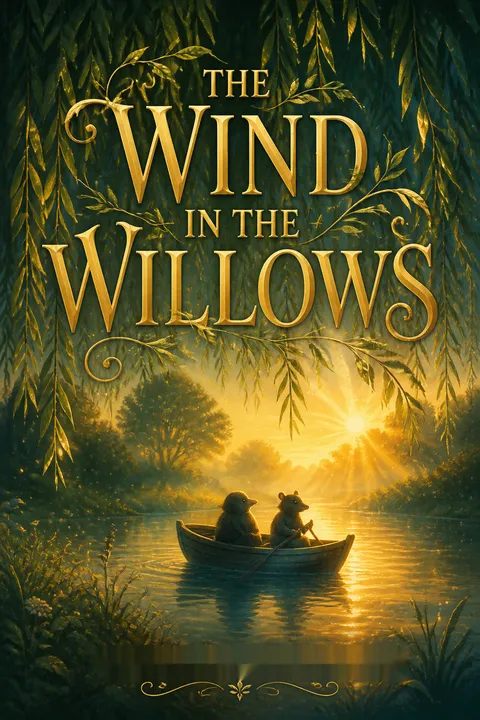


Plot Summary
Spring Opens the Burrow
Mole abandons spring-cleaning and climbs from his underground home into a meadow bright with new growth. At the river he meets Rat, who rows him across and introduces him to boats, the riverbank, and a picnic basket full of food. Mole is enchanted by this unfamiliar life, but his eagerness outruns his skill: when he grabs the oars, the boat overturns and he tumbles into the water.
Rat rescues him, retrieves their scattered belongings, and takes him home to dry by the fire. Seeing Mole's shame, Rat offers him a place to stay and promises to teach him to row and swim. Mole accepts, exchanging his solitary routine for friendship and a wider world.
Mole's departure is not a rejection of home so much as an answer to the pressure of possibility. Spring draws him upward before he knows what he is seeking. His first failure in the boat matters because Rat does not convert embarrassment into exclusion: he rescues, teaches, and makes room. Their friendship begins through practical care, giving Mole a safe way to become inexperienced. The river therefore represents more than freedom. It is a social world whose pleasures are learned through trust, correction, and shared meals.
Toad Chooses the Motorcar
Once Mole has learned the river's routines, he asks Rat to introduce him to Toad, the wealthy owner of Toad Hall. Toad has already abandoned boating and now insists that a painted caravan and the open road will make him happy. Rat objects, but Mole's curiosity persuades him to join the trip.
Their first days expose Toad's habit of leaving work to others, and a speeding motorcar soon sends their horse into a panic, wrecking the caravan in a ditch. Rat and Mole must manage the damage while Toad stares after the car, newly captivated by its speed and noise. They return home without him for long: the next day Toad orders an expensive motorcar, beginning a fixation that his friends cannot dismiss as another passing hobby.
Toad's appetite for novelty is more than fickleness. Each new pursuit promises him a self that feels grander than the last, and the motorcar offers spectacle, speed, and public attention at once. The caravan's destruction should have taught caution, but instead it supplies the image that Toad wants to inhabit. Rat and Mole's concern is affectionate, yet their efforts to accommodate him also help normalize his excess. The episode plants the central conflict between belonging, which requires regard for others, and the intoxicating fantasy of being answerable only to one's own excitement.
Faces in the Wild Wood
When winter closes in, Mole grows restless indoors and sets off alone to find Badger in the Wild Wood, despite Rat's warnings. At first the bare trees seem harmless; then hostile faces appear at burrow entrances, whistles spread through the dark, and unseen feet seem to surround him. Mole runs until he hides in a hollow tree.
Rat notices his absence, follows Mole's fresh tracks, and reaches him with a cudgel and pistols. They cannot leave before nightfall, so they sleep in the shelter. Snow covers the familiar paths by morning, and the friends wander until Mole cuts his shin on something buried. Rat recognizes the clue in the wound, uncovers a scraper and mat, and finds a hidden door bearing Badger's name.
The danger in the wood is both real and disorienting: Mole cannot tell where threat ends and imagination begins, yet his fear is not treated as foolishness. Rat's search transforms friendship into action, while the snow removes the landmarks that might have made escape easy. The discovery of household objects beneath the drifts gives Rat's practical attention a quiet power. Mole first sees debris; Rat sees evidence of a door and a person. The sequence suggests that courage is not always mastery of danger. Sometimes it is the willingness to keep looking until shelter becomes visible.
Badger's Buried Kingdom
Badger opens his door to the exhausted pair, warms them, treats Mole's cut, and feeds them without reproach. In the morning, he welcomes Otter, who has crossed the snowy wood to check on his friends, and gives the travelers a tour of his extensive underground home. Mole learns that the passages were built by an ancient human city and reclaimed by animals after the city vanished.
Badger's home is refuge, but it is also a record of lives that came before. He promises that Mole will be safe in the wood and leads the group through a concealed tunnel to the river's edge. Rat hurries homeward, and Mole recognizes that he belongs to cultivated fields and familiar lanes, not the Wild Wood's harsher country.
Badger's hospitality makes security tangible: warmth, food, clean bandages, and a route home. His underground city adds a longer scale to the animals' lives. The present inhabitants are neither owners of history nor its final chapter; they occupy what earlier builders left behind. Mole's response is not a universal rejection of risk. He understands instead that different temperaments need different landscapes. Rat's loyalty to the river and Mole's preference for settled places are both legitimate forms of belonging, rather than measures of bravery.
Mole End Calls Home
Later, after an outing with Otter, Mole and Rat walk home through a winter village. A familiar scent reaches Mole and brings back the memory of Mole End, the small home he left when he first found the river. He tries to explain, but Rat walks ahead and misses the plea. Mole follows rather than abandon his friend, then breaks down when Rat finally notices his distress.
Understanding what he has done, Rat turns back through the dark and snow. Mole's nose leads them across a field and down the tunnel to his front door. The house is dusty and cold, but Rat lights fires, finds food and beer, and helps Mole welcome the field-mice carolers. Mole sees that loving his new life need not mean surrendering his old home.
Mole's grief arises from a divided loyalty: the river has given him friendship and discovery, while his old burrow still carries the intimate weight of a life he made himself. Rat initially fails to hear him, but his return matters more than his mistake. He does not ask Mole to choose between friendship and home; he helps him recover both. The field-mice's visit restores Mole to a local community, and Rat's generous attention lets the neglected house become hospitable again. The episode defines home as an anchor that makes exploration sustainable.
Toad Under Lock and Key
With winter over, Badger, Rat, and Mole arrive at Toad Hall to stop Toad from taking delivery of yet another car. Toad resists their warnings, so they lock him in his room and take turns guarding him. When Rat is left alone, Toad pretends to be ill and asks him to fetch a doctor and lawyer.
As soon as Rat leaves, Toad climbs down knotted sheets and escapes. At an inn, the sound of a motorcar overcomes his resolve; he steals it and drives recklessly until the law catches him. The court sentences him to twenty years in prison. His friends' confinement fails, but Toad's own choice brings a consequence far more severe than their intervention.
The friends' attempt to reform Toad exposes the limits of care when it becomes control. They correctly perceive that his driving endangers others, but confinement cannot produce an inner commitment he does not possess. Toad's performance of illness exploits Rat's compassion, turning intimacy into an opening for escape. The theft and sentence make the cost of his appetite public and institutional. Yet the episode does not reduce Toad to a villain: his weakness is a refusal to distinguish pleasure from entitlement, not an absence of affection for those who try to help him.
The Piper's Dawn
Rat learns from Otter that his young son Portly has been missing for days. Worried that the pup may have gone near the dangerous weir, Rat and Mole search through the night, landing to inspect banks, ditches, and hollows. At dawn, Rat hears piping that Mole cannot initially hear and follows it toward an island by the weir.
There they find Portly asleep beneath a mysterious horned figure holding pipes. The vision vanishes with sunrise, leaving the friends unable to explain what they witnessed, but Portly is safe. They carry him back to the ford where Otter has been waiting. Father and son recognize one another, ending the vigil. Rat and Mole return downstream tired, with only a fading sense of wonder.
The search begins in concrete parental fear and opens into an experience that exceeds ordinary explanation. Rat's ability to hear the piping gives his attentiveness a spiritual dimension, while Mole follows through trust before understanding. The vision does not solve the mystery by supplying knowledge; its disappearance and the animals' subsequent forgetting protect ordinary life from being overwhelmed by revelation. What remains ethically clear is the rescue of Portly and Otter's patient love. The sacred encounter matters, but the story returns its attention to the vulnerable relationship that made the search urgent.
The Sea Rat's Spell
As summer wanes, Rat notices migrating birds preparing to leave and feels a restlessness he cannot explain. A seafaring rat, traveling inland from the coast, describes ports, ships, and the pleasures of a wandering life.
Rat becomes so absorbed that he packs a bag and starts toward the South, leaving his home and familiar world behind. Mole stops him, brings him indoors, and stays beside him until the strange intensity passes. Rat wakes shaken, unable to explain why the foreign life had seemed irresistible.
Mole does not argue against adventure; instead, he talks Rat through harvest, winter stores, and the comforts of the coming season. Rat gradually recovers enough interest to begin writing poetry again, and the riverbank's ordinary rhythms draw him back.
Rat's episode mirrors Mole's earlier departure from the burrow, but reverses its emotional direction. The river-loving animal discovers that rootedness can contain an unacknowledged longing for elsewhere. The seafarer's stories act less like a reasoned proposal than a spell, turning imagined destinations into immediate need. Mole's response is deft because he neither mocks the desire nor forcibly substitutes his own preferences. He restores Rat's contact with the seasonal future already available to him. The scene treats belonging as a choice that must sometimes be renewed, rather than a permanent immunity to temptation.
A Washerwoman Escapes
In prison, Toad sinks into despair until the gaoler's daughter coaxes him to eat and helps him arrange an escape. He pays her washerwoman aunt for clothes and puts the woman in his place, then walks out disguised in her dress and bonnet. At the railway station he discovers that his money and pockets are still in his prison clothes.
An engine-driver takes pity on the stranded washerwoman and offers him a ride. Their train is pursued by another carrying police and warders, so the driver tells Toad to jump into a wood after they pass through a tunnel. Toad escapes the pursuers but reaches unfamiliar countryside with no money, food, or clear route home. He sleeps in a hollow tree, free but still far from safety.
Toad's escape depends on the generosity of people he has little reason to expect help from: the gaoler's daughter and the engine-driver both respond to distress. His disguise gives him passage through a system that reads clothing before character, while his forgotten pockets turn that apparent freedom into a practical crisis. He still embellishes his own importance and hides the truth, but survival now requires improvisation rather than command. The train chase gives the adventure real danger, and the abandoned Toad in the wood is briefly stripped of the social setting that usually cushions his confidence.
Toad's Roadside Undoing
Toad persuades a barge-woman that he is a washerwoman headed toward Toad Hall. When she asks him to wash her clothes, his inability exposes the disguise; she throws him into the canal. Toad retaliates by unfastening her horse and riding away, then trades it to a gypsy for cash and a hot meal. On the road, he encounters the very motorcar he stole.
Its owners mistake him for a fainting washerwoman, offer him a ride, and even let him drive. Toad reveals himself and crashes the car into a pond, escaping the passengers but drawing police after him. He runs blindly into the river, where the current carries him to Rat's bank. Rat pulls him inside, ending his flight.
Each apparent recovery in Toad's journey carries a fresh cost. He obtains transport through deception, loses it through pride, and converts the barge horse into food and money through opportunism. The stolen car offers the old thrill again, but Toad cannot remain disguised once he is given the wheel. His confession is followed not by a clever escape plan but by a crash and a river he cannot master. The river that welcomed Mole and steadied Rat now brings Toad to the consequences he has outrun, and to the friend who can help him face them.
Toad Hall Taken
Rat lets Toad wash and change, then rebukes him for turning repeated misfortunes into boasts. Toad admits no lasting regret before learning that stoats and weasels have seized Toad Hall while he was imprisoned. They overwhelmed Mole and Badger, who had been staying there to protect it. Toad rushes to reclaim the house, but an armed sentry drives him away, and stoats sink his boat with a stone.
Back at Rat's home, Badger explains that Toad's father once showed him an ancient passage beneath the Hall. The invaders plan a feast, leaving the house lightly defended inside. As the friends prepare weapons, Mole disguises himself as a washerwoman and gives the sentries a false warning that rival forces are coming.
The invasion turns Toad's private recklessness into a threat to the community around him. Mole and Badger have protected his property during his absence, yet Toad's first response is to charge forward without a plan, costing Rat a boat and himself another escape route. Badger's knowledge of the passage links family memory to present responsibility: Toad's father anticipated danger even though his son never learned the secret. Mole's ruse is a meaningful counterpoint to Toad's disguises. He uses performance not to evade accountability, but to protect his friends and make a collective plan possible.
The Secret Passage Opens
After dark, Badger leads Mole, Rat, and Toad through the concealed tunnel and up into the butler's pantry. The noise of the weasels' feast covers their arrival. The four friends burst into the dining hall, where their sudden attack scatters the unprepared company and clears the room.
Mole leaves through a window to deal with the sentries; his earlier false warning has already unsettled them, and they turn on one another in the confusion. He returns with their rifles and reports that the danger has passed.
Badger assigns Mole the prisoners and the bedrooms, while Rat and Toad help restore the dining table and gather food. Toad Hall is back in its owners' hands, reclaimed through preparation and teamwork rather than a direct assault on the guarded doors.
The successful return to Toad Hall depends on the combination of Badger's historical knowledge, Mole's ingenuity, Rat's readiness, and Toad's willingness to follow a plan. Their victory is not a simple triumph of force: the passage bypasses the sentries, and Mole's deception fractures the invaders' confidence before the attack begins. The aftermath is deliberately domestic. Badger directs the treatment of prisoners and the restoration of rooms, turning victory into renewed order rather than revenge. Toad participates, but the friends' coordinated competence prevents his self-image from swallowing the achievement.
A Quieter Mr. Toad
Badger tells Toad to write invitations for a celebration banquet, while Badger takes charge of the food. Toad secretly drafts a program centered on his own speeches and songs, but Rat and Badger discover his plan and forbid the performance.
Toad accepts their decision, then privately sings his imagined triumph to an audience of chairs. At the banquet, he resists the praise he once would have seized and credits Badger, Mole, and Rat for their parts in retaking the Hall.
Afterward, he compensates the barge-woman and engine-driver and sends a grateful gift to the gaoler's daughter, though he still complains about the expense. The friends settle back into their lives. Toad remains proud, but he has begun to see that friendship asks more of him than applause.
Toad's change is credible because it is partial. He still stages a private fantasy of acclaim, but he can also suppress it in public and recognize the work of others. The banquet becomes a social test: humility matters not as self-erasure, but as the ability to share credit and allow other people to occupy the story. Restitution to those he used or harmed gives his improved manners a material consequence, even when he resents the cost. The ending preserves comic imperfection while suggesting that character develops through repeated acts of restraint, gratitude, and repair.
Analysis
The book is organized less like a single quest than like a community's seasonal life, with Toad's escalating motorcar trouble gradually gathering the other adventures into a shared crisis. Mole's movement from burrow to river and back again establishes the emotional pattern: discovery need not cancel attachment, and home need not be a prison. Rat and Mole repeatedly make that principle practical by searching, turning back, feeding guests, and restoring neglected spaces.
Toad supplies the comic instability. His self-absorption is funny because the story lets him narrate his failures as triumphs, but the consequences are not weightless. He endangers strangers, wastes his friends' time, loses his freedom, and leaves Toad Hall vulnerable. The novel's answer is neither punishment alone nor sentimental forgiveness. His friends restrain him when necessary, rescue him when he is in danger, and finally require him to share credit and make restitution. Care here includes limits.
The landscape gives these relationships different forms. The river is a home Rat chooses and tends; Mole End is a smaller refuge whose value returns through memory; Badger's tunnels hold evidence that civilizations and households pass away while places endure. The Wild Wood is genuinely threatening, yet Badger's shelter and Mole's resourcefulness show that danger does not make the whole world hostile. Even the Piper's encounter preserves uncertainty rather than turning wonder into doctrine. By ending with Toad only partly changed, the story avoids a false conversion. Friendship does not erase temperament, but it can make self-restraint, gratitude, and repair possible.
Review Summary
The Wind in the Willows is a beloved children's classic that enchants readers with its whimsical tale of anthropomorphic animals in the English countryside. Many reviewers praise its charming characters, gentle humor, and evocative descriptions of nature. While some find it slow-paced, others appreciate its timeless themes of friendship, loyalty, and the joys of simple pleasures. The book's enduring appeal extends to adults, who often discover deeper meanings and social commentary within its pages. Mr. Toad's adventures provide much of the story's excitement and humor.
People Also Read



Characters
Mole
The searching newcomerMole begins as a tidy, sheltered animal who abandons spring-cleaning for the unfamiliar river. His curiosity makes him willing to try boats, visit Toad Hall, and enter the Wild Wood, though his fear there is real and does not disappear through bravado. He is emotionally perceptive: he recognizes when Rat is caught by homesickness or a dangerous longing, and he can make space for another creature's feelings without ridicule. Mole's attachments are plural. He loves the wider life he discovers with Rat, yet his old home remains part of him. His steadiness, practical kindness, and capacity to learn make him the group's quiet center.
Water Rat
The riverbank anchorRat is a sociable river-dweller whose identity is bound to boats, familiar banks, and the animals who share them. He is practical in a crisis, as when he searches for Mole, but his loyalty can lead him to accommodate Toad long after Toad's behavior becomes dangerous. Rat's poetry and sensitivity to birds reveal a private imaginative life beneath his settled habits. He does not always notice when another animal needs him, yet he can acknowledge a mistake and turn back. His attachment to home is deep, but not effortless: other lives and distant places can stir longings he has never examined.
Toad
The restless showmanToad is wealthy, hospitable, affectionate, and dangerously enamored of his own excitement. He throws himself into successive enthusiasms with little regard for expense, competence, or the people who must manage the consequences. His vanity makes him an unreliable judge of his own behavior, but he is not cold-hearted: he responds to kindness, accepts correction from genuine friends, and can recognize when he has acted badly. Toad wants admiration as much as adventure, which makes public attention both his reward and his trap. His comic confidence is matched by a real capacity for shame, gratitude, and imperfect self-restraint.
Badger
The burrow's stern guardianBadger is an independent, private animal whose authority comes from competence rather than display. He dislikes social ceremony, but he opens his home to travelers in danger and offers care without humiliating them. His knowledge of the Wild Wood and its buried human city gives him a long view of change, while his bluntness makes him willing to confront Toad when indulgence becomes harmful. Badger trusts planning, patience, and action more than persuasion alone. He can be severe, but his severity serves a protective purpose: he wants his friends safe, respected, and capable of living well among others.
Otter
The bold river friendOtter is a sociable, energetic river-dweller and an old friend of Rat. His confidence in the water and the Wild Wood makes him a reassuring presence during the winter journey. Beneath his easy humor, he is a devoted father who keeps searching when Portly goes missing. His worry is restrained rather than absent, which makes his nightly vigil at the ford especially affecting.
Portly
The wandering young otterPortly is Otter's young son, adventurous enough to stray from familiar places and too young to manage every danger alone. His attachment to the ford and his father gives the search for him its emotional center. He represents the vulnerability that can hide beneath the riverbank's easy, playful life.
Sea Rat
The wandering storytellerThe Sea Rat is a traveler from Constantinople whose stories carry the colors, tastes, and sounds of ports around the Mediterranean. He prefers coastal voyages and lively shore life to the hardships of open sea. His charisma comes from the vividness of his memories, and his restlessness offers Rat a glimpse of a life beyond the river.
Gaoler's daughter
The prisoner's allyThe gaoler's daughter is compassionate toward animals and attentive to distress others have stopped noticing. She brings Toad food, listens to his stories, and devises a practical route out of prison. Her kindness is paired with clear judgment: she understands that Toad's pride must be managed if her help is to succeed.
Engine-driver
The compassionate helperThe engine-driver is a working man whose sympathy overcomes his suspicion when a distressed traveler needs help. He gives Toad a place on his engine and risks trouble to help him evade pursuit. His generosity is practical, direct, and limited by the dangers around them.
Barge-woman
The sharp-eyed boatwomanThe barge-woman is hardworking, observant, and difficult to fool for long. She sees through Toad's disguise when his claimed skill at washing fails, and she responds with force when he insults her. Her bluntness makes her one of the few strangers who refuses to indulge his performance.
Chief Weasel
The swaggering invaderThe Chief Weasel leads the Wild Wood animals who occupy Toad Hall. He uses the group's numbers and Toad's absence to assert control, and he turns the Hall into a place for mockery and disorder. His confidence depends on keeping the house's defenders divided and unprepared.
Plot Devices
The River
A map of belongingThe river gives the story its shared geography and its measure of emotional security. Rat treats it as home, Mole discovers it as a world beyond his burrow, and the two friends travel along it to search for Portly. Its changing seasons also shape the animals' habits, from winter's enforced stillness to summer's boating. The river does not make every journey safe: it floods, divides the landscape, and carries Toad helplessly toward Rat's bank. Its importance lies in how it connects distinct homes and temperaments without making them identical.
Toad's Motorcars
Novelty without restraintMotorcars give Toad a recurring object for his appetite for speed, status, and self-invention. Each encounter begins as an exciting promise and ends in damage, legal trouble, or danger to other animals. Toad's friends try warnings and confinement, but neither can make him choose restraint for himself. The cars turn his private vanity into a public problem, while the repeated crashes show how little he learns when he treats consequences as fresh adventures. His fixation makes the story's comic thread a sustained test of responsibility.
The Wild Wood Door
Shelter across generationsThe hidden door to Badger's underground home first provides refuge to Mole and Rat when snow and darkness leave them lost. Badger's passages reveal that his home occupies the remains of an ancient human settlement, making shelter a form of inherited history. Much later, a separate secret route into Toad Hall, known to Badger through Toad's father, gives the friends a way past the armed sentries. Underground spaces therefore serve both as intimate homes and as practical knowledge preserved across generations. Their protection depends on knowing the landscape, not on owning its surface.
The Piper's Call
Wonder beyond explanationThe piping Rat hears during the search for Portly draws him and Mole toward the island by the weir. It changes an ordinary search into an encounter with a powerful presence, but the vision disappears at sunrise and leaves the animals unable to retain its full meaning. The call does not replace the practical work of finding and returning the lost pup. Instead, it places rescue within a larger mystery, then allows the friends to resume daily life without being trapped in awe. Its effect is felt most clearly as wonder that cannot be possessed or explained.
FAQ
0. Synopsis & Basic Details
What is The Wind in the Willows about?
- Pastoral Animal Adventures: The story follows the gentle Mole, who, weary of spring cleaning, ventures from his underground home to discover the joys of the riverbank, befriending the poetic Water Rat, the reclusive Badger, and the impulsive Mr. Toad.
- Exploration of Worlds: It chronicles their adventures through the idyllic river, the mysterious Wild Wood, and the bustling "Wide World" beyond, each representing different aspects of life, society, and the tension between domesticity and adventure.
- Friendship and Folly: At its core, it's a tale of enduring friendship, the allure of novelty (especially through Mr. Toad's motorcar obsession), and the consequences of unchecked enthusiasm, leading to his imprisonment and the friends' heroic efforts to reclaim his ancestral home.
Why should I read The Wind in the Willows?
- Timeless Charm & Wisdom: Kenneth Grahame's classic offers a blend of whimsical adventure, profound insights into human nature, and a celebration of the simple pleasures of life, appealing to readers of all ages. It's a cornerstone of classic children's literature analysis.
- Rich Character Development: Readers will find themselves drawn to the distinct personalities of Mole, Rat, Toad, and Badger, whose journeys explore universal themes of home, friendship, ambition, and redemption, making The Wind in the Willows character analysis deeply rewarding.
- Evocative Prose & Imagery: Grahame's lyrical descriptions of the English countryside, from sun-dappled rivers to snowy woods, create an immersive and comforting reading experience, establishing it as a masterpiece of pastoral fiction.
What is the background of The Wind in the Willows?
- Origin as Bedtime Stories: Kenneth Grahame initially wrote the tales as bedtime stories for his son, Alastair, who had a particular fondness for Mr. Toad's adventures, giving the narrative a personal and intimate foundation.
- Edwardian Era Commentary: Published in 1908, the book subtly reflects the social anxieties and rapid changes of the Edwardian era, particularly the tension between traditional rural life and the advent of modern technology like motorcars, offering a unique historical context for The Wind in theows.
- Pastoral Idealism & Escapism: Grahame, disillusioned with his banking career, infused the narrative with a deep longing for a simpler, more natural existence, creating an idealized world that served as an escape from the complexities of industrial society, a key aspect of Kenneth Grahame's themes.
What are the most memorable quotes in The Wind in the Willows?
- "Believe me, my young friend, there is NOTHING—absolute nothing—half so much worth doing as simply messing about in boats.": Rat's iconic declaration to Mole in Chapter 1 encapsulates the novel's celebration of simple, unhurried pleasures and the joy of living in the moment, a core theme in The Wind in the Willows analysis.
- "The Piper at the Gates of Dawn!": This evocative phrase, the title of Chapter 7, refers to the mystical encounter with Pan, symbolizing a profound, almost spiritual connection to nature that transcends ordinary experience, a key moment for The Wind in the Willows symbolism.
- "The world has held great Heroes, As history-books have showed; But never a name to go down to fame Compared with that of Toad!": From Toad's self-composed song in Chapter 10, this quote perfectly captures his boundless, often deluded, self-conceit and serves as a humorous highlight of Toad's character traits.
What writing style, narrative choices, and literary techniques does Kenneth Grahame use?
- Lyrical and Evocative Prose: Grahame employs rich, descriptive language, often personifying nature and imbuing the landscape with emotional depth, creating a sensory experience for the reader, a hallmark of Kenneth Grahame's writing style.
- Anthropomorphic Allegory: The animal characters embody distinct human traits and social classes, allowing Grahame to explore complex themes of morality, social responsibility, and the clash between tradition and modernity through a charming, accessible lens, central to The Wind in the Willows literary analysis.
- Shifting Tones and Genres: The narrative seamlessly transitions from pastoral idylls and lighthearted adventures to moments of profound mysticism (The Piper), thrilling escapades (Toad's adventures), and even social commentary, showcasing Grahame's versatility and enriching the narrative choices in The Wind in the Willows.
1. Hidden Details & Subtle Connections
What are some minor details that add significant meaning?
- Mole's "Divine Discontent": In Chapter 1, Mole's initial feeling of "divine discontent and longing" before leaving his burrow isn't just spring fever; it foreshadows his deeper yearning for a larger life and connection, setting up his entire journey of self-discovery and the Mole's motivations explained.
- Rat's "Messing About" Philosophy: When Rat says "Nothing seems really to matter, that's the charm of it," after capsizing the boat in Chapter 1, it subtly reveals his underlying philosophy of embracing life's unpredictable flow, contrasting with Mole's initial anxiety and Toad's later frantic pursuits, a key insight into Water Rat's character analysis.
- Badger's Ancient City: The revelation in Chapter 4 that Badger's home is built within the ruins of an ancient human city ("a city of people, you know") adds a layer of deep time and historical continuity, suggesting the transient nature of human civilization compared to the enduring presence of nature and its animal inhabitants, a subtle historical theme in The Wind in the Willows.
What are some subtle foreshadowing and callbacks?
- The Wild Wood's Early Warning: Rat's initial, almost dismissive description of the Wild Wood as "just the Wild Wood... We don't go there very much, we river-bankers" in Chapter 1, coupled with his nervous "W-e-ll," subtly hints at its inherent dangers long before Mole's terrifying encounter, building suspense and foreshadowing in The Wind in the Willows.
- Toad's "Poop-poop!" Echoes: Toad's repeated, almost trance-like murmuring of "Poop-poop!" after his first motorcar encounter in Chapter 2 is a direct callback to the car's horn, symbolizing his immediate and complete surrender to this new obsession, highlighting the Toad's obsession analysis and its immediate, overwhelming nature.
- The Sea Rat's "Call" and Rat's Near Departure: The Sea Rat's vivid descriptions of the South in Chapter 9, which stir a "sweet unrest" in Water Rat, directly mirror Mole's initial "divine discontent" in Chapter 1, showing that even the most settled characters can experience profound wanderlust, creating a parallel character arc for Rat and Mole.
Who are the most significant supporting characters?
- The Gaoler's Daughter: Her empathy and cleverness are pivotal in enabling Toad's escape from prison, demonstrating that kindness can come from unexpected places and directly influencing
Download PDF
Download EPUB
.epub digital book format is ideal for reading ebooks on phones, tablets, and e-readers.








