

Plot Summary
The Library Door Closes
Roberta,1 Peter,2 and Phyllis3 begin in a comfortable London home, where their playful father5 repairs Peter’s2 beloved toy engine and their mother4 writes stories for them. Then two men arrive to speak with Father5 in the library. He leaves that night, and Mother4 hides the reason, telling the children only that he has gone away on business.
Money tightens; servants disappear, and the family must leave their house. Mother4 packs useful furniture and tries to make the move sound like an adventure, but Roberta1 sees the strain behind her cheerfulness. The children arrive after dark at Three Chimneys, a remote country house with no supper prepared and no garden in sight. Their familiar life has vanished, leaving them to make a home together.
The rupture is first registered through domestic details rather than explanation: a missing father, fewer servants, packed furniture, a cold house. That choice makes the children’s loss legible before they can understand its cause. Mother’s concealment protects them from adult knowledge, but it also gives Roberta a new task: reading what her mother cannot say. The move turns comfort into dependence, not simply poverty. The children will need to discover which parts of their former security can be rebuilt through work, trust, and the unfamiliar community around the railway.
Coal From the Wrong Heap
On their first night, Mother4 and the children prise open a packing case with a shovel and poker, make a fire, and improvise supper from scraps Aunt Emma16 packed. They begin learning the work of their new home, but poverty becomes real when Mother4 says they cannot afford a fire during cold June rain.
Peter2 decides the railway’s coal heap is a mine, and he and his sisters secretly haul coal up the hill in an old pram. The station master11 catches Peter2 taking another load.
When Peter2 explains he wanted warmth for his family, the man lets the children go but makes clear that calling theft mining does not change what it is. Peter2 later apologizes, and the station master11 welcomes him back, allowing a guilty mistake to become a lesson rather than a lasting estrangement.
Peter’s coal scheme converts a child’s literal-mindedness into an ethical test. He does not steal for pleasure or gain, but his need does not erase the ownership he ignored. The station master responds with both accountability and mercy, a combination the children will encounter repeatedly in their new community. The episode also shifts the family’s adjustment from cheerful improvisation to material fact: a fire is a luxury they must calculate. Peter learns that good intentions require honest judgment, while his sisters’ complicity shows how affection can support an idea before examining it.
A Wave Through the Window
The railway becomes the children’s daily landmark, and they name the trains by their schedules. When they wave their love toward London, hoping it might reach their absent father,5 a white-haired passenger6 in the 9:15 waves back.
Mother4 earns money by writing stories, but she still works long hours and refuses expensive treatment when influenza confines her to bed. Roberta1 and her siblings make a warning sign for the train and send the passenger6 a plea for the doctor’s10 medicines. He sends a hamper stocked with the requested supplies and more.
Mother4 later rebukes the children for asking a stranger, then thanks the benefactor6 through a letter. The children have found kindness on the railway, but their mother’s4 illness also shows how thin the family’s safety net has become.
The railway is more than a setting: it gives the children a route for expressing attachment when ordinary family communication has failed. Their wave toward Father receives an answer from a stranger, and that small exchange matures into practical aid when Mother falls ill. The children act from care, though they cross a boundary their mother considers important. Her anger and later apology to the benefactor distinguish gratitude from permission: help can be generous while still raising questions about dignity and privacy. The scene deepens Roberta’s instinct to notice distress and respond before she has adult authority.
Bobbie Boards the Engine
For her birthday, Roberta1 receives a buttercup-shaped brooch, while Peter2 offers to share the sweets in his toy engine. She is touched by the offer and decides to have the damaged model repaired for Peter.2
When Mother4 and the younger children go shopping, Roberta1 carries the engine to the station and climbs aboard a real locomotive to reach its crew. The train starts before she can get down. Once she explains herself, the driver and fireman treat her kindly, show her the controls, and arrange for a railway worker to repair the toy.
They transfer her to a returning train, so she reaches home safely with a new understanding of engines and a story to share. Peter’s2 model is restored, and Roberta’s1 boldness brings her closer to the railway people.
Roberta’s adventure grows from reciprocal affection: Peter’s imperfect gift prompts her to repay him, not to claim the engine for herself. Her accidental ride exposes both the limits and possibilities of childhood daring. She is vulnerable among machinery, yet the railway workers respond to the purpose behind her trespass rather than reducing her to a rule-breaker. Their practical instruction turns fear into knowledge, while the repaired toy makes the adventure matter to Peter as well. Roberta’s courage is relational; she takes a risk for someone she loves, then brings the experience back to the family.
Petticoats Stop the Train
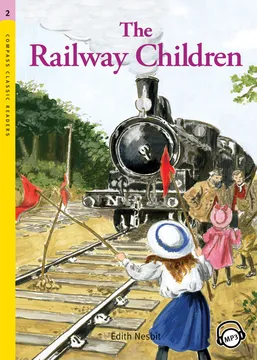
While searching near the tunnel for wild cherries, the children see a section of hillside break away and bury the railway line. The next train is due before they can reach the station, so Peter2 realizes they need a warning visible around the bend.
Their red flannel petticoats become flags, fastened to sticks and planted along the track. The children wave the remaining pieces as the train rushes toward them. The driver sees the warning and brakes before reaching the fallen rock and trees. Roberta1 faints from the strain, but she recovers on the train.
The railway staff and passengers praise all three children, and the company later invites them to a presentation. What began as a day out has made their affection for the railway consequential: its safety now depends, briefly, on their quick judgment.
The children’s rescue is built from practical observation, not sudden heroism. Peter identifies the need for a signal, while Roberta and Phyllis sacrifice clothing they can spare because the danger to passengers outweighs embarrassment or property. Their action reverses the usual railway arrangement: children who watch trains pass now intervene in the system that carries them. Roberta’s fainting complicates the public celebration, since doing the right thing has a bodily cost that she cannot simply convert into pride. The incident gives the railway community a reason to recognize the children, and it enlarges their sense of responsibility.
The Russian at the Station
At the station, Peter2 encounters a shabby, frightened man speaking Russian, while the crowd and station master11 cannot understand him. Roberta1 persuades the station master11 to wait for their mother,4 then uses a Russian postage stamp to help identify the stranger.
Mother4 recognizes him as Mr. Szezcpansky,8 a writer she has read, and brings him to Three Chimneys. He has spent years imprisoned and exiled in Siberia for writing about the poor. After escaping, he came to England searching for his wife and child, but lost his ticket, money, and address.
Mother4 nurses him in Father’s5 clothes and begins writing to people who might locate his family. The children bring flowers and food, discovering that welcoming someone in distress can begin before they know how to solve his problem.
Mr. Szezcpansky’s arrival forces the children to distinguish unfamiliarity from danger. The crowd reads his strange speech and disordered appearance as reasons for suspicion; Roberta reads his fear as evidence that he needs protection. Her limited French and the Russian stamp are imperfect tools, but they keep the stranger from being treated as a criminal before he can explain himself. Mother’s hospitality extends the household’s new ethic of care beyond its own members. Yet the exile’s story also sharpens the book’s concern with injustice: authority can punish a person whose work is humane, while the evidence of his innocence travels slowly.
Watches for the Rescue
The railway company honors Roberta,1 Peter,2 and Phyllis3 for preventing the landslide disaster, presenting each with a gold watch. At the ceremony, Roberta1 cannot bring herself to ask the old gentleman6 for anything personal.
She writes afterward, explaining Mr. Szezcpansky’s8 separation from his family and asking the railway director to help find them. He already knows the writer’s work and promises to make inquiries among his Russian contacts. Ten days later, he comes to Three Chimneys with news that the exile’s wife and child have been found.
Roberta1 carries the message to Mr. Szezcpansky,8 whose relief overwhelms him. The family prepares to leave, and Mother4 thanks the old gentleman,6 though she tells him she cannot invite him to visit again. His intervention resolves the exile’s search but leaves the children’s own separation from Father5 untouched.
The watches make public recognition tangible, but Roberta redirects the occasion toward someone whose need is more urgent than her own reward. Her request extends the children’s established habit of helping into a problem they cannot solve with courage alone; she must ask an adult with access and influence. The old gentleman’s response demonstrates how social privilege can be used constructively, though the scene does not pretend that all suffering yields to goodwill. Mr. Szezcpansky’s reunion gives the children proof that persistence can reconnect a family. Mother’s refusal to invite the benefactor back hints at a private grief that still resists easy consolation.
Smoke Over the Barge
The children plan a birthday celebration for Perks,7 but first they return to the canal, where a barge owner12 has angrily driven Peter2 away from fishing. That evening, smoke pours from the boat’s cabin. Peter2 plunges into the canal, climbs aboard, and enters the smoke to bring out the barge owner’s12 baby.
Roberta1 returns for the dog, which nips her hand, while Phyllis3 stays with the child until its mother13 arrives. The children run to summon the parents, and the barge owner12 helps put out the fire, which began when his pipe ember caught the cabin rug. The rescue changes the canal family’s view of the children. Bill12 invites them on a trip through the locks, and he promises other bargees will treat them as friends.
The fire transforms a local antagonism without pretending the earlier hostility never happened. Peter’s decision to enter the cabin follows the danger to the baby, not a calculation about whether Bill deserves help. Roberta and Phyllis act in complementary ways, protecting the dog and keeping the infant safe. The barge family’s gratitude opens a relationship across a social boundary that had first appeared as threat. The incident also broadens the children’s map of belonging: the railway is no longer their only community. Their willingness to help makes space for friendship, but it does not require them to deny that Bill was once cruel.
Perks Rejects the Presents
For Perks’s7 birthday, the children ask villagers to contribute gifts, gathering food, household tools, a pound from the old gentleman,6 and a pram from Mrs. Ransome.17 When Perks7 sees the loaded pram, he assumes the neighbors think his family is poor and refuses the gifts as charity.
Roberta1 remembers that she forgot to attach the labels identifying each donor. She reads them aloud, showing that the villagers gave because they respect and like Perks,7 while Mother’s4 contribution is clothing Phyllis3 has outgrown.
Perks7 relents, accepts the gifts, and hosts the children for tea. The celebration restores his pride without asking him to pretend he has no need. Mrs. Perks14 and the neighbors also discover how much affection had been present but unspoken.
Perks’s refusal reveals that generosity is not emotionally neutral. He has kept his household respectable through work and self-reliance, so a large anonymous gift looks like public judgment rather than kindness. Roberta’s forgotten labels nearly turn a communal gesture into humiliation; naming the donors restores the meaning of the gifts. This is a precise social negotiation, not a simple lesson that recipients should accept help. The villagers’ contributions express reciprocal regard, grounded in Perks’s history of helping others. By the end, his pride is not defeated but accommodated: he can accept assistance because it recognizes his place in the community.
The Verdict in the Wrapper
While fetching illustrated papers to amuse Peter2 after he injures his foot, Roberta1 notices a newspaper fragment wrapped around the bundle. It reports that her father5 was convicted of selling state secrets and sentenced to five years’ imprisonment. Roberta1 confronts Mother4 privately.
Mother4 explains that letters found in Father’s5 office persuaded the jury, though she believes a jealous subordinate planted them. She has tried to challenge the conviction and has found no one willing to listen.
Roberta1 promises not to tell Peter2 and Phyllis,3 then writes the old gentleman,6 enclosing the report and asking him to investigate. Until now, she has protected Mother4 by not asking about the family’s sorrow. Now she understands its source and chooses to share the burden, while keeping the truth from her younger siblings.
The newspaper scrap converts scattered signs of sorrow into a specific injustice. Its accidental discovery echoes the family’s earlier dependence on small acts of interpretation, but the stakes are now adult and institutional: a printed verdict has more authority than a wife’s knowledge of her husband. Roberta’s first response is trust, not doubt, and her appeal to the old gentleman acknowledges that private conviction cannot overturn public judgment by itself. Keeping Peter and Phyllis uninformed repeats Mother’s protective silence, but it is also Roberta’s deliberate choice to shield them. Her childhood role has shifted toward shared guardianship.
The Hound in the Tunnel
During a paperchase, the children watch the hounds enter the long railway tunnel and notice that the boy in a red jersey9 never emerges. They go inside and find Jim9 fainted beside the track with a badly broken leg. Roberta1 stays with him while Peter2 and Phyllis3 seek help.
At a signal-box, they wake a sleep-deprived signalman18 whose sick child has kept him from resting; Peter2 refuses the man’s attempted payment for their silence, while Phyllis3 offers forgiveness. Farm workers carry Jim9 to Three Chimneys, where the doctor10 sets his leg and Mother4 agrees to nurse him. Jim’s9 father is away in Northumberland and his mother is dead, so the children’s rescue becomes an unexpected household responsibility.
The tunnel compresses the children’s familiar railway world into a place of genuine danger. They enter because the missing runner might be injured, and their decisions divide labor according to need: Roberta stays, while Peter and Phyllis find help. Their encounter with the signalman complicates moral judgment. His exhaustion explains his failure without making it safe, and his offer to pay the children tests their honesty when he is vulnerable. Jim’s arrival brings a new need into a household already marked by absence. The children’s care is not abstract benevolence; it requires time, space, and their mother’s labor.
The Grandfather’s Promise
Jim’s grandfather6 arrives at Three Chimneys and the children discover he is the old gentleman6 who has been their railway friend. He arranges for Jim9 to stay while his leg heals and offers Mother4 the means to care for him without abandoning the household. Roberta1 speaks privately with him at the gate.
He has received her letter about Father’s5 conviction and says his own inquiries have convinced him Father5 is innocent, though he asks her to keep the hope from Mother4 until he knows more. The old gentleman’s6 generosity gives Mother4 time to nurse Jim9 and lets Peter2 enjoy the company of a boy his age. For Roberta,1 the promise is the first credible sign that Father’s5 absence may end, but certainty has not yet arrived.
The old gentleman’s identity ties together two strands of the children’s life: the railway friendship that began with a wave and the family responsibility created by Jim’s injury. His resources do not merely provide comfort; they make care sustainable by allowing Mother to step away from paid writing. Roberta receives a private assurance, but the request for secrecy reflects the emotional danger of hope when the evidence is incomplete. She must carry optimism without spreading it as fact. The section makes support reciprocal: the family shelters Jim, while his grandfather helps relieve the pressures that have shaped their home.
The 11:54 Homecoming
As Jim9 recovers, Mother4 resumes lessons and play with the children, and they begin waving to the 9:15 again. One September morning, the old gentleman6 arranges for passengers to wave back, while villagers greet Roberta1 with unusual warmth.
At the station, Perks’s7 excitement and the late train deepen her sense that something is coming. Father5 steps down from the 11:54 and embraces her. He explains that the real traitor has been caught and his innocence is known. Roberta1 brings him to the house, where Mother4 waits.
Their reunion closes the separation that began with the officials’ visit, though the narration leaves the family alone together rather than following them inside. The railway that carried their messages and witnessed their lives delivers Father5 home.
The ending answers the opening through a reversal of movement: the father who disappeared into official custody returns by the same railway that has connected the children to him in absence. The passengers’ coordinated waves and the villagers’ greetings show that private suffering has become legible to a community, even before Roberta knows why. The resolution depends on the old gentleman’s investigation and on the actual traitor being caught, not on the children’s innocence alone. Yet their actions matter: Bobbie’s letter helped mobilize the person able to act. The final closed door protects the family’s reunion from becoming public spectacle.
Analysis
The Railway Children makes childhood agency practical. The children do not overturn poverty, illness, political persecution, or a wrongful conviction through innocence alone. They notice specific needs, improvise with what they have, and enlist adults when their own resources fail. A petticoat becomes a signal, a stamp identifies a frightened stranger, and a forgotten label changes the meaning of a gift. These acts matter because the book treats attention as a form of competence.
Its moral world is built from distinctions that are easy to blur: taking coal for warmth remains theft, but Peter2 is more than the theft; Perks’s7 pride deserves respect, but accepting help need not diminish him; the signalman’s18 exhaustion explains his negligence without making it safe. The children learn to judge actions without reducing people to their worst moments. That ethic supports the book’s recurring movement from suspicion to recognition, whether with the station master,11 Bill the bargee,12 or the Russian exile.8
The railway gives this moral education a visible structure. It is mechanical and rule-bound, yet it depends on human perception: workers must notice signals, passengers carry news, and children can intervene when adults have not seen danger. The trains also preserve a thread between the separated family members. Their waves to Father5 begin as a ritual of longing and end as a communal sign of welcome.
At the emotional center is Roberta’s1 development from a child who protects her mother4 by not asking questions into one who can share the truth and seek help. Her courage includes restraint, tenderness, and the willingness to act despite uncertainty. The return of Father5 resolves the family’s separation, but the story’s deeper assurance is social: even when official systems fail, relationships formed through attention and reciprocal care can make justice imaginable.
Review Summary
The Railway Children is widely praised as a timeless classic that transcends age boundaries, blending humor, sorrow, love, and adventure. Readers highlight the realistic, relatable sibling dynamics and the heartwarming plot centered on three children adapting to poverty while their father is mysteriously absent. Many note the satisfying ending and Nesbit's engaging writing style. Adult readers often discover deeper, darker themes upon rereading. While some find it slightly dated in its gender commentary, most agree it remains a deeply comforting, joyful read that evokes nostalgia and genuine emotional warmth.
People Also Read




Characters
Roberta, called Bobbie
The quiet-hearted eldestBobbie is the eldest of the three children and often notices what others miss: her mother’s4 concealed sadness, a frightened stranger’s vulnerability, or the meaning behind a neighbor’s anger. Her impulse is to help, but she is not simply fearless or invariably right. She hesitates, worries about imposing, and sometimes struggles to speak when emotion overwhelms her. Her empathy is most active when it does not demand attention; she tries to ease another person’s burden without making them perform gratitude. In the family, she is a careful mediator between Peter’s2 boldness and Phyllis’s3 open-hearted spontaneity. Bobbie’s characteristic courage is less about seeking danger than accepting responsibility when someone nearby needs her.
Peter
The railway-minded brotherPeter is the middle child, an aspiring engineer whose curiosity turns railway equipment, tools, and systems into a daily education. He wants to be competent and brave, and his pride sometimes makes him defensive, as when he mistakes taking coal for mining. Yet he can admit fault, protect his sisters, and act decisively under pressure. Peter’s practical intelligence is valuable in emergencies, but his confidence can outrun his judgment; Roberta1 and Phyllis3 help him see the human consequences of his schemes. He misses the company of boys and feels the absence of his father5 partly as a loss of the adult man he hopes to resemble. His development comes through learning that strength includes restraint and repair.
Phyllis
The sunny youngestPhyllis is the youngest, affectionate, imaginative, and often cheerfully oblivious to the signals other people notice. Her mishaps, loose bootlaces, and impulsive questions give the family levity, but she is no mere comic relief. She offers care without calculation, whether carrying food, comforting someone frightened, or insisting that kindness should not be withheld because another person has behaved badly. Her directness can wound, and she sometimes misreads danger, yet her loyalty keeps her beside her siblings when events become frightening. Phyllis’s imagination turns trains into dragons and ordinary tasks into adventures. That playfulness helps the children inhabit an unfamiliar life without pretending it is easy.
Mother
The family’s steady centerMother is a loving, resourceful writer who tries to preserve her children’s security through humor, stories, and steadiness even when she herself is frightened and exhausted. She accepts poverty without making it the children’s identity, but her pride and protectiveness lead her to keep painful facts from them. Her work supports the household, yet it also takes her away from the play and attention she once gave freely. She treats hospitality as an obligation of the heart, welcoming a sick stranger and making room for an injured boy. Mother is neither invulnerable nor endlessly self-sacrificing: the children see her grief, and she needs their affection even as she tries to protect them from it.
Father
The absent playful parentFather is a Government office worker remembered by his children as playful, fair, and skillful with his hands. He repairs toys, explains things patiently, and gives the family a sense that practical problems can be solved together. His absence changes the household’s emotional balance: Mother4 carries adult responsibilities alone, while Peter2 feels pressure to become the family’s man. Though he is physically distant for much of the story, the children keep him present through their daily waves to the train and their memories of home. Father’s importance lies not only in what he provides but in the trust and affection he has built with each child.
The old gentleman
The railway’s generous allyA white-haired passenger who travels regularly on the 9:15, the old gentleman first becomes familiar to the children through a returned wave. He is dignified without being distant, curious about the children, and willing to use his influence when a problem exceeds their reach. His generosity is practical: he sends help when Mother4 is ill, listens to Bobbie’s1 requests, and treats the children as people whose judgment matters. He does not confuse kindness with taking control; he supports the family while respecting Mother’s4 independence. The children’s uncomplicated trust in him contrasts with their uncertainty about adult institutions, making him a rare figure who can move comfortably between warmth and authority.
Mr. Perks
The proud station porterPerks is the station porter, a practical railway worker and one of the children’s most approachable friends. He enjoys explaining railway machinery and treats their questions seriously. He is proud of earning his living and supporting his family, which makes him sensitive to anything that resembles charity. His initial brusqueness can conceal affection, but his pride is not a flaw to be dismissed: it reflects the dignity he attaches to work and self-reliance. Perks’s relationship with the children grows through shared knowledge, honest apologies, and their effort to understand what respect means to him.
Mr. Szezcpansky
The exiled Russian writerMr. Szezcpansky is a Russian writer whose work about poverty has brought him political persecution. When the children meet him, he is sick, disoriented, and unable to communicate easily in English. His gentleness becomes clearer as he recovers, but his manner also carries the weight of imprisonment and separation from his family. He depends on Mother’s4 fluency and the children’s willingness to treat him as a person before they understand his history. His presence makes the children’s local acts of kindness part of a wider world where speech, reputation, and political power can determine who is believed.
Jim
The injured schoolboyJim is a schoolboy encountered after a paperchase leaves him injured in the railway tunnel. He is older and physically larger than the children, but in the crisis he must depend on their courage and practical care. His humor and frankness emerge even while he is in pain, and he gives Peter2 the companionship of another boy that he has missed. Jim’s school stories open a new world to the children, while his vulnerability tests their capacity to help someone beyond their household. He is a person with his own family and history, not merely an occasion for the children to feel heroic.
Dr. Forrest
The village doctorDr. Forrest is a capable village physician who treats the children with warmth and respects their intelligence. He responds to Mother’s4 illness, Peter’s2 injury, and later Jim’s9 broken leg, while also speaking to the children as people capable of moral thought. His practical competence is matched by a humane understanding of fear, fatigue, and responsibility. He sometimes corrects Peter2 by explaining why physical and emotional strength should be used with care. The doctor’s presence gives the family a trusted professional ally in a rural community where their limited money makes every medical need feel consequential.
The station master
The railway’s fair-minded gatekeeperThe station master manages the children’s railway world, enforcing rules while showing them patience and kindness. After Peter2 takes coal, he holds him accountable but does not reduce him to a thief once he understands the reason. He becomes a link between the children, railway workers, and the old gentleman6, helping messages travel to the right person. His authority is local and practical, grounded in keeping the station safe. Through him, the children learn that fairness can include both boundaries and forgiveness.
Bill
The rough canal bargeeBill is a canal bargee whose rough manner initially frightens and angers the children. He is protective of his work and family, and he reacts sharply when he thinks strangers are crossing a boundary. The children’s encounter with his family reveals a more complicated man, capable of gratitude and accountability as well as aggression. His life on the canal gives the children access to a community unlike the railway, and his changing relationship with them shows how a frightening first impression can be revised through shared action.
Mrs. Bill
The barge family’s caretakerMrs. Bill cares for her baby aboard the canal boat and speaks to the children with more openness than her husband12 initially does. She explains Bill’s12 temper without excusing it and trusts the children with the truth about their family. Her fierce response to danger shows how quickly affection can become action. She represents the domestic labor and vulnerability of life on the canal, while her friendliness helps the children find a place in a community that first seemed hostile.
Mrs. Perks
Perks’s warm-hearted wifeMrs. Perks manages a busy household and shares her husband’s7 concern for their children. She is moved by the birthday gifts, but understands that Perks7 may interpret them as an insult before he knows who gave them. Her affection for him makes her willing to challenge his stubbornness, while her gratitude reveals how deeply the neighbors’ respect matters to the family.
Mrs. Viney
The practical housekeeperMrs. Viney helps Mother4 manage the household at Three Chimneys and gives the children glimpses of village life. Her practical advice about money and the doctor’s club helps Bobbie1 find a way to care for her mother4 without adding to the family’s anxiety.
Aunt Emma
The brisk, useful auntAunt Emma is a visiting relative preparing to work abroad as a governess. The children find her clothes and manner unappealing, but she has quietly packed useful food and weather gear that helps the family during its move and country life.
Mrs. Ransome
The village postmistressMrs. Ransome is an elderly postmistress whom the children first find irritable and unapproachable. Their thoughtful birthday gesture softens her, and she responds with generosity of her own. Her actions show that kindness can awaken a connection where the children expected only refusal.
The signalman
The exhausted railway workerThe signalman is responsible for directing trains safely through his section of the line. Exhaustion from caring for a sick child compromises his attention, and his shame makes him react defensively when the children discover him asleep. His encounter with them exposes the human strain behind railway procedure.
Plot Devices
The railway
A lifeline between worldsThe railway links the children’s new home to their old life and gives them a daily structure in the valley. At first they watch trains and wave toward London, hoping their affection might reach their absent father5. The station then becomes a place of learning, friendship, danger, and intervention: the children ask a passenger for help, explore engines, prevent a train wreck, and encounter strangers whose lives cross their own. Its schedules and signals give the story a steady pulse, while its trains carry both news and people. The railway is not simply a backdrop; it is the public network through which private acts become possible.
Red flannel flags
A warning made by handWhen a landslide blocks the track, the children have no time to reach the station and no proper signaling equipment. Peter2 recognizes that a train must be warned before it rounds the bend. The children tear their red petticoats into flags, fasten them to sticks, and wave them as the train approaches. The improvised signal makes their domestic clothing into public safety equipment. Its importance is set up by the railway’s recurring need for clear signals and paid off when the driver brakes in time. The flags embody the children’s ability to turn limited resources into useful action.
The old gentleman’s waves
A signal of trustThe old gentleman6 first answers the children’s wave from the 9:15, making him familiar before they know his name or influence. The repeated exchange creates a small ritual of recognition and gives the children confidence to approach him when they need help. Later, they send him requests through the station, and he responds to their appeals with practical assistance. The wave is modest, but it establishes the trust that lets a child ask an adult for help with a stranger’s family and, eventually, with her own. In the ending, the railway passengers’ collective gesture echoes the original exchange and signals that the children’s community has grown.
The newspaper fragment
A truth found by accidentA discarded newspaper used to wrap illustrated papers gives Roberta1 information her mother4 has carefully withheld: Father5 was convicted and sentenced to prison. The report supplies the name of the case and the official version of events, while Mother4 supplies her belief that evidence was planted by a jealous subordinate. This contrast turns printed authority into both a source of harm and a tool for action. Roberta1 sends the report to the old gentleman6, allowing him to investigate. The fragment is an accidental discovery, but its consequence is deliberate: Bobbie1 chooses to seek help rather than remain outside the family’s deepest sorrow.
Download PDF
Download EPUB
.epub digital book format is ideal for reading ebooks on phones, tablets, and e-readers.








