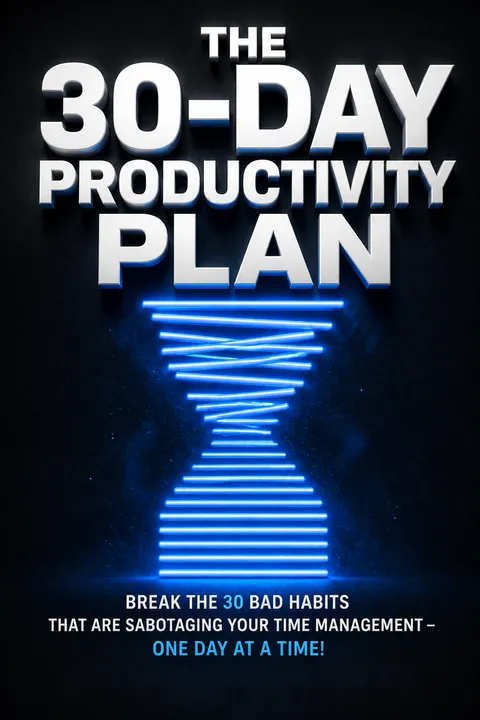


Key Takeaways
Treat productivity as a month of habit repair, not a bag of hacks
Practice beats reading. The book is arranged as 30 short daily lessons, each naming a habit that drains time and offering actions to change it. Its aim is not to finish the pages, but to practice new responses until they become routine. The author suggests reading one lesson at a time, trying its advice, and checking progress periodically. The 30-day format is a guide, not a deadline for mastering 30 habits. In fact, the book's closing advice is to work on one habit at a time, using small steps, consistency, and support from others.
Make change observable. Identify the situations that trigger a habit, decide what to do instead, and review setbacks for useful information. A missed workout, for example, may reveal that the plan was too ambitious or that the time was poorly chosen. The book recommends revisiting its list of habits every 60 days to notice progress and choose a next target.
The strongest feature of this plan is its distinction between exposure to advice and practice of advice. A month can help readers notice recurring problems, but changing 30 entrenched behaviors in 30 days is an unrealistic interpretation of the format. The more useful unit is one behavior, repeated in a recognizable situation. The book's emphasis on reviewing setbacks also matters: it replaces the pass-or-fail logic of resolutions with a feedback loop. That makes the plan more adaptable to different jobs, households, and constraints.
Batch messages and hide alerts to protect unbroken attention
Interruptions have a price. Email, social media, news, and phone checks seem brief, but they fragment attention and can leave a message or headline occupying the mind after the screen is closed. The book cites estimates that regaining momentum after a distraction can take 20 minutes or more. Its practical remedy is to choose set windows for checking messages, close inboxes between them, and disable alerts that invite a glance.
Give each check a purpose. A planned visit to a social platform is different from repeatedly opening it without a reason. The same principle applies to news: the author suggests taking a temporary break, unsubscribing from headline emails, or limiting updates to subjects that matter. Keep the phone away during focused work, then check it at times chosen in advance rather than whenever it calls.
This advice treats attention as a limited resource rather than a test of character. That is a useful shift: notifications and open inboxes make interruption the default, while scheduled checks make it a deliberate choice. The broader lesson is to design a work setting that supports concentration instead of relying on repeated acts of resistance. Still, a fixed limit such as two email checks daily may not suit roles with genuine response obligations. The principle is not silence at all costs, but an intentional communication rhythm agreed upon with relevant colleagues.
Prioritize work by the value it creates, not the space it occupies
Busy is not the same as useful. The book uses the Pareto principle, often expressed as an 80/20 pattern, to ask which small portion of activity produces most of the meaningful results. It is a prioritization aid, not a promise that every workplace divides neatly into those percentages. A task can still need doing even if it contributes little to a goal; the point is to spend less time on it, automate it, or delegate it when possible.
Make priorities visible. The author recommends keeping the daily list short, assigning priorities, and starting with the most consequential task, called a Big Rock. A separate capture list can hold other ideas without crowding today's plan. Before adding an item, ask why it matters and whether it advances an actual objective. This prevents an endless list from disguising low-value work as progress.
The memorable contribution here is not the ratio itself, but the demand to distinguish activity from contribution. Lists can make work visible while also making every item look equally important. Ranking tasks by their effect on goals corrects that distortion. The principle also invites organizational questions: if low-value tasks repeatedly consume a worker's day, individual discipline may not be enough. A process may need redesign, or responsibilities may need renegotiation. The Pareto pattern is best used to prompt investigation, not to justify ignoring obligations without checking their consequences.
Give work a deadline before it expands to fill your day
Time limits create structure. Parkinson's Law is the idea that work tends to expand to occupy the time available for it. If a report has a week, it may take a week; a focused block can reveal that a shorter period is sufficient. The author recommends estimating a task's duration, setting a visible timer, and comparing the estimate with the actual result. Adjust future limits as experience improves the estimate.
Work in intervals. The Pomodoro Technique divides work into 25-minute sessions followed by 5-minute breaks. The book also mentions other work-and-rest patterns, since no single schedule suits everyone. During a timed session, silence notifications and stay with one task. A deadline should create useful urgency, not panic, so begin with a challenging but plausible estimate and revise it when evidence shows it is wrong.
A timer can turn an abstract intention into a bounded experiment: focus on one task, observe what fits, and use the result to plan better. That is more informative than simply deciding to work faster. The approach also guards against perfectionism, because the question becomes whether more effort improves the outcome enough to justify its cost. But time limits are estimates, not universal productivity laws. Novel, collaborative, or high-stakes work may resist compression. The useful discipline is to notice where time goes, not to mistake speed for quality.
Shrink intimidating work until starting feels easier than avoiding it
Make the first move small. The book identifies fear, perfectionism, boredom, and overwhelm as common reasons people postpone tasks. Large projects can feel impossible when treated as a single object. Break one into smaller actions, schedule the first, and work on it for a limited period rather than demanding instant completion. The author suggests giving an important task an hour in the morning, or committing to just 30 minutes when a task feels especially daunting.
Start before certainty arrives. For a major report, for instance, the first action might be listing needed information or identifying its sections. This creates a path where the whole project once looked like a wall. The book recognizes that some people gain momentum by tackling the hardest task first, while others benefit from beginning with an easier task. Test both approaches, notice which gets work moving, and protect the start from familiar detours such as checking a phone.
The emphasis on starting addresses a key asymmetry: a task's imagined difficulty can be more paralyzing than the work itself. Breaking it down makes progress visible and gives the next action a clear shape. This is especially useful when a person is waiting to feel motivated or fully prepared before beginning. The advice is strongest when the first step produces information, not merely motion. A small action should reduce uncertainty or advance the project. Otherwise, planning can become a more respectable form of avoidance.
Say no, delegate, and systematize before overtime becomes normal
Protect the capacity you have. Repeatedly agreeing to help others can push personal responsibilities into evenings and weekends. Before accepting a request, check current priorities, ask what the work actually involves, and distinguish a genuine emergency from someone else's preference for speed. A tactful no, or a later time to help, can preserve both focus and relationships. Managers and business owners also need to delegate operational tasks instead of monitoring every detail themselves.
Stop rebuilding the same solution. Recurring duties can be streamlined with templates, automation, or batching similar tasks into one work block. The book advises keeping a realistic list, allowing for interruptions, taking breaks, and leaving nonurgent unfinished work for the next day. It notes that, in an eight-hour day, planning for about five productive hours may be more realistic than assuming every minute will be focused. The aim is sustainable output, not a longer workday.
These recommendations connect boundaries to workflow design. Saying no is not only a personal skill; it clarifies what a person can reliably deliver. Delegation and templates reduce repeated decisions, while a stopping time prevents work from expanding into every available hour. Yet boundaries are not equally easy for everyone to enforce. Workers may face limited authority, understaffing, or expectations set by managers. In those cases, a productivity plan should include a conversation about workload and tradeoffs, rather than treating overwork as an individual's failure to organize.
Schedule demanding work for high energy, and rest before focus collapses
Use energy as a planning clue. A circadian rhythm is the body's roughly 24-hour cycle; an ultradian rhythm refers to shorter recurring changes in alertness during the day. The book recommends tracking energy and concentration for two weeks, then placing complex work in the periods when focus is strongest and routine tasks in lower-energy periods. It also suggests breaks, such as 25 minutes of work followed by 5 minutes off, while encouraging readers to test different intervals.
Support attention physically. The author connects work capacity with sleep, exercise, food, and rest. The book cites a study reporting that workers with unhealthy diets were 66% more likely to experience a significant productivity decline, and describes research linking exercise with improvements in areas such as memory and workplace performance. Rather than making a dramatic overhaul, begin with small changes: take short walks, plan meals, and schedule breaks away from the screen.
This takeaway broadens productivity beyond calendars and apps. A plan that ignores fatigue treats the person as a machine, then blames them when output deteriorates. Tracking personal energy is a practical way to fit work to observed patterns instead of assuming everyone has the same productive hours. The book's health statistics should be read cautiously: an association between diet and performance does not by itself prove that one caused the other, and results may vary. The low-risk, useful idea is to observe how sleep, movement, meals, and breaks affect one's own attention.
Turn long-range ambitions into measurable actions you can review weekly
Give effort a destination. Goals help distinguish progress from busyness and provide a way to learn when a plan is not working. The book recommends breaking a long-term aim into smaller tasks that can be scheduled and reviewed. Its S.M.A.R.T. system describes goals as specific, measurable, attainable, relevant, and time-sensitive. For example, a broad wish to advance at work becomes more actionable when translated into defined projects, deadlines, and skills to develop.
Separate effort from outcome. Some results depend on other people's choices, even when the work is excellent. The author advises focusing on performance that can be controlled, such as the quality and timeliness of a deliverable, while treating a promotion or other external decision as uncertain. Review the small actions regularly, adjust the plan when they fail to produce progress, and avoid confusing a missed milestone with a verdict on personal worth.
A goal is most useful when it links an aspiration to observable behavior. Otherwise, it can remain a flattering statement about the future rather than a guide to today's choices. The distinction between controllable performance and external outcomes also prevents ambition from becoming a promise that success is guaranteed. At the same time, measurable targets can narrow attention if the metric becomes more important than the underlying purpose. A regular review should therefore ask two questions: is progress visible, and is the goal still worth pursuing?
Treat mistakes and stress as signals for redesign, not self-punishment
Learn without turning errors into identity. The book argues that perfectionism consumes time, delays action, and makes mistakes feel like proof of inadequacy. A more productive response is to ask what the error reveals about the process, then change the process. Taking responsibility means recognizing where one's choices mattered, not assuming every setback was entirely one's fault. The same approach applies to self-pity and fear of criticism: identify what can be influenced, and act there rather than surrendering to shame or imagined judgment.
Notice the cost of strain. Persistent stress and burnout can show up as fatigue, irritability, declining work quality, and difficulty concentrating. The author recommends reviewing responsibilities, reducing low-value demands, taking breaks, and seeking support. Conflict and gossip deserve similar scrutiny: they can absorb attention without solving the underlying problem. Focus on clear communication and the facts, then return attention to work that matters.
This section's most useful distinction is between accountability and self-condemnation. Accountability asks what can change; self-condemnation turns a specific event into a global judgment and often makes action harder. That distinction also helps avoid the opposite error of blaming oneself for circumstances beyond one's control. Stress is not always removable through better habits: sometimes the workload, workplace, or relationship is the source. A sound response can include personal adjustments, but it can also require asking for help or changing the conditions that keep producing the strain.
Analysis
The book's 30 daily topics become clearer when grouped around a single scarce resource: directed attention. Email, social feeds, phones, news, multitasking, interruptions, and workplace drama all compete for it. Overloaded lists, weak boundaries, perfectionism, and procrastination then determine whether the remaining attention is spent on consequential work. The book's breadth is useful because it shows how these problems reinforce one another: a crowded list increases stress, stress encourages avoidance, and avoidance creates overtime.
Its most durable contribution is practical rather than theoretical. It repeatedly turns vague intentions into observable choices: cap a daily list, schedule message checks, estimate a task's duration, track energy, or define a stopping time. These are small experiments readers can adapt. The one-habit-at-a-time advice is also more credible than treating the 30 chapters as a demand to overhaul one's life in a month.
The book's evidence needs more caution than its confident tone sometimes suggests. It cites studies and numerical claims to support links between behaviors and productivity, but the text does not consistently distinguish correlation from causation or explain how broadly a finding applies. Claims about distraction recovery time, attention span, diet, and television should therefore not be treated as universal constants. The recommendations often remain sensible without them, because they can be tested in an individual's own workflow.
A second limitation is the focus on personal behavior. Some readers cannot simply mute messages, refuse extra work, or take breaks at will. Organizational incentives and staffing levels shape the choices available. The strongest interpretation is not that every productivity problem is self-inflicted, but that people should improve what they can control while making constraints visible. In that sense, the book is best used as a diagnostic checklist and a set of experiments, not as a moral scorecard or a claim that busier people only need better discipline.
Review Summary
The 30-Day Productivity Plan receives mixed reviews, with an average rating of 3.95 out of 5. Many readers find it helpful, praising its straightforward approach and actionable advice. They appreciate the 30-day format and practical tips for improving productivity. Some criticize it as repetitive or oversimplified, while others find it life-changing. The book's focus on breaking bad habits and implementing small changes resonates with many readers. However, some feel it lacks depth or doesn't account for different job types. Overall, most reviewers recommend it as a useful guide for productivity improvement.
People Also Read









Glossary
Parkinson's Law
Work expands to available timeThe idea that a task tends to take as long as the time allotted to it. The book uses it to explain why generous or undefined deadlines can encourage delay and unnecessary effort. Setting a focused time limit can create urgency, but the estimate should remain realistic and responsive to the task's complexity.
Pomodoro Technique
Timed work and rest intervalsA work method that divides focused effort into short timed intervals, commonly 25 minutes, followed by a brief break, commonly 5 minutes. In the book, it provides structure, helps limit distractions, and offers regular opportunities to rest and check progress. The author encourages readers to adjust the schedule to fit their own concentration patterns.
Pareto principle
A few actions drive many resultsA prioritization concept commonly summarized as 80% of results coming from 20% of actions. The book applies it by asking readers to identify which tasks contribute most to their goals, then spend less time on low-value work. It is presented as a useful pattern for examination, not an exact ratio that applies to every situation.
Big Rocks
Most important tasksThe book's label for the day's most consequential tasks, especially those that strongly affect a larger objective or are easy to postpone because they feel difficult. The recommendation is to identify these priorities, limit how many are planned, and give them focused time rather than letting smaller tasks consume the day.
S.M.A.R.T. system
A test for actionable goalsA goal-setting method in which objectives are specific, measurable, attainable, relevant, and time-sensitive. The book uses it to turn broad ambitions into concrete targets that can guide daily or weekly work. The framework makes progress easier to review, while the author cautions readers to distinguish their own performance from outcomes controlled by other people.
circadian rhythm
The body's 24-hour cycleA roughly 24-hour biological cycle that influences sleep, alertness, and other bodily processes. The book uses the term to explain why a person's energy may rise and fall at predictable times of day. Tracking those patterns can help place demanding work during periods of stronger alertness and routine work during lower-energy periods.
ultradian rhythm
Shorter cycles of alertnessA recurring biological rhythm shorter than a 24-hour circadian cycle. The book describes ultradian rhythms as changes in alertness that unfold in shorter periods during the day, and connects them with the mental lull that can follow sustained work. It recommends taking breaks and observing personal concentration rather than forcing uninterrupted effort.
FAQ
What's "The 30-Day Productivity Boost" by Damon Zahariades about?
- Focus on bad habits: The book identifies 30 bad habits that sabotage time management and productivity, offering a structured plan to overcome them.
- 30-day action guide: It provides a day-by-day guide, with each day focusing on breaking a specific habit and implementing actionable steps.
- Practical and concise: Unlike lengthy productivity books, this guide is designed to be practical and easy to apply, with short chapters that encourage daily application.
- Goal of lifelong habits: The ultimate aim is to develop lifelong productive habits that enhance one's lifestyle and efficiency.
Why should I read "The 30-Day Productivity Boost"?
- Identify and break habits: It helps you recognize and break habits that are hindering your productivity, offering a clear path to improvement.
- Structured approach: The book's day-by-day structure makes it easy to follow and implement changes gradually, ensuring lasting results.
- Actionable steps: Each chapter ends with specific action steps, making it practical and immediately applicable to your daily routine.
- Boost productivity: By following the guide, you can significantly enhance your productivity and time management skills.
What are the key takeaways of "The 30-Day Productivity Boost"?
- Daily focus: Concentrate on breaking one bad habit each day to avoid feeling overwhelmed and to ensure gradual improvement.
- Action-oriented: The book emphasizes taking action rather than just understanding theory, with practical steps to implement changes.
- Consistency is crucial: Consistent application of the steps is necessary to develop new, productive habits and replace old ones.
- Self-awareness: Understanding your triggers and responses is key to effectively breaking bad habits and forming new ones.
How does Damon Zahariades suggest breaking bad habits in "The 30-Day Productivity Boost"?
- Identify triggers: Recognize the triggers that lead to bad habits and develop strategies to avoid or alter them.
- Small, consistent steps: Focus on small, manageable steps each day to gradually replace bad habits with productive ones.
- Use of action steps: Each chapter provides specific action steps to help you implement changes and track your progress.
- Reinforcement through repetition: Consistent repetition of new behaviors is emphasized to solidify them as habits.
What is the format of "The 30-Day Productivity Boost"?
- 30 chapters: Each chapter corresponds to one day and focuses on breaking a specific bad habit.
- Three sections per chapter: Each chapter includes a description of the problem, its impact on productivity, and action steps to overcome it.
- Encourages daily application: The format is designed to be read and applied one chapter per day for maximum effectiveness.
- Flexible approach: While structured, the book allows readers to adapt the pace to their own needs and learning style.
What are some examples of bad habits discussed in "The 30-Day Productivity Boost"?
- Checking email too often: The book advises limiting email checks to twice a day to avoid constant interruptions.
- Perfectionism: It highlights how striving for perfection can lead to procrastination and stress, suggesting a focus on completion instead.
- Multitasking: The book explains how multitasking reduces efficiency and suggests focusing on one task at a time.
- Procrastination: It offers tactics to overcome procrastination, such as breaking tasks into smaller, manageable parts.
How does "The 30-Day Productivity Boost" address perfectionism?
- Perfectionism as a barrier: The book identifies perfectionism as a major productivity killer that leads to stress and procrastination.
- Shift focus: It suggests shifting focus from perfecting work to completing it, emphasizing progress over perfection.
- Embrace mistakes: Encourages viewing mistakes as learning opportunities rather than failures.
- Set realistic goals: Advises setting attainable goals to reduce the pressure of achieving perfection.
What are the best quotes from "The 30-Day Productivity Boost" and what do they mean?
- "Focusing is about saying no." This quote emphasizes the importance of prioritizing tasks and avoiding distractions to maintain productivity.
- "Work expands so as to fill the time available for its completion." Known as Parkinson's Law, this quote highlights the tendency to use all available time for a task, suggesting setting strict time limits to increase efficiency.
- "Self-pity is easily the most destructive of the non-pharmaceutical narcotics." This quote warns against the dangers of self-pity, which can lead to inaction and decreased productivity.
- "A man without a goal is like a ship without a rudder." This quote underscores the importance of setting clear goals to provide direction and purpose in one's work.
How does Damon Zahariades suggest handling email in "The 30-Day Productivity Boost"?
- Limit checks: The book advises checking email no more than twice a day to minimize interruptions and maintain focus.
- Turn off notifications: It suggests turning off email notifications to avoid the temptation to check messages constantly.
- Set specific times: Recommends setting specific times for checking email and treating them like appointments.
- Communicate expectations: Advises informing others of your email-checking schedule to manage their expectations regarding response times.
What is the significance of the 80/20 rule in "The 30-Day Productivity Boost"?
- Focus on high-value tasks: The book emphasizes the importance of focusing on the 20% of tasks that deliver 80% of the results.
- Prioritization: It encourages prioritizing tasks based on their impact on long-term goals, rather than treating all tasks equally.
- Eliminate low-value tasks: Suggests identifying and eliminating or delegating tasks that contribute little to overall productivity.
- Efficient time management: Applying the 80/20 rule helps streamline workflow and improve time management.
How does "The 30-Day Productivity Boost" suggest dealing with social media distractions?
- Limit usage: The book advises setting strict limits on the number of times and duration for checking social media each day.
- Turn off notifications: Recommends turning off social media notifications to reduce distractions and maintain focus.
- Use blocking apps: Suggests using apps to block access to social media during work hours to prevent time-wasting.
- Have a purpose: Encourages having a specific reason for checking social media to avoid aimless browsing.
What are some practical tips from "The 30-Day Productivity Boost" for improving productivity?
- Set time limits: Apply strict time limits to tasks to prevent them from expanding unnecessarily and to maintain focus.
- Batch tasks: Group similar tasks together to minimize switching costs and improve efficiency.
- Take regular breaks: Schedule breaks to rest and recharge, which helps maintain focus and prevent burnout.
- Create systems: Develop systems for recurring tasks to streamline processes and save time.
About the Author
Other books by Damon Zahariades






Download PDF
Download EPUB
.epub digital book format is ideal for reading ebooks on phones, tablets, and e-readers.








