

Key Takeaways
Put a timer around attention, not just around your calendar
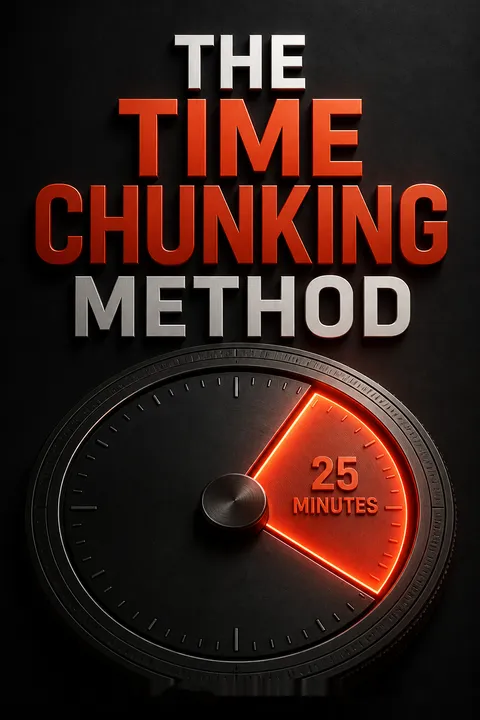
Give work a boundary. The time chunking method divides work into timed periods, usually 25 minutes of focused effort followed by a 5-minute break. After four work periods, take a longer break of about 15 minutes. During a work period, focus on one task rather than juggling several. If a task ends early and cannot usefully be reviewed, stop the period and take the break.
Why it helps. The author found that open-ended workdays invited interruptions, procrastination, and online detours. A timer creates a small, defined commitment: start now, stay with the task, and pause when the interval ends. The method is meant to make beginning easier and attention more deliberate, not to turn every minute into work.
The method works as a form of behavioral scaffolding: a visible endpoint makes a demanding task feel less endless, while a planned pause reduces the temptation to manufacture one through distraction. That is especially useful when motivation fluctuates. The timer is not proof that attention reliably expires at 25 minutes, however. Focus varies with the task, the person, and the setting. The interval is best treated as a practical starting hypothesis, not a neurological law.
Name what more productive work is meant to give back
Make the reason personal. The author describes having 16 hours available yet managing only a few productive hours, partly because interruptions and online diversions repeatedly took over. Time chunking mattered when it promised something beyond a vague wish to be efficient: less stress, more time with loved ones, better sleep, or the ability to earn more without extending the workday.
Write down the payoff. A compelling reason can help sustain a new routine when it becomes inconvenient. “Be more productive” is too broad to guide a choice in a difficult moment. A specific aim, such as finishing work earlier to care for a family member, makes the trade-off clearer. Keep the reason visible and revisit it if the routine starts to feel pointless.
This is a useful distinction between an activity goal and a value behind it. In motivational psychology, durable effort is often stronger when people can connect a task to personally meaningful outcomes, rather than relying only on pressure or rewards. The book’s dramatic health example makes the point vividly, though high stakes are not necessary for everyone. A modest, concrete benefit can be more credible than an intimidating life overhaul, and it can help reveal when productivity is serving no worthwhile end.
Test work intervals against your real concentration rhythm
Adapt the interval. The familiar 25-minute work period is a default, not a rule. The author writes for a living and found that frequent alarms interrupted the momentum he needed to enter a writing groove. He shifted to 50 minutes of work followed by 10 minutes away, with a longer pause after three work periods. That schedule fit his writing better than the conventional pattern.
Run a small trial. Try different work and break lengths over several days, then compare how much useful work you complete and how you feel. A morning of strong concentration may call for longer periods than a distracted afternoon. If an alarm interrupts productive work, it can be reasonable to finish the immediate task before pausing. The point is fit, not obedience.
This emphasis on experimentation prevents a productivity technique from becoming another source of guilt. It also reflects a broader principle in human factors: a tool should be evaluated in the setting where it is used, because its effects depend on the task and the person. A writer’s sustained-flow needs may differ from an employee whose work arrives in short requests. Tracking results matters, since a longer interval can feel satisfying while quietly reducing accuracy or recovery.
Batch tiny chores, but handle them one at a time
Group small tasks. Some jobs, such as paying a bill, starting laundry, or returning a quick administrative item, take only a few minutes. Rather than letting each interrupt a substantial work task, collect related small jobs and handle them within one work period. This practice, called batch processing, means completing items in sequence, not doing several things simultaneously.
Keep the batch bounded. A cluster of household errands or routine messages can be a sensible use of a 25-minute period. By contrast, switching between unrelated projects throughout the day creates more opportunities to lose focus. The author’s distinction is practical: work through a prepared list of small tasks as one defined activity, then return to the next major task. Batching gives minor obligations a place without allowing them to occupy every spare moment.
Batching is most valuable when tasks share a context, such as the same software, location, or kind of decision. That can reduce the mental overhead of repeatedly getting set up. The caution is that batching can also become a convenient disguise for avoiding the important work. A stack of easy completions feels productive, but its value depends on whether it supports meaningful priorities. A brief, planned batch is useful; an entire day spent clearing trivial items is not.
Use chunks to focus and deadlines to finish
Separate focus from completion. Time chunking gives a task a short interval of protected attention. Timeboxing gives a task or project a larger deadline and asks whether the result meets its requirements when that limit arrives. The author presents them as complementary: one helps people stay with the work, while the other discourages endless polishing.
Combine the two. For example, someone expecting to draft a long article in two hours could set a two-hour deadline and divide that period into work chunks and breaks. At the deadline, the writer checks whether the draft is sufficient for its purpose. If it is not, another timebox can be scheduled. The approach counters Parkinson’s Law, the idea that work tends to expand to fill the time available, without pretending that every project can be completed in a single session.
The pairing addresses two distinct failure modes: attention can wander, and standards can expand without limit. A deadline makes scope visible, while shorter intervals make action more manageable. Together, they turn “work on this” into a clearer plan. Still, some work resists neat completion tests. Exploration, care work, and complex creative projects can produce value without a crisp finish line. In those cases, timeboxing should constrain the next step, not force a false claim that the work is complete.
Defend each work block from people, screens, and stray thoughts
Reduce preventable interruptions. The author recounts working from home while friends and family assumed his time was freely available. He recommends setting expectations, returning calls at a chosen time, and closing email or turning off the phone during focused work. Digital distractions may need stronger barriers, such as a browser tool that blocks tempting sites.
Capture, then continue. Not every interruption comes from another person. A new idea can pull attention away just as effectively. The author’s solution is to write the thought down and return to the current task, rather than researching it immediately. Emergencies are different: when something urgent happens, abandon the schedule and respond. The method is meant to reduce avoidable interruptions, not to make a person unreachable at any cost.
The practical strength here is that attention is treated as an environmental problem, not merely a test of character. Turning off a notification or recording a thought lowers the number of decisions required to stay on task. Research on task switching also supports the general concern that moving between activities carries a reorientation cost. Yet rigid isolation is not always possible, especially in caregiving or collaborative roles. Clear availability windows and shared expectations often work better than expecting others to guess when focus time matters.
Measure finished output, then protect the energy behind it
Connect time to a result. A timer shows that work happened, but not whether it moved a goal forward. The author recommends specific, trackable, realistic goals that fit the life a person wants. A novelist aiming for 60,000 words in a month can translate that target into weekly and daily amounts, then estimate how many work periods are needed. If each period produces about 400 words, five periods can support a 2,000-word day.
Track what matters. Choose measures suited to the work: word count for writing, study time for a student, or completed responsibilities for a caregiver. The author uses a spreadsheet to monitor daily output and number of work periods, noticing that his Sunday writing slowed. Sleep, exercise, food, and stress also affect the capacity to focus, so output should not be pursued by sacrificing the conditions that sustain it.
This is a stronger model than counting hours alone: it links effort to an observable result and makes a slipping target easier to diagnose. It also resembles feedback control, where a system is adjusted based on measured performance rather than intention. But metrics can distort the work if they become the goal. Word count, for instance, cannot measure insight or revision quality. Pair a simple quantitative indicator with a periodic judgment about quality, health, and whether the target remains worth pursuing.
Build recovery into the schedule before burnout does it for you
Protect more than short pauses. Burnout, as the book describes it, is not simply ordinary stress. Stress can bring urgency and anxious energy; burnout is more associated with exhaustion, disengagement, and diminished motivation. Long stretches of work with only brief pauses may leave too little room to recover. The author recommends setting a daily stopping point, taking genuine longer breaks, and making time for days off or short vacations.
Guard the conditions of work. Realistic goals reduce the strain of constantly falling behind. Variety can make repetitive work more engaging, while time with friends and family can provide support beyond the workday. Unplugging from technology and saying no to requests that overwhelm the schedule also help protect time and attention. These practices are not rewards for finishing everything. They are part of a sustainable way to work.
The book usefully frames recovery as infrastructure, rather than a prize earned after unlimited effort. That is important because a schedule that depends on permanent overextension is brittle: ordinary illness, family needs, or a difficult project can break it. Its recommendations also point to structural causes, such as lack of control or repetitive work, not just personal habits. Individual boundaries help, but they cannot fully repair a workplace that chronically demands more time than people have.
Make breaks restorative, not portals into another distraction
Prepare a short menu. A five-minute pause can hold a quick walk, stretching, water, a few household tasks, or a song. The author suggests preparing a list in advance so the break does not disappear while choosing an activity. Small chores can be useful when they involve getting up and moving, but a longer break may be better for a meal, a nap, or a proper walk.
Avoid attention traps. Email, social media, news sites, videos, and phone calls can turn a short pause into a much longer detour. They also keep the mind engaged with fresh demands instead of allowing it to rest. The best break depends on the person and the work, but it should end easily and leave the next work period possible. A timer can help when an activity has a tendency to stretch.
The distinction is not simply between work and leisure, but between activities that restore attention and those that recruit it again. A brief screen break may feel relaxing while exposing someone to messages, headlines, and unfinished conversations. Movement or looking away from a screen offers a different kind of pause. Still, not every break needs to be optimized. Treating rest as another productivity assignment can erase its value, so the menu should create options rather than obligations.
Start with one chunk, and keep the toolset boring
Begin before perfecting the system. The author recommends trying one ordinary work period rather than researching every timer, app, or productivity method first. That small test can reveal whether a timed interval helps with a real task. If it does, repeat it and adjust the length. If it does not, change the interval or the task rather than assuming a particular tool must be purchased.
Choose tools for a specific problem. A kitchen timer, browser timer, paper list, or app can all serve the basic purpose. The book surveys task managers, distraction blockers, and timer apps, but warns that experimenting with too many tools can consume time better spent working. Use an extra tool only when it solves a clear need, such as blocking a website or recording progress.
This closing advice resists a familiar form of productive procrastination: polishing the workflow instead of doing the work. A low-friction trial produces information that abstract comparison cannot. The value of a tool is not its feature list but whether it reliably changes behavior in the intended setting. Simplicity is not automatically superior, though. Someone managing a team or many interdependent projects may need more structure than a timer and notebook. The sensible test is whether added complexity earns its keep.
Analysis
The book’s central contribution is less the 25-minute interval than its insistence that a productivity method must be fitted to actual work. Its narrative begins with a familiar mismatch: the author has abundant nominal time but loses it to interruptions and self-chosen diversions. The timer supplies a boundary, yet the deeper system combines motivation, environmental control, measurement, and recovery. This makes the method adaptable rather than doctrinaire. A reader can change interval length, combine chunks with project deadlines, and use a paper timer instead of adopting an elaborate app ecosystem.
That flexibility is also the book’s main limitation. It offers confident explanations of focus, food, sleep, and productivity, but these claims are not consistently tied to specific research or carefully qualified. The 25-minute model is presented as a useful convention, while the author’s own 50-minute writing schedule demonstrates why no single interval should be treated as universal. The book would be strongest if readers understood its timed periods as experiments and judged them by both output and well-being, rather than accepting claims about attention spans as fixed biological rules.
The advice also assumes a degree of control over one’s schedule. A freelancer may be able to silence a phone, but a nurse, parent, manager, or support worker may face interruptions that are part of the job. In those contexts, the method needs adaptation around predictable windows, handoffs, and urgent responsibilities. Similarly, counting output can sharpen feedback, but quantity is an incomplete proxy for quality, especially in creative, relational, or strategic work.
Taken as a practical guide rather than a scientific theory, the book offers a useful cycle: identify a meaningful reason, set a bounded work period, reduce avoidable distraction, record an outcome, and recover. Its best lesson is not that every worker should follow a timer. It is that attention becomes easier to direct when the work period, desired result, and stopping point are made explicit.
Review Summary
The Time Chunking Method receives mostly positive reviews, with readers praising its practical approach to productivity. Many find the book concise, easy to read, and helpful for implementing time management strategies. Readers appreciate the flexibility of the method and its adaptability to different work styles. Some criticize the book for being too basic or similar to existing techniques like the Pomodoro method. Overall, reviewers find the book valuable for improving focus, completing tasks, and managing time more effectively in both personal and professional settings.
People Also Read









Glossary
Time chunking method
Timed work and breaksA way to organize work into focused periods separated by short breaks. The book presents 25 minutes of work followed by 5 minutes of rest as a common pattern, with a longer break after four work periods. It also encourages changing those lengths to fit the task, the person's concentration, and the surrounding schedule.
Timeboxing
A task deadlineA method for assigning a defined amount of time to a task or project, then checking whether the result meets its requirements. If it does not, another period can be planned. In the book, timeboxing complements time chunking: it sets a broader limit that encourages completion, while work chunks structure focused effort within that limit.
Batch processing
Grouped small tasksThe practice of collecting small, often related tasks and completing them in sequence during one planned work period. Examples include routine household jobs or brief administrative duties. It is not multitasking: attention moves from one item to the next, but the items share a designated block instead of repeatedly interrupting larger work.
Parkinson's Law
Work expands to available timeThe idea that a task tends to consume the time allotted to it. The book uses this principle to explain why a defined deadline can discourage unnecessary delay and over-polishing. Timeboxing applies the idea by setting a limited period for work, then reassessing whether the task is complete or needs another planned interval.
About the Author
Other books by Damon Zahariades








Download PDF
Download EPUB
.epub digital book format is ideal for reading ebooks on phones, tablets, and e-readers.








