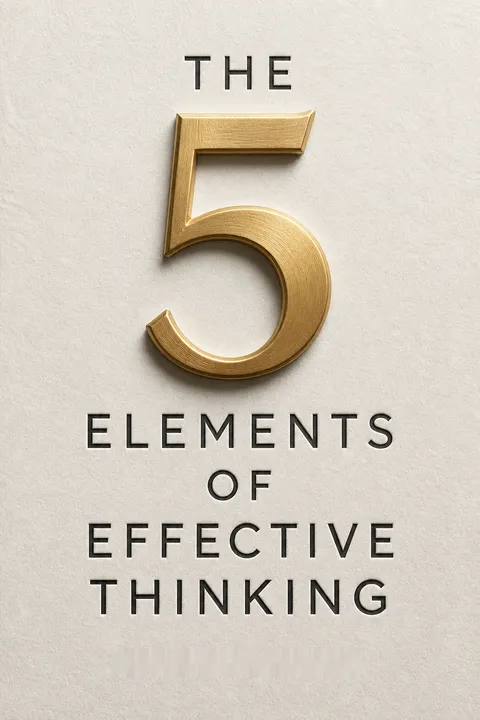


Key Takeaways
Treat effective thinking as a trainable practice, not a gift.
Talent is not the starting point. The book argues that better thinking comes from habits that can be learned, not from a rare inborn spark. Mark, a student whose early mathematics work was nearly meaningless, changed course when he stopped repeating terminology and returned to the ideas underneath it. He eventually produced an original solution to a difficult problem. His change illustrates the book’s central claim: progress depends less on looking naturally brilliant than on how a person learns.
The authors organize their habits through five elements: Earth means understanding deeply, Fire means learning through mistakes, Air means creating questions, Water means tracing how ideas develop, and the Quintessential Element is change. The labels are memory aids for a practical approach, not a claim that every kind of thinking fits neatly into five boxes.
The strongest implication is democratic without pretending that everyone has identical abilities. A learnable method can expand what people do with their existing strengths, even if it cannot erase every difference in aptitude or circumstance. This distinction matters: telling people that effort guarantees any outcome can make setbacks feel like personal failure. The more defensible promise is that deliberate habits improve the quality of engagement and reveal capacities that passive confidence or self-doubt can conceal. The framework is useful as a reminder system, provided the elements remain flexible tools rather than a checklist applied mechanically.
Rebuild the foundations before attempting the impressive problem.
Simple does not mean shallow. The book’s Earth principle asks learners to return to basic ideas until they understand their meaning and connections, rather than memorizing isolated procedures. In a master class, trumpet virtuoso Tony Plog asked accomplished players to perform a simple warm-up. Their notes sounded competent; his sounded expressive and controlled. The contrast showed that expertise can live in the quality of basic execution, not only in the difficulty of the piece.
The same logic applies to hard problems. If a challenge feels too large, isolate a smaller part and solve it thoroughly. NASA’s path to the Moon included intermediate steps, beginning with an unmanned craft that struck the lunar surface and sent back photographs. For a personal problem, a small, focused practice can expose the conditions that make the larger challenge manageable.
This approach echoes a useful distinction in education: knowing a procedure is not the same as understanding when it applies or why it works. Strong foundations make transfer possible, because the learner can adapt a principle when the surface details change. The trumpet example makes that difference audible. There is a caution, though: returning to basics can become an excuse to delay difficult work. The productive test is whether deeper practice changes performance on more demanding tasks. Foundations should be a launchpad, not a permanent waiting room.
Separate what you observe from what you assume you see.
Clear the mental clutter. To understand a complicated situation, identify an essential feature, then distinguish direct observation from interpretation. Picasso’s sequence of bull drawings offers a visual example: each version removes detail until a few lines preserve what he regarded as the subject’s core. The point is not that every problem has one hidden essence, but that removing distractions can make a useful central feature easier to examine.
The authors also urge readers to state what they know and what they do not. A painting professor challenged students who invented elaborate symbolism before describing the visible scene. Likewise, the familiar belief that heavier objects fall faster persisted for centuries partly because it sounded plausible and came from an authority. Naming uncertainty, checking evidence, and temporarily considering an opposing view help reveal the assumptions inside a confident opinion.
This is a practical form of epistemic humility: confidence should track the basis for a belief, not merely how familiar or socially accepted it feels. Separating observation from interpretation is especially valuable in conflict, where people often treat an inference about another person’s motives as if it were a witnessed fact. Yet simplification has a risk. A focus on essentials can erase context that changes what the evidence means. The strongest use of the method is iterative: simplify to see a pattern, then restore relevant complexity to test whether the pattern still holds.
Write the imperfect first attempt so you have something to improve.
Errors give thought a target. The authors recommend replacing the blank page with a rough attempt. Once an idea exists, a learner can inspect what works, locate what fails, and revise specific defects. Mary, a student who disliked mathematics, used this process to solve a challenging question about infinity. Her instructor asked her to propose an answer, identify one flaw, repair it, and repeat. After several rounds, she reached a correct solution that differed from the textbook’s version. She later applied the same method to an essay she had been unable to start.
The principle applies beyond school. Franklin Roosevelt’s initial draft of his speech after the attack on Pearl Harbor was revised into a sharper opening. In the authors’ classes, part of the grade rewarded productive failure, meaning a failed attempt examined and used to improve the next one. Mistakes without analysis are not automatically progress.
A rough draft reduces the cognitive burden of inventing and judging at the same time. It turns an abstract demand for quality into observable choices: keep, clarify, remove, or test. This resembles iterative design, where prototypes make hidden assumptions concrete enough to challenge. The crucial ingredient is feedback. Repeating an ineffective attempt without diagnosing it can deepen a bad habit, while premature criticism can prevent useful ideas from appearing. The book’s emphasis on revision is strongest when paired with a clear question about what the error reveals and a next attempt designed to test that answer.
Ask what your failed solution might answer instead.
A wrong turn can change the problem. Sometimes a failed attempt contains a useful feature for a different purpose. At 3M, Spencer Silver developed an adhesive weaker than the product he meant to create. Years later, colleague Arthur Fry used that adhesive to keep bookmarks in a hymnal without damaging the pages. Their combination led to the Post-it note. The lesson is not that every mistake hides a commercial breakthrough, but that a result should be examined for unexpected uses before it is discarded.
The book also recommends deliberate exaggeration. Imagining a solution at an impractical extreme can expose a workable principle. A teacher’s fantasy of taking students to Paris to measure the Eiffel Tower suggested a realistic alternative: take mathematics outside the classroom and connect it to the physical world. Stress-testing an idea, or imagining its opposite, can expose weaknesses that ordinary thinking leaves concealed.
This is a form of reframing: instead of asking only whether an attempt met its original goal, ask what properties it actually produced and where those properties might matter. That orientation is valuable in creative work, where a mismatch between intention and outcome can reveal an overlooked opportunity. Still, retrospective success stories can make serendipity look easier to recognize than it is. Most failed experiments remain failures. A disciplined search for alternate uses should therefore complement, not replace, criteria for deciding when to stop investing in an unpromising line of work.
Question the question before spending your effort on an answer.
Better framing directs action. The Air element treats question-making as a thinking skill in its own right. During the investigation of the Challenger disaster, physicist Richard Feynman focused attention on a basic test: whether a cooled O-ring would regain its shape after being compressed. His simple demonstration with an O-ring in ice water made a possible cold-weather vulnerability visible to a broad audience.
Questions also need to be useful, not merely interesting. Asking how to fix all traffic may leave a commuter powerless; asking how to use an unavoidable delay opens choices within that person’s control. Similarly, asking how to get a better grade can be less helpful than asking how to understand the course well enough to explain it. Before acting, identify the task’s purpose, the assumptions inside its framing, and the next step the answer would make possible.
Question quality shapes attention. A question that presumes the wrong cause can send an entire investigation toward the wrong variables, while a basic question can expose an assumption hidden beneath technical complexity. This is closely related to problem formulation in science and public policy: solutions are constrained by what the initial model makes visible. The authors’ emphasis on actionable questions is especially practical, but not every valuable question offers immediate control. Some questions matter because they clarify responsibility, expose structural barriers, or prevent a convenient answer from being mistaken for a complete one.
Teach an idea aloud to discover where your understanding breaks.
Explanation tests understanding. Preparing to teach forces a learner to organize a topic, choose examples, explain its purpose, and connect details to a larger structure. Mark, a successful mathematics teacher, said he truly learned calculus when he first had to teach it. The questions he needed to answer for students exposed what he understood and what still needed work. A short lesson for a friend, colleague, or even an imaginary audience can serve the same purpose.
The book extends questioning to listening. Create questions while reading, attending a meeting, or hearing a lecture, even if they are not asked aloud. The act of generating them makes listening active: What is assumed? What remains unclear? What example would test the claim? A self-made practice exam can reveal whether the central ideas are understood, rather than merely familiar from repeated exposure.
Teaching creates a useful pressure test because fluent recognition can masquerade as knowledge. A person may follow an explanation yet struggle to reconstruct it without the original cues. Explaining from memory makes that gap visible, while questions from an audience expose ambiguities the speaker missed. This method also has a social benefit: knowledge becomes something communicated and checked, not privately possessed. Its limitation is that clarity of explanation is not identical to truth. A smooth lesson can transmit an error just as efficiently, so teaching should be paired with evidence and opportunities for correction.
Trace an idea backward, then push it one step forward.
Ideas have histories and futures. The Water element treats knowledge as a flow rather than a pile of unrelated facts. New ideas grow from earlier work, and each solution can create new questions. The authors note that calculus developed from ideas mathematicians had been approaching before Newton and Leibniz, and that a modern textbook’s many pages extend a small number of foundational concepts. Seeing those connections makes material more coherent than memorizing every topic as a separate unit.
Use the same method on your own work. Ask what earlier idea made the current one possible, then ask what could follow from it. Hemingway revised the ending of a novel many times; revision was not a detour from creation, but part of how the finished work emerged. A rough project can be improved through successive versions, and a useful solution can be extended into applications its original creator did not anticipate.
Thinking historically guards against the myth that innovation appears from nowhere. It also changes the learner’s relationship to difficult material: a concept becomes a consequence that can be reconstructed, not an arbitrary fact to store. Looking forward adds a generative dimension, inviting application and testing. The danger is assuming that every new step is progress. Ideas can evolve into harmful or less effective forms, and historical sequences do not guarantee improvement. The useful discipline is to trace connections while evaluating their consequences, rather than treating continuity as proof that a development is worthwhile.
Become better by changing how you perform the task.
Improvement can change the work itself. The book’s final element is change: adopt the habits that make growth part of how you operate. The authors distinguish doing the same task more intensely from doing a different, more informed task. A student who applies a physics formula without understanding it is forced to manipulate symbols blindly; a student who understands the underlying idea can reason about what the formula means. The second task is often easier because it uses a richer mental model.
A story about mathematics student Sam Y. shows the potential of rebuilding from the beginning. Struggling in class, he used a winter break to work through early questions until the logic became clear, then returned able to solve new problems. The authors do not claim everyone has equal ability. Their point is that people often set their personal limits far below what careful methods and sustained learning could make possible.
The shift from trying harder to changing the task is powerful because it redirects attention from willpower to competence, tools, and mental models. In many domains, experts perceive patterns novices do not, so the same external assignment presents a different cognitive problem. This view helps explain why deliberate practice must target specific weaknesses rather than simply accumulate time. It also needs a humane qualification: better methods do not remove unequal resources, disability, or every natural constraint. The realistic invitation is not limitless achievement, but continual revision of the assumptions that prematurely define what a person can learn.
Analysis
The book’s central achievement is to make creative thinking feel less like a mysterious personality trait and more like a repeatable sequence of moves. Start with what is simple enough to inspect. Make a provisional attempt. Ask what is missing or wrong. Trace where the idea came from, and test what it might lead to. Then revise the thinker as well as the thought. The classical elements give this sequence a memorable structure, while the classroom stories make abstract advice visible in practice.
The most powerful connective thread is epistemic honesty. A learner who admits a gap can fill it; someone protecting an image of competence cannot. That principle links the book’s advice about basics, mistakes, questioning, and revision. It also helps explain why the examples travel beyond mathematics. The same habits apply to writing, teaching, leadership, and civic judgment because each involves claims, evidence, uncertainty, and decisions.
The book is most persuasive when it presents failure as information, not as virtue in itself. A mistake matters only when it produces a sharper question, a better test, or a useful revision. The Post-it story is memorable precisely because the failed adhesive acquired value through attention and a new application, not through failure alone. This qualification matters in environments where mistakes carry real costs. Low-risk experiments and reversible trials are better settings for deliberate error than consequential decisions made without safeguards.
The authors’ optimism about learnable thinking is valuable, but its best interpretation is practical rather than absolute. Methods cannot make every outcome inevitable or dissolve structural constraints. They can make learning more deliberate, reveal hidden assumptions, and help people move beyond habits that unnecessarily limit their performance. The book’s lasting message is therefore neither that genius is effortless nor that effort guarantees success. It is that effective thought can be practiced, observed, and improved, one better question and one more informed attempt at a time.
Review Summary
The 5 Elements of Effective Thinking is highly regarded for its practical approach to improving thinking and learning. Readers appreciate its concise presentation of key concepts: understanding basics deeply, learning from mistakes, asking questions, following idea flows, and embracing change. Many found it insightful and applicable across various fields, particularly for students. While some felt the content wasn't entirely novel, most praised its clarity and memorable framework. The book's brevity and accessibility were frequently highlighted as strengths, with many recommending multiple readings to fully absorb its lessons.
People Also Read




Glossary
The 5 Elements of Effective Thinking
Five habits for better thinkingThe authors’ organizing framework for learnable thinking practices. Earth represents deep understanding, Fire represents learning through mistakes, Air represents creating questions, Water represents tracing the development and consequences of ideas, and the Quintessential Element represents change. The elements are mnemonic categories for habits that can be used across learning, work, and everyday problem-solving.
Earth
Understand foundations deeplyThe book’s label for grounding thought in strong understanding. Earth means returning to simple fundamentals, identifying the essential parts of a subject, distinguishing evidence from assumption, and admitting gaps in knowledge. A solid grasp of basics supports more reliable reasoning about complex topics and makes it easier to recognize what a learner still needs to understand.
Fire
Learn through mistakesThe book’s label for using errors as material for learning and invention. Fire involves making an attempt, identifying what failed, and using that information to improve the next attempt. It also includes considering whether a failed result may be useful for a different problem, or whether exaggerating an idea can expose its weaknesses.
Air
Create useful questionsThe book’s label for questioning as an active thinking practice. Air means generating questions to expose assumptions, clarify uncertainty, direct attention, and identify the real problem. It includes asking questions while listening or learning, testing whether a question leads to useful action, and questioning the purpose of an assignment before beginning it.
Water
Trace ideas through timeThe book’s label for seeing ideas as connected and evolving rather than isolated facts. Water means looking backward to understand the earlier ideas that led to a current concept, then looking forward to explore possible extensions, applications, and consequences. The approach treats each solution as a starting point for further understanding and creation.
The Quintessential Element
Make change a habitThe book’s name for change as the purpose and condition of effective thinking. After the four other elements provide methods for understanding, questioning, learning from mistakes, and extending ideas, this element asks people to adopt those methods and revise how they work. Improvement is framed as changing the task through better knowledge or strategy, not merely applying more force to the same approach.
negative space
Notice what surrounds or is missingA term borrowed from art for the space around an object, applied in the book to gaps in perception and understanding. Looking for negative space means noticing absences, limitations, or unasked questions that remain easy to overlook when attention is fixed only on what is visibly present. Naming what is missing can reveal opportunities and identify knowledge gaps.
meta-questions
Questions about the taskQuestions asked before beginning a project or assignment to clarify its purpose and expected benefit. Examples include asking what a task is intended to accomplish and what useful change should result from it. These questions can focus effort on the central goal, uncover confusion early, and prevent efficient work on an activity that does not serve its intended purpose.
FAQ
What's "The 5 Elements of Effective Thinking" about?
- Core Concept: The book explores five key elements that can enhance thinking and learning, applicable across various fields and aspects of life.
- Authors' Background: Edward B. Burger and Michael Starbird, both educators, share insights from their experiences in teaching and learning.
- Practical Approach: It provides practical strategies to improve problem-solving, creativity, and understanding.
- Universal Application: The methods are designed to be accessible and beneficial to anyone, regardless of their background or profession.
Why should I read "The 5 Elements of Effective Thinking"?
- Improve Thinking Skills: The book offers strategies to think more effectively, which can lead to success in personal and professional life.
- Broad Applicability: The elements discussed are relevant to students, professionals, and lifelong learners.
- Actionable Advice: It includes exercises and real-life examples to help readers apply the concepts.
- Inspiration for Change: The book encourages readers to embrace change and continuous improvement.
What are the key takeaways of "The 5 Elements of Effective Thinking"?
- Understand Deeply: Focus on mastering the basics and understanding simple things deeply.
- Fail to Succeed: Embrace mistakes as learning opportunities and a path to success.
- Be Your Own Socrates: Constantly create and ask questions to deepen understanding.
- Look Back, Look Forward: Recognize the flow of ideas and build on past knowledge to innovate.
What are the five elements of effective thinking according to the book?
- Earth - Understand Deeply: Ground your thinking by mastering the basics and seeking the essential.
- Fire - Fail to Succeed: Use mistakes as a guide to ignite insights and progress.
- Air - Be Your Own Socrates: Create questions to challenge assumptions and stimulate curiosity.
- Water - Look Back, Look Forward: See the flow of ideas to understand current concepts and create new ones.
- Quintessential Element - Engage Change: Embrace change as a constant and transform yourself through continuous improvement.
How can "Understand Deeply" improve my thinking?
- Master the Basics: Focus on understanding fundamental concepts thoroughly to build a solid foundation.
- Clear the Clutter: Identify and concentrate on the essential elements of any issue.
- See What's There: Be honest about what you know and don't know to fill knowledge gaps.
- See What's Missing: Look for gaps in understanding to uncover new possibilities and solutions.
How does "Fail to Succeed" contribute to effective thinking?
- Embrace Mistakes: View errors as opportunities for learning and growth.
- Iterative Process: Use mistakes to refine and improve your approach incrementally.
- Find New Questions: Sometimes a wrong answer can lead to a new, valuable question.
- Intentional Failure: Deliberately explore extreme scenarios to gain insights and discover new paths.
What role do questions play in "Be Your Own Socrates"?
- Stimulate Curiosity: Questions drive deeper engagement and understanding of any topic.
- Challenge Assumptions: Asking questions helps reveal biases and hidden assumptions.
- Guide Learning: Questions can direct focus to the most important aspects of a subject.
- Active Listening: Creating questions transforms passive listening into an active learning process.
How does "Look Back, Look Forward" help in understanding ideas?
- Historical Context: Understanding the evolution of ideas provides a coherent structure for learning.
- Iterative Improvement: Recognize that every idea can be extended and improved upon.
- Predict Future Trends: Use past developments to anticipate future innovations.
- Continuous Learning: View learning as an ongoing journey rather than a series of isolated facts.
What is the "Quintessential Element" and its significance?
- Embrace Change: Recognize change as a constant and essential part of growth.
- Transformative Thinking: Use the other four elements to continuously improve and adapt.
- Lifelong Learning: Adopt a mindset of perpetual learning and self-improvement.
- Personal Growth: Change is not just about learning new things but transforming oneself.
What are some of the best quotes from "The 5 Elements of Effective Thinking" and what do they mean?
- "Success is the ability to go from one failure to another with no loss of enthusiasm." - Winston Churchill: Emphasizes the importance of resilience and learning from mistakes.
- "The unexamined life is not worth living." - Socrates: Highlights the value of questioning and self-reflection.
- "A ship in port is safe, but that’s not what ships are built for." - Grace Murray Hopper: Encourages taking risks and embracing challenges for growth.
- "If I have seen farther than others it is because I have stood on the shoulders of giants." - Isaac Newton: Acknowledges the importance of building on past knowledge.
How can I apply the elements of effective thinking in my daily life?
- Daily Practice: Incorporate exercises from the book into your routine to develop these thinking habits.
- Reflect on Mistakes: Regularly review and learn from your errors to improve continuously.
- Ask Questions: Make it a habit to question assumptions and explore new perspectives.
- Plan for Change: Set goals for personal growth and adapt strategies to achieve them.
How do the authors, Edward B. Burger and Michael Starbird, support their ideas in the book?
- Real-Life Examples: The book includes stories and examples from various fields to illustrate the concepts.
- Educational Experience: Both authors draw from their extensive backgrounds in teaching and learning.
- Practical Exercises: Each chapter offers actionable exercises to help readers apply the elements.
- Broad Audience: The strategies are designed to be accessible and beneficial to a wide range of readers.
Download PDF
Download EPUB
.epub digital book format is ideal for reading ebooks on phones, tablets, and e-readers.








