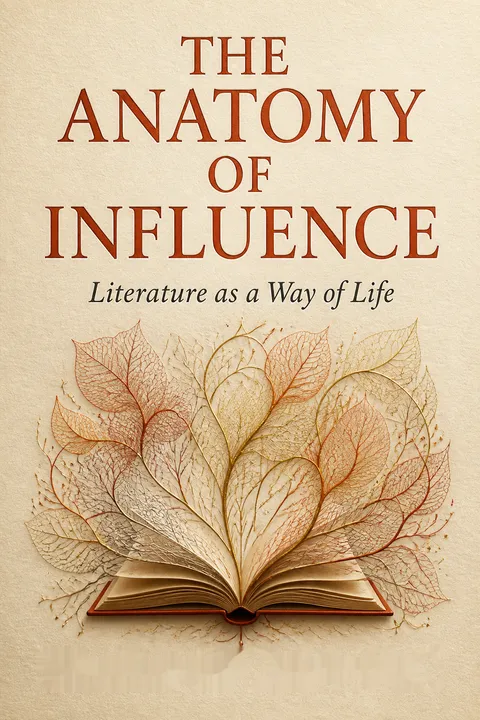


Key Takeaways
Treat influence as literary love under pressure, not polite inheritance
Love with resistance. Harold Bloom’s central claim is that writers inherit through conflict. A later poet loves a powerful predecessor, learns from that work, and also resists being absorbed by it. Bloom calls this struggle an agon. The anxiety belongs chiefly to the poems and their imaginative relationship, not necessarily to the writers’ private feelings. A poet may redirect a precursor’s images, voice, or way of seeing to make room for a distinct artistic identity.
Misreading can create. Bloom calls a forceful, inventive revision of an earlier work a creative misreading, or misprision. Shakespeare’s relation to Marlowe offers his model: Shakespeare learned from Marlowe’s command of an audience, then transformed theatrical rhetoric into characters with far greater inward complexity. Milton’s selective resistance to Shakespeare and Joyce’s near-total appropriation show different ways of negotiating the same burden.
The model makes originality relational rather than miraculous: a new work becomes legible partly through the older work it alters. That resembles how scientific ideas develop, as researchers revise inherited concepts rather than begin from nothing. The literary version, however, is not simply a contest for status. Bloom’s emphasis on emotional attachment helps explain why imitation can be intimate and adversarial at once. The framework is most useful when treated as an interpretive lens, not a universal law. Some writers inherit collaboratively, and some artistic innovations arise from traditions Bloom does not foreground.
Read great literature for the strangeness that enlarges perception
The familiar turns strange. Bloom uses the sublime for writing that overwhelms, transports, and enlarges its reader. Its signal is not sheer grandeur but strangeness: a voice feels foreign to ordinary experience yet close enough to enter the reader’s imagination. Reading Hamlet, for example, can make a person feel the prince’s quick, unstable consciousness without making that consciousness fully understandable. The reader encounters a mind beyond the limits of familiar moral categories.
Difficulty has a purpose. Bloom connects this experience to Longinus’s account of the sublime, Walter Pater’s idea that beauty gains force through strangeness, and Owen Barfield’s insistence that the strangeness must be meaningful. A powerful work does not yield one tidy message. Its metaphors widen the field of possible meanings, and criticism should map those paths rather than pretend the text explains itself.
This account takes reading seriously as an encounter that can alter the reader, not just transfer information. It also explains why ambiguity need not mean that every interpretation is equally persuasive: some readings account for more of a work’s language and effects than others. The useful distinction is between openness and vagueness. Bloom’s praise of difficulty can sometimes romanticize obscurity, though. A text is not profound merely because it resists explanation. The reader still needs evidence in the words, structure, and consequences of an interpretation.
Study Shakespeare to see how characters can exceed their plots
People larger than roles. Bloom sees Shakespeare as the central writer of modern drama because his characters seem to possess more consciousness than their plots can contain. Falstaff, Hamlet, and Cleopatra invite readers to imagine them beyond the plays in which they appear. Their wit and contradictions make them feel less like examples of a moral lesson than like people whose inner lives keep unfolding.
The audience is part of the invention. Bloom argues that Shakespeare learned from Marlowe how powerful rhetoric could command a theater audience. Shakespeare transformed that force into characters who can capture attention while remaining morally unsettling. Iago’s eloquence, for instance, draws the audience into his perspective without giving it a firm moral guide. Bloom’s claim that Shakespeare helped people recognize themselves is deliberately expansive: the plays did not create human beings, but gave readers new ways to imagine human complexity.
The idea of characters exceeding their plot helps explain why some fictional figures become cultural reference points: they supply patterns for thinking about motives, self-deception, and identity. That influence extends beyond literature into performance, where actors must make choices the text leaves open. Yet the claim that Shakespeare’s characters are uniquely complete should be read as a critical judgment, not a measurable fact. It can also obscure the collective labor of actors, audiences, editors, and translators that keeps those characters alive across generations.
Treat Shakespeare’s omissions as invitations to interpret, not gaps to repair
Absence does dramatic work. Bloom calls Shakespeare a master of ellipsis, meaning that he withholds information while making the missing material shape our experience. In Hamlet, uncertainty about the prince’s family and past intensifies his questions about who he is. The play offers no definitive answer to whether Claudius was involved with Gertrude before the king’s death, or whether Hamlet’s doubts about his parentage have any basis.
The gaps redirect attention. The Tempest opens with a storm that turns out to be an illusion, then leaves much of its island world unexplained. Bloom argues that these omissions are not defects to patch with a single historical or political account. They make the audience test perspectives and notice the limits of what the play reveals. His own interpretations, such as the possibility that Othello and Desdemona never consummated their marriage, remain provocative conjectures, not settled facts.
Attention to omission is valuable because readers often mistake uncertainty for a puzzle with one hidden solution. In drama, withheld information can instead organize tension, shift sympathy, or expose how much an audience assumes. The method also encourages intellectual restraint: a plausible interpretation is not automatically a verified fact about the characters or the playwright. Bloom’s own bold readings demonstrate both the excitement and the risk of this approach. The strongest interpretation should illuminate the text without claiming certainty where the work deliberately withholds it.
Ask how a writer’s later work answers the writer’s earlier work
The self can be a precursor. Following the poet-critic Paul Valéry, Bloom uses self-influence to describe how a major writer revises and responds to their own earlier work. This is more than repetition or autobiographical reflection. The question is what a writer accomplishes as a writer by returning to earlier artistic possibilities.
A career becomes an internal argument. Bloom reads Shakespeare’s movement from Falstaff and Hamlet through the tragedies and late plays as a series of transformations in dramatic power. The Tempest, for example, can be read against the earlier Falstaff plays: its controlled, enigmatic Prospero contrasts with Falstaff’s comic abundance. Whitman’s later elegies also reshape the expansive self presented in the first Leaves of Grass. Such comparisons do not require claims about what the authors consciously intended. They trace how one work changes the meaning of another.
This approach makes a writer’s career more than a sequence of stylistic phases. It treats revision as a form of thought, where an artist discovers what an earlier work could not yet say. The idea has parallels with developmental psychology: identity is partly built by reinterpreting one’s past, not simply preserving it. Still, the analogy has limits. A literary work is not a transparent record of a person’s inner development, and a critic can mistake contrast between works for deliberate self-correction. Close attention to form helps keep the interpretation grounded.
Let poetry’s sensory force complicate its declared beliefs about life
Sensation can resist doctrine. Bloom traces a skeptical, materialist current from the Roman poet Lucretius through Shelley, Leopardi, Whitman, and Wallace Stevens. Lucretius argues that nature consists of material processes and that death should not be feared as an experience after life. Bloom calls the resulting artistic possibility a Lucretian or skeptical sublime: poems can face mortality without relying on religious consolation.
The poem may contradict its speaker. Tennyson’s dramatic monologue “Lucretius” gives the ancient poet vivid erotic visions and then turns toward a moralizing conclusion. Bloom reads that tension as evidence that Tennyson’s sensory imagination resists the beliefs the poem appears to endorse. Whitman’s grass poems similarly begin from uncertainty about what nature means, then generate images that hold death and renewal together. In Bloom’s view, a poem’s felt experience can exceed its stated philosophy.
The distinction between what a poem argues and what it makes readers feel is crucial to literary interpretation. A text can affirm an idea explicitly while its images, rhythms, or emotional movement complicate it. This resembles the difference between a speaker’s stated beliefs and the evidence of their behavior. Bloom’s approach is particularly strong when it attends to formal details, as in the contrast between Tennyson’s erotic imagery and moral conclusion. It is less secure when it assumes that sensory vividness reveals an author’s truer philosophy. Art can sustain contradictions without resolving them.
Follow Whitman’s tally from bodily desire into collective mourning
A small sign gathers meaning. Bloom treats the tally as Whitman’s signature image: a token that counts, records, and links what might otherwise remain separate. In “Live Oak, with Moss,” a speaker takes a twig from a solitary tree and keeps it as a sign of longing for a companion. The object makes private desire visible while also becoming part of the poem’s form.
The tally changes with grief. In “When Lilacs Last in the Dooryard Bloom’d,” Whitman brings together a lilac sprig, a bird’s song, and the memory of Abraham Lincoln. Bloom reads the tally there as an image that joins erotic feeling, poetic voice, and public mourning. Whitman’s elegy does not simply praise a president. It makes loss communal while preserving its intimate texture, and it lets images of death coexist with the return of spring.
The tally is compelling because it gives abstract continuity a physical form. A twig or flower can serve as a mnemonic object, joining an individual’s memory to a shared event. This is one way poetry makes grief both personal and public without flattening either. Bloom also reads sexual meanings into Whitman’s plant imagery, especially the calamus and lilac. Those readings can be illuminating, but symbolic meanings need not cancel literal, social, or ecological ones. The image’s power may come precisely from carrying several meanings at once.
Inherit Whitman’s poetic stance without copying his free-verse style
Influence runs beneath style. Bloom argues that Whitman’s reach is strongest not where later poets imitate his long lines, but where they inherit his way of making a poem feel like an environment of thought. Hart Crane writes in tightly patterned stanzas, yet The Bridge answers Whitman’s expansive vision of America. Wallace Stevens and T. S. Eliot likewise resist Whitman’s surface manner while remaining deeply shaped by his images and poetic stance.
Each heir changes the inheritance. D. H. Lawrence adopts Whitman’s immediacy and energy, then challenges his democratic outlook. John Ashbery and A. R. Ammons develop looser, wave-like forms that Bloom connects to Whitman’s shifting phrases. Their work shows that influence need not produce resemblance. A later poet can preserve a predecessor’s central question or imaginative ambition while inventing a sharply different sound.
This distinction between style and stance is useful in any study of influence. Artists often inherit a problem, ambition, or way of attending rather than a recognizable technique. It explains why direct imitation can be less revealing than transformation. Whitman’s legacy, as Bloom describes it, is not a single national voice but a set of experiments with scale, selfhood, and poetic form. The account also raises a useful caution: calling a writer an heir can make influence seem inevitable. Readers should still ask what the later work changes, resists, or leaves behind.
Make criticism personal, but show readers why your judgments matter
Reading is a life practice. Bloom presents criticism as passionate attention to works that change how readers perceive and think. His model is Samuel Johnson, who reportedly left the room while reading Hamlet alone because the Ghost frightened him. For Bloom, that response is not a distraction from criticism. It shows how literary art can feel immediate before analysis begins.
Appreciation needs judgment. Bloom rejects criticism that treats literature only as evidence of politics, institutions, or social power. He argues that critics should read closely, describe, evaluate, and appreciate, making judgments of artistic value explicit rather than hiding them behind academic procedure. His defense of a literary canon follows from this commitment, though he presents his own preferences openly as judgments. Literature, in this account, is not merely an object of study but one of the ways a person lives.
Bloom’s insistence on affect corrects a sterile model of criticism in which the reader’s experience is treated as irrelevant. The Johnson anecdote makes the point memorably: attention begins in an encounter, and analysis can deepen rather than erase it. Explicit evaluation also lets readers examine a critic’s standards instead of mistaking them for neutral facts. The tension is that personal passion can become gatekeeping when one canon is treated as universal. Strong criticism earns authority not by avoiding judgment, but by explaining its criteria and remaining open to challenge.
Analysis
The book is both a theory of literary inheritance and an extended demonstration of how that theory works. Bloom moves among close readings, personal memories, and judgments of literary stature, returning repeatedly to Shakespeare and Whitman as the figures who make later writing feel belated. The architecture is deliberately associative: the reader encounters influence as a maze of relations rather than a neat chronology. This form mirrors the argument, though it can also make the book’s emphatic claims hard to separate from its examples.
Its most durable insight is that influence is not adequately described as a list of sources. A writer’s relation to predecessors is visible in transformations of image, voice, form, and imaginative possibility. Bloom’s accounts of Shakespeare learning from Marlowe, Milton wrestling with Hamlet, and Crane answering Whitman show how literary history can be read as a succession of revisions. His attention to omission and self-revision extends that method beyond obvious echoes.
The method also has limits. Bloom privileges a Western canon and often treats a small group of male writers as universal benchmarks. That choice gives his arguments sharp focus, but narrows the range of traditions and forms that can test them. His speculative readings of Shakespeare can be exhilarating, yet the distinction between a productive hypothesis and an unsupported claim is not always maintained. The reader benefits from separating the textual evidence from the critic’s imaginative extrapolation.
A contemporary account of reading can connect Bloom’s intuition to predictive processing: readers use prior expectations to make sense of new language, while surprising forms force those expectations to adjust. That does not prove that every poem is an agon, but it clarifies why a powerful work can feel at once recognizable and unfamiliar. Bloom’s best achievement is to make literary history experiential. The past is not background scenery. It is an active presence that a new work must absorb, alter, or refuse.
Review Summary
The Anatomy of Influence receives mixed reviews, with praise for Bloom's literary knowledge and passion, but criticism for repetitiveness and arrogance. Readers appreciate his insights on Shakespeare, Whitman, and other influential writers, while some find his focus narrow and exclusionary. The book is seen as a culmination of Bloom's career, exploring the concept of literary influence. Many reviewers note the dense, challenging nature of the text, recommending it for those well-versed in literature and literary theory.
Glossary
agon
creative struggleA contest or struggle between writers and their literary predecessors. In Bloom’s account, a later poet admires an influential earlier poet but must also resist being overwhelmed by that influence. The conflict is primarily visible in the poems’ imaginative choices, not necessarily in the authors’ personal feelings or conscious rivalry.
creative misreading
transformative rereadingBloom’s term for a strong writer’s inventive transformation of an earlier work. The later writer does not merely repeat or accurately summarize the precursor, but bends its language, images, or vision into a new artistic direction. Such revision can preserve the predecessor’s importance while establishing a distinct voice.
misprision
willful interpretive revisionA deliberate or productive misreading through which a later writer reworks a precursor’s authority. Bloom draws on Shakespeare’s use of the word and links it to the processes of misreading and swerving. In his critical vocabulary, misprision names a form of resistance that can become an act of artistic creation.
daimon
the poet’s inward geniusA term Bloom draws from ancient Greek thought for the poet’s deeper, nonordinary creative self. He distinguishes it from the everyday or rational self, and uses it to describe the source of a writer’s distinctive imaginative power. It is a critical metaphor for poetic potential, not simply a synonym for personality.
self-influence
a writer revising earlier workBloom’s term, developed from Paul Valéry’s reflections, for the way a writer’s earlier works shape the writer’s later ones. It is more than self-reference or autobiographical reflection. The critic examines how a writer transforms prior artistic choices, as Shakespeare’s later plays can be read in relation to his earlier characters and forms.
American Sublime
American poetry’s expansive visionBloom’s name for a tradition of American poetry associated with Emerson, Whitman, and Stevens. It describes writing that attempts to enlarge the self and experience through visionary language, while confronting nature, mortality, and the limits of belief. The tradition is defined by imaginative ambition, not by one fixed style.
American Religion
faith in imaginative selfhoodBloom’s description of a distinctly American spiritual outlook, especially in Emerson and Whitman. It centers on self-reliance, inward authority, and the possibility that poetic imagination can remake a person’s sense of reality. Bloom presents it as a literary and cultural faith, not as an organized church or conventional Christian doctrine.
tally
Whitman’s token of connectionBloom’s name for a recurring Whitmanian image that can count, record, and join experiences. A twig, a sprig of lilac, or a bird’s song can become a tally linking bodily desire, memory, poetic voice, and mourning. The term emphasizes how a concrete object gathers meaning across a poem.
Lucretian swerve
freedom through a slight deviationBloom adapts the ancient idea of the clinamen, the slight and uncaused deviation of atoms in Lucretius’s account of nature. As a literary figure, the swerve describes how a later poet departs from a predecessor just enough to create a distinct imaginative path. It is both resistance and dependence.
supreme fiction
a sustaining poetic selfA phrase associated in Bloom’s discussion with Wallace Stevens for an imaginative construction that gives shape to experience without claiming literal or eternal truth. The fiction must remain open to change and provide aesthetic pleasure. It helps a poet or reader oppose mortality by making a meaningful, knowingly invented account of the self.
About the Author
Download PDF
Download EPUB
.epub digital book format is ideal for reading ebooks on phones, tablets, and e-readers.








