

Key Takeaways
Read deeply to enlarge the self, not to perform virtue
A private purpose. Bloom argues that reading matters first because it strengthens a person’s capacity to judge, feel, and understand their own interests. Information is plentiful; wisdom is harder to find. Great writing offers not a substitute for life, but a way to experience lives and minds beyond the narrow circle of people one can know directly.
Pleasure with a cost. Reading, in this account, is solitary work that can ease loneliness and prepare a person for change and mortality. Its reward is a demanding pleasure, not a certificate of goodness or a direct way to improve society. Hamlet, Cervantes’s Don Quixote, and Proust’s Marcel enlarge life by making the reader inhabit unfamiliar forms of consciousness.
What's compelling is the refusal to reduce reading to a tool for self-improvement or civic virtue. Research on narrative engagement suggests that stories can help readers imagine other perspectives, but that effect is neither automatic nor guaranteed to make anyone kinder. Bloom's distinction is useful: literature can expand a reader's inner range without promising social transformation. The limitation is that solitary reading is not equally available to everyone, and private enrichment can become a status marker. Its strongest defense is not that reading makes people morally superior, but that it gives them richer material with which to question themselves.
Let great books challenge your judgments, not serve your ideology
Read to consider. Bloom adapts advice from Francis Bacon and Samuel Johnson: do not approach a book merely to agree, argue, or collect talking points. Weigh what it says, and notice what it makes newly visible. He urges readers to resist canned academic or political language that predetermines what a work is allowed to mean.
Context is not a verdict. Bloom's example is King Lear. Reading it only as evidence for a preselected social argument, he says, can obscure its complexity, including its account of conflict between generations and between women and men. His challenge is to let the play complicate the reader's judgment rather than enlist it as an illustration. The reader's own response matters, but it should be earned through attention.
This is a strong defense of interpretive independence, especially against readings that turn literature into a set of approved conclusions. Cognitive research on confirmation bias also explains why readers often notice evidence that supports what they already believe. Yet context is not simply a distraction: history, gender, and power can reveal features that an uncontextual reading misses. The useful distinction is between context as a lens and context as a sentence passed in advance. Bloom's own polemics show that resistance to ideology can become ideological too, so independence requires examining the critic's assumptions as carefully as the text's.
Read slowly enough to hear what a work refuses to explain
Attend to the gaps. Bloom asks readers to slow down, reread, and notice not only what a work says but what it leaves unsaid. A short story may omit a character's history; a play may make a sudden change in tone without explaining it. Those absences are not necessarily puzzles with one correct solution. They can be invitations to participate in the work.
Ambiguity is evidence. In Keats's ballad about a knight and an elusive fairy woman, the knight may misunderstand her gestures and words. The poem never settles whether his encounter was supernatural, erotic, or imagined. Hamlet presents another challenge: the prince who returns in the final act seems markedly changed from the young man of the earlier scenes. Close reading preserves these tensions instead of smoothing them away.
The invitation to read for omissions aligns with how people make sense of incomplete information: the mind supplies causes, motives, and continuity. A skilled writer can use that impulse to make the reader an active partner. The danger is that an open gap can invite overconfident invention, especially when every image is treated as a symbol. Bloom's more productive lesson is restraint: infer what the text supports, keep competing explanations available, and accept that some uncertainty is part of the experience rather than a defect to repair.
Memorize poems so their language can outlast the reading
Carry the poem inward. Bloom recommends rereading short poems, saying them aloud, and memorizing those that matter. Familiarity makes sound, rhythm, and meaning available without the page, allowing a poem to accompany the reader through changing circumstances. He recalls carrying poems by A. E. Housman and William Blake in memory from childhood.
A mind in miniature. His examples show poetry doing different kinds of work. Housman's remembered landscape turns nostalgia into loss; Dickinson's lyrics press against easy consolations; Whitman's long poem explores tensions among the performed self, inner self, and soul. Tennyson's Ulysses sounds heroic, yet the speaker's self-absorption complicates that heroism. Memorizing such poems gives the reader time to hear those conflicts rather than consume the lines once and move on.
Memorization can be understood as a form of embodied attention: repeated retrieval strengthens access to language, while speaking a poem makes its pacing and sound physical. This is not merely rote learning when the reader returns to the poem's meanings and notices new pressures in familiar words. The practice also democratizes access to literature because a remembered poem is not dependent on a library or device. Still, memorization should remain an invitation, not a test of literary seriousness. Some readers engage deeply through listening, discussion, or translation, and those routes deserve equal respect.
Study characters as rehearsals for contradiction and self-revision
People change in different ways. Bloom contrasts Shakespearean characters, who often discover themselves by hearing their own words, with Cervantes's Don Quixote and Sancho Panza, whose friendship develops through sustained conversation. The two companions remain distinct, but each absorbs something of the other's outlook. That makes their bond unusually reciprocal.
Fiction makes change legible. Austen's Emma must recognize how her imagination has led her to misread other people. Proust's narrator studies jealousy and memory as forces that alter his understanding of himself. Ibsen's Hedda Gabler, by contrast, turns perception and control into destructive games, while Wilde's characters in The Importance of Being Earnest expose social seriousness through absurdity. These figures are not rules for living; they are intricate models of motive, error, and change.
Fictional characters can function as thought experiments: readers observe a motive unfolding over time without having to live through its consequences themselves. That makes literature a valuable complement to abstract moral reasoning, which can overlook how mixed motives feel from the inside. Bloom's contrast between conversational change and self-overhearing also points to two recognizable forms of reflection, learning through dialogue and noticing oneself from a distance. The caution is that a compelling character is not a clinical case study. Literary minds are crafted, selective constructions, not reliable samples of human behavior.
Read stories by tracking whether they reveal reality or remake it
Two distinct pleasures. Bloom distinguishes a Chekhovian mode, which attends to ordinary lives and leaves emotional outcomes unresolved, from a Borgesian mode, which builds deliberate fantasies, labyrinths, and invented worlds. In Chekhov's 'The Student,' a brief story about a young man speaking with two widows links their tears to a biblical tale, then ends with his sudden hope. The story does not explain or guarantee that change.
Fantasy can diagnose reality. Borges's 'Tlon, Uqbar, Orbis Tertius' imagines an encyclopedia describing a fictional world that begins to displace the real one. The contrast is not a simple ranking: Turgenev and Hemingway offer attentive encounters with people and landscapes, while Borges and Calvino reveal how systems of belief can reshape what counts as real. O'Connor's grotesque stories blur the boundary between realism, comedy, and religious vision.
The distinction maps two different reading contracts. Realist fiction asks readers to infer unspoken motives from recognizable behavior; speculative fiction tests how beliefs and descriptions can reorganize a world. Modern genre labels sometimes divide these modes too sharply: realistic narratives rely on invention, and speculative stories often expose familiar social habits. Bloom's categories are most useful as prompts about what kind of attention a story rewards, not as rigid boxes. A reader can ask whether a tale is making the ordinary strange, or making the impossible feel ordinary.
Use America's darkest novels to see national violence without euphemism
A literary lineage of catastrophe. Bloom follows a line from Melville's Moby-Dick through Faulkner, Nathanael West, Thomas Pynchon, Cormac McCarthy, Ralph Ellison, and Toni Morrison. These books unsettle comforting stories about American innocence. Ahab's hunt for the white whale becomes a grand act of defiance with lethal consequences; Faulkner's As I Lay Dying turns a family's attempt to bury its mother into a nightmare of flood, fire, and resentment.
Violence takes many forms. West's Miss Lonelyhearts parodies a culture hungry for redemption; Pynchon's The Crying of Lot 49 leaves its heroine unsure whether she has uncovered a conspiracy or entered paranoia. McCarthy makes violence relentless in Blood Meridian, while Ellison and Morrison confront racial erasure and the search for identity. The books do not offer tidy cures, but they make denial harder.
These novels are powerful because they refuse to let national ideals stand untouched by the violence committed in their name. Their scale and symbolic force can reveal patterns that isolated incidents do not. At the same time, aesthetic intensity is not a substitute for historical testimony: a novel's invented scenes cannot establish facts about a people or period. Bloom's lineage also gives less room to writers outside his chosen tradition, including those whose work might challenge its central assumptions. The novels are best read both as art and as provocations to seek fuller historical accounts.
Let irony protect your judgment from certainty and slogans
Hold two meanings together. For Bloom, irony is not a decorative joke. It is the ability to hear a statement while sensing that it may mean something more, or even something contrary. That double attention matters in Shakespeare's Hamlet, whose sharp speech repeatedly unsettles what others think they know, and in Dickinson, whose small poems can place awe beside danger without resolving the tension.
Surprise needs patience. Thomas Mann's irony can soften a serious claim with humor, while Wilde's The Importance of Being Earnest treats trivial concerns with extravagant gravity. These writers reward readers who can sustain conflicting impressions rather than demand a single moral. Bloom fears that when irony disappears, reading loses both discipline and surprise. His advice is to notice the gap between a character's words, intentions, and actions before deciding what the work believes.
Irony is a form of intellectual flexibility: it makes room for competing interpretations and can expose the confidence of slogans. That capacity is especially useful in environments where quick certainty is rewarded. But irony is not always emancipating. It can become cynicism, allowing a speaker to avoid responsibility by claiming that nothing was meant literally. Bloom's emphasis is most persuasive when irony remains accountable to evidence in the work. Readers can preserve its openness while still asking who is harmed, who benefits, and whether ambiguity clarifies or merely evades.
Keep reading even when no reader can finish the whole work
The work exceeds a lifetime. Bloom closes with Rabbi Tarphon's counsel that a person need not complete the work, but should not abandon it. The saying suits reading: no one can read everything, and no single interpretation can exhaust a great book. Yet the effort remains worthwhile because the encounter changes as the reader changes.
Finish without mastering. Shakespeare eventually stopped writing, and his last dramatic lines accept the limits of human questioning and time. Bloom sets that acceptance beside Tarphon's insistence on continuing. Together, they resist two temptations: believing that every task must be completed, and deciding that an incomplete task is pointless. The practical lesson is to read with seriousness, but without pretending that a final list, a definitive interpretation, or a lifetime's reading can close the matter.
This ending offers a useful model for intellectual life under finite attention: commitment does not require the fantasy of completion. It resembles research, where a good question often opens more paths than one person can follow. The tension between continuing and accepting limits is productive, not solvable. Bloom's own emphasis on a demanding canon can make the work seem reserved for readers with unusual time, training, or access. A more inclusive version keeps the discipline while allowing different starting points, reading speeds, and forms of participation.
Analysis
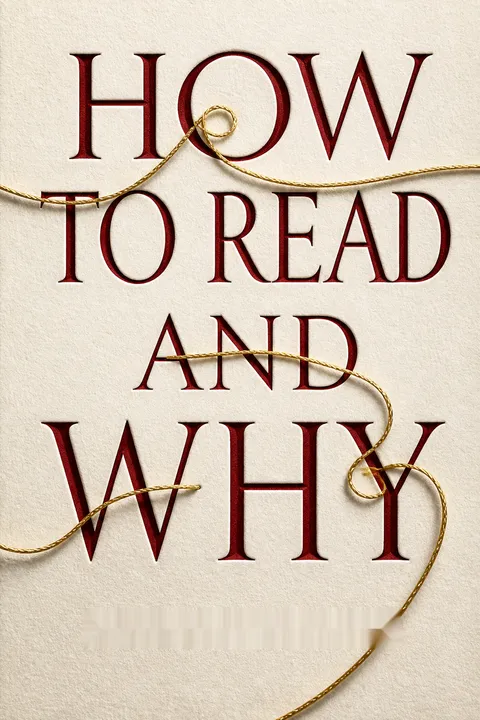
How to Read and Why is part guide, part anthology of literary criticism, organized around a claim about the solitary reader: literature is valuable because it expands the self through difficult pleasure. Bloom does not offer a universal technique. He models attention through selected readings of stories, poems, novels, and plays, moving from Turgenev and Chekhov to Borges, from Shakespeare and Dickinson to Proust and Faulkner. His recurring methods are close reading, rereading, memorization, attention to irony, and respect for ambiguity. The book's form makes its argument visible: the reader learns not from an abstract system but from seeing a critic make details consequential.
Its strongest insight is that literary value cannot be reduced to a work's usefulness as political evidence, moral instruction, or social representation. A reader who permits a text to resist prior beliefs can encounter complexity that an instrumental reading may erase. Bloom is especially persuasive when he demonstrates how a character's voice changes, how a story's silence functions, or how an apparent conclusion leaves an unresolved question. His comparisons across authors give readers portable ways to notice differences between inward realism, speculative artifice, dramatic self-awareness, and lyric intensity.
The limitation is that Bloom's defense of individual judgment sometimes becomes a defense of his own hierarchy. His canon is heavily weighted toward European and American writers, and his denunciations of ideological criticism can treat historical context as if it were inherently reductive. That creates a tension: he asks readers to resist received frameworks while presenting his own aesthetic judgments with considerable authority. His skepticism that reading improves social life is also too categorical. Literary encounters do not guarantee empathy, but they can supply language and perspective used in social thought.
The durable lesson is therefore less that readers should accept Bloom's canon than that they should practice his most valuable habits independently. Read patiently, notice how form shapes meaning, question both the work and the critic, and allow pleasure to arise from difficulty. The book succeeds when it turns literary judgment into an activity readers can continue beyond its recommendations.
Review Summary
How to Read and Why received mixed reviews. Some praised Bloom's insights and passion for literature, while others criticized his elitist tone and focus on Western canon. Many felt the book failed to deliver on its title's promise, instead offering literary criticism and Bloom's personal opinions. Readers appreciated his analysis of specific works but found his Shakespeare obsession excessive. The book's value seemed to depend on the reader's prior literary knowledge and alignment with Bloom's perspective on what constitutes great literature.
People Also Read


Glossary
self-overhearing
hearing oneself anewA mode of self-recognition in which a person encounters their own thoughts or words as if spoken by someone else. Bloom uses it to describe how Shakespearean characters, especially Hamlet, discover unexpected aspects of themselves through speech. In his account, reading can produce a related experience by letting readers observe their own assumptions from a new angle.
Chekhovian
elliptical realist storytellingBloom's label for short fiction that begins with little setup, attends to ordinary experience, and leaves gaps in action or character history. Such stories often avoid explicit moral judgments and conclusive explanations. Readers must infer what matters from conversation, gesture, landscape, and what the narrative chooses not to tell.
Borgesian
self-aware invented worldsBloom's label for fiction that foregrounds its own artifice and builds labyrinthine, speculative, or fantastic worlds. Rather than primarily presenting recognizable social reality, this mode makes the reader consider how language, books, and systems of thought shape reality. Borges is the central example, with Kafka as a major precursor.
reader's Sublime
pleasure earned through difficultyBloom's name for the heightened experience of reading that requires sustained effort and offers more than easy entertainment. Difficult language, intense emotion, or complex thought can enlarge a reader's sense of life when met with patience. The term joins aesthetic pleasure to challenge rather than treating them as opposites.
Blessing
more life beyond limitsBloom uses this capitalized biblical term for an enlargement of life that exceeds ordinary boundaries. Great literature can offer such an enlargement by making readers encounter more people, perspectives, and possibilities than their personal experience alone provides. The effect is aesthetic and inward, not a guarantee of moral improvement or social benefit.
About the Author
Download PDF
Download EPUB
.epub digital book format is ideal for reading ebooks on phones, tablets, and e-readers.








