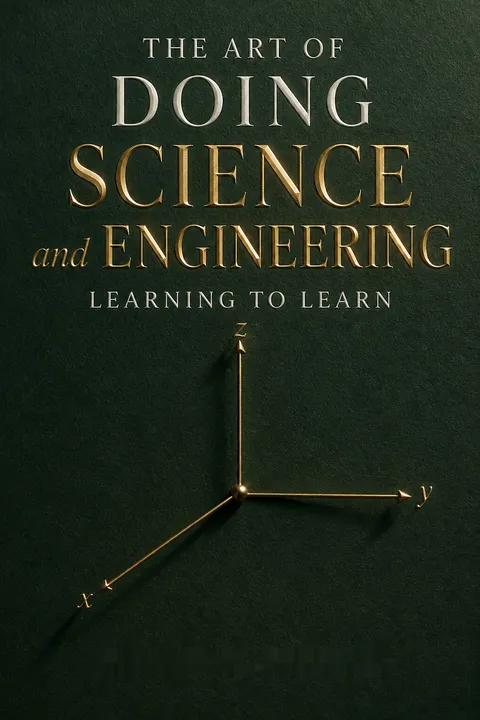


Key Takeaways
Learn the craft of thinking, not just the facts your field teaches.
A craft, not a syllabus. Hamming’s lectures range from computer history to quantum mechanics, but the technical topics are examples, not the destination. The course is about “style”: the practiced judgment used to frame problems, question assumptions, and connect ideas. He compares learning this craft to studying painting. Fundamentals matter, but copying a master is not enough; the learner must practice, select useful techniques, and develop a style suited to new conditions.
Learning must transfer. Hamming distinguishes training, which teaches how to perform a task, from education, which helps decide what to do and why. Rapid technical change makes both essential, especially when important knowledge appears after formal schooling. Reading his stories can suggest a method, but applying it to unfamiliar problems is what turns advice into skill.
The distinction between having knowledge and knowing how to use it resembles the difference between explicit rules and tacit expertise. A textbook can describe a filter; judgment develops through trying it, noticing where the explanation breaks down, and adapting the idea elsewhere. That is why Hamming’s mix of stories and technical examples is more than colorful packaging. One caution: apprenticeship works best when learners receive feedback, not merely inspiration. A vivid account of a successful thinker can open a door, but practice and critique are what help someone walk through it.
Give your career a direction before daily choices scatter it.
Direction compounds. Hamming compares a career without a vision to a sailor staggering through unrelated steps. Random choices tend to cancel, so the distance traveled grows slowly. Choices guided by a sustained aim reinforce one another, making progress accumulate faster. The point is not to predict a perfect career path. Hamming argues that a rough vision is better than drifting, because the effort of pursuing it builds a coherent direction even when circumstances change.
Separate three questions. When imagining the future, ask what is possible, what is likely, and what is desirable. The first concerns technical limits; the second includes human behavior and institutions; the third concerns values. Comparing the likely future with the desirable one reveals where deliberate action might help close the gap. A vision is useful not just for personal ambition, but for deciding which future to help create.
This is a useful correction to the idea that good careers emerge from keeping every option open. A guiding aim reduces the cost of repeated decisions: each opportunity can be judged by whether it builds relevant skill, relationships, or insight. Yet a vision should function as a compass, not a prediction. Research and practice in adaptive planning emphasize revising plans when new evidence arrives. Hamming’s own three questions help: distinguish the future that can be built from the one that is merely expected, then keep checking whether the desired outcome still deserves pursuit.
Use quick models to test claims, then return to first principles.
Calculate before believing. Hamming recommends back-of-the-envelope calculations: rough numerical models that test whether a claim is plausible. He checks two claims from his era, that technical knowledge doubled about every 17 years and that most scientists who had ever lived were still alive. Under a simple exponential-growth model, and an assumed 55-year scientific lifetime, the figures came out broadly compatible. The estimate did not prove either claim; it exposed the assumptions and showed what “most” implied in years.
Keep the durable pieces. Hamming expects technical details to become obsolete, so he advises learning fundamentals that have lasted and from which other results can be derived. Quick models and fundamentals work together: one checks today’s claims, while the other helps rebuild understanding when the field changes.
A rough model is a form of intellectual friction. It interrupts the easy passage from impressive statistic to confident belief, and forces hidden definitions into view. In modern terms, this is model-based reasoning: a conclusion is only as useful as the assumptions and variables that produced it. Hamming’s calculation is valuable less as a historical forecast than as a habit. The danger is false precision: a neat equation can make weak inputs look authoritative. The best quick models are explicit about what they assume and modest about what they establish.
When technology arrives, redesign the job instead of copying its old form.
New tools change the task. Hamming argues that mechanization rarely reproduces hand work exactly. A machine-made equivalent often requires redesigning the product or process around what the technology does well. The same principle shaped his work with computers. At Bell Labs, a small computer attached to a cyclotron could display experimental data as it arrived, allowing researchers to stop flawed runs and change the experiment. The computer did not merely perform the old task faster; it changed what experiments could be done.
Plan for the whole life. Designs should include maintenance from the start, because field repairs can dominate the eventual cost of complex equipment. Hamming applies this to organizations as well as machines: a system must work for the people operating it under real conditions, not only for its designers in a laboratory.
This is a strong version of the idea that technology is not a neutral add-on. A tool changes the costs, timing, and available choices of a task, which can alter the task itself. Good redesign begins with the function that matters, rather than preserving every inherited step. The cyclotron example shows the reward: feedback during an experiment made iteration possible while the apparatus was running. The qualification is that a redesigned equivalent must still preserve the outcome people depend on. Efficiency is not improvement if it quietly removes a feature the old process supplied.
Learn across fields so expertise does not become a cage.
Question inherited limits. Hamming describes how programmers dismissed symbolic languages and FORTRAN as inferior to hand-coded machine instructions. Their expertise in the old methods made the new tools look wasteful, even when higher-level languages saved time and reduced errors. He also recalls rejecting the fast Fourier transform as impractical on one computer, then forgetting that the limitation came from that particular machine. When the hardware changed, his old conclusion no longer applied.
Keep judgment flexible. A paradigm is a field’s accepted assumptions, problems, and methods. Those conventions make routine work possible, but can also hide alternatives. Hamming advises asking which assumptions support a claim of impossibility and what evidence would change a confident expert’s mind. This is not an argument against expertise. It is a case for combining deep knowledge with the ability to learn from other fields and new conditions.
The most persuasive feature here is Hamming’s willingness to use his own mistake as evidence. Expertise compresses experience into fast judgment, but that same compression can make old constraints feel like laws of nature. Cross-disciplinary work can expose the difference. Still, outsiders do not automatically see more clearly: they may miss essential technical limits that insiders understand. The productive arrangement is not expert versus generalist, but informed challenge between them. A useful question in any field is whether a barrier is physical, institutional, or simply a habit that has outlived its reason.
Add redundancy where failure matters, and make systems expose their errors.
Use checks to locate faults. Hamming’s error-correcting codes grew from a practical irritation. A relay computer could detect that a bit pattern was wrong, but could not identify the faulty bit. He arranged message bits so parity checks could identify an error’s position. In the resulting Hamming code, the check results form a binary number that points to the bad bit, allowing a single-bit error to be corrected. An extra overall check can also flag certain multiple errors.
Reliability includes repair. Redundant bits cost storage and transmission capacity, so the design must balance overhead against the risk of failure. But the benefit is larger than recovering the right answer. At a telephone exchange installation, self-checking equipment made faults visible as technicians brought each unit online. A system designed to detect its own errors can be easier to install and maintain, not merely more accurate in operation.
Redundancy looks wasteful only if the system is judged by its ideal operating state. In reality, components fail, signals degrade, and people need clues about what went wrong. Error correction turns extra capacity into both resilience and diagnosis. The same logic appears in safety engineering, where independent checks can catch faults before they cascade. The hard question is whether failures are independent: several safeguards built on the same mistaken assumption may all fail together. Redundancy is most valuable when checks are diverse, errors are observable, and repair procedures are part of the design.
Treat simulations as arguments that need reality checks, not as reality.
A model can mislead neatly. Hamming recounts a spaceflight discussion in which a simulation’s reliability was reported as about 99.44 percent. Under questioning, the figure turned out to describe the simulation’s internal reliability, not the probability that the actual flight would succeed. The distinction matters: correct computation does not guarantee a faithful model of the world.
Test the chain. Before trusting a simulation, ask whether its assumptions match the field, whether key effects are missing, whether the input data are sound, and whether small changes produce large outcome shifts. Compare results with known cases, and use internal checks such as conservation of energy when appropriate. Hamming also recommends beginning with a simple model to reveal the main behavior, then adding detail. More computation cannot rescue a badly framed question.
Simulation is powerful because it lets people explore situations that are expensive, dangerous, or impossible to test directly. Its authority comes from that usefulness, but polished output can conceal uncertainty in the model itself. This is the distinction between verifying that the code follows its specification and validating that the specification represents the real situation. Hamming’s questions anticipate modern model-risk practice: check assumptions, inputs, sensitivity, and comparison with observations. A further safeguard is to report uncertainty in the model, not just numerical precision in the output. A colorful display is not evidence of accuracy.
Question the measurement before trusting the number or rewarding the behavior.
Numbers have consequences. Hamming’s point is not merely that measurements can be inaccurate. The chosen measure changes what people do. If programmers are judged by lines of code, they have little incentive to make software concise; the metric rewards bloat. He also challenges IQ test claims: if questions are selected and calibrated to produce a normal distribution, that distribution partly reflects the testing procedure, not an independent discovery about intelligence.
Inspect the data’s history. Instruments can be miscalibrated, records can contain inconsistencies, and definitions can shift over time. A trend in inventory, poverty, or organizational readiness may partly reflect a change in reporting rules rather than a change in the underlying reality. Before acting on a statistic, ask how it was gathered, what it leaves out, and whether the people being measured have incentives to alter their behavior.
This is an early, practical account of what is often called Goodhart’s law: once a measure becomes a target, people adapt to it, sometimes damaging the goal it was meant to represent. The argument also connects to measurement theory, where an operational definition shapes what a study can conclude. Yet imperfect metrics are not useless. Organizations need indicators to coordinate action. Better practice combines several measures, audits the data independently, and watches for gaming. The crucial distinction is between a number that is precise and one that actually tracks the outcome decision-makers care about.
Prepare for discovery by thinking deeply, connecting distant ideas, and letting problems incubate.
Creativity has a process. Hamming describes a recurring pattern: notice a problem, refine it without forcing it into a familiar shape, think about it intensely, and sometimes step away. An insight may arrive suddenly, but it still needs checking; false starts can narrow the search by revealing what fails. When stuck, he asks what a solution would have to contain and which assumptions are truly necessary.
Build useful connections. Analogy is a central tool because a pattern from one field can suggest a new move in another. Hamming notes that a useful analogy need not match perfectly; it only needs to point toward a possibility worth testing. He therefore recommends turning new knowledge over from several angles, so it has more retrieval cues when an unfamiliar problem appears. Novelty alone is not creativity; a new idea must also prove useful.
The account makes creativity less mystical without pretending it is fully programmable. Deep preparation supplies material; incubation can loosen a stuck approach; testing separates an appealing idea from a sound one. Cognitive research on memory offers a compatible explanation for the role of varied connections: information linked to multiple contexts is easier to retrieve when a new problem supplies an unexpected cue. Hamming’s method remains a personal account, not a universal recipe. Some problems yield to steady incremental work, and stepping away is not guaranteed to produce insight. The reliable practice is preparation, not the promise of a breakthrough.
Make your work teachable so others can extend its value.
Communication is part of the work. Hamming believed technical contributors needed to write clearly, give prepared talks, and speak effectively in informal discussions. He practiced by accepting repeated talks about computing for IBM customers, choosing a topic the audience wanted and improving with each presentation. The effort helped him communicate and kept him studying the field’s direction.
Make results usable. He encourages people to share ideas rather than make themselves indispensable. Others must be able to use, adapt, and improve a result if it is to have broad influence. His own computing work often began with practical problems brought by colleagues, and collaboration with people in other specialties helped turn those problems into useful methods. The goal is not visibility for its own sake. It is work clear enough to travel beyond its creator.
The book’s ideal of achievement is not simply individual recognition. An idea becomes consequential when it can be understood, criticized, reused, and extended. Communication is therefore part of technical quality, not a promotional layer added afterward. Hamming’s accounts also reveal a tension: stories center the individual thinker, while the work depends on colleagues, technicians, institutions, and shared tools. That tension is productive. Credit matters, and open exchange is not always risk-free, but protecting an idea so tightly that nobody can build on it limits its reach. Teachability is one way to make a contribution durable.
Analysis
Hamming’s central claim is that technical mastery alone does not prepare someone for a changing field. The harder capability is judgment: choosing important problems, recognizing which assumptions are fragile, transferring knowledge across contexts, and learning fast enough to keep contributing. His lecture-like structure enacts that claim. Computer history, coding theory, filters, simulation, and quantum mechanics are not a conventional textbook sequence so much as practice material for seeing how ideas arise, fail, and become useful.
The book’s strongest method is its insistence that tools do not remove responsibility. A computer can produce an answer without knowing whether the question was framed well. A simulation can be numerically reliable while misrepresenting its subject. A metric can be precise and still reward the wrong behavior. These examples form a coherent argument for combining formal analysis with domain knowledge, skepticism, and attention to human incentives. Hamming’s stories make the method memorable because they include his own errors, not only his successes.
The same autobiographical approach has limits. A career narrated by a celebrated scientist can make ambition and preparation appear more sufficient than they are. Opportunity, institutional support, collaboration, and historical circumstance also shape who gets to do influential work. The foreword rightly complicates the heroic picture by emphasizing Hamming’s social environment and the public value of shared knowledge. His claims about experts, education, and creativity are often forceful judgments grounded in experience, not universal laws. They are most useful as prompts for inquiry rather than final verdicts.
Some technical forecasts belong to the book’s 1990s setting and should not be mistaken for current predictions. Its durable contribution is a way to meet uncertainty: learn fundamentals, test claims with simple models, seek reality checks, and revise beliefs when conditions change. The book offers no turnkey formula for greatness. It argues that intellectual style is built through repeated choices, and that the reader must practice those choices rather than merely admire them.
Review Summary
The Art of Doing Science and Engineering is highly praised for its insights on creativity, problem-solving, and career development in scientific fields. Readers appreciate Hamming's wisdom, anecdotes, and advice on tackling important problems and adapting to change. The book is seen as inspirational and thought-provoking, especially in its later chapters. Some find the technical sections challenging, but most agree the overall message is valuable. Many recommend it for aspiring scientists and engineers, with some suggesting it should be reread periodically for its enduring relevance.
People Also Read








Glossary
Style
Practiced thinking judgmentHamming uses style to mean the habits of thought that shape how a person frames problems, examines fundamentals, connects knowledge, and acts under uncertainty. It is not a fixed personality trait or a set of technical facts. It develops through practice, reflection, and adaptation, and each learner must make a personal approach rather than copy a successful predecessor.
back-of-the-envelope calculations
Quick plausibility checksA rough quantitative model used to test whether a claim, estimate, or design is plausible. It relies on simple assumptions and approximate arithmetic rather than exhaustive data or precision. The method helps expose hidden premises, identify important variables, and decide whether a claim deserves closer investigation. Hamming treats it as a practical habit for scientists, engineers, and decision-makers.
paradigm
Field’s accepted frameworkA field’s shared assumptions, standard problems, and accepted methods of solving them. A paradigm guides ordinary research by making some questions and approaches seem natural while others may be ignored or dismissed. A major change in paradigm alters what researchers consider a valid question or explanation. Hamming uses the term to discuss both scientific revolutions and smaller shifts in technical practice.
Hamming code
Single-error correcting codeA binary error-correcting code that adds carefully arranged parity bits to a message. When a single bit changes in transmission or storage, the pattern of failed parity checks forms a syndrome that identifies the bit’s position, allowing it to be corrected. Adding an overall parity check can also detect certain multiple errors. Hamming emphasizes that these codes can help equipment reveal faults and simplify maintenance.
Systems engineering
Design for whole-system goalsThe practice of keeping a system’s larger objectives in view while connecting local decisions to overall performance. It resists optimizing individual components when doing so could damage the whole, and it accounts for operating conditions, maintenance, human behavior, and future changes. Hamming presents systems engineering as an iterative activity: the proposed solution often changes understanding of the problem and creates new requirements.
FAQ
What's The Art of Doing Science and Engineering about?
- Focus on Learning: The book emphasizes learning how to learn, especially in science and engineering. Richard W. Hamming shares insights from his career, blending personal anecdotes with practical advice.
- Interdisciplinary Approach: Hamming advocates for understanding various disciplines broadly, encouraging creativity and innovation in problem-solving.
- Emphasis on Teamwork: The author highlights the importance of collaboration in complex projects, stating that teamwork is crucial for success in scientific endeavors.
Why should I read The Art of Doing Science and Engineering?
- Valuable Insights: Hamming provides knowledge from his experiences at Bell Telephone Laboratories, relevant for aspiring scientists and engineers.
- Practical Advice: The book offers strategies for improving learning and research, emphasizing the importance of curiosity and asking the right questions.
- Historical Context: Readers gain perspective on the evolution of scientific thought and technology, enriching their understanding of contemporary challenges.
What are the key takeaways of The Art of Doing Science and Engineering?
- Learning to Learn: Hamming stresses the importance of developing effective learning skills, essential for success in any field.
- Creativity and Originality: The book discusses cultivating creativity through practice and exposure to diverse ideas.
- Importance of Measurement: Hamming highlights the need for careful consideration of data collection and interpretation, applicable to research and personal development.
What are the best quotes from The Art of Doing Science and Engineering and what do they mean?
- "Luck favors the prepared mind.": Success often comes to those ready to seize opportunities, emphasizing preparation and hard work.
- "There is never time to do the job right, but there is always time to fix it later.": This quote reminds us to prioritize quality over speed in work.
- "An expert is one who knows everything about nothing.": This humorous definition critiques the narrow focus of specialists, encouraging a balance between expertise and general knowledge.
How does Hamming define creativity in The Art of Doing Science and Engineering?
- Creativity vs. Originality: Creativity involves combining existing ideas in novel ways, emphasizing the value of new connections.
- Process of Insight: The creative process includes recognizing problems, refining ideas, and moments of insight, often involving subconscious work.
- Cultivating Creativity: Hamming believes creativity can be developed through practice and exposure to diverse fields, encouraging new experiences and ideas.
What role does measurement play in Hamming's philosophy?
- Measurement Influences Outcomes: Metrics used to evaluate performance can shape behavior and results, applicable to research and personal development.
- Importance of Relevant Metrics: Hamming warns against relying solely on easily quantifiable metrics, advocating for thoughtful selection aligned with broader goals.
- Dynamic Range of Measurements: The choice of measurement scale can affect perceptions and outcomes, influencing interpretations of performance.
How does Hamming suggest we approach problem-solving in The Art of Doing Science and Engineering?
- Ask the Right Questions: Formulating the right questions is crucial for guiding research and problem-solving, as a well-defined problem is half-solved.
- Iterative Process: Solutions should be refined over time, revisiting earlier assumptions and adapting to new insights.
- Embrace Ambiguity: Tolerance for ambiguity allows exploration of unconventional solutions, enabling great thinkers to hold conflicting ideas simultaneously.
What is Hamming's view on teamwork in The Art of Doing Science and Engineering?
- Teamwork is Essential: Collaboration is increasingly important in modern scientific endeavors, with collective effort being crucial.
- Shared Success: Working with others enhances productivity and leads to greater satisfaction, outweighing the pursuit of fame.
- Respect for Contributions: Recognizing and valuing team members' contributions is important, as they may see their work differently.
What is Hamming's perspective on the future of education and training?
- Need for Adaptation: Education must evolve to meet changing societal and technological demands, as traditional methods may not suffice.
- Focus on Fundamentals: Mastering fundamental concepts is crucial, as they remain relevant despite technological advancements.
- Encouraging Creativity: Fostering creativity in education is essential for preparing students to tackle complex problems, prioritizing critical thinking and problem-solving skills.
How does Hamming view the relationship between science and philosophy?
- Science as a Descriptive Tool: Science describes how things happen but does not explain why, highlighting its limitations.
- Philosophical Implications: Considering the philosophical implications of scientific discoveries can lead to deeper understanding.
- Continuous Exploration: The pursuit of knowledge requires both scientific and philosophical inquiry, urging curiosity and open-mindedness.
What are Hamming's thoughts on the role of experts in society?
- Experts and Innovation: Experts may resist new ideas, hindering progress and innovation, as they are often certain they are right.
- Need for Generalists: A balance between specialists and generalists is crucial, as generalists provide valuable perspectives.
- Encouraging Open-Mindedness: Experts should remain open to new ideas and question their assumptions, fostering collaboration and breakthroughs.
How does Hamming suggest we cultivate creativity in The Art of Doing Science and Engineering?
- Practice and Exposure: Creativity can be developed through practice and exposure to diverse fields, encouraging new experiences.
- Combining Ideas: Creativity involves usefully combining unrelated ideas, emphasizing the value of new connections.
- Creative Process: The process includes recognizing problems, refining ideas, and moments of insight, often involving subconscious work.
Download PDF
Download EPUB
.epub digital book format is ideal for reading ebooks on phones, tablets, and e-readers.








