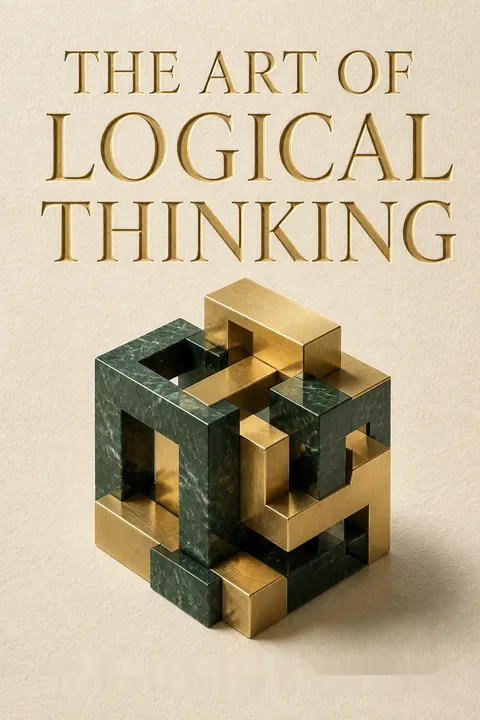


Key Takeaways
Train reasoning deliberately; intelligence alone does not protect you from error
Skill beats raw ability. Atkinson’s starting point is practical: people reason constantly, but often accept claims because they sound confident or come from an authority. A strong intellect does not automatically catch a bad inference, just as physical strength does not teach someone how to wrestle. Logic is the discipline of spotting when thought follows the evidence and when it slips into error.
Check the argument, not the speaker. The book presents reasoning as a learnable craft that helps people connect facts, draw conclusions, and avoid mistakes. Its value is not winning debates for sport. It is making better judgments in ordinary life, where a polished assertion can otherwise pass for proof.
What's striking is the distinction between having cognitive capacity and knowing how to use it. Modern research on motivated reasoning reinforces the point: people can reason skillfully in defense of a preferred conclusion while overlooking evidence against it. Formal logic helps inspect the structure of an argument, but it cannot make a person neutral or guarantee that the premises are true. The practical discipline is therefore twofold: test whether the conclusion follows, and test whether the starting claims deserve belief. That combination makes logic a tool for intellectual humility, not merely a weapon for debate.
Revise your categories whenever new examples break the old ones
Concepts grow through experience. Atkinson describes a concept as a general idea built from particulars. A child who first sees a mastiff may assume that every dog must look like one. Meeting a toy terrier can expose the mistake and force a broader understanding of the category. The child has not discovered a strange exception to “dog”; the original concept was too narrow.
Build categories carefully. The book traces concept formation through receiving examples, comparing them, separating relevant qualities, grouping shared features, and naming the result. No one encounters every member of a category, so concepts remain open to correction. Wider experience and attention to differences make classifications more reliable.
This account anticipates a central problem in machine learning and cognitive science: categories are built from examples, yet new cases can reveal that the training set was biased or incomplete. A useful category must capture what matters without mistaking familiar examples for the rule. The toy terrier corrects the child because it preserves the relevant membership while varying in appearance. Still, not every counterexample should trigger a wholesale rewrite. Some categories are defined by convention, others by function or biology. The first task is to ask what makes the classification useful and what evidence could legitimately revise it.
Do not confuse a vivid example with the whole category
A concept is not a picture. A mental image of an apple must have a particular color, size, and shape. The general concept “apple” cannot be limited to one such picture, because it must apply across many different apples. Atkinson distinguishes a concept, the general idea of shared features, from a percept or remembered image of one particular object.
Experience colors perception. The book calls apperception perception shaped by prior knowledge and experience. In its tree anecdote, different passersby notice timber, bark, or a possible squirrel’s nest, depending on what they know. The tree is the same; the features that stand out differ. A representative example can make an abstract idea easier to explain, but it should not be mistaken for the entire class.
The distinction matters in teaching, communication, and public debate. A vivid case is memorable, so audiences often treat it as representative even when it is unusual. Cognitive psychology describes this pull through availability: easily recalled examples can feel more common than they are. Atkinson’s tree story also shows why observation is not a passive camera. Prior expertise directs attention toward some details and away from others. That expertise can improve perception, but it can also narrow it. A sound account pairs concrete examples with a reminder of the category’s boundaries and the cases that do not fit the first image.
Define the terms before arguing about what they imply
Words carry hidden scope. A term is the verbal sign for a concept, and unclear terms make arguments slippery. Atkinson distinguishes a term’s extension, the range of things it includes, from its intension, the qualities it implies. “Animal” has broad extension because it covers many kinds of creatures, but relatively few features are shared by all of them. A narrower term such as “horse” includes fewer individuals and more defining characteristics.
Definitions expose boundaries. To define a category, identify its broader class and the feature that separates it from neighboring classes. The book also warns that an explanation is not a definition if it merely repeats the word or uses vague, figurative language. Before disputing a claim, clarify whether its key word is being used broadly, narrowly, or in more than one sense.
This is a useful antidote to arguments that sound substantial but trade on shifting meanings. In law, science, and policy, a dispute can turn on whether a word names a broad population, a measurable property, or a technical category. The extension and intension distinction makes that hidden choice visible. It also explains why precise definitions can feel restrictive: narrowing a term often makes it more informative but less inclusive. Definitions are not always discovered facts; some are adopted for practical purposes. The crucial requirement is consistency. If a speaker changes the definition mid-argument, the conclusion may no longer follow.
Move from observations to a testable rule, not a confident guess
Induction climbs from cases. Inductive reasoning uses particular observations to propose a broader pattern. Atkinson follows a four-part process associated with the logician William Stanley Jevons: observe cases, form a hypothesis, deduce what should follow if it is true, and compare those predictions with evidence. His example begins with observed magnets that attract iron, proposes that magnets generally do so, and then tests the idea on another magnet.
The leap is probabilistic. A rule inferred from some cases goes beyond what has actually been observed. The book calls complete enumeration “perfect induction,” but notes that it is rarely practical. “Imperfect induction” generalizes from a sample to unobserved cases. Its strength depends on the number and character of the observations, not merely on how persuasive the pattern feels.
The sequence is recognizably scientific: observations generate a conjecture, the conjecture yields predictions, and evidence checks those predictions. Contemporary statistical reasoning makes the uncertainty more explicit by treating generalizations as degrees of confidence rather than as guaranteed universal laws. The book’s magnet example is clean because the category and outcome are easy to test; social patterns are far messier, with biased samples and changing conditions. The enduring lesson is to ask what observations support a rule, which cases remain untested, and what result would count against it. Without the last question, a hypothesis can become immune to evidence.
Let imagination propose causes, then make evidence judge them
Hypotheses begin as possibilities. Atkinson describes a hypothesis as a provisional explanation, not an established fact. He argues that the mind can leap from a few observations to a possible law or cause, drawing on imagination and accumulated knowledge. The book recounts that Kepler proposed many possible shapes for Earth’s orbit before settling on one that fit the evidence. A wrong guess can still help by directing attention toward a better question.
Test causal claims systematically. The book presents four methods associated with John Stuart Mill: look for a factor shared by cases with the same outcome; compare cases where a suspected cause is present or absent; account for known causes and examine what remains; and check whether changes in one factor accompany changes in another. Each method helps organize inquiry, but none makes a causal conclusion automatic.
The productive tension here is between creative inference and disciplined testing. Scientific discovery is not simply a mechanical pileup of facts; a useful hypothesis often supplies a pattern that observations alone do not announce. But ingenuity can generate elegant explanations for the wrong reasons. Modern causal inference sharpens this caution: correlation can arise from a common cause, selection effects, or coincidence, so a changing factor is not necessarily the cause of a changing outcome. The book’s methods are valuable as questions to investigate, especially when combined. A plausible explanation earns confidence by surviving attempts to distinguish it from alternatives.
Use induction to build rules and deduction to apply them
The two forms work together. Induction moves from observed cases toward a general rule; deduction applies a general rule to a particular case. If observations support the claim that magnets attract iron, deduction says that a newly encountered object will attract iron if it is indeed a magnet. The first step proposes the rule. The second draws out what the rule implies.
Do not confuse implication with proof. A deduction can be logically valid even when its starting rule is false. Atkinson emphasizes that general premises often come from experience, scientific induction, or provisional theories. Deduction does not independently verify them; it shows what follows if they hold. When a prediction fails, the problem may lie in the general rule, in the classification of the particular case, or in the observation itself.
This division of labor is fundamental to scientific practice and everyday decision-making. Generalization makes prediction possible, while deduction turns a broad claim into a concrete expectation that can be checked. The distinction also prevents a common mistake: treating a valid argument as evidence that its premises are true. In Bayesian terms, evidence updates confidence in a rule, while deduction describes the consequences of temporarily accepting it. The book’s model is strongest when understood as a loop rather than a one-way ladder. Rules guide new tests, and new results can force revisions to the rules or to the way cases are classified.
Expose the missing premise before trusting a tidy argument
A syllogism makes the bridge visible. A syllogism connects a particular claim to a broader one through a shared middle term. For example: all mammals are animals; a horse is a mammal; therefore, a horse is an animal. A valid argument needs three propositions and three terms, with the middle term genuinely linking the other two. If a premise is omitted because the audience is expected to supply it, the argument is an enthymeme.
Conditional claims have traps. From “if it rains, the road gets wet” and “it rains,” one may infer a wet road. But a wet road does not prove that it rained; another cause may explain it. Atkinson warns against affirming the consequent and against denying the condition and then rejecting the outcome. In both cases, the conclusion claims more than the premise permits.
Formalizing an argument is a practical form of debugging. It separates the structure of inference from the emotional force of an example and reveals assumptions that might otherwise remain invisible. The conditional example also models causal restraint: one event can have several possible explanations, so observing an outcome does not identify its source. Yet formal validity is only one test. Everyday claims often contain probabilities, exceptions, and vague categories that categorical syllogisms flatten. The best use of the form is diagnostic: expose the missing link, clarify the scope of each premise, and then decide whether those premises are credible.
Treat resemblance as a clue, never as proof
Analogy suggests, but does not establish. Reasoning by analogy infers that two things may share another feature because they already resemble each other in some respects. Similarity can be informative when the shared features are numerous and relevant. It can also mislead: Atkinson notes the mistaken assumption that all swans must be white because the observed swans were white, a conclusion overturned by black swans in Australia.
Inspect the route to the conclusion. The book’s catalogue of fallacies includes hasty generalization, confusing a sequence with a cause, circular arguments, and appeals to authority or popular belief in place of evidence. A memorable analogy or confident-sounding premise can conceal weak support. Ask whether the similarities matter to the question, whether counterexamples exist, and whether the conclusion has been tested by observation or a stronger form of inference.
Analogy is cognitively efficient because it lets people transfer knowledge from familiar cases to unfamiliar ones. It is also a powerful source of error: resemblance is easy to notice, while the differences that matter may be less visible. Modern work on analogical reasoning similarly emphasizes relational structure over surface likeness. Two cases that look different can share the same causal pattern, and two cases that look alike can behave differently for decisive reasons. The book’s warning does not require abandoning analogy. It suggests treating it as a generator of hypotheses, then checking whether the proposed relationship survives evidence and plausible alternatives.
Analysis
Atkinson’s book is best understood as a practical map of reasoning rather than a modern textbook in formal logic. Its organizing movement is from mental material to inference: people attend to particulars, build categories, connect concepts in judgments, and then infer beyond what is immediately given. That sequence gives readers a useful way to locate errors. A mistaken conclusion may originate in careless observation, a crude category, an ambiguous term, an unsupported generalization, or a faulty link between premises.
The most durable contribution is the insistence that inference has two distinct standards. A conclusion can follow validly from premises while the premises themselves remain doubtful. The separation of induction from deduction makes this distinction teachable: induction proposes general patterns from cases, while deduction draws out consequences that can be tested. The account of hypotheses adds a further strength by recognizing that discovery requires both imaginative conjecture and evidential discipline.
The book’s limits reflect its 1909 setting. Its treatment of categories, universal propositions, and natural regularity often sounds more certain than contemporary science would allow. Many useful generalizations are statistical, context-dependent, or revisable, not universal laws. Its discussion of cause also gives readers tools for comparison, but does not fully address confounding variables, measurement problems, or the design of controlled studies. Modern reasoning benefits from adding probabilistic thinking: evidence can raise or lower confidence without proving a claim absolutely.
Even so, the work’s practical questions remain sharp. What exactly does this term mean? Which observations support the rule? Does the conclusion exceed the evidence? Is there another explanation? The book’s value lies less in memorizing technical labels than in making those questions habitual. It portrays logic not as a substitute for judgment, but as a way to inspect the steps by which judgment is formed.
Review Summary
The Art of Logical Thinking receives mixed reviews, with an average rating of 3.35/5. Positive reviews praise its insights on reasoning, logical thinking, and decision-making. Readers find it helpful for understanding inductive and deductive reasoning. However, some criticize the outdated language and formatting errors in certain editions. The book is considered a basic introduction to logic, beneficial for those new to the subject but potentially too simplistic for others. Overall, readers appreciate its content but suggest caution regarding the edition chosen.
People Also Read










Glossary
Concept
general idea of a classA concept is a general mental idea that groups objects, people, or events by shared qualities. It is formed from experience with particular examples, then refined through comparison and classification. Unlike a mental image of one specific object, a concept is intended to apply to the class as a whole.
Apperception
perception shaped by prior knowledgeApperception is perception accompanied by recognition and interpretation through ideas already held in the mind. Two people may encounter the same object yet notice different features because of their experience, interests, training, or expectations. In Atkinson’s account, prior knowledge enriches perception but also influences what a person takes the object to mean.
Extension
range of a term’s membersA term’s extension is the range of individuals or cases to which it applies. A broad term such as “animal” has a wide extension because it includes many kinds of creatures. As a term becomes more specific, its extension usually narrows, covering fewer individuals.
Intension
qualities implied by a termA term’s intension is the set of attributes or qualities implied by its meaning. More specific terms generally carry more defining qualities and apply to fewer individuals. Atkinson presents extension and intension as inversely related: broad categories include many members but share fewer attributes, while narrow categories include fewer members and more specific attributes.
Induction
generalizing from observed casesInduction is reasoning from particular observations toward a general rule or probable pattern. It extends beyond the cases already examined, so its conclusion is not guaranteed simply by the observations. Atkinson describes a process of observing, proposing a hypothesis, deriving consequences, and checking those consequences against evidence.
Imperfect Induction
generalizing from a sampleImperfect Induction draws a conclusion about a larger class from only some of its members. It is the practical form of induction because complete knowledge of every case is rarely available. Its reliability depends on whether the observed cases adequately represent the class and whether contrary examples have been sought.
Hypothesis
provisional explanation to testA hypothesis is a proposed explanation or principle accepted provisionally so that its consequences can be examined. It may suggest a cause or a general pattern, but it is not established merely because it seems plausible. In Atkinson’s account, a hypothesis must generate expectations that can be compared with observed or experimental results.
Method of Agreement
find a shared factorThe Method of Agreement looks across cases in which an outcome occurs and asks which circumstance is present in each. A shared factor may be relevant to the outcome, especially when competing influences are absent or controlled. Agreement provides evidence for a causal connection, but shared presence alone does not prove causation.
Method of Difference
compare presence and absenceThe Method of Difference compares cases that are alike in relevant respects but differ in the suspected cause and outcome. If the outcome appears when the factor is present and disappears when it is absent, the factor gains support as a possible cause. The inference is strongest when other differences between cases have been ruled out.
Method of Residues
explain what remainsThe Method of Residues accounts for the portions of an observed result already explained by known causes, then considers whether the unexplained remainder may be due to another factor. It directs attention toward what existing explanations leave out. The remaining effect still requires investigation before it can be confidently assigned to a new cause.
Method of Concomitant Variations
track linked changesThe Method of Concomitant Variations asks whether changes in one factor accompany changes in another. A consistent relationship can suggest that the factors are connected, perhaps as cause and effect. The method does not by itself establish causal direction, since both factors may also change because of a third influence.
Deduction
applying a general ruleDeduction derives a particular conclusion from general premises. If the premises are true and the inference is valid, the conclusion follows from them. Deduction does not independently establish that its premises are true; it clarifies what those premises imply for a specific case.
Syllogism
inference through a middle termA syllogism is an argument made from two premises and a conclusion, using a middle term to connect the conclusion’s subject and predicate. In a standard categorical example, one premise links a class to a broader class, and another places a particular case in the first class. The form can be valid even if a premise is false.
Enthymeme
argument with an unstated premiseAn enthymeme is an argument in which one premise or part of the reasoning is left unstated because the speaker expects the audience to supply it. For example, a claim that someone must be imaginative because they are a poet assumes an unspoken connection between poets and imagination. Making the missing premise explicit allows it to be examined.
Reasoning by Analogy
inference from resemblanceReasoning by Analogy infers that two things may share an additional feature because they resemble each other in known respects. Its conclusion is probable rather than certain. The strength of the inference depends on whether the similarities are relevant to the feature being inferred and whether important differences or counterexamples have been overlooked.
Fallacy
misleading error in reasoningA fallacy is an argument that appears to support a conclusion but does not actually establish it. Errors can arise from unsupported premises, invalid inference, ambiguous words, hasty generalization, mistaken causes, or appeals to authority and popular belief. Identifying the kind of error helps locate the weak step rather than merely rejecting the conclusion.
About the Author

Download PDF
Download EPUB
.epub digital book format is ideal for reading ebooks on phones, tablets, and e-readers.








