

Key Takeaways
Do what the situation needs, even when your feelings object
Action is the point. At twenty-two, Gregg Krech let dirty dishes pile up until he ran out, then bought paper plates rather than load the dishwasher. The task was simple, but he kept waiting to feel like doing it. The book begins with this familiar gap between knowing and doing, and argues that taking action means responding to what needs doing, when it needs doing, as well as one can.
Not a productivity contest. This is not a call to fill every hour with chores. The appropriate action might be caring for family, resting, or tending to a relationship. The test is whether the action fits the situation and a considered purpose, rather than mere urgency or a wish to stay comfortable.
The dishes make the argument concrete: procrastination is often less a failure of knowledge than a habit of treating mood as permission. That distinction shifts attention from self-criticism to the next observable act. The book also wisely separates meaningful action from sheer output, a distinction that matters in cultures where busyness is easily mistaken for worth. Still, action cannot be a universal remedy. Illness, disability, poverty, and acute distress can constrain what someone can do. The useful principle is not that every obstacle yields to effort, but that available agency deserves attention without denying real limits.
Choose what matters through attention, purpose, reflection, and urgency
Notice what needs doing. Krech offers four ways to decide what action fits: pay attention to the world around you, clarify your purpose, reflect on your conduct and relationships, and distinguish what matters from what is merely urgent. An empty birdfeeder, for instance, makes a need visible; a meaningful but deadline-free project may require deliberate protection from more pressing tasks.
Make priorities visible. A crowded schedule can conceal avoidance: errands and small obligations may keep someone busy while a book, exercise, or time with children remains postponed. Reflection provides distance from this momentum, like stepping back from a garden to see the whole layout. The question is not simply what can be done next, but what deserves the next stretch of attention.
This decision process is valuable because it joins perception with values. Attention identifies needs, while purpose helps rank them; reflection can expose the gap between stated priorities and actual behavior. The urgent versus important distinction also explains why long-range aims need protection: they rarely arrive with someone else’s deadline attached. Yet purpose can become another rigid concept if treated as unquestionable truth. A useful check is whether a priority still serves real people and circumstances, rather than merely preserving an idealized picture of how life ought to look.
Let anxiety ride along instead of waiting for the right mood
Acceptance enables movement. Morita Therapy, a Japanese psychological approach, treats thoughts and feelings as largely outside direct control while emphasizing action within one’s control. Its term arugamama means accepting things as they are. Anxiety before a presentation may remain, and boredom may accompany taxes, but neither has to decide whether the person proceeds.
Acceptance is not surrender. Krech distinguishes this approach from avoidance, which tries to erase discomfort, and resignation, which lets discomfort dictate behavior. A person can feel depressed and still prepare a meal, or feel anxious and still attend an interview. The aim is not to make unpleasant feelings disappear, but to stop spending all one’s effort trying to change them before acting.
The distinction between acceptance and resignation is crucial. Acceptance makes room for an emotion without granting it authority over every choice, a stance that can reduce the exhausting struggle to feel perfectly ready. It also avoids the trap of interpreting unwanted thoughts as proof of character. This is not a claim that feelings never signal danger or that action should override judgment. Fear can warn of genuine risk, and persistent symptoms can call for professional care. The approach is strongest when paired with discernment: notice the feeling, assess the situation, then choose a response.
Start so small that resistance has little to grab
Lower the starting threshold. Kaizen is an approach to continuous improvement, applied here to personal change through small, repeatable actions. Instead of demanding a dramatic transformation, begin with a step that feels manageable. One example in the book is a person who struggles to floss being asked to care for a single tooth each day. The modest act helps establish the routine of beginning.
Motion can make motion easier. Krech describes a law of momentum: after starting, continuing often feels easier than starting from rest. Psychologist Robert Maurer, discussing Kaizen, began a book by committing to write for one minute a day, and often continued beyond that minute. Showing up in the right place, with the necessary tools, can also help; the first commitment need not be finishing the whole project.
Small starts are more than miniature versions of ambitious goals. They change the immediate problem from completing a daunting project to initiating one concrete behavior. That reframing can reduce anticipatory resistance and create useful feedback about what the task actually requires. Momentum, however, is not automatic: illness, interruptions, or a difficult environment can stop a new routine. A missed day need not invalidate prior effort, but the next start may require rebuilding the cue and lowering the threshold again. The practical lesson is to design for restarting, not to expect uninterrupted progress.
Reflect on what you receive, give, and make difficult for others
See the relationship clearly. Naikan, meaning inside looking, is a structured method of self-reflection developed in Japan. It asks three questions about a person or a period of time: What did I receive? What did I give? What difficulties did I cause? The questions shift attention from a one-sided account of personal effort to the support and consequences that can otherwise go unnoticed.
Gratitude can change the task. Krech describes a woman caring for her elderly mother who sometimes resented the work. In reflection, she remembered the years her mother had cared for her as a child. This did not make caregiving effortless, but helped her understand it as part of a relationship of receiving and giving. Naikan can also prompt practical acts, such as thanking someone, repaying a debt, or apologizing.
Naikan is distinctive because it includes both gratitude and accountability. Reflection does not merely collect evidence that others have been kind; it asks what one’s own behavior has cost them. That broader view can counter the self-centeredness that often accompanies stress and make repair more specific than a vague intention to be better. The practice should not become a demand to excuse mistreatment or erase unequal burdens. Appreciation is most useful when it clarifies relationships, including where a boundary or apology is needed, rather than turning indebtedness into an obligation to endure anything.
When clarity is missing, take a step that teaches you something
Action can be a way of learning. Some problems are not solved by more thinking because the missing information only appears through experience. Krech recommends beginning with a small investigation: examine the broken object, ask questions, consult people, or try a low-risk version of an unfamiliar activity. The step need not settle the whole question; it can reveal what the next question should be.
Risk can serve purpose. The book contrasts a life organized entirely around security with one that makes room for considered risks. Albert Schweitzer, already established as a theologian and musician, chose to study medicine and pursue work in Africa despite strong opposition from those around him. His story illustrates that worthwhile contributions may require leaving a familiar path, not that every bold choice is wise.
The idea that action produces information is a useful corrective to endless internal rehearsal. It treats uncertainty as something to investigate rather than a defect that must be eliminated before life can proceed. Small experiments are especially valuable because they can limit the cost of a mistaken assumption. The book’s risk examples are inspiring, but boldness alone does not establish that a choice is responsible. Good judgment still requires considering likely consequences, obligations, and who else bears the risk. A purposeful first step can be courageous without being reckless.
Set deadlines that protect others from the cost of your delay
Delay has a social footprint. Procrastination can lead to rushed work, frayed communication, lateness, and unfinished tasks that someone else must absorb. The book emphasizes that keeping others waiting uses their limited time, even when they are too polite to complain. If a commitment cannot realistically be met, declining early may be kinder than accepting and leaving it undone.
External structure helps. In an experiment described by the book, students had three papers due. Those assigned one deadline each week did best; those who chose their own deadlines came next; those with only a final deadline did worst. The pattern suggests that spreading deadlines can counter predictable delay. Planning extra time for disruptions also reduces the frantic, careless work that turns one late task into several problems.
This section broadens procrastination from a private struggle into a question of trust. Missed commitments distribute costs, often invisibly, across families, coworkers, and service providers. That makes realistic promises and early communication ethical practices as well as productivity tactics. The deadline experiment supports the value of structure, though an example involving students and papers cannot settle how every kind of work should be scheduled. Deadlines are tools, not substitutes for adequate capacity or fair workloads. Their best use is to make commitments visible before urgency turns them into emergencies.
Measure your effort by what you control, not by the result
Separate effort from outcome. A job seeker cannot control whether an employer makes an offer, but can control preparing a strong application, contacting people, and arriving ready for interviews. Krech recommends using the quality of one’s effort, rather than an uncertain result, as a more reliable measure of success. This keeps attention on the present action instead of making self-worth depend entirely on what happens next.
Let values shape the method. Focusing only on a desired outcome can tempt people to compromise honesty or consideration for others. Attending to effort brings the manner of acting into view: Was the work sincere, attentive, persistent, and consistent with one’s values? This does not make outcomes irrelevant. It recognizes that effort matters while accepting that circumstances beyond one person’s control also shape results.
This distinction protects motivation from the false promise that effort guarantees success. It also gives ethics a practical role: the route to a goal matters, not only arrival. The idea resonates with a broader distinction between process goals and outcome goals, where the former can guide action while the latter provide direction. A caution is that effort alone cannot be the only measure. Poor strategy may deserve revision, and outcomes can reveal whether a method works. The balanced lesson is to own the effort, learn from the result, and avoid confusing control with certainty.
Show care through behavior before warm feelings arrive
Make concern observable. In a story from the book, Shinichi Suzuki hears that his sister wanted to help a wounded soldier standing outside in the cold. He challenges her to move beyond wanting, and she brings the soldier home to warm up. The point is not that kind intentions are worthless, but that they do not provide help until they become action.
Choose a small loving act. A contributor applies this idea to relationships by acting as a caring partner even when affection or patience is temporarily absent. A person might offer a kind greeting or take initiative on a shared activity. This is not pretending that conflict does not exist. It is choosing behavior deliberately rather than letting a passing mood determine every interaction.
The section gives generosity a behavioral definition: care becomes legible through what someone does. That is useful because other people cannot reliably infer benevolent intentions from private feeling. Small acts can also interrupt reciprocal hostility, where each person waits for the other to soften first. The limit matters: acting kindly should not require concealing harm, surrendering boundaries, or maintaining an unsafe relationship. In ordinary friction, chosen behavior can create a different opening. In serious conflict, compassion may mean honest speech, distance, or seeking support.
Make something instead of spending all your time as an audience member
Move from consuming to creating. Krech closes by asking readers to notice how much of life is spent receiving other people’s work through books, music, films, and performances. Enjoying an audience role is not a problem, but it can become the default while one’s own ideas remain unexpressed. A poem, drawing, song, quilt, or other small creation can turn passive interest into a contribution.
Begin before the conditions are perfect. The book’s broader advice applies here too: do not wait for a flawless plan, ideal setting, or a clear sense of talent. Give the work a short, real place in the day, even if household tasks remain unfinished. The first result need not be impressive. The point is to make an attempt that exists outside the imagination.
The invitation to create follows naturally from the book’s central distinction between imagining an act and doing it. Making something also changes the reader’s relation to culture: a person can receive others’ work while adding a small piece of their own. This is not a claim that every hobby must become a public achievement. Private play, practice, and unfinished exploration have value too. The sharper challenge is simply to notice when consumption has crowded out a form of expression that matters, then make room for a modest first attempt.
Analysis
The book’s central contribution is to recast action as a way of living with experience, not as a technique for maximizing output. Its Japanese psychological sources form a complementary set: Morita Therapy loosens the demand to feel ready, Kaizen lowers the cost of beginning, and Naikan makes action answerable to relationships. Together, they move from inner resistance to practical conduct and then to the effects of conduct on other people.
Its most memorable move is to separate action from mood. The dirty dishes, the anxious presentation, and the stalled creative project all expose the same mistaken bargain: life will begin once discomfort has gone away. The book instead asks readers to carry discomfort into ordinary tasks. This is more humane than the familiar command to think positively, because it does not make a preferred emotional state the price of participation.
The framework is strongest when it distinguishes what can be influenced from what cannot. Focusing on effort rather than outcomes protects integrity and helps people act amid uncertainty. Naikan adds an ethical correction to self-help’s usual inward focus by asking what support one has received and what inconvenience one has caused. The result is a vision of productivity measured partly by attention, reliability, and care.
The evidence is more uneven than the practical wisdom. Stories, personal observations, and selected studies illuminate the ideas, but do not establish that action alone treats depression or anxiety. A reader with severe symptoms, physical limitations, or unsafe circumstances may need professional, social, or material support, not simply a smaller first step. That limitation does not erase the book’s value. Its durable lesson is more modest and more useful: do not confuse a thought, an intention, or a good feeling with an action, and do not confuse action with control over everything that follows.
Review Summary
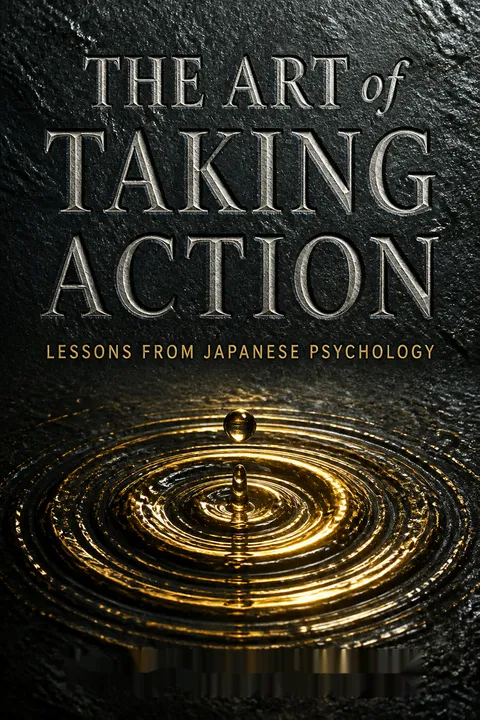
The Art of Taking Action is praised for its practical approach to overcoming procrastination and taking meaningful action. Many readers found it insightful and life-changing, appreciating its blend of Eastern philosophy and actionable advice. The book emphasizes the importance of purpose-driven decisions, gratitude, and embracing discomfort. Some readers felt certain sections were less cohesive or too simplistic. Overall, reviewers recommend it as a valuable resource for personal growth, though a few found it lacking depth or originality.
People Also Read





Glossary
Morita Therapy
Accept feelings, take actionA Japanese psychological approach developed by psychiatrist Shoma Morita. It treats thoughts and feelings as largely beyond direct voluntary control, while emphasizing purposeful action. Rather than trying to eliminate anxiety, boredom, or other discomfort before acting, a person accepts the experience and responds to the needs of the situation.
arugamama
Accepting things as they areA term used in Morita Therapy for accepting present circumstances, including uncomfortable feelings, without trying to escape, suppress, or complain them away. It is not passive resignation: the person can acknowledge anxiety or sadness and still take action that serves a meaningful purpose.
Kaizen
Continuous improvement through small stepsA Japanese term meaning improvement, used in the book for an approach to gradual, ongoing change. Applied to personal behavior, Kaizen begins with a small action that feels manageable, then repeats or expands the effort over time. The modest first step is intended to reduce resistance and help establish a pattern of action.
Naikan
Structured relationship reflectionA method of self-reflection developed by Ishin Yoshimoto and rooted in Shin Buddhism. It examines a relationship or period of life through three questions: what one received from another, what one gave, and what difficulties one caused. The practice can deepen appreciation, reveal one’s impact, and suggest concrete acts of gratitude or repair.
ocho
Overcoming by going aroundA Buddhist term used in the book for moving around an obstacle rather than confronting it head-on. In the context of difficult emotions, it means accepting fear, anxiety, or sadness while finding a practical route toward the task or purpose. The feeling need not be defeated before movement is possible.
FAQ
What's "The Art of Taking Action" about?
- Focus on Action: "The Art of Taking Action" by Gregg Krech emphasizes the importance of taking action in life, drawing from Japanese psychology to guide readers in overcoming obstacles to action.
- Japanese Wisdom: The book integrates Japanese psychological principles, such as Morita Therapy, Kaizen, and Naikan, to help readers understand and implement effective action-taking strategies.
- Practical Guidance: It offers a practical approach to living a purposeful life, addressing common challenges like procrastination, fear, and indecision.
- Character Development: The book focuses on character development over symptom reduction, encouraging readers to live meaningfully despite limitations and problems.
Why should I read "The Art of Taking Action"?
- Overcome Inaction: If you struggle with procrastination or indecision, this book provides tools and insights to help you take meaningful action.
- Cultural Insights: It introduces Eastern psychological concepts to a Western audience, offering a fresh perspective on personal development.
- Practical Application: The book is filled with practical advice and real-life examples, making it easy to apply the concepts to your own life.
- Inspiration and Motivation: It inspires readers to pursue their dreams and passions, emphasizing the importance of taking risks and living purposefully.
What are the key takeaways of "The Art of Taking Action"?
- Acceptance and Action: Accept your thoughts and feelings without trying to change them, and focus on taking action despite them.
- Small Steps Matter: Embrace the concept of Kaizen, which emphasizes continuous improvement through small, incremental steps.
- Purpose Over Feelings: Make decisions based on purpose rather than feelings, and learn to coexist with discomfort.
- Self-Reflection: Use Naikan self-reflection to gain insights into your relationships and actions, fostering gratitude and responsibility.
How does "The Art of Taking Action" incorporate Japanese psychology?
- Morita Therapy: Focuses on accepting feelings and taking action regardless of them, emphasizing the uncontrollable nature of thoughts and emotions.
- Kaizen: Encourages continuous improvement through small, manageable steps, making change more achievable and less daunting.
- Naikan: A method of self-reflection that involves considering what you have received, given, and the troubles you have caused others, promoting gratitude and awareness.
- Integration: The book combines these methods to provide a comprehensive approach to taking action and living purposefully.
What is Morita Therapy, and how is it applied in "The Art of Taking Action"?
- Acceptance: Morita Therapy teaches acceptance of thoughts and feelings without trying to change them, focusing instead on taking action.
- Action Over Feelings: It emphasizes that action should not be dictated by feelings, encouraging individuals to act according to their purpose.
- Non-Resistance: The therapy promotes non-resistance to emotional experiences, allowing individuals to move forward with their lives.
- Practical Application: The book uses Morita Therapy to help readers understand how to take action despite anxiety, fear, or depression.
What is Kaizen, and how does it relate to personal change in "The Art of Taking Action"?
- Continuous Improvement: Kaizen is about making small, incremental changes over time, leading to significant improvements.
- Manageable Steps: It encourages breaking down tasks into manageable steps, reducing resistance and making progress more achievable.
- Momentum: Small actions create momentum, making it easier to continue taking action and achieve goals.
- Personal Application: The book applies Kaizen to personal development, helping readers implement change in a sustainable way.
How does Naikan self-reflection contribute to taking action in "The Art of Taking Action"?
- Three Questions: Naikan involves reflecting on what you have received, given, and the troubles you have caused, fostering gratitude and responsibility.
- Awareness and Insight: This reflection provides insights into your relationships and actions, helping you understand your impact on others.
- Motivation for Action: By recognizing the support you receive, Naikan can motivate you to take action to repay or acknowledge that support.
- Practical Use: The book uses Naikan to encourage readers to reflect on their lives and take meaningful action based on those reflections.
What are some of the best quotes from "The Art of Taking Action" and what do they mean?
- "Action is the antidote to despair." – This quote emphasizes that taking action can alleviate feelings of hopelessness and depression.
- "A journey of a thousand miles begins with the first step." – It highlights the importance of starting with small steps to achieve significant goals.
- "Hold the sadness and pain of samsara in your heart and at the same time the power and vision of the Great Eastern Sun." – This suggests balancing awareness of suffering with a positive vision for the future.
- "Proceed as the path opens." – Encourages taking action as opportunities arise, without waiting for perfect conditions.
How does "The Art of Taking Action" address procrastination?
- Understanding Procrastination: The book explains that procrastination often stems from a focus on feelings rather than purpose.
- Action Despite Feelings: It encourages taking action even when you don't feel like it, emphasizing the importance of purpose-driven decisions.
- Small Steps: By taking small, manageable steps, you can overcome the inertia of procrastination and build momentum.
- Practical Strategies: The book offers practical strategies, such as showing up physically and starting before you're ready, to combat procrastination.
How does "The Art of Taking Action" suggest dealing with fear?
- Coexist with Fear: The book advises learning to coexist with fear rather than trying to eliminate it, allowing you to take action despite it.
- Fear as Energy: Fear can be a source of energy that propels you to take necessary action, rather than a barrier.
- Acceptance: Accept fear as a natural part of the process, and focus on your purpose to move forward.
- Practical Examples: The book provides examples of individuals who have successfully taken action despite fear, illustrating the concept in practice.
What role does self-discipline play in "The Art of Taking Action"?
- Purpose Over Feelings: Self-discipline involves making decisions based on purpose rather than feelings, allowing you to take consistent action.
- Building Habits: The book emphasizes the importance of building habits through small, consistent actions, which require self-discipline.
- Overcoming Resistance: Self-discipline helps you overcome resistance and procrastination, enabling you to achieve your goals.
- Practical Application: The book provides practical advice on developing self-discipline, such as setting clear priorities and taking small steps.
How does "The Art of Taking Action" encourage living a purposeful life?
- Clarifying Purpose: The book encourages readers to clarify their purpose and align their actions with it, leading to a more meaningful life.
- Action-Oriented: It emphasizes the importance of taking action to fulfill your purpose, rather than just thinking or talking about it.
- Balancing Reflection and Action: The book suggests balancing self-reflection with action, using insights from Naikan to guide purposeful living.
- Overcoming Obstacles: By addressing common obstacles like fear, procrastination, and indecision, the book helps readers live purposefully despite challenges.
Download PDF
Download EPUB
.epub digital book format is ideal for reading ebooks on phones, tablets, and e-readers.








