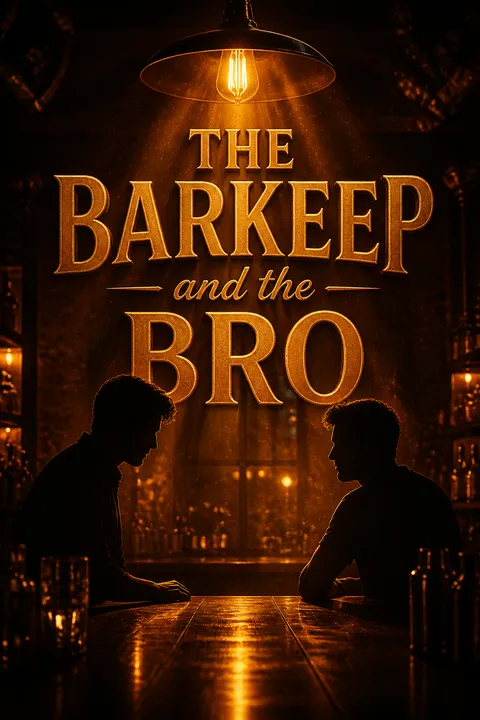


Plot Summary
The Wall Street Fall
Charlie Porterfield has built his confidence around charm, a Manhattan finance job, and a glamorous girlfriend. Then Demeter, the agricultural startup he helped his firm invest in, is exposed for allegedly faking its technology. His employer fires him, his girlfriend Serena ends their relationship, and because he had moved into her apartment, he has nowhere to stay.
After friends fail to offer him a room, his old summer-camp acquaintance Amos takes him in at his Sourwood condo. Charlie admits he never cared much for finance and likes talking with people more than staring at screens. When Amos mentions a tavern seeking a bartender, Charlie sees a chance to start over, though the owner is his ex-girlfriend’s imposing father.
Charlie’s collapse is not simply a punishment for professional error. It exposes how little of his life he chose for himself: finance offered status and money, while Serena’s apartment supplied the appearance of stability. Losing both leaves him without the audience that affirmed his self-image. Amos’s practical kindness offers a different kind of value, one based on showing up rather than networking. The bartending idea matters because it translates Charlie’s sociability from a liability, as his former colleagues saw it, into a potential craft.
A Familiar Applicant
Mitch Dekker has run Stone’s Throw Tavern for decades, and after another bartender quits, he needs a dependable replacement. Charlie arrives with no professional bartending experience and a history Mitch remembers as frat parties and a breakup with his daughter Ellie. Mitch initially refuses him, doubting both his judgment and his ability to manage alcohol.
Charlie explains that he ended things with Ellie because she was ready for a focused future while he was still searching for direction, not because he wanted to hurt her. He also draws on his fraternity experience managing parties and cutting off drunk students. Mitch recognizes his sincerity and gives him the job, warning himself as much as Charlie not to regret taking the risk.
Mitch’s decision tests the difference between a person’s reputation and his present capacity. He sees Charlie through two old categories, the careless young man and the ex who hurt Ellie, while Charlie offers evidence that his easy manner can coexist with responsibility. Mitch’s own history makes him receptive to second chances: an unplanned pregnancy once redirected his life, and he knows that a poor fit at one moment need not define someone forever. Hiring Charlie opens a professional relationship already crowded with personal history.
Training in Tight Quarters
Mitch begins Charlie on mock orders, showing him how to pour measured drinks, choose the right glass, change a keg, and keep premium liquor from being wasted. Charlie’s first rum and Coke is mostly spill, but he absorbs correction without losing his nerve.
During his early shifts, Mitch tests him with distracting conversation and difficult orders; Charlie improves quickly and handles customers with practiced ease. A rush of newly graduated flight attendants forces Mitch to help behind the bar, where the two men repeatedly brush against each other in the cramped workspace.
Charlie’s inability to reach an upper shelf frustrates him, while Mitch’s attraction makes ordinary contact harder to ignore. The apprenticeship turns Charlie into a capable worker and makes Mitch’s professional distance newly difficult.
The bar provides an unusually concrete measure of competence. Charlie cannot charm his way through a pour, but he can observe, practice, and accept correction; his social intelligence becomes useful only when joined to technical discipline. Mitch, meanwhile, is accustomed to being the person who knows how every part of the tavern works. Training makes him temporarily a teacher rather than a solitary owner, and that shared attention exposes desire beneath routine. Their chemistry develops inside an unequal workplace relationship, where Mitch’s authority makes restraint a real responsibility, not merely romantic suspense.
Remix Sees Them
Amos brings Charlie to Remix, Sourwood’s gay bar, with several teacher friends who feel awkward approaching men. Charlie gives them practical confidence, and each eventually manages to connect with someone. He enjoys helping, but his own attention shifts when Mitch arrives with his friend Leo.
Seeing Mitch across the room turns Charlie’s earlier, confusing physical reactions into something harder to dismiss. At Stone’s Throw afterward, Charlie proposes replacing the fading monthly queer night with a weekly musical-themed event.
Mitch and Natasha see the chance to revive a slow evening, and Charlie’s idea becomes Musical Mondays. The night out has therefore changed more than Charlie’s understanding of his attraction: it also gives him a concrete way to contribute to the tavern beyond learning its existing routines.
Remix places Charlie in a social world where he is not automatically the expert. He can coach others because he understands the risk of making the first move, yet Mitch’s presence unsettles the confidence he offers so freely. The proposed event converts that experience into work: Charlie notices what people enjoy and designs a new reason to gather. His attraction and his growing professional value begin along parallel tracks. Both ask him to risk acting before he can guarantee how others will respond.
Monday Finds Its Voice
Musical Mondays quickly fill Stone’s Throw with customers singing along to Broadway clips. Charlie handles a busy bar with increasing skill, while Mitch watches him turn a slow night into a lively one.
A persistent patron named Kirk follows Charlie, touches his face, and later corners him near the dumpster after closing. Mitch intervenes and pretends to be Charlie’s boyfriend to make Kirk leave. Charlie kisses him to support the ruse, but the contact is real enough to leave both men shaken.
Back home, Charlie recognizes that he wanted the kiss rather than merely using it to escape. He asks Amos how he understood his own sexuality, then begins privately testing whether his attraction extends beyond women, with Mitch increasingly at its center.
The tavern’s success gives Charlie a visible reason to belong, but the kiss is the more destabilizing event: it turns a protective performance into an encounter neither man can comfortably file away. Kirk’s harassment also clarifies why Mitch steps in, while the workplace setting complicates that care because Mitch is Charlie’s employer. Charlie’s private questioning is less a sudden transformation than an attempt to revise a self-description that no longer fits. He has to distinguish genuine desire from the role of agreeable, flirtatious entertainer he has long performed.
The Drunk Confession
Charlie goes to Manhattan for his former college friend Asa’s birthday, where his old crowd treats his bartending job as a temporary detour and urges him back into finance. He finds he no longer wants their version of success, and a woman’s interest does not stir him as he expects.
After too many drinks, he calls Mitch from a bathroom and admits that he keeps thinking about their kiss. Mitch responds with desire of his own, and the call becomes an intimate encounter neither can dismiss as a mistaken kiss.
The next morning, Charlie turns down the rest of the birthday weekend and leaves for Sourwood. When Skeeter mocks his changed priorities, Charlie walks away from a friendship that had depended more on partying and generosity than on knowing who he is now.
The call makes desire reciprocal, but its intoxicated circumstances leave the men with different risks: Charlie is emotionally exposed and Mitch is his sober employer. Charlie’s changing response to his old friends gives the scene a larger consequence. He does not merely choose a different job; he recognizes that the people who once formed his social identity have little interest in the life he is building. Leaving early is a small but decisive act of authorship, even as his confession to Mitch remains vulnerable and unresolved.
A Kiss Rewritten
At work, Charlie panics about the kiss and the late-night call, then tells Mitch both were inappropriate and should be forgotten. He wants to protect the job he finally enjoys, but his attempt to make the events meaningless wounds Mitch. For the next month, Mitch keeps physical and emotional distance, even as Charlie proves himself a strong bartender.
Their fragile truce is interrupted when Ellie’s caterer cancels her wedding one week before the ceremony. Mitch offers to cook and coordinate the replacement catering, and Ellie asks Charlie to help behind the bar. Charlie agrees, giving the two men a demanding project that will keep them together while neither has resolved what the other means to him.
Charlie’s denial is an act of self-protection, not evidence that the encounter meant nothing. He has learned to expect that he is valued for charm and good times, so he retreats before anyone can ask more of him. Mitch responds by taking the boundary literally, but his withdrawal also reveals how much he had hoped for. Ellie’s emergency forces them back into cooperation without magically repairing trust. The wedding becomes a pressure chamber where service, family obligation, and private longing will have to coexist.
The Wedding Rescue
Mitch and Charlie reconstruct Ellie’s wedding catering in a week. Charlie researches local craft breweries, finds inexpensive equipment from a closing restaurant, and helps negotiate supplies, while Mitch manages the menu and logistics.
Their shared work restores the ease they had lost, and Charlie sees how much of Mitch’s life has been spent keeping the family tavern alive. Mitch admits that he sometimes thinks about selling, a possibility Charlie cannot easily imagine.
After a late night reviewing the plan, Charlie falls asleep against Mitch on the office couch. Mitch kisses him, and Charlie responds. At Ellie’s venue, Mitch discovers he forgot to book Charlie a room. The hotel has only his room available, leaving them to share a bed as the wedding weekend begins.
The emergency reveals Charlie’s value through action rather than reassurance. He contributes research, negotiation, and judgment, displaying the practical attention his old finance career failed to engage. Mitch’s admission about selling exposes a fatigue he has hidden beneath competence; the tavern is not only his pride but also the structure that has consumed his adult life. Their couch kiss follows genuine collaboration, yet the forgotten room creates a new test of boundaries. Intimacy is no longer an isolated accident, but neither man has decided what it will require.
One Bed, Open Truths
At the hotel, Charlie accuses Mitch of treating him like a mistake, while Mitch admits that keeping away has been painful because he cannot stop wanting him. Charlie acknowledges that his attraction to Mitch has forced him to reconsider the identity he took for granted. Their argument becomes a mutual choice to stop pretending the desire is one-sided, and they spend the night together.
In the morning, they return to wedding preparations, but Mitch insists they cannot continue because he is Charlie’s boss and the relationship could damage both the job and his bond with Ellie. Charlie will not pretend he wants only one night. They carry that unresolved disagreement into a rain-threatened wedding day, each still drawn to the other.
The shared room strips away the convenient explanations that followed the first kiss. Charlie’s self-understanding changes, but he does not present that change as a debt Mitch can collect; he chooses him while also asking for honesty. Mitch’s caution is ethically grounded in the power he holds over Charlie, though it is tangled with fear of emotional dependence. Their physical intimacy does not settle the conflict. Instead, it raises the stakes, making the next day’s public and professional roles harder to separate.
Rain, Rumors, and Dancing
Rain forces Ellie’s ceremony indoors, and Charlie calms her by reminding her that marrying Tim matters more than the planned photographs. During preparations, he and Mitch steal private moments, but Charlie also turns his bartending judgment toward the guests.
When Skeeter demands more alcohol after Charlie cuts him off, he insults Charlie’s work and reaches across the bar; Mitch backs his employee and confirms the decision was right. Later, Mitch asks Charlie to dance in front of the wedding guests.
Charlie accepts, but afterward he jokes that he only wanted to keep Mitch from being left out, hiding how much the dance meant. When Charlie returns to their room rather than joining the afterparty, Mitch finally admits he wanted that dance because he wanted Charlie.
Charlie’s work at the wedding reveals a firm ethical center beneath his playfulness: he refuses to serve a guest whose drinking has become dangerous, even when that guest is an old friend. Mitch’s defense validates Charlie’s professional authority instead of treating him as a subordinate who needs rescuing. The dance then makes their private connection visible, but Charlie’s joke shows how quickly he retreats from emotional exposure. Mitch’s confession matters because it replaces implication with responsibility. He must name his desire rather than ask Charlie to guess at it.
Ellie Learns the Truth
The morning after the wedding, Ellie notices the closeness between her father and her former college boyfriend and asks Charlie directly whether they are together. Charlie admits they are, and Ellie worries that he will treat Mitch as another passing romance.
Mitch arrives and tells her that the relationship is his choice, not a mistake Ellie must prevent. Charlie, stung by Ellie’s doubts, explains that he has often mistaken being entertaining for being capable of commitment, but Mitch makes him feel valued beyond his charm.
Ellie sees how happy her father is and softens, though the family still has to adjust to an unusual new arrangement. The three return to breakfast together, no longer hiding the relationship from the person whose history connects them.
Ellie’s concern is protective, but it also risks turning her father into someone whose choices she must manage. Mitch refuses that role without dismissing her love, asserting adult agency while acknowledging the awkwardness. Charlie’s response is crucial: he does not rely on sexual chemistry to persuade her, but identifies the longstanding belief that made him fear commitment. Acceptance begins when the relationship is described as a mutual choice with consequences, not as a secret thrill. Their family bond remains important rather than disappearing once the couple is acknowledged.
The Ball Pit Proposal
After the wedding, Mitch tells Charlie that he is considering a lucrative offer from investors introduced by Ellie’s stepfather, Vince. Charlie fears the buyers will profit from decades of work and urges Mitch to remember what the tavern means to him.
When the investors inspect the property, they describe replacing its character with a family entertainment complex, complete with a children’s play area, virtual-reality arcade, and possible demolition. They also tell Mitch his staff would have to reapply for their jobs.
The plan makes the cost of selling immediate: his workplace, his employees, and the community gathering place would all be remade for a different audience. Mitch withdraws from the deal, choosing to keep Stone’s Throw rather than accept money for a future he does not want.
The investors give Mitch a material alternative to his inherited identity, but their proposal reveals that the price is not merely the building. It would displace the staff and erase the tavern’s social function, converting a lived local institution into a standardized attraction. Charlie’s challenge helps Mitch distinguish exhaustion from a genuine wish to leave. Still, the choice is Mitch’s: love does not rescue him from responsibility, but it helps him imagine a future that includes changing how he runs the bar instead of abandoning it.
A Bar Built Together
With the sale abandoned, Charlie helps Stone’s Throw grow through Musical Mondays, themed cocktails, and a bartending class that draws new customers. Mitch promotes him to assistant manager, making clear that the role rests on his ideas and work, not their relationship. Their friends’ lives also move forward: Cal and Russ become engaged, and at a film screening for Leo’s daughter, Ellie tells Mitch she is pregnant.
Charlie and Mitch appear together openly, while Ellie continues adjusting to seeing her father in love. The tavern is no longer sustained by Mitch alone. Charlie has become a partner in its daily life, and Mitch can picture sharing the burden instead of carrying it as a private family obligation.
The romance’s resolution is also an economic and relational reorganization. Charlie’s promotion matters because it grants him real responsibility, while the new events and training program turn his social instincts into durable business practice. The story does not solve the age and authority gap by pretending it is absent; instead, Charlie’s demonstrated competence gives their partnership a basis outside attraction. The expanding circle of children, partners, and friends echoes this shift. Care becomes distributed, allowing Mitch’s legacy to remain meaningful without requiring him to shoulder it alone.
Married at the Reception
Six months later, Mitch and Charlie attend Cal and Russ’s backyard wedding as a couple and as part of the enlarged Single Dads Club family. Charlie discusses a possible second Stone’s Throw location in Hudsonville, showing that his ambitions now reach beyond surviving one job.
While they dance, he asks Mitch whether marriage is something he can imagine for them. Mitch stops the music-filled evening and asks Leo, an ordained minister, to marry them there and then.
Charlie accepts, and family members join by video call as the friends gather around. Their wedding is spontaneous, but the decision is not casual: it grows from months of shared work, intimacy, and chosen family. Charlie ends the story with a husband, a vocation, and a future he helped shape.
The final proposal reverses the novel’s opening logic. Charlie once repeated affirmations to convince himself that status and romantic success made him secure; now his confidence rests on reciprocal commitments and work he has helped build. Mitch’s spontaneity does not erase his history of sacrifice or divorce. It marks a willingness to make a future rather than merely protect what remains. The communal setting matters: their marriage is witnessed by the friends and family who helped them become less isolated, while Charlie’s expansion idea keeps their shared life open-ended.
Analysis
The novel makes work the ground on which both romance and identity are tested. Mitch’s tavern is not simply an obstacle to love; it is the accumulated consequence of an early choice made under pressure, a livelihood he both resents and cherishes. Charlie begins with the opposite problem. He has been offered multiple paths but has mistaken prestige for direction, and his gift for connecting with people has remained detached from lasting responsibility. At the bar, he learns that sociability is valuable when disciplined by attention, craft, and accountability.
Their attraction unsettles familiar categories: age, size, employer and employee, father and daughter’s ex, straight and gay. Charlie’s shift in self-understanding is framed as discovery rather than conversion, while Mitch’s guardedness reflects a life in which intimacy has often seemed like one more obligation competing with work. The romance gains credibility when Charlie demonstrates competence and Mitch acknowledges the real power imbalance between them. Still, the workplace boundary remains imperfect. Their desire repeatedly crosses into the tavern, so the story’s resolution rests less on eliminating the imbalance than on their increasing honesty and Charlie’s earned professional standing.
Stone’s Throw’s possible sale gives the emotional conflict a public consequence. Investors see land and a target demographic; Mitch sees a community built through decades of service. Charlie helps him recognize that exhaustion does not necessarily mean he wants to leave. Keeping the tavern is not a retreat into the past, because the business changes through new events, training, and shared management. The ending’s spontaneous marriage completes the book’s movement from self-performance to chosen commitment. Charlie no longer needs to announce that he is successful; his work, friendships, and love make that claim tangible. Mitch, in turn, learns that protecting what he built does not require carrying it alone.
Review Summary
People Also Read



Characters
Mitch Dekker
Overworked tavern ownerMitch is a gay single father who has spent most of his adult life running Stone’s Throw Tavern, the family business he inherited after his parents died. Broad, taciturn, and dependable, he expresses affection through practical care and has trouble imagining a self outside work. His teenage hockey ambitions ended when Ellie’s unexpected pregnancy redirected him toward supporting a family. He is proud of the tavern but worn down by its constant demands, and his resistance to vulnerability is partly a defense against further obligations. Charlie’s energy attracts him, while Charlie’s competence challenges Mitch’s assumption that the younger man is only a charming partygoer.
Charlie Porterfield
Restless new bartenderCharlie is a sociable, confident-seeming young man whose humor often masks uncertainty about what he wants. After a finance career collapses, he leaves Manhattan and discovers that working with people suits him better than chasing status. His charm is genuine, but he has learned to use it as a substitute for emotional seriousness, which leaves him vulnerable to being underestimated. Curious and quick to learn, he becomes invested in the practical life of Stone’s Throw. His attraction to Mitch unsettles his assumptions about himself and asks him to risk being known as more than the fun, easygoing man in the room.
Ellie Dekker
Mitch’s protective daughterEllie is Mitch’s only daughter, a lawyer whose disciplined, ambitious nature contrasts with Charlie’s former drift. She loves her father and is attentive to the sacrifices he made to raise her, which can make her protective instincts stronger than he needs. Her past relationship with Charlie gives her a personal stake in his character, while her engagement to Tim reflects the stable future she has carefully built. Ellie is practical and affectionate, and she expects the people close to her to take one another seriously.
Amos
Generous teacher roommateAmos is a public-school teacher who gives Charlie a room when his more established friends do not. Organized, thoughtful, and openly gay, he offers Charlie both practical help and a safe place to ask questions. His frank humor makes difficult subjects easier to approach, though his romantic history is less resolved than his confident manner suggests. Amos becomes Charlie’s closest confidant in Sourwood and helps him see that beginning again need not mean having everything figured out.
Natasha
Blunt assistant managerNatasha is Mitch’s fiercely loyal assistant manager, known for her directness, dark humor, and refusal to let him work himself into the ground. She understands the tavern’s rhythms and is willing to challenge its owner when his judgment is clouded by exhaustion. Her practical competence makes her a stabilizing force for the staff, while her sharp eye quickly notices changes in the people around her.
Leo McCaslin
Mayor and longtime friendLeo is Sourwood’s mayor and one of Mitch’s oldest friends. A former lawyer, he pairs political ambition with a dry, needling sense of humor and is often the first to see through Mitch’s excuses. His relationship with Dusty has made him more willing to accept intimacy than he once was. As part of the Single Dads Club, Leo offers Mitch a model of friendship that can endure blunt honesty and change.
Cal Hogan
Warmhearted single dadCal is a longtime friend of Mitch and Leo, a devoted father to Josh, and an easygoing man who can be both sentimental and messy. He is a recording artist and voice actor whose warmth helps make the Single Dads Club feel like a family rather than a social arrangement. His relationship with Russ shows how a new partnership can include children and old habits without requiring either person to become someone else.
Russ
Cal’s steady partnerRuss is Cal’s partner and a reliable presence in the circle of single fathers. More orderly than Cal, he values a well-run home and is attentive to the children in their blended family. His steadiness does not make him humorless; he can meet Cal’s exuberance with affection and patience. Russ represents the practical work of building a shared household, not simply the excitement of falling in love.
Penny
Shy tavern waitressPenny is a waitress at Stone’s Throw, initially shy around Charlie and more comfortable once his warmth puts her at ease. She is observant and kind, with a gentler manner than Natasha’s, but she belongs to a staff capable of standing up for itself. Her presence helps establish the tavern as a workplace shaped by friendships as well as management.
Hannah
Ellie’s devoted motherHannah is Mitch’s former wife and Ellie’s mother. She and Mitch have remained cooperative parents despite their marriage ending, and she is emotional around the milestones that mark Ellie’s adulthood. Her marriage to Vince gives her a new life while preserving the history she shares with Mitch. Hannah’s affection for her daughter is expressed through memory, tenderness, and attention to family transitions.
Tim
Ellie’s lawyer fiancéTim is Ellie’s fiancé and fellow lawyer, a thoughtful, somewhat earnest man who values the small acts that make a relationship durable. He is less intimidating to Mitch than Charlie once was, though he still has to earn the older man’s confidence. Tim’s devotion to Ellie is steady and visible in how carefully he treats their plans and shared future.
Dusty
Leo’s affectionate boyfriendDusty is Leo’s boyfriend, a warm presence who brings a more openly affectionate energy to Mitch’s close circle. Originally from Los Angeles, he has built a life in Sourwood and is expanding his construction business there. He enjoys teasing Leo and supporting his ambitions, while their easy intimacy offers Mitch a nearby example of a relationship that can include both friendship and desire.
Serena
Charlie’s ambitious exSerena is Charlie’s former girlfriend and colleague in finance. Competitive, ambitious, and highly focused on her clients’ outcomes, she expects seriousness from a partner in a high-pressure industry. Their relationship is built partly on mutual drive, but the Demeter scandal exposes how differently she and Charlie respond to professional risk.
Skeeter
Charlie’s finance-world friendSkeeter is one of Charlie’s old college friends, still immersed in finance and the social rituals of drinking and spending. He is generous when the group is celebrating but dismissive of work he considers low status. His attachment to the past makes him a measure of how much Charlie’s priorities have changed since leaving Manhattan.
Asa
Charlie’s med-school friendAsa is Charlie’s college friend, now a medical student. He remains part of Charlie’s old Manhattan social world and celebrates his birthday with their former crowd. Asa is less confrontational than Skeeter, but his assumptions about Charlie’s availability reveal how easily old friends can take familiar patterns for granted.
Vince
Hannah’s investor husbandVince is Hannah’s husband and a real-estate investor who sees commercial potential in the land occupied by Stone’s Throw. He presents a major business opportunity to Mitch, but his professional interests connect the tavern to investors with a very different vision for its future. Vince is polished and persuasive, and his proposal forces Mitch to look directly at the possibility of leaving.
Kirk
Persistent tavern customerKirk is a customer who ignores Charlie’s discomfort and treats friendliness at work as permission to pursue him. His behavior exposes the vulnerability of service workers who are expected to remain pleasant while being harassed. Mitch’s response to him marks an early point where professional responsibility and personal jealousy become difficult to distinguish.
Plot Devices
Stone’s Throw Tavern
Legacy under pressureThe tavern is Mitch’s workplace, inheritance, and main source of identity. Its constant operational demands explain why he has stayed single and why the possibility of selling feels both tempting and frightening. It also gives Charlie a practical arena in which to prove that his sociability can become skilled work. The tavern’s regulars, staff, and themed nights make it a community space rather than a neutral backdrop, so any change to the business affects many relationships at once.
Musical Mondays
Community made visibleCharlie proposes a weekly musical-themed queer night after seeing how people gather and connect at Remix. Broadway clips and singalongs bring new customers to Stone’s Throw, helping revive its slowest evening. The event gives Charlie a concrete early success and gives Mitch evidence that his new bartender can contribute ideas, not just pour drinks. It also creates the busy, close-quarters workplace that sharpens their attraction and makes the tavern’s social role visible to both men.
Bartending apprenticeship
Charm becomes craftMitch’s training turns the bar’s hidden labor into a test Charlie cannot pass through confidence alone. He must learn measurements, glassware, inventory, responsible service, and how to work under pressure. Charlie’s progress gives his character development an observable foundation and complicates Mitch’s initial view of him as an unserious ex-boyfriend. Later, Charlie’s business ideas and teaching role extend the same device: he converts social ease into expertise and responsibility.
The investors’ offer
A future made concreteThe potential sale initially appears to offer Mitch relief from decades of work. The investors’ walkthrough reveals the actual cost: they envision a family entertainment complex that could demolish or radically alter the tavern, displace the current staff, and replace its local character. The proposal forces Mitch to distinguish the desire for rest from a desire to abandon his life’s work. Charlie’s challenge matters, but the decision ultimately belongs to Mitch, allowing his choice to register as personal agency rather than romantic compliance.

Download PDF
Download EPUB
.epub digital book format is ideal for reading ebooks on phones, tablets, and e-readers.








