

Plot Summary
Snails on the Table
Cosimo Piovasco di Rondò grows up in a noble household ruled by his father’s obsession with titles, his mother’s military discipline, and his sister Battista’s grotesque culinary experiments. When Battista serves the very snails he and his younger brother Biagio had tried to help escape, Cosimo refuses to eat.
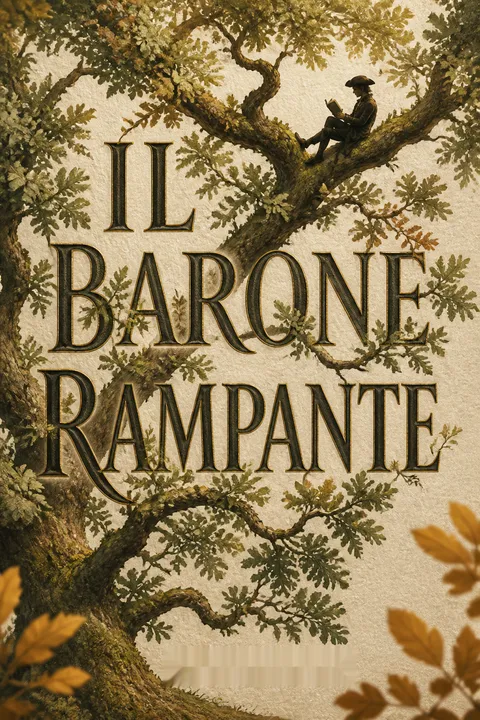
His father threatens another punishment, but Cosimo leaves the dining room, takes his hat and rapier, and climbs the familiar holm oak outside the window. He announces that he will never return to the ground. Biagio eats the snails, and his brother’s protest becomes a separation from the family as well as from the table. The choice begins in childish defiance, but Cosimo’s stubborn promise gives it the force of a life’s rule.
The rebellion begins in a small domestic ritual, not in a grand political conviction. Cosimo’s refusal is sharpened by the household’s habit of turning obedience into performance: proper meals, proper posture, proper inheritance. His ascent converts an argument over food into a physical refusal of the place assigned to him. Biagio’s compliance matters because it makes Cosimo feel abandoned as well as punished, giving the choice a personal cost from its first moment. The tree is not initially an escape from human life; it is a new position from which Cosimo can decide how to meet it.
The Branch Kingdom
The first night leaves Cosimo cold and aching, but at dawn he begins mapping the trees around Ombrosa and discovers that their branches can carry him far beyond his family’s park. He crosses into the walled garden of the Ondarivas, whose rare imported trees make the place feel unlike the surrounding countryside.
There he finds Viola, the blonde daughter of the neighboring family, swinging beneath a magnolia. She mocks his powdered wig and fine gaiters, while he insists that branches belong to him because he can travel through them without touching her family’s soil.
Their teasing turns into a game of swings, challenges, and shifting rules. An invitation to join the Ondarivas for chocolate briefly tempts him, but Cosimo retreats deeper into the leaves instead.
The tree kingdom is born through movement and negotiation. Cosimo does not simply reject land ownership; he invents a different kind of territory, defined by access and skill rather than fences. Viola immediately tests that claim, exposing how much of his new identity still depends on pride and on being recognized. Their first encounter makes the branches both refuge and social arena: she can visit his world, but she can also ridicule its rules. His refusal of the invitation is not proof that he feels nothing for ordinary comforts. It shows that he is already trying to make the choice irreversible before he understands what it will demand.
The Sinforosa Horn
Biagio brings Cosimo food and learns that his brother means to stay aloft, though Cosimo will not yet explain the full extent of his decision. Exploring the valley, Cosimo meets the ragged children who steal fruit from the orchards.
He helps them escape farmers armed with dogs and pitchforks, then learns that their former protector, the Sinforosa, is Viola, the girl from the swing. When Viola appears on her pony and sounds her hunting horn, the gang rushes toward her despite their anger at her past betrayals.
Cosimo follows, blurting out that he has never left the trees. Their laughter and Viola’s teasing unsettle him; a branch breaks beneath his feet, but his coat catches on a lower limb before he reaches the ground. He climbs back up, humiliated and more determined to prove himself.
Cosimo’s first social alliances do not make him a leader by simple virtue of his difference. The fruit thieves have their own loyalties, grievances, and history with Viola, and he enters their world as an outsider who must earn a place. His fall is especially revealing: the vow is tested not by a deliberate surrender, but by the body’s accidental failure. The coat saves him, leaving his principle intact while exposing its vulnerability. His public boast turns private discipline into a contest for recognition, particularly from Viola. The children’s laughter wounds him because it makes his chosen identity look less like freedom than a performance they can puncture.
Cat Blood Farewell
Cosimo’s father sends the Cavalier Carrega and household servants into the Ondariva garden to capture him. Cosimo evades their ladders by moving from tree to tree, but the commotion gets Viola confined indoors.
He flees into the woods, where a wildcat attacks him; clinging to a branch, he uses his rapier to kill it and suffers deep scratches across his face. Carrying the animal as a trophy, he returns to the Ondariva villa hoping Viola will admire his courage. Instead, he sees her family preparing to send her away to school.
Viola barely acknowledges his feat before the carriage leaves. Cosimo tends his wounds himself, retrieves the cat’s body, and makes a fur cap from its hide. The victory that might have won her praise becomes a private token of a farewell he did not choose.
The cat encounter turns Cosimo’s rule into a survival practice: when his instinct to flee conflicts with his vow, he finds a third action and kills the predator without descending. Yet the emotional reward he expects does not arrive. He has imagined courage as a language Viola will understand, only to discover that she is leaving on terms beyond his control. The fur cap transforms a violent event into equipment for the life he has chosen, a practical response to disappointment. Cosimo can master the branches and defend himself from an animal, but he cannot make affection answer to effort or prevent another person’s departure.
Lessons Above Ground
As the days pass, Cosimo learns routes through Ombrosa and constructs a shelter high in a beech tree. During a storm, Biagio finds the hidden tent and brings him blankets, umbrellas, and warm apple syrup. The visit shows that their bond survives Cosimo’s anger, although Biagio still returns to the safety of the house.
Later, Baron Arminio confronts his son beneath a tree and urges him to resume the duties of his rank. Cosimo refuses, arguing that decency and learning do not require a life on the ground.
His father cannot persuade him, but the household adapts: the Abbé Fauchelefleur begins giving Latin lessons from a branch, even climbing up to sit beside his pupil. The old tutor’s fear soon sends him back down by ladder, yet study continues without requiring Cosimo to return.
The family’s response shifts from punishment toward accommodation, though no one fully understands Cosimo’s choice. His shelter demonstrates that refusal need not mean passive endurance: he makes a livable structure and accepts practical help without surrendering the principle. Biagio’s visits preserve intimacy across a difference neither brother can erase. The lesson with the Abbé also complicates the idea that social institutions exist only on the ground. Education can move into the branches, but the tutor’s frightened retreat shows that adaptation has limits. Cosimo’s independence grows not by severing every connection, but by making relationships operate under conditions he can accept.
The Dog and Cavalier
Cosimo begins speaking with peasants from the branches, carrying their messages and helping them watch fields and orchards. He also befriends the Cavalier Carrega, whose scattered beehives and unfinished irrigation schemes reveal a more capable, more private man than the family usually sees.
Their work on a proposed hanging aqueduct never reaches the fields, but it gives Cosimo a glimpse of Carrega’s longing to reshape Ombrosa. Hunting brings another companion. Cosimo meets a young dachshund, helps him track a fox, and names him Ottimo Massimo.
When the dog leads him into the overgrown Ondariva garden, Cosimo finds Viola’s abandoned ribbons and toys, confirming that the animal once belonged to her. The dog joins Cosimo in the trees and becomes his steady partner in hunting and daily life.
Cosimo’s solitude is increasingly porous. He can remain physically apart while becoming useful to farmers, curious about Carrega’s experiments, and devoted to a dog whose life unfolds mostly on the ground. These relationships prevent his independence from hardening into mere withdrawal. Carrega serves as a warning: private longing can produce ingenious plans, but plans that depend on other people may collapse when their maker cannot sustain cooperation. Ottimo Massimo offers a simpler reciprocity, built from shared work and trust rather than rank or explanation. The abandoned toys also keep Viola present as memory before she can return as a person.
Gian dei Brughi Reads
Cosimo has long wanted to meet Gian dei Brughi, the notorious bandit blamed for robberies throughout the region. When constables chase the outlaw through the woods, Cosimo hides him in a tree and misdirects the search. The grateful fugitive asks to borrow the French novels Cosimo is reading.
Their exchange becomes a routine: books pass from Cosimo to Gian, and reading gradually replaces robbery as the bandit’s chief occupation. Former accomplices Ugasso and Bel-Lorè force Gian into one last attempt to rob a tax collector, using the promise of a novel to make him comply.
He is captured and imprisoned. Cosimo obtains another copy of the unfinished book and reads to him through the cell’s bars until the execution. The experience deepens Cosimo’s own hunger for books and knowledge.
Reading changes the bandit without absolving the violence that has defined his life. Gian’s absorption in novels isolates him from the criminal network that once depended on his name, making his new inward life both humane and dangerous. Cosimo’s intervention is not a reform program; he offers access to books, and the consequences exceed his control. The execution makes literature painfully material: a story can occupy a prisoner’s remaining hours, but it cannot release him. For Cosimo, the episode turns reading from pastime into a sustained discipline, while revealing that companionship can form around shared attention even between people separated by radically different lives.
Fires and Father's Sword
Ugasso and Bel-Lorè retaliate against Cosimo by setting a fire beneath the tree where he sleeps. He contains the first flames before they spread, then organizes local workers and landowners into watch groups as a larger summer fire threatens the woods.
With Carrega’s help, the community stores water and establishes a system for raising alarms. Cosimo’s practical leadership earns him respect in Ombrosa, and his father comes to see him.
Baron Arminio offers him the family sword, recognizing that his son has acted for the common good despite rejecting noble ceremony. Cosimo accepts it as a tool rather than a badge of rank. The fire danger passes, and the two men part with a measure of mutual regard that had been absent since the dinner of snails.
The forest emergency allows Cosimo to lead without requiring him to rule. He coordinates people around a concrete danger, and the task gives cooperation a purpose beyond status or ideology. That distinction matters: Cosimo trusts collective action when it answers an urgent shared need, but does not mistake authority for a permanent entitlement. His father’s gift of the sword is therefore a rare reconciliation expressed through an object both can understand. Cosimo accepts the responsibility embedded in his inheritance while refusing its ceremonial form. The scene shows that his departure from the family’s conventions has not erased his attachment to the people and land that formed him.
The Cavalier's Last Crossing
Watching the coast at night, Cosimo discovers that Carrega is guiding Barbary pirates to Ombrosan ships and helping them hide stolen cargo. He waits to see whether the next meeting will confirm his suspicion.
When the pirates unload goods, Cosimo alerts the poor charcoal burners, who seize the hidden supplies and fight the armed crew. Carrega escapes by rowing toward the pirates, hoping to reach a woman named Zaira, but the pirates reject him and kill him. Cosimo returns to shore with the Cavalier’s severed head and initially conceals the full story from his father.
The Baron grieves, takes over Carrega’s beehives, and is badly stung while trying to manage them; his health declines. After Arminio dies, Cosimo inherits the barony but keeps living among the branches.
Carrega’s betrayal resists a clean moral explanation. His longing for Zaira may help account for his choices, but it cannot make the harm to Ombrosa’s sailors disappear. Cosimo’s decision to let the charcoal burners take the cargo also reveals that his loyalties are not simply to property or law; he responds to the deprivation he sees around him. His first concealment of the truth protects his father from added grief, while risking a distorted account of events. The inherited title does not pull him back into conventional life. Instead, Cosimo becomes a baron whose legitimacy depends less on ceremony than on continued contact with the community.
The Spanish Tree Colony
Traveling through the woods, Cosimo reaches Olivabassa and finds Spanish nobles living in trees because a treaty forbids them to touch local soil. Their host, Don Federico, explains that the exiles are waiting for permission to return to Spain.
Cosimo helps them build rope bridges and practical shelters, and he falls in love with Ursula, Don Federico’s daughter. He shares books and political ideas with the small group willing to question their condition.
The exiles’ Jesuit adviser, Don Sulpicio, tries to bind the elderly El Conde to a tree and force a confession of heresy; Cosimo cuts him free and fights the priest. When Spain grants the exiles amnesty, Ursula is carried away with her family. Cosimo refuses their invitation to travel with them, choosing his own arboreal home over a future in Granada.
The Spanish colony mirrors Cosimo’s life while exposing the difference between chosen and imposed separation. The nobles inhabit trees because law has trapped them there; Cosimo stays because he has made the branches his own. His practical help makes him part of their community without dissolving his independence. Ursula’s presence gives him a chance at intimacy that could lead toward a conventional future, but he cannot imagine reaching Granada without compromising the rule that structures his life. His refusal is not a rejection of Ursula. It is a decision about which conditions he can inhabit, and the departure makes that decision costly.
Ombrosa's Wild Philosopher
Back in Ombrosa, Cosimo becomes a familiar figure to townspeople who gather beneath his trees to hear about hunting, books, and his encounters with the world. He writes a proposed constitution for an ideal republic in the branches, though the work mixes political argument with imaginative adventures and remains unfinished.
Women visit him, and rumors multiply around his love life, but the narrator cannot verify many of the stories. Biagio travels to Paris and hears Voltaire discuss his famous brother; he returns when their mother’s asthma worsens.
Cosimo stays outside her bedroom window, passing her small comforts until she dies. Biagio later marries and moves his family away from Ombrosa, fearing Cosimo’s influence. As Ottimo Massimo grows old, Cosimo senses that even his familiar life is changing.
Adulthood brings Cosimo both recognition and a new loneliness. His public audience turns private experience into local legend, but Biagio’s account makes clear that fame cannot establish what truly happened. The unfinished constitution exposes a central tension in Cosimo’s thought: he can imagine a just society more easily than he can design a life that joins political ideals to stable institutions. His vigil at his mother’s window offers a quieter form of connection, built from practical care rather than return to the house. Biagio’s retreat with his own family marks a parallel choice: one brother keeps the branches, the other chooses domestic distance.
Viola Returns by Horse
When Ottimo Massimo wanders into the estate of the widowed Duchess Tolemaico, Cosimo follows him to a broad field he cannot cross. The dog returns repeatedly, then disappears into the distant park, where Viola is staying.
The meeting with the horsewoman who gallops across the field brings Cosimo’s childhood memory into focus: the rider is Viola, now a widow and mistress of her own decisions. She returns to the abandoned Ondariva villa and recognizes Cosimo in the magnolia.
They meet again among the branches, where she tells him that she has come back to Ombrosa. Their old attraction becomes a real love affair. For Cosimo, who once imagined he had waited for her, the reunion brings joy and a new danger: Viola’s presence can now wound him as deeply as her absence.
The dog functions as a bridge between two periods of Cosimo’s life. His route across the field exposes the limit of Cosimo’s established geography, while his return brings Viola back within reach. The open ground is more than an obstacle; it makes distance visible in a way the dense trees do not. Viola’s return revives the childhood relationship, but the adults they have become cannot simply resume the old game. Cosimo’s identity has been shaped by years of independent practice, while Viola arrives with her own history and appetite for freedom. Their reunion begins with recognition, but it cannot guarantee that they want the same kind of love.
Porcupines at the Pavilion
Viola and Cosimo build a passionate life among the trees, but their differences turn intimacy into a test. Cosimo treats love as a natural bond that should leave each person free; Viola wants proof of devotion through surrender and jealousy.
When two visiting naval officers court her, she encourages both and lets Cosimo watch their rivalry. He rigs their saddles with porcupines, then warns the men before they mount. Viola sees his mercy as a refusal to love absolutely and leaves Ombrosa after he rejects her demand to give himself up entirely.
Cosimo understands the loss too late. He searches the woods in grief, strips branches and bark from trees, and realizes that his pride and rigid reasoning helped drive her away. Viola never returns to him.
Their conflict is not merely a contest between fidelity and flirtation. Viola seeks a love that proves itself through risk, while Cosimo believes affection should intensify a person without requiring self-erasure. Each mistakes the other’s terms for a failure of feeling. His warning to the officers reveals a generosity that contradicts the jealous role Viola wants him to perform, but he cannot explain that choice in a way she can accept. After she leaves, Cosimo recognizes how much he used principle to avoid vulnerability. His grief becomes destructive because he can now name the cost of his position without knowing how to revise it.
Wolves Break the Fever
After Viola’s departure, Cosimo withdraws into the woods and behaves erratically. He dresses in feathers, prints animal-themed pamphlets, and argues on behalf of birds, while townspeople debate whether he has lost his reason.
During a severe winter, wolves descend toward Ombrosa, and Cosimo seems too sick and withdrawn to help. Then he organizes a defense: villagers tie sheep to branches as bait, and Cosimo waits above them in a sheepskin disguise with loaded muskets placed along the route.
The wolves gather beneath the trees, allowing him to shoot them while townspeople join the fight. Cosimo nearly dies from the fever brought on by the cold, but recovers. Afterward, he continues publishing, now with a more measured paper, and his neighbors again treat him as capable rather than merely mad.
The wolf crisis does not cure Cosimo’s heartbreak, but it reconnects him to a form of agency that grief had interrupted. His earlier skills remain available beneath the eccentric behavior: observation, planning, and the ability to coordinate people around a shared threat. The disguise is both tactical and psychologically apt, placing him between human and animal worlds without making him a simple emblem of either. The townspeople’s judgment shifts according to what he can do for them, exposing how quickly communities label difference as madness when it has no visible use. Recovery restores function, not innocence or emotional resolution.
The Jesuit on the Sheet
Cosimo becomes involved in guilds and woodland associations, seeking forms of collective life unlike the hierarchies he distrusts. When two Spanish visitors meet a masked man and begin compiling names, Cosimo recognizes the visitors as former Jesuits connected to Don Sulpicio.
He challenges them and identifies himself as a Freemason. Don Sulpicio draws his sword, and the two men fight on a sheet suspended between nut trees. Sulpicio claims that Ursula died in a convent, a remark that shakes Cosimo and gives the priest an opening to cut the sheet’s support.
Cosimo catches a rope and counters with his blade; Sulpicio falls to the ground, while his companions carry him away. The episode strengthens Cosimo’s reputation as a mysterious figure within Ombrosa’s secret societies.
Cosimo’s associations complicate any simple reading of him as an enemy of society. He repeatedly joins groups, helps shape their rules, then resists their tendency to reproduce authority and exclusion. The duel with Sulpicio makes that contradiction physical: both men invoke larger causes, but their struggle turns on balance, deception, and the precarious sheet between them. The false or uncertain news about Ursula targets Cosimo’s unresolved vulnerability, showing that even a life organized around self-command remains open to injury. His triumph does not settle the question of what these societies are for; it deepens his involvement while preserving his distance from their formal power.
Grapes Against the Tithes
As news of the French Revolution reaches Ombrosa, Cosimo explains events to townspeople and invites them to record both their grievances and their wishes in a hanging notebook. The book fills with complaints about taxes, rents, labor, and private troubles, but no assembly acts on it.
During the next vintage, workers quietly refuse to set aside the customary shares for nobles, clergy, and Genoa. When tax collectors press them, conch shells sound across the vineyards and the crowd surges together, singing revolutionary songs and driving the collectors into grape vats.
Cosimo signals from above, but the rebellion belongs to the harvesters as much as to him. Troops soon occupy Ombrosa and arrest suspected leaders. Cosimo escapes capture, while the movement’s brief celebration gives way to military control.
The hanging notebook gives private discontent a public form, but it cannot by itself create a political institution capable of acting. The vintage uprising supplies what the book lacks: synchronized bodies, shared risk, and a direct target in the tax collectors. Cosimo helps the people read events and coordinate, yet the revolt is not his personal project alone. Its energy comes from material grievances embedded in harvest labor and inherited dues. The rapid arrival of troops exposes the gap between a successful local action and durable political change. Ombrosa briefly experiences collective power, then discovers how quickly a larger state can contain it.
Napoleon Looks Up
During the fighting between French and Austro-Sardinian forces, Cosimo uses his knowledge of the woods to mislead troops, relay information, and help a French patrol capture an Austrian unit.
He works with Lieutenant Agrippa Papillon’s soldiers but prefers to act independently, using animals and natural obstacles to disrupt advancing columns. After the French take control, Cosimo helps survey a road through the woods, steering it toward easier routes and local needs. He also protects villagers from requisitions and helps conscripts hide.
Years later, Napoleon visits Ombrosa as part of a carefully staged display of the famous baron in the trees. Cosimo remains in his branches while the emperor looks up, and their brief exchange leaves Napoleon imagining a life other than his own.
Cosimo’s wartime role reveals a practical patriotism that refuses to become obedience to any single power. He assists the French against troops that threaten his region, then protects local people when French occupation turns coercive. His decisions are conditional and specific, not expressions of permanent allegiance. The road project captures this same ethic: he accepts an imposed piece of infrastructure but tries to make it serve inhabitants as well as artillery. Napoleon’s visit reverses the usual spectacle. The emperor, surrounded by ceremony, has to look upward toward a man whose authority comes from refusing the political stage.
The Balloon's Last Branch
As Napoleon’s power collapses, Cosimo waits beside the road for the defeated emperor he imagines may return to ask for advice. Instead, he meets exhausted French soldiers and Russian cavalry, then hears the violence of their passing without changing his allegiance to the ideals he once served.
In old age, Cosimo grows frail and begins sleeping in the town square, where Biagio and others can watch over him. He refuses to come down even when ill. One day, an English balloon is blown out over the gulf; its trailing anchor rope passes close to his tree.
Cosimo leaps, catches the rope, and disappears over the sea. Biagio records that his brother never returned to earth, then looks out over an Ombrosa stripped of the old woods that had made Cosimo’s life possible.
The ending preserves the tension at the heart of Cosimo’s vow. He has spent a lifetime insisting that he can remain connected to people without accepting their ground-level terms, and his final departure gives that conviction an image no one can verify or domesticate. The balloon is not a planned escape; it is a contingent opening that he chooses at the last moment. Biagio’s account cannot settle whether Cosimo’s disappearance is triumph, death, or legend. The altered landscape sharpens the loss: the trees that supported his experiment have largely vanished, and the narrator must preserve them through memory and writing.
Analysis
The novel makes independence concrete by giving it a body and a geography. Cosimo’s refusal is not an abstract claim to freedom: he must find water, build shelter, negotiate with people on the ground, and accept that some routes cannot be crossed. The trees enable distance from inherited authority, but they also make dependence newly visible. A book, a dog, a sibling’s visit, or a community’s assistance can reach him where a conventional household cannot.
Cosimo’s life tests the difference between autonomy and isolation. He repeatedly joins collective projects when danger or shared work gives them purpose, yet he mistrusts institutions once they begin to demand obedience for its own sake. His strongest acts of leadership are practical and temporary: organizing fire watches, helping villagers, or guiding troops through woods he knows. The story suggests that refusal can generate civic responsibility, but it cannot abolish conflict between personal principles and other people’s needs.
Love exposes the limit of Cosimo’s self-command. His relationship with Viola is not defeated by lack of feeling, but by incompatible definitions of what feeling should require. He wants to remain himself within attachment; she wants attachment to prove itself through surrender and risk. His eventual recognition that pride helped cost him the relationship does not make his original principle false. It makes its emotional price undeniable.
Biagio’s narration keeps Cosimo from becoming a simple emblem. He is remembered through uncertain reports, embellished anecdotes, and a brother’s mixture of loyalty and distance. That instability is essential: Cosimo’s significance lies partly in the difficulty of translating his life into a settled explanation. The ending extends that uncertainty into the landscape. As Ombrosa’s woods disappear, Biagio can preserve the idea of Cosimo only through an account that admits its own limits. Freedom survives here not as a universal formula, but as a particular life that changed the people who watched it.
Review Summary
The Baron in the Trees is a whimsical tale of rebellion and individualism. Readers praise Calvino's imaginative storytelling, following Cosimo's life in the treetops. The novel explores themes of freedom, social conventions, and the role of intellectuals. Many find it charming and thought-provoking, though some criticize the later chapters. The book's fantastical elements and philosophical undertones resonate with readers, who appreciate Calvino's unique perspective on society and nature. Overall, it's considered an enjoyable and captivating read, despite occasional pacing issues.
People Also Read



Characters
Cosimo Piovasco di Rondò
The tree-dwelling baronCosimo is a nobleman’s eldest son whose refusal to eat snails becomes a decision to live in the trees. He values self-command, curiosity, and the freedom to choose his own terms, but his confidence can harden into pride and make intimacy difficult. From the branches he studies, hunts, helps neighbors, joins associations, and observes political change without surrendering his independence. His relationships with Biagio, Viola, Ottimo Massimo, and the people of Ombrosa reveal that solitude does not mean indifference. Cosimo is most compelling when his private rule forces him to find practical ways to remain connected to others. His life continually tests whether an individual can resist convention without mistaking distance for complete freedom.
Biagio Piovasco di Rondò
The brother who remembersBiagio is Cosimo’s younger brother and the narrator who reconstructs his unusual life. As a child, he admires Cosimo but lacks the courage to follow him, and his later choices lead toward marriage, property, and a more conventional household. He remains emotionally attached to his brother, visiting him, carrying messages, and watching over him when illness comes. Biagio’s practical temperament gives the narrative a counterweight to Cosimo’s defiance, while his memories are openly shaped by uncertainty, hearsay, and the stories Cosimo told in public. He does not simply explain his brother; he struggles to preserve what made Cosimo impossible to classify.
Viola Ondariva
The returning childhood loveViola is the spirited daughter of the neighboring Ondariva family, first encountered by Cosimo in her garden. She is proud, quick to provoke, and skilled at making other people reveal what they want from her. Her childhood friendship with fruit thieves hints at her taste for independence and risk, while her later life brings her through marriage, travel, and return to Ombrosa. Viola wants love to feel total, exciting, and impossible to take for granted. She is not merely a muse for Cosimo’s private world: she has her own social power, desires, and contradictions. Her capacity for tenderness sits beside a capriciousness that can make closeness feel like an ongoing trial.
Baron Arminio Piovasco di Rondò
The title-bound fatherArminio is Cosimo and Biagio’s father, preoccupied with family rank, genealogies, and the recovery of a disputed dukedom. His formal manner conceals genuine attachment, though he often expresses care through rules and expectations. Cosimo’s refusal challenges both his authority and the inheritance he imagines for his son. Arminio is also a comic figure of misplaced grandeur, yet his later willingness to recognize Cosimo’s public service suggests that he can respond to action even when he cannot accept the life behind it.
The Generalessa
The military-minded motherCosimo and Biagio’s mother, born into a military family, channels her strategic intelligence into household routines, maps, and practical plans. Her maternal worry often takes the shape of surveillance and logistics, including a telescope and signaling flags for tracking Cosimo. She does not demand that he become ordinary before she can care for him. Her relationship with her son shows a quieter form of acceptance, grounded in recognizing his presence even when he remains physically outside the house.
Battista Piovasco di Rondò
The unsettling sisterBattista is Cosimo and Biagio’s older sister, confined to the family home after a scandal that remains unclear. She is a gifted cook whose elaborate dishes turn meals into unnerving performances. Her strict appearance contrasts with a rebellious imagination that finds expression through shock and mischief. Battista’s culinary inventions help create the immediate crisis at the family table, but her own life also reflects the family’s habit of disguising confinement as respectability.
Enea Silvio Carrega
The elusive uncleCarrega is Arminio’s illegitimate half-brother, an administrator and self-taught specialist in hydraulics who spent years in North Africa or the Ottoman world. Timid, private, and often difficult to read, he keeps bees and imagines ambitious irrigation schemes. Cosimo grows close to him by observing the work others overlook. Carrega embodies the difference between an inventive desire and the ability to carry a project through, while his uncertain past lends him a persistent air of mystery.
Abbé Fauchelefleur
The drifting tutorThe family tutor is a Jansenist priest whose strict religious reputation is undercut by bouts of apathy and distraction. He teaches Cosimo Latin and later becomes an unlikely student as Cosimo’s reading outgrows his own knowledge. The Abbé’s difficulty climbing down from a tree makes visible the gap between intellectual openness and physical or emotional readiness for change. His presence connects Cosimo’s unconventional education to the traditions he is trying to remake.
Ottimo Massimo
The faithful dachshundOttimo Massimo is a dachshund who joins Cosimo after the boy encounters him during a hunt. The dog is energetic, inquisitive, and happiest when tracking game, but his loyalties also connect Cosimo’s present life to Viola’s childhood. Their companionship depends on shared activity rather than human speech or social convention. Ottimo Massimo keeps Cosimo in contact with ordinary needs and relationships, even as he travels through a world few people can follow.
Gian dei Brughi
The book-loving banditGian dei Brughi is a feared outlaw whose reputation spreads farther than reliable knowledge of his crimes. Cosimo first meets him while he is fleeing constables, then lends him novels. The bandit’s hunger for stories gradually displaces his former appetite for criminal life. Gian is both a comic reader who demands the next volume and a man whose new inward life leaves him exposed to people who still expect violence from him.
Ursula
The Spanish exile's daughterUrsula is Don Federico’s daughter, living with her family in the treetops while political exile prevents them from crossing local soil. She is observant, warm, and more curious than many of the nobles around her. Her affection for Cosimo gives him an intimate connection to the Spanish colony and a glimpse of a life that could lead elsewhere. Ursula’s ease among the branches helps make the colony feel like a community rather than merely a political spectacle.
Don Federico Alonso Sánchez y Tobasco
The exiled Spanish princeDon Federico leads the Spanish noble families living in trees near Olivabassa. He is formal, proud, and devoted to rank, yet willing to accommodate Cosimo because the young baron makes himself useful to the colony. His manner reveals how quickly aristocratic habits can survive even when the material setting that once supported them has disappeared.
El Conde
The grieving exileEl Conde is an older Spanish exile whose son is imprisoned in Spain. Unlike many of the other nobles, his grief is not a performed loyalty to a lost home. His pain gives the colony a genuine moral center and leads him to listen to Cosimo’s political ideas. He represents the human cost of exile beneath the rituals and self-protective composure of the aristocratic group.
Don Sulpicio de Guadalete
The authoritarian JesuitDon Sulpicio is a Jesuit priest among the Spanish exiles, committed to religious authority and suspicious of new political ideas. He tries to control discussion within the colony and sees Cosimo’s influence as a threat. His clashes with Cosimo show how arguments about faith and power can become physical, especially when institutions lose their usual means of enforcement.
Agrippa Papillon
The poet in uniformPapillon is a French lieutenant who combines poetic reveries with command of a Republican Army patrol. His troops have become so absorbed in the forest that Cosimo has to help them recover their military purpose. Papillon’s ideals are sincere, but his romantic view of nature can make him ineffective until practical intervention restores his unit’s movement.
Napoleon Bonaparte
The emperor looking upwardNapoleon appears in Ombrosa during a carefully arranged visit to its famous tree-dwelling baron. His authority rests on armies and political transformation, while Cosimo’s rests on a life lived outside ordinary institutions. Their brief encounter makes the emperor’s curiosity more revealing than his power: he can admire a form of independence he cannot inhabit.
Prince Andrei
The weary Russian officerPrince Andrei is a Russian officer encountered by Cosimo as his troops pursue the retreating French. He speaks with a troubled awareness that victory does not make war morally simple. His brief conversation with Cosimo links the broader European conflict to the private doubts of people asked to serve ideals through violence.
Orbecche
The Ombrosan booksellerOrbecche is a Jewish bookseller who supplies Cosimo with works from beyond the local area. Cosimo pays with game he has hunted, turning a practical exchange into an intellectual lifeline. Orbecche helps make the branches a place of sustained study rather than only refuge and adventure.
Plot Devices
Cosimo's vow
A rule with real costsCosimo’s decision never to descend from the trees begins as a response to family punishment, then becomes the governing constraint of his life. It forces him to solve practical problems of shelter, food, travel, study, and intimacy without simply returning to the ground. The vow also gives physical form to his resistance against inherited rank and obedience. Because accidents, storms, illness, and love continually test it, the rule functions less as a magical prohibition than as a chosen discipline whose meaning changes with each challenge.
The arboreal landscape
A second social geographyThe interconnected trees around Ombrosa create routes, shelters, meeting places, and vantage points distinct from the roads and property lines below. Cosimo’s skill lets him cross private gardens, aid farmers, evade pursuers, and observe political events from above. The landscape is not merely a hiding place: its limits matter, as open fields and sparse branches can make people or places unreachable. Its gradual disappearance also gives the story a material measure of historical change, making the loss of trees a loss of the world that sustained Cosimo’s experiment.
Biagio's retrospective account
Memory blurred into legendBiagio narrates Cosimo’s life years later, combining personal memory, things Cosimo told him, and stories circulated around Ombrosa. He openly admits uncertainty and sometimes reports several versions of an event. This framing makes Cosimo both a person and a local legend, while preventing the narrative from claiming complete authority over him. Biagio’s affection shapes the account, but his more conventional life also gives him reasons to misread or envy his brother. The result is a story that asks readers to distinguish factual sequence from the imaginative meaning people build around an unusual life.
Books passed between trees
Reading becomes a relationshipBooks first connect Cosimo to Gian dei Brughi, the bandit who begins borrowing novels, then expand Cosimo’s own appetite for knowledge. Through reading, Cosimo encounters philosophies, scientific ideas, histories, and political arguments that shape his participation in the world below. The exchange is practical as well as intellectual: books travel through the woods, are traded for game, and provoke conversations with the Abbé, the exiles, and other readers. Literature does not erase the consequences of violence or isolation, but it gives people a shared mental space they could not otherwise reach.
Ombrosa's changing woods
History measured in treesThe forest provides both the setting for Cosimo’s life and a record of the forces that reshape Ombrosa. Its branches permit escape, travel, hunting, and collective defense, while war, development, and later cutting alter the routes that once seemed endless. The opening’s abundant canopy and Biagio’s final view of a transformed landscape frame the story’s central contrast between a world that makes unusual freedom possible and a society that gradually removes its material conditions. The trees are therefore active infrastructure as well as natural imagery.
About the Author
Other books by Italo Calvino


Download PDF
Download EPUB
.epub digital book format is ideal for reading ebooks on phones, tablets, and e-readers.








