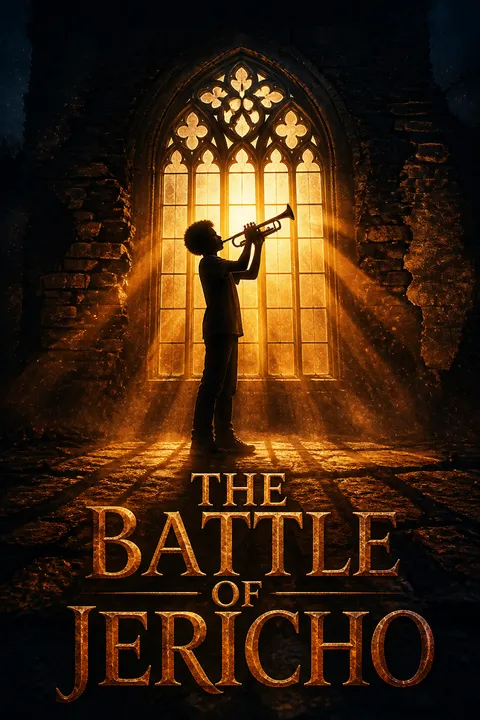


Plot Summary
The Jackets at Lunch
At Douglass High, Jericho Prescott1 jokes easily with his cousin Josh2 and their friend Kofi,3 but he feels clumsy around Arielle,5 the girl he hopes will notice him. Their lunch changes when two sharply dressed members of the Warriors of Distinction invite the boys to help with the club’s holiday toy drive.
The Warriors are admired for their parties and silk jackets, and their long history at school gives them an aura of influence. Jericho1 wants that status, partly because his father14 never joined and partly because he imagines it might bring Arielle5 closer.
His music teacher, Mr. Tambori,13 separately urges him to take a coming trumpet competition seriously, since a Juilliard professor may attend. Jericho1 hears the advice, but the promise of belonging feels more immediate.
The invitation catches Jericho where his self-worth is most exposed. He is talented, affectionate, and funny, yet he measures himself against Josh’s easy confidence and assumes Arielle’s attention must be earned through status. The Warriors offer a visible solution: jackets, access, and a name others recognize. Mr. Tambori’s encouragement points toward a different future, one built on a skill Jericho already possesses, but that future asks him to imagine beyond high school. The tension is not simply ambition versus music. It is the immediate relief of being chosen versus the slower work of believing he is worth choosing already.
Arielle Hears Him Play
At the Warriors’ first meeting, teacher sponsor Mr. Culligan11 presents the toy drive as serious community service, while senior Rick Sharp9 hints that the club has other traditions. The meeting is interrupted when a drunk man storms in looking for his son, Eddie Mahoney,8 exposing a glimpse of Eddie’s8 troubled home life.
At Josh’s2 gathering that weekend, Dana Wolfe4 challenges the boys’ assumption that a fifty-year-old club should exclude girls. The argument strains Kofi3 and Dana’s4 already uncertain relationship.
Jericho1 escapes upstairs with Arielle5 and introduces her to his trumpet, Zora. Playing lets him express feelings he cannot manage in conversation, and Arielle5 listens with genuine attention. When Jericho1 invites her to help with the toy drive, she accepts, giving him a first, fragile reason to feel hopeful.
The club’s public virtue and private hierarchy appear side by side from the beginning. It serves children, yet its male-only tradition is defended as if longevity itself were proof of fairness. Dana’s challenge makes the boys’ desire for admission less innocent: they are seeking entry into an institution whose rules they have barely examined. Jericho’s trumpet offers a contrasting kind of recognition. He does not need to perform toughness or obey anyone to reach Arielle; he shares a piece of himself, and she responds. That moment establishes music as both his identity and a quieter alternative to the Warriors’ manufactured brotherhood.
Midnight Makes Them Pledges
On December 8, Jericho1 and his friends begin sorting and wrapping donations with Arielle5 and the other volunteers. The Warriors watch the newcomers closely, making the cheerful service project feel like an audition. That night, Jericho1 and Josh2 sneak out to attend a secret warehouse ceremony.
The seniors demand absolute secrecy and obedience, asking pledges to accept that they may have to lie or steal for one another. Jericho1 repeats the vows despite unease, afraid to lose the chance he has wanted.
Then Dana4 removes her skullcap and reveals she has taken the pledge too. A senior had mistakenly called her after Demetrius Stanford substituted her number for his. Dana4 argues that the club must honor the commitment she made, and the leaders reluctantly allow her to continue under harsher scrutiny.
The ceremony converts aspiration into obligation before the boys understand what they are accepting. Its language makes loyalty sound mutual, but the seniors control the terms and can demand obedience without explaining the purpose. Jericho’s silence is already a choice shaped by fear of exclusion. Dana’s entry exposes the instability of a tradition that depends on being unquestioned: the same pledge meant to bind her gives her grounds to insist she belongs. Her tactic is audacious, but it also places her inside a system that can punish her for challenging it. The ritual promises brotherhood while revealing who gets to define its boundaries.
Ornaments With a Price
As the toy drive continues, Jericho1 begins to enjoy working beside Arielle,5 while Dana4 keeps attending despite Eddie’s8 hostility and Kofi’s3 resentment. At a shopping mall, senior Madison10 reveals that the Warriors obtain some club decorations by stealing them.
He orders Jericho1 and Kofi3 to take ornaments for the orphanage tree. Jericho1 stalls by asking a store clerk about nutcrackers, while Kofi3 slips four ornaments into his coat. Jericho1 leaves without stealing, but does not challenge Madison10 or report what happened.
The encounter leaves him ashamed and uneasy. While still at the mall, he and Kofi3 talk with Eric Bell,7 a classmate who uses a wheelchair. Eric7 explains that a childhood dare caused his spinal injury and that Arielle5 treats him as a person rather than a condition.
The theft turns the club’s admirable service into a cover for private entitlement. Madison’s excuse that insurance absorbs the loss teaches the boys to confuse lack of immediate harm with moral permission. Jericho resists the direct act but remains inside the silence that protects it, an early example of how the pledge rules weaken his judgment without making him wholly passive. Eric’s account sharpens the contrast. His injury came from a reckless dare, but he speaks about it with agency and refuses pity. Jericho begins to recognize how often he has mistaken another person’s visible vulnerability for the whole of their life.
The Gifts Reach Home
On December 23, Jericho1 joins the Warriors’ deliveries and sees families receive toys in cramped apartments, a nearly bare home, and a trailer where a widowed father is raising four children.
Their gratitude makes the project feel more valuable than the club’s parties or jackets, easing Jericho’s1 doubts about the organization. At home, he shares Christmas with his father,14 stepmother Geneva,16 and younger stepbrothers, then discovers a red used Pontiac waiting in the driveway. His mother in Alaska helped his father14 and Geneva16 afford it.
The gift makes Jericho1 feel trusted and brings him closer to Geneva,16 who credits his recent responsibility. He connects that approval to the Warriors, while his father14 cautions him that membership matters less than becoming his own person.
The deliveries give Jericho evidence that the Warriors can do genuine good, which makes their later abuses harder to recognize and harder to reject. Need is no abstraction here: he sees children watching gifts arrive beneath a thin tree and a bereaved parent trying to provide for them. The club’s service earns his trust through real generosity, not merely clever public relations. Christmas also strengthens the home life he often undervalues. His father and Geneva’s car is a concrete vote of confidence, yet Jericho interprets the trust partly as proof that the Warriors are improving him. Approval becomes another thing he hopes to secure by succeeding.
Names on Black Envelopes
At the New Year’s Eve party, Jericho1 arrives in his new car with Arielle,5 Josh,2 and November.6 He and Arielle5 dance and share a midnight kiss, while Kofi3 and Dana4 arrive together after beginning to mend their quarrel.
During the brief blackout, Dana4 feels someone touch her despite holding Kofi’s3 hands; she suspects Eddie8 but cannot be certain. When the party ends, the pledge invitations are laid out in the hall. Jericho,1 Josh,2 Kofi,3 and Dana4 each find an envelope bearing their name.
Dana’s4 inclusion delights her friends, but Eddie8 warns her that he intends to make the coming weeks miserable. The envelopes make the next step official: the teenagers must complete a demanding week of secret pledge activities before they can wear the coveted jackets.
The party offers the emotional reward Jericho hoped the club would bring: Arielle is beside him, his friends are included, and his name appears among the chosen. Yet the same night introduces a more dangerous intimacy. Dana cannot identify who touched her in the blackout, but the incident sits beside Eddie’s open hostility and makes the club’s celebratory surface feel unsafe. Her invitation is both a victory and a trap, because the institution grants access without surrendering control. Jericho’s happiness is real, but it is still attached to an external test. He wants to believe that being selected means the group will treat its members as brothers.
The Red Queen Spins
On January 2, Jericho1 lets Josh2 drive his new car. When Eddie8 pulls alongside them on the expressway and provokes a race, Josh2 accelerates on icy roads. The Pontiac spins across an exit ramp but stops without hitting anything.
Josh2 admits he is sorry, then tries to erase his guilt over a stolen ornament by giving food to strangers. Jericho1 soon learns Kofi3 has a heart murmur, though Kofi’s3 inattentive parents barely respond to the doctor’s message.
At a later school conversation, Mr. Boston12 warns Jericho1 that hazing can be dangerous and recalls leaving a football team rather than participate in humiliating initiations. The January pledge schedule also conflicts with Jericho’s1 trumpet competition. He hears these warnings, but decides that abandoning the Warriors would cost too much.
The near crash foreshadows the consequences of treating risk as a performance for male approval. Josh does not simply drive badly; Eddie’s challenge turns speed into a test of nerve, and Jericho’s desire to preserve his place makes him reluctant to confront the danger. Kofi’s heart condition adds a physical vulnerability the pledge leaders have little interest in understanding, while his parents’ absence leaves him to minimize it himself. Mr. Boston gives Jericho a clear model of refusal, grounded in his own regret. Jericho does not lack information. He is caught between what he knows and the social cost he imagines if he acts on it.
Pink Shirts, First Humiliations
On January 26, fifteen pledges gather at the warehouse for the first official night. The seniors blindfold them, bind their hands, and make them swallow spoonfuls of egg whites presented as spit. The fake substance is harmless, but the exercise teaches them to obey before they know what is happening.
The boys then run laps while holding photographs of the jackets they hope to earn; a senior strikes a stumbling pledge with a shovel handle. They hesitate when ordered to remove their shirts, aware that Dana4 is present, and the seniors issue pink shirts instead.
That morning at school, the pledges wear them while greeting every student with a rehearsed introduction. November6 laughs and students take pictures. Jericho1 feels exposed, yet tells himself the embarrassment is temporary and the group will protect one another.
The first night mixes deception with actual physical coercion, making it difficult for the pledges to know where the line lies. The egg whites reveal how easily their senses can be manipulated, while the running and striking demonstrate that not every threat is theatrical. At school, the pink shirts turn private submission into a public spectacle. The humiliation is framed as a shared joke, but the pledges have not chosen how or when to be seen. Jericho’s defense is collective language: if everyone endures the same treatment, he can interpret it as bonding. That belief will soon be tested by the very people who insist the group is inseparable.
Eddie Turns Them Into Dogs
The next pledge night, Eddie8 makes the group wear dog collars and crawl, bark, and perform tricks across the warehouse. The seniors then strike the pledges with paddles; Eddie8 hits Dana4 especially hard, and the others watch rather than stop him.
Bound to chairs afterward, the pledges choose between candy worms and real earthworms. Dana4 is forced to swallow a worm, and Eddie8 uses the ritual to assault her with an unwanted kiss. Kofi3 protests and is punished with the real worms. The following afternoon, Jericho1 sees Arielle5 laughing with Eric7 and accuses her of encouraging him.
Arielle5 rejects his attempt to control her friendships. Jericho1 leaves angry and ashamed, while Eric7 withdraws from the conversation. The pledge abuse and Jericho’s1 possessiveness both expose how readily power is mistaken for entitlement.
The night’s rituals make bodily control the club’s measure of loyalty. Dana’s endurance is treated as proof that she can belong, while Eddie uses the group’s silence to turn a test into personal violation. Kofi’s protest matters, but the punishment teaches the others that defending someone can invite retaliation. Jericho’s jealousy repeats a smaller version of the same error: he treats Arielle’s attention as something he may regulate because he fears losing her. His apology is still ahead, but this confrontation exposes the insecurity beneath his romantic ideal. The novel places institutional coercion beside everyday possessiveness without equating their severity, showing how both depend on denying another person’s autonomy.
The Gun in the Dumpster
On January 28, the pledges run around the warehouse in cold rain before being sent into a manure-filled Dumpster to find a list of objects. One item is a handgun wrapped in plastic. Jericho1 discovers it and hands it to Eddie,8 who refuses to explain why it is there.
The seniors then line each pledge up in the muddy yard and order them to remove a pledge master’s boot and sock. Jericho1 kneels in the rain and complies, lowering himself further when Rick9 demands it. Dana4 bites Eddie’s8 toe hard enough to injure him.
The opening image of Jericho1 in the mud becomes a lived reality: he has continued because he believes leaving would betray his friends and erase his chance to belong. Back home, he apologizes to Arielle5 for his jealousy, and she agrees to keep talking with him.
The handgun changes the meaning of the pledge from foolish humiliation to a situation with potentially lethal consequences. Jericho notices the danger and asks for an explanation, but the code of silence has trained him to accept the senior’s refusal. His compliance in the mud is not evidence that he has stopped judging the club; it shows how completely the threat of exclusion has narrowed his choices. Dana’s bite is a moment of resistance within an otherwise controlled ritual, though it cannot undo the structure that placed her there. Jericho’s apology to Arielle offers a more honest model of repair: he names his mistake instead of demanding that she absorb it.
The Contest He Surrenders
On January 29, Jericho1 skips his trumpet competition, despite the possible Juilliard opportunity, because missing pledge week would eliminate him. His father14 and Mr. Tambori13 challenge the decision, but Jericho1 insists that the club and Arielle5 matter more right now.
That night, the seniors stage a branding ceremony with glowing forks, then press ice to the pledges’ backs so fear makes it feel like fire. They force each pledge to dunk his head in a toilet. Eddie8 locks himself in with Dana4 and urinates in the bowl before pushing her head into it.
She runs out crying, then returns the next morning determined to finish. She reveals that Eddie8 also gave her a real burn, unlike the others’ ice, and the pledge class rallies around her. The seniors reprimand Eddie8 but leave him in the club.
Jericho’s absence from the competition is the clearest cost he has yet paid for belonging. He gives up a genuine opportunity, not because music has ceased to matter, but because he believes exclusion would make him socially irredeemable. The ice trick exposes how fear can make the mind experience an imagined injury as physical, while Dana’s real burn distinguishes the seniors’ theatrical tests from Eddie’s deliberate cruelty. The leaders’ response is revealing: they apologize for the excess but preserve the hierarchy that enabled it. Dana’s decision to continue is an act of self-definition, yet her endurance should not be confused with consent to the abuse.
The Leap Becomes a Fall
On January 30, the final ceremony begins with symbols of unity and a gun the seniors claim they have never used. Eddie8 then makes the pledges drink repeated cups of whiskey until they are drunk and eager to obey.
At an abandoned house, he orders them to jump from a second-floor window onto mattresses hidden beneath mud. The first pledges land safely. Kofi3 throws Eddie8 out after Eddie8 threatens Dana,4 then jumps himself and breaks his arm. Jericho1 follows. Josh,2 the last, launches himself like he is flying, twists in midair, and lands beyond the mattresses, striking his head on a rock.
Jericho1 runs to him as the others call for help. Paramedics work on Josh2 while the pledges stand in the cold. The promised brotherhood has become an emergency scene, and no jacket can make the risk disappear.
The final ritual gathers every earlier mechanism into one catastrophe: secrecy, alcohol, group pressure, a weapon used to intimidate, and a challenge whose danger the seniors have concealed. The word faith disguises a physical gamble, while intoxication weakens the pledges’ ability to judge it. Josh’s jump begins as performance, consistent with his love of making people laugh and watching him, but the fall strips that performance of control. Jericho’s earlier silence now has a concrete consequence he cannot reverse. The scene does not make him solely responsible; it exposes a chain of adult and senior failures that turned teenagers’ need for acceptance into a lethal test.
A Jacketless Funeral
At the warehouse, Jericho’s father14 confirms that Josh2 has died. Kofi3 is hospitalized with a broken arm, while Dana4 stays beside him. Police question the pledges, and parents confront Mr. Culligan11 and Principal Zucker19 about the unsupervised initiation.
At Josh’s2 funeral, Jericho1 serves as a pallbearer beside Kofi3 and Eric;7 the Warriors attend without their jackets, and the planned celebration never happens. Eddie8 is arrested over the gun and Dana’s4 assault, while Mr. Culligan11 faces investigation and arrest.
In the following days, Arielle5 tells Jericho1 they should see less of each other because she needs to support her friends. He returns to Josh’s2 home with the pledge group and plays Zora, his trumpet, giving grief and anger a shape that speech cannot provide. The final notes fall quiet, but his questions remain.
The aftermath refuses the club the clean ending it had promised. Jackets and a formal welcome are replaced by a funeral, police interviews, and adults who must answer for trusting senior students with unsupervised power. Responsibility is distributed, but that does not make it abstract: Jericho must live with what he saw, the adults face scrutiny, and Josh’s family bears an irreversible loss. Arielle’s distance compounds his grief, while Eric’s presence among the mourners reverses Jericho’s earlier assumption that disability places someone outside ordinary friendship. Playing the trumpet becomes an act of witness rather than a performance for advancement. The music cannot resolve the loss, but it lets the group hear it.
Analysis
The novel’s central question is not whether belonging matters, but what people will permit an institution to demand in exchange for it. The Warriors are compelling because their public identity contains real generosity. Their toy deliveries help families, and their older members occupy positions of influence at school. This credibility makes the private rituals harder to challenge. Service becomes a kind of moral credit that the club spends to excuse coercion, while the pledges’ desire for acceptance helps turn each new demand into a test they feel they must pass.
Jericho’s1 choices are shaped by an adolescent economy of visibility. He wants the jacket, Arielle’s5 attention, his father’s14 pride, and a place beside Josh2 and Kofi.3 Those wishes are ordinary, but the Warriors translate them into leverage. Jericho1 does not lack warnings: Mr. Boston12 speaks from experience, his father14 questions the club, and the gun in the Dumpster alarms him. The tragedy grows because he repeatedly recognizes danger, then lets loyalty and fear of humiliation overrule that recognition. The novel therefore treats complicity as a process, not a single villainous decision.
Dana4 provides the sharpest test of the club’s ideals. She forces it to confront a gender boundary, accepts the same pledge obligations, and continues to assert her right to belong. Yet her courage does not make the organization fair. It can admire her toughness while still permitting Eddie8 to target her. The distinction between resilience and consent matters: enduring harm is not proof that the harm was justified.
The adults’ failures widen the story beyond teenage cruelty. A faculty sponsor11 trusts the seniors, a principal19 trusts the club’s reputation, and a former member15 offers confidence instead of warning. Against this machinery, Jericho’s1 trumpet represents a different form of selfhood, one built through practice and expression rather than submission. His final music does not undo the loss or answer who is to blame. It gives the survivors a way to acknowledge what the club’s slogans tried to silence.
Review Summary
The Battle of Jericho received mixed reviews, with an average rating of 4.14 out of 5. Many readers praised its compelling plot, relatable characters, and important messages about peer pressure and hazing. They found the story engaging and thought-provoking, particularly regarding the consequences of trying to fit in. However, some critics felt the dialogue was unrealistic and the characters underdeveloped. The book's ending was frequently mentioned as shocking and impactful, leaving a lasting impression on readers.
People Also Read




Characters
Jericho Prescott
Insecure trumpet hopefulJericho is a funny, warm-hearted high school junior who is often more comfortable with his trumpet than with people he wants to impress. He is self-conscious about his size and assumes that popularity, a prestigious club, or a girlfriend’s approval might confirm his worth. His musical ability offers a genuine source of identity, but he struggles to trust it when the Warriors promise immediate belonging. He cares deeply about his cousin Josh2 and his friends, which makes loyalty both his strength and the pressure point others can exploit. Jericho’s story asks whether he can distinguish commitment from obedience, and whether he can recognize his own value without borrowing the club’s status.
Josh Prescott
Magnetic cousin and athleteJosh is Jericho’s1 cousin and closest companion, a capable athlete whose jokes and easy confidence make him the center of many rooms. He is dating November6 and wants his father, Brock15, to be proud of him, so joining the Warriors carries a family legacy as well as social promise. Beneath his swagger, Josh is affectionate and observant, and he often uses humor to steady his friends or deflect discomfort. His closeness with Jericho1 reaches back to childhood, making their bond feel less like ordinary friendship than shared history. Josh’s charm can make reckless choices seem harmless, especially when he is trying to prove himself.
Kofi Freeman
Neglected computer prodigyKofi is Jericho1 and Josh’s2 quick-witted friend, a gifted self-taught computer user who often hides loneliness behind teasing and bravado. His parents are frequently absent, and their indifference has taught him to act as if he needs little from anyone. The Warriors appeal to him because membership could make him feel recognized and valued. Kofi is drawn to Dana’s4 strength, though at first he resents the way her bid to join disrupts his own hopes. He is loyal to his friends and wants to prove himself physically as well as intellectually, sometimes pushing past limits he should take seriously.
Dana Wolfe
Defiant boundary breakerDana is a tall, athletic student known for defending friends and refusing to let convention dictate what she can attempt. Her military father taught her to fly and encouraged her to cross boundaries usually reserved for boys, though his expectations also leave her determined to prove she is capable on her own terms. Dana wants access to the Warriors because she believes she could contribute, not because she needs its approval to feel distinguished. She is disciplined, direct, and difficult to intimidate. Her connection with Arielle5 and November6 gives her a softer circle of trust, while her changing relationship with Kofi3 reveals that independence and intimacy can coexist.
Arielle Gresham
Perceptive first loveArielle is thoughtful, stylish, and socially confident, with a warmth that makes room for people others overlook. She volunteers with the Warriors’ toy drive and treats Eric7 as a friend rather than reducing him to his wheelchair. Her growing connection with Jericho1 begins when she listens to him play and recognizes the feeling inside his music. Arielle values her independence and expects a partner to respect her choices, including whom she befriends. She is close to Dana4 and November6, and her loyalty to them shapes how she responds when events become painful. Her confidence is not cruelty; it is a clear sense of where her boundaries belong.
November
Compassionate social organizerNovember is Josh’s2 girlfriend, a practical planner who fills her calendar with tutoring, hospital volunteering, and community work. Her cheerful organization can look like effortless confidence, but she has endured profound family losses and cares deeply for children facing illness or disability. She encourages Josh2 to become more socially responsible while also enjoying the style and parties attached to the Warriors. Her friendship with Arielle5 and Dana4 gives the girls a dependable center, and her attentiveness often reveals more than her lighthearted manner first suggests.
Eric Bell
Wheelchair-using classmateEric is a perceptive Douglass student who has used a wheelchair since a childhood accident injured his spine. He is independent, funny, and willing to speak plainly about the practical and emotional difficulties of living with a disability. Other students often avoid asking him direct questions or treat him as fragile, but Eric wants ordinary conversation and the chance to be included. His friendship with Arielle5 is easy and genuine. Through Eric, the story tests whether Jericho1 can see a whole person rather than make assumptions from the most visible fact about him.
Eddie Mahoney
Volatile pledge masterEddie is a short, muscular senior who exercises his authority through intimidation and enjoys making younger students obey. His home life is troubled, and the glimpses of his father suggest that Eddie has grown up around aggression. Rather than acknowledging vulnerability, he turns it outward, using the Warriors’ traditions to control and humiliate others. His hostility toward Dana4 combines resentment with an unwanted personal fixation. Eddie is not merely a strict leader; he repeatedly crosses boundaries that the group’s language of brotherhood is supposed to protect.
Rick Sharp
Cruel senior enforcerRick is a broad-shouldered senior who presents the Warriors’ rules with confidence and carries out its pledge rituals. His authority depends on making obedience seem normal, even when a task is degrading. He can be welcoming during the public service project, which helps make the club’s darker practices harder for newcomers to anticipate. Rick embodies the ordinary face of institutional harm: he does not need to invent every abuse to help sustain a system that rewards seniority and discourages dissent.
Michael Madison
Bald senior gatekeeperKnown at school as Madison, he is a senior Warrior who initially helps make the toy drive feel organized and welcoming. He later helps administer the club’s secret pledging rules and shares authority with Rick9 and Eddie8. His role shows how a person can move between civic service and coercive tradition without recognizing the contradiction, or without choosing to challenge it. Madison’s calm manner gives the Warriors a less openly menacing face than Eddie’s8, but he still helps enforce the system.
Richard Culligan
Complicit teacher sponsorMr. Culligan teaches chemistry and serves as the Warriors’ unofficial faculty sponsor. He speaks proudly about the club’s history and community work, while leaving much of its operation to the senior members. His confidence in tradition and student leadership helps the club retain legitimacy with the school. Culligan’s position illustrates the risk of adult supervision that exists mainly on paper: the title of sponsor offers reassurance, but it does not ensure that students are protected.
Mr. Boston
Conscientious math teacherMr. Boston is a strict, dedicated teacher who stays late because he values the school and its students. His own experience with humiliating football hazing makes him alert to the danger behind the Warriors’ secrecy. He warns Jericho1 without pretending that advice alone can make the choice for him. Boston is one of the few adults willing to name the difference between service and abuse, though he understands that a teenager may not yet be ready to listen.
Mr. Tambori
Trumpet teacher and mentorMr. Tambori is Jericho’s1 music teacher and a serious advocate for his trumpet talent. He has arranged for Jericho’s1 playing to be heard at a competition attended by a Juilliard professor and urges him to imagine a future larger than the one immediately visible. His investment in Jericho1 is both practical and personal: he sees artistic promise where Jericho1 sees uncertainty. Tambori understands that talent needs discipline, but cannot force Jericho1 to value the opportunity he has helped create.
Cedric Prescott
Police officer fatherCedric is Jericho’s father1, a police officer who works long shifts and tries to balance caution with trust. He supports his son’s interests, shares responsibility for the car Jericho1 receives, and urges him not to confuse club membership with personal worth. His advice is grounded in affection rather than control, though Jericho1 often hears it as an adult’s failure to understand teenage life. Cedric’s relationship with his brother Brock15 also ties the cousins’ families closely together.
Brock Prescott
Proud Warrior fatherBrock is Josh’s father2, a successful lawyer and former Warrior who speaks proudly of his own membership. He is affectionate with Josh2 and wants the club to give his son the same sense of belonging and growth he associates with his own youth. His secrecy is meant to preserve the tradition, but it also leaves Josh2 without a realistic account of what the pledge process may demand. Brock’s confidence helps explain why the younger boys assume that the adults must know what is coming.
Geneva
Guarded, caring stepmotherGeneva is Jericho’s stepmother1, whose reserved manner often makes him feel criticized even when she is trying to care for him. She provides a stable home for Jericho1 and his father14, cooks for the family, and treats Jericho’s1 younger stepbrothers with warmth. Her concern about his late nights and responsibilities can sound like disapproval to a boy already sensitive to rejection. Over time, Jericho1 begins to notice that her practical care is more generous than her restrained words suggest.
Marlene Prescott
Josh’s protective motherMarlene is Josh’s mother2 and Brock’s wife15. She creates a welcoming home where Jericho1 feels comfortable, and her family’s travel and cultural artifacts give the house a vivid contrast to Jericho’s1 plainer home. She is affectionate with the boys and proud of Josh2. Her warmth makes the Prescott family feel like an extended refuge for Jericho1, especially because he and Josh2 have been close since childhood.
Mr. Redstone
Watchful head custodianMr. Redstone has worked at Douglass for decades and notices more than students assume. He knows about the Warriors’ recurring pledge customs and quietly questions whether all of them are acceptable. His plainspoken concern gives Jericho1 another chance to examine what the club is asking of him.
Mr. Zucker
Protective school principalMr. Zucker is Douglass High’s principal and a former Warrior. He values the club’s long history and its visible service to the school, and his trust helps it maintain access and legitimacy. His confidence in the organization reflects the institution’s tendency to rely on reputation rather than direct oversight.
Plot Devices
The Warriors’ pledge code
Turns belonging into obedienceThe Warriors’ vows promise loyalty, mutual responsibility, and brotherhood, but they also demand secrecy and obedience to the seniors. The code helps the pledges interpret each new ordeal as a shared test and makes refusal feel like betrayal of the other boys. Its repeated group language is especially powerful for Jericho1, Josh2, and Kofi3 because each wants to feel chosen. The mismatch between the code’s protective claims and the seniors’ coercive behavior drives the story’s central conflict.
The holiday toy drive
Earns trust through real serviceThe Warriors’ annual toy drive gives the club a credible public purpose. The pledges sort, wrap, and deliver gifts to families in need, and Jericho1 sees the relief the deliveries bring. Because the work genuinely helps people, the club’s charitable reputation is not simply a sham. That truth complicates the boys’ doubts: they are not choosing between obvious good and obvious evil, but between a meaningful service project and an organization that uses its reputation to shield harmful traditions.
Zora the trumpet
Gives Jericho an honest voiceJericho1 names his trumpet Zora and treats it as a trusted companion. Playing lets him communicate feelings that he cannot easily express to Arielle5 or his family, and it connects him to a future in music that Mr. Tambori13 encourages. The trumpet also marks a path distinct from the Warriors’ status system. As Jericho1 increasingly invests in the club, his postponed competition makes the cost of that choice tangible. In the final gathering of friends, music becomes a way to express grief when ordinary language fails.
Pink shirts and black jackets
Makes status visibleThe pink pledge shirts mark the boys as temporary outsiders, while the black silk jackets represent the acceptance they hope to earn. The contrast turns belonging into something public and wearable. At school, the pink shirts invite laughter and photographs; at the party, the black jackets are displayed as a reward just out of reach. Jericho’s1 longing for the jacket is tied to his wish to be admired, especially by Arielle5. The clothing therefore makes an inward insecurity visible and gives the Warriors a simple tool for controlling status.
The Leap of Faith
Turns peer pressure lethalThe final pledge challenge is presented as a test of courage, with seniors claiming that hidden mattresses make a jump from an abandoned house safe. The language of faith and brotherhood disguises the physical danger, while alcohol leaves the pledges less able to judge it. Earlier rituals have taught them to obey, endure embarrassment, and distrust the impulse to withdraw. The handgun has already established that the seniors are willing to use fear as leverage. The jump brings those elements together in a disaster no ritual language can contain.
Jericho Series

Download PDF
Download EPUB
.epub digital book format is ideal for reading ebooks on phones, tablets, and e-readers.








