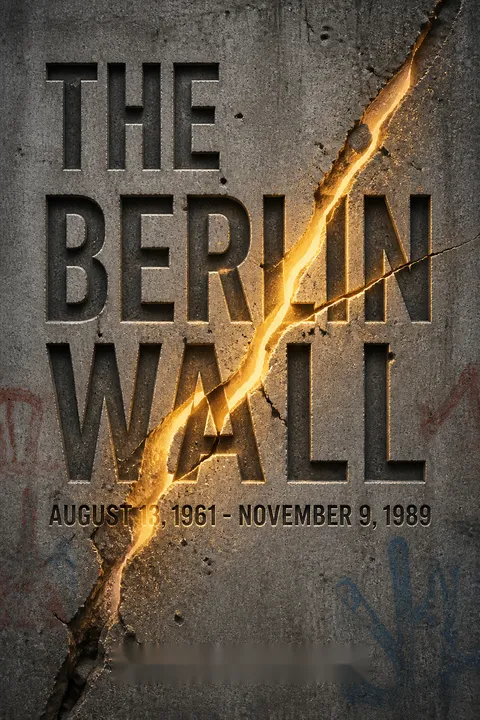


Key Takeaways
The Wall was the GDR’s admission that its citizens preferred the exit.
A state hemorrhaging people. Between 1945 and 1961, about 2.5 million people left East Germany through Berlin, roughly 15 percent of the GDR’s population. Many were young and skilled: doctors, engineers, teachers, and trained workers whose departure weakened the country’s ability to function. The regime refused to remove the political and economic restrictions driving them away.
In August 1961, the government closed Berlin’s open border instead. The barrier stopped the immediate exodus, but it could not make East Germans freely choose the system. It made that choice impossible to act on. The Wall’s lasting political message was therefore not just that the state could control movement, but that it feared letting people compare lives on either side.
The exodus works as a form of revealed preference: people’s costly decisions disclose what official slogans cannot. Here, the departing population also carried the skills the GDR most needed, turning private dissatisfaction into a public economic crisis. That does not mean every refugee rejected every feature of East German life, or that migration is a perfect measure of political consent. Still, when a government answers persistent departure by preventing departure, it supplies unusually strong evidence about the limits of its legitimacy.
A ballot cannot legitimize a state that controls every route to power.
Democracy as a façade. When Walter Ulbricht’s Communist group returned to Berlin in 1945, it installed respectable non-Communists in visible positions while reserving key posts, especially control of personnel and police, for trusted Communists. The arrangement looked pluralistic, but the SED alone had reliable access to Soviet power and the institutions that enforced its decisions.
The gap between appearance and consent showed in Berlin’s 1946 election: the Social Democrats won nearly 49 percent, while the Communist-led SED received about 20 percent. The answer was not open competition. In later GDR elections, voters faced a single approved list, with no real choice of candidates. The state borrowed the language of democracy while removing the conditions that make a vote meaningful.
This is a useful distinction between formal institutions and effective accountability. Elections, parties, and legislatures can exist on paper while the distribution of power remains insulated from public choice. The critical test is not whether a ballot is held, but whether opposition can organize, communicate, win, and take office. The book’s Berlin examples make that test concrete: control of police, staffing, and access to the occupying power mattered more than the number of party names on a ballot.
Western leaders defended access to West Berlin, not reunification.
A divided city, two calculations. The 1948 Soviet blockade tried to force the Western Allies out of Berlin. They kept West Berlin supplied by air, making access to the city a test of Western credibility. But in 1961, when East Germany sealed its sector border, the Western powers did not try to reopen East Berlin or restore free movement across the whole city.
President Kennedy drew a careful line: the United States would defend West Berlin and its access routes, but not risk war to keep East Berlin open. Britain and France also had reasons to avoid a showdown. The Wall was cruel to Berliners, yet for Western leaders it reduced the chance that a recurring crisis would trigger a wider conflict. Public condemnation and private acceptance could coexist.
This episode shows how security policy can protect a boundary while abandoning the people living just beyond it. The Western position was not irrational: military escalation between nuclear powers carried risks far beyond Berlin. Yet the language of freedom sounded less persuasive when Western governments accepted a barrier that trapped millions. The distinction between defending an ally’s territory and defending a population’s rights remains politically important, especially when strategic stability is purchased at someone else’s expense.
In 1953, Soviet tanks rescued a government its own workers rejected.
A workers’ state confronts workers. In June 1953, construction workers in East Berlin protested a 10 percent increase in work requirements without increased pay. Their march became a broader uprising. Strikes and demonstrations spread across the GDR; official records later estimated about half a million strikers and more than 400,000 demonstrators.
The Soviet military crushed the revolt with tanks and gunfire. The book records 267 deaths during the disturbances and a further 200 executions. The uprising exposed the distance between the SED’s claim to represent workers and the coercion it used against them. Ulbricht survived, not because the protest had validated his rule, but because Moscow feared that removing him would make the regime look weak. The state then purged reformers and punished participants.
The uprising demonstrates that repression can preserve a government without restoring consent. It also reveals a danger in treating a protest’s immediate outcome as its full historical meaning: the Soviet tanks stopped the crowds, but the event permanently exposed the regime’s dependence on outside force. The workers’ demands began with pay and workload, then widened into political claims. Such escalation is common when institutions provide no credible channel for grievances to be negotiated.
Secrecy let Operation Rose divide Berlin before most residents woke.
A border imposed overnight. The operation to close Berlin’s sector border was called Operation Rose. East German security chief Erich Honecker coordinated it with a small circle of officials, while troops and building materials were moved around the country to conceal the plan. Shortly after one in the morning on 13 August 1961, armed units began blocking streets and laying barbed wire.
Sixty-eight of the city’s 81 crossing points were closed, and 193 streets were cut. Rail lines and stations were sealed as well. Along the Bernauer Strasse, buildings belonged to East Berlin while the pavement outside belonged to the West. Residents jumped from windows into West Berlin, sometimes into firefighters’ rescue sheets. The improvised wire barrier turned familiar streets and homes into a border before most people understood what was happening.
The operation’s effectiveness came from timing, coordination, and control of information, not from a wall’s physical strength alone. That makes it a revealing case of administrative power: transport systems, streets, and ordinary routines can be repurposed quickly when authorities have prepared in secret. The same efficiency that made the operation appear orderly also concealed its human cost. A city’s infrastructure is never politically neutral when someone controls who may use it.
The Wall was a lethal system, not a single concrete structure.
Fortifications backed by force. In 1964, only about 15 kilometres of the Berlin barrier consisted of solid wall; much of the wider border was fencing. Over time, the regime added layers: a rear wall, alarmed wire, obstacles, floodlights, patrol roads, watchtowers, dogs, and a cleared strip where footprints could be seen. Guards were ordered to stop escape attempts, and a de facto shoot-to-kill policy emerged soon after the border closed.
The visible concrete face was only one part of the system. In 1962, Peter Fechter was shot while trying to cross and lay wounded in view of West Berliners for about an hour before East German guards removed him. His death became a symbol of the Wall’s cruelty, while the wider apparatus made escape dangerous long before anyone reached the concrete.
Calling the structure a wall can make the violence seem architectural, as if concrete alone did the imprisoning. In practice, surveillance, rules, weapons, and human decisions made the barrier work. This distinction matters because it locates responsibility in institutions and orders, not in an inert object. The system also placed guards in a moral trap: many were conscripts, yet the state’s discipline and penalties made refusal dangerous. Technology reinforced coercion, but did not replace it.
Escapes made individual courage visible, but never made the risks fair.
Ingenious routes, brutal stakes. Some East Germans crossed water or crawled beneath fences. Others relied on helpers who forged passports, dug tunnels, or concealed people in vehicles. The student-led Girrmann Group helped thousands escape in the early years. Tunnel 29, partly financed by the American television network NBC, brought 29 people to the West in 1962. These were not safe passages: escapees and helpers risked arrest, injury, and death.
The famous photograph of border guard Conrad Schumann leaping over barbed wire captures one decision in a larger pattern. So does Peter Fechter’s death. Escape groups were often courageous, but methods and motives varied; some helpers charged money, and some operations involved weapons. The book resists turning every escape into a clean heroic tale, because the Wall created circumstances in which survival and moral compromise could become entangled.
Escape stories return agency to people whom the border system tried to reduce to manageable cases. They also expose the unequal distribution of risk: the person fleeing faced immediate danger, while organizers, journalists, and distant sponsors could sometimes choose how much to invest. Payment does not automatically erase a rescue’s value, just as idealism does not guarantee prudence. The ethically serious question is what a method required of others, including the people whose lives were used to tell its story.
When reunification stalled, Brandt turned small agreements into practical relief.
Contact before grand settlement. After the Wall made quick reunification seem impossible, West Berlin mayor Willy Brandt and his adviser Egon Bahr pursued a policy that became known as Ostpolitik. Its premise was that practical contact with East Germany could improve ordinary lives even while the division remained. The first crossing-permit agreement allowed West Berliners to visit relatives in the East during the 1963 holiday season. More than 700,000 people made about 1.2 million visits.
The policy developed into wider agreements. The 1971 Berlin Agreement regulated access and affirmed West Berlin’s continued security. A 1972 Basic Treaty established relations between the two German states, bringing East Germany greater international recognition. These steps did not reunite families permanently or dismantle the Wall. They did make contact and travel more manageable, while forcing West Germans to reckon with the political reality they had hoped would disappear.
Incremental diplomacy can protect human interests when a comprehensive settlement is unavailable. Here, permits and transit arrangements had value precisely because they addressed lived problems rather than promising an imminent historical breakthrough. The trade-off was real: practical agreements could ease hardship while helping normalize the division. That tension is not a reason to dismiss the policy. It is a reminder that diplomatic gains should be judged both by what they relieve and by what they leave intact.
Western credits kept the GDR afloat, including cash earned by selling prisoners.
A hidden economy buys time. East Germany’s leaders promised social benefits and rising consumption, but the economy became increasingly dependent on Western loans, technology, and hard currency. The secret Commercial Co-ordination network, known as KoKo, moved money through front companies and overseas accounts, sold goods and art, and helped secure restricted technology. The state also released political prisoners to West Germany in return for payment. About 34,000 prisoners were transferred in this way; official proceeds reached at least 3.4 billion West German marks.
These arrangements prolonged the regime without repairing its weak productivity or dependence on outside support. They also created a grotesque contradiction: the state that imprisoned people could turn their release into revenue. Western payments sometimes rescued individuals from jail, but they also helped sustain the apparatus that had imprisoned them.
This is a case where humanitarian relief and political financing became inseparable. Buying a prisoner’s freedom could be an immediate moral good for that person and family, while the payment strengthened a state able to imprison more people. The arrangement resembles a ransom economy: coercion creates the asset that the coercer then sells. It also complicates any simple story of self-contained East and West. The GDR’s survival depended partly on the capitalist resources it publicly denounced.
The Wall fell when citizens moved and Moscow stopped enforcing obedience.
A crisis no longer contained. In 1989, East Germans crossed through Hungary and occupied West German embassies, while mass demonstrations spread at home. On 9 October, about 70,000 people demonstrated peacefully in Leipzig. Security forces had prepared to intervene, but did not fire, and Soviet troops did not repeat their 1953 intervention. The government’s ability to rely on force was visibly weakening.
That evening, spokesman Günter Schabowski announced new travel rules, mistakenly saying they took effect immediately. Crowds went to the checkpoints. At Bornholmer Strasse, commander Harald Jäger eventually ordered the gates opened rather than risk a deadly crush. People streamed into West Berlin. The opening was not a perfectly planned act of reform: public pressure, confused instructions, and local restraint converged while Moscow withheld the force that might have stopped them.
The fall is often compressed into one accidental press conference, but the mistake mattered because the public was already mobilized and the state’s chain of command had lost credibility. The episode resembles a coordination shift: once people saw that others were willing to act and guards might not shoot, the cost of joining fell sharply. Yet contingency matters. A different order, or a Soviet intervention, could have made the same crowd’s courage end in bloodshed.
Reunification ended the Wall, but four decades of lost capacity remained.
A costly inheritance. The GDR inherited advanced industrial regions, but Soviet removals, central planning, and the flight of skilled people weakened their productive base. The Wall stopped much of the population loss after 1961; it did not restore the capital, expertise, and management that had already moved west. When the border opened, many East German industries could not compete in the wider market, and closures brought unemployment and renewed migration.
Western investment rebuilt infrastructure and restored historic towns, but money could not quickly recreate a competitive industrial system or reverse decades of demographic change. The book calls this deeper damage a theft of hope: people were denied not only freedom to leave, but also the opportunity to develop their region while the world economy changed around it. Reunification ended coercion; it did not erase the accumulated consequences.
The long aftermath is best understood through path dependence: choices made under one system shape which choices are feasible under the next. That helps explain why opening a border cannot instantly equalize regions whose industries, skills, and populations have diverged for decades. It also cautions against assigning every post-reunification hardship to one cause. The GDR’s structural damage mattered, as did the speed and terms of economic integration. Freedom changed the options; it could not guarantee equal outcomes.
Analysis
Taylor’s central argument is that the Wall was both a material border and a confession. It protected the GDR from the consequences of its own unpopularity, but every day it stood, it advertised that the state could not compete for its citizens. The book makes this contradiction vivid by moving between strategic negotiations and intimate scenes: leaders calculate risk in Moscow and Washington, while families find streets, windows, and railway platforms suddenly transformed into borders.
The narrative’s most productive tension is between moral judgment and geopolitical explanation. The West’s restraint in 1961 can be understood as an attempt to prevent nuclear war, yet that same restraint helped abandon East Germans to an enforced division. Neither the security argument nor the human-rights argument cancels the other. The strongest reading holds both in view, rather than treating the Wall as either a simple Western defeat or a tidy Cold War solution.
The book also shows that authoritarian power is not just police violence. It depends on controlling appointments, information, transport, money, and the terms under which people can leave. The Wall’s concrete face is memorable, but the broader system made it effective. Conversely, its end required more than a flawed announcement. Years of departure, economic dependence, public protest, and a Soviet leadership unwilling to intervene had weakened the state before the gates opened.
The afterword sharpens the account by arguing that lost productive capacity and regional opportunity were deeper injuries than the visible structure. That interpretation is persuasive, though post-reunification hardship also reflects the speed and design of economic integration. The book’s lasting insight is not merely that walls fail. It is that coercion can freeze a crisis for decades while making the eventual repair harder, more unequal, and less controllable than the leaders who built the barrier imagined.
Review Summary
The Berlin Wall is praised as an engaging and comprehensive history of the iconic Cold War barrier. Reviewers appreciate Taylor's detailed research, compelling personal stories, and broad historical context, though some find the scope too wide. The book is lauded for its readable style and insights into Cold War politics, but criticized for occasional editing issues and digressions. Many readers found it informative and eye-opening, particularly regarding escape attempts and the wall's impact on everyday life in Berlin.
People Also Read



Glossary
Stasi
East German state securityThe common name for the GDR’s Ministry for State Security, or Ministerium für Staatssicherheit. The Stasi protected the ruling SED, monitored the population through agents and informers, and investigated and imprisoned people considered opponents of the regime. It also conducted intelligence operations abroad. Its reach extended into everyday life, not just formal policing.
Operation Rose
Secret Berlin border closureThe codename for the East German operation that sealed the border between East and West Berlin during the night of 12 to 13 August 1961. Planned by a small group under Erich Honecker, it used police, troops, and work crews to block streets, rail connections, and crossing points before most residents knew what was happening.
Republikflüchtige
People fleeing the GDRA politically charged label used by the East German authorities for citizens who left the GDR without permission. The word cast departure as desertion from the republic rather than a choice made by individuals. The label supported the regime’s claim that escapees were disloyal or manipulated, obscuring the political and economic conditions that drove many to leave.
Ostpolitik
Engagement with the EastThe West German policy associated with Willy Brandt of pursuing practical relations with East Germany and other Eastern Bloc states, rather than insisting that all contact wait for reunification. Agreements on visits, transit, and diplomatic relations aimed to reduce hardship and manage the division. The policy accepted political realities without formally abandoning the goal of German unity.
Helsinki Accord
European rights agreementThe 1975 Final Act of the Conference on Security and Co-operation in Europe, signed by countries from both Cold War blocs, including East and West Germany. It affirmed human rights and freedoms, including movement and family contact. East German dissidents later used the government’s own signature on the agreement to challenge restrictions on travel and emigration.
KoKo
Secret hard-currency networkShort for Commercial Co-ordination, a covert East German organization that obtained foreign currency through trade and other arrangements outside the ordinary planned economy. Its activities included exports, use of foreign companies and accounts, and access to Western technology. KoKo helped the GDR meet financial needs while concealing some of the scale and methods of its economic activity.
Passierscheinabkommen
Temporary Berlin visit permitsThe crossing-permit agreement that allowed West Berliners to make temporary visits to relatives in East Berlin, beginning during the 1963 holiday season. More than 700,000 people made about 1.2 million visits during the first period. The agreement offered limited family contact after a long separation, without reopening the border or ending the division.
Anti-Fascist protection barrier
GDR name for the WallThe East German government’s official justification for the Berlin border fortifications. It described the barrier as defensive protection against Fascists, spies, and Western interference. In practice, its central purpose was to stop East Germans from leaving for the West. The phrase turned a system built to restrict citizens into a claim that the state was defending them.
FAQ
What's Berlin Wall: A World Divided, 1961-1989 about?
- Historical Overview: The book chronicles the history of the Berlin Wall from its construction in 1961 to its fall in 1989, detailing its impact on Berliners and the world.
- Cold War Context: It situates the Wall within the broader Cold War, highlighting its role as a symbol of division between East and West.
- Personal Stories: Frederick Taylor includes personal accounts, illustrating the human cost of political decisions and the emotional impact on individuals.
Why should I read Berlin Wall: A World Divided, 1961-1989?
- In-depth Research: Frederick Taylor provides a well-researched narrative, combining historical facts with personal anecdotes for an engaging read.
- Understanding Division: The book helps readers grasp the complexities of political division and its long-lasting effects on society.
- Cultural Significance: It offers insights into the cultural and political ramifications of the Wall, which resonate even today.
What are the key takeaways of Berlin Wall: A World Divided, 1961-1989?
- Impact of the Wall: The Wall divided not just a city but also families, illustrating the personal tragedies of political decisions.
- Futility of Division: The book emphasizes the Wall's ultimate futility, as it couldn't prevent Germany's reunification.
- Lessons on Freedom: It highlights the importance of freedom and the lengths people will go to achieve it, as seen in escape stories.
What are the best quotes from Berlin Wall: A World Divided, 1961-1989 and what do they mean?
- “The Wall represented a uniquely squalid, violent—and, as we now know, ultimately futile—episode in the post-war world.”: This quote highlights the Wall's role as a symbol of oppression and its eventual failure.
- “The drastic power-political surgery of 13 August 1961 was, of course, an especially tragic and painful experience.”: It reflects on the abrupt and violent nature of the Wall's construction and its emotional toll.
- “I hope that those who live in more fortunate communities elsewhere in the world will summon up the imagination to conceive what it might have been like for Berliners.”: This urges readers to empathize with the struggles of those affected by the Wall.
How did the Berlin Wall come to be constructed?
- Post-War Division: After WWII, Germany was divided into East and West, with Berlin as a focal point of tension.
- Mass Exodus: Between 1945 and 1961, about 2.5 million East Germans fled to the West, prompting drastic measures.
- Khrushchev's Decision: On August 13, 1961, Soviet leader Khrushchev supported East German leader Ulbricht's plan to seal off West Berlin, leading to the Wall's construction.
What were the immediate effects of the Berlin Wall on Berliners?
- Separation of Families: The Wall abruptly separated families and friends, causing immense emotional distress.
- Increased Repression: The East German government intensified surveillance and imprisonment of escapees.
- Symbol of Oppression: The Wall became a powerful symbol of the Cold War, representing the struggle for freedom.
How did the international community react to the Berlin Wall?
- Shock and Outrage: The Wall's construction shocked the world, seen as a violation of human rights.
- Political Maneuvering: Western leaders condemned the Wall but were cautious to avoid military confrontation.
- Media Coverage: The Wall was one of the first major international crises to be televised, influencing public perception.
What role did the Berlin Wall play in the Cold War?
- Dividing Line: It served as a physical and ideological barrier between the capitalist West and communist East.
- Military Tensions: The Wall heightened military tensions and was used as a propaganda tool by both sides.
- Eventual Reunification: Its fall in 1989 marked a turning point, symbolizing the collapse of communist regimes.
How did the Berlin Wall affect East and West Germany's economies?
- Economic Disparities: The Wall highlighted stark economic differences, with the West enjoying greater prosperity.
- Isolation of East Germany: The GDR's economy suffered due to isolation and reliance on Soviet support.
- Impact on Migration: The Wall aimed to stem the flow of skilled workers but led to a brain drain in East Germany.
What were some notable escape attempts documented in Berlin Wall: A World Divided, 1961-1989?
- Conrad Schumann's Leap: An East German soldier's dramatic jump over the barbed wire became iconic.
- Tunnel Escapes: Projects like “Tunnel 29” facilitated numerous escapes, showcasing ingenuity and determination.
- Vehicle Breakouts: Some used vehicles to crash through barriers, highlighting the lengths people would go for freedom.
How did the fall of the Berlin Wall impact global politics?
- End of the Cold War: The Wall's fall is seen as pivotal in ending the Cold War and leading to the Soviet Union's dissolution.
- Shift in Alliances: It prompted a re-evaluation of international alliances, especially in Europe.
- Inspiration for Change: The fall inspired democratic movements in other authoritarian regimes, showcasing popular resistance.
What lessons can be learned from the history of the Berlin Wall?
- Value of Freedom: The escape stories highlight the fundamental human desire for freedom.
- Impact of Division: The Wall serves as a reminder of the destructive consequences of political division.
- Resilience of the Human Spirit: The Wall's fall illustrates the power of collective action and resilience against oppression.
Download PDF
Download EPUB
.epub digital book format is ideal for reading ebooks on phones, tablets, and e-readers.








