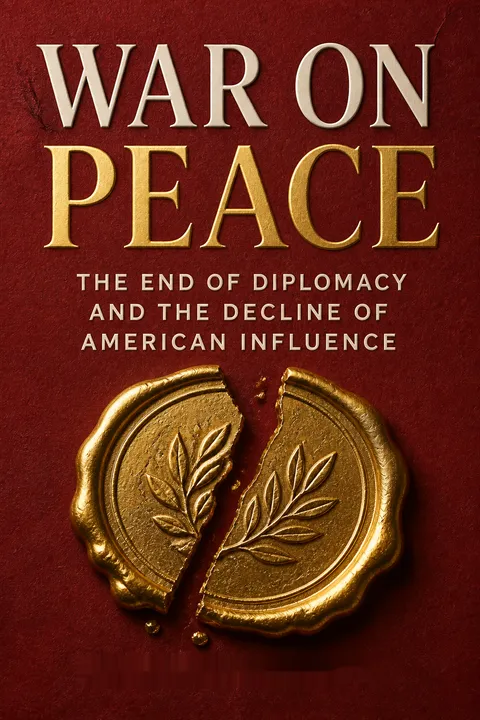


Key Takeaways
Treat diplomacy as national security, not a ceremonial alternative to force.
A mission interrupted. In January 2017, veteran arms-control diplomat Thomas Countryman was in Jordan for talks on nuclear risks when he learned that his career was ending. He had spent 35 years negotiating across administrations, yet was removed just before a major international meeting. His dismissal opens a larger argument: diplomacy is not polite conversation added after the serious work. It is a way to prevent threats from becoming wars and to make military power serve a political goal.
Capacity is strategic. The book traces how American policy increasingly shifted authority and resources toward the military and intelligence agencies, while civilian diplomacy lost staff, expertise, and influence. Farrow argues that this imbalance is a choice, not an unavoidable feature of a changing world.
What's striking is the contrast between the urgency of Countryman's work and the apparent ease with which his expertise could be discarded. Diplomacy resembles preventive maintenance: its value is often invisible precisely when it is working. That makes it politically vulnerable, since the benefits are counterfactual, a crisis that never happens cannot be photographed. The argument is strongest when it treats diplomats as a complement to military power, not its moral substitute. Negotiation can fail, and force can sometimes be necessary, but a state that stops investing in alternatives narrows its choices before a crisis begins.
Restore diplomatic capacity before the next crisis makes its absence costly.
The retreat began earlier. The book challenges the idea that the Trump administration alone created the State Department's decline. During the 1990s, the international affairs budget fell by about 30 percent, and the United States closed consulates and USAID missions just as new states emerged after the Cold War. By September 11, 2001, the State Department was roughly 20 percent below its staffing needs.
Emergency funding had strings. After the attacks, resources returned, but much of the increase was tied to counterterrorism. Development and other civilian work stagnated while defense spending soared. World War II offers a contrast: facing an existential challenge, the Department tripled its workforce and modernized its planning. The lesson is not to preserve every old procedure. It is to reform institutions before they are needed, rather than improvise after expertise has vanished.
Institutional knowledge behaves like option value: it may look idle in calm periods, yet it expands the choices available when events change. Diplomacy also depends on accumulated relationships and language skills that cannot be purchased instantly through consultants. This is a familiar problem in public administration, where efficiency measures can erase capabilities whose benefits arrive years later. Still, institutional preservation should not become a defense of bureaucracy for its own sake. The book's own examples of slow processes and turf battles point toward a harder task: build a leaner service without confusing fewer people with greater readiness.
Keep generals from owning political problems that military force cannot settle.
Tactics can crowd out strategy. In Iraq, the Pentagon took a leading role in reconstruction, despite State Department warnings about the difficulty of governing a country after invasion. The Iraqi security forces were disbanded, leaving hundreds of thousands of armed men without jobs. Some American reconstruction funds later reached insurgents. The episode illustrates the danger of treating battlefield competence as a substitute for political understanding.
Afghanistan echoed Vietnam. Richard Holbrooke warned that counterinsurgency, a strategy combining security operations with efforts to win local support, could not succeed against insurgents with safe havens across the Pakistani border. Yet the Obama administration's review centered on troop numbers and military advice. The military can create room for a political settlement, but it cannot decide what settlement is legitimate or make an unreliable partner share American aims.
The book's core distinction is between winning operations and resolving conflicts. In organizational terms, this is a problem of mission fit: an institution excels at the tasks for which it is trained, then may mistake those tasks for the whole problem. Military planning can supply discipline and logistics, but legitimacy, bargaining, and governance require other expertise. The caution is not that generals should be excluded from policy. Military advice is indispensable. The danger appears when the institution with the greatest budget and clearest chain of command becomes the default owner of every question, including those it cannot answer.
Treat proxy allies as temporary leverage, never as dependable institutions.
A useful ally can be dangerous. After 9/11, American special forces partnered with Afghan warlord Abdul Rashid Dostum to defeat the Taliban in the north. The battlefield gains were rapid, but Dostum's history of abuses and shifting loyalties did not disappear. Investigators later found a mass grave near his stronghold. Estimates of prisoners killed during transport ranged from more than 1,000 to nearly 2,000, while the extent of American knowledge remained contested and official inquiries produced little public clarity.
Somalia repeated the pattern. The CIA backed warlords against Somalia's Islamic Courts Union, weakening a force that had brought some order to the capital. The resulting invasion by Ethiopia helped radicalize opposition and expand al-Shabaab. In both cases, the short-term partner strategy weakened alternatives and left violence behind. Tactical cooperation can help win a battle, but it does not automatically create a legitimate political order.
This is a classic principal-agent problem: a sponsor hires a local actor to pursue a goal, but the actor has separate interests, local knowledge, and far less accountability to the sponsor's public. The military advantage is real, especially when local forces can operate where outsiders cannot. The hidden cost is that their behavior becomes associated with the sponsor, even when control is weak. A sound partnership therefore needs more than shared enemies. It needs oversight, political alternatives, and a plan for reducing dependence. Otherwise the partner's incentives become the policy by default.
Require strategic alignment, not just tactical cooperation, from powerful partners.
Pakistan's partnership was transactional. During the Soviet war in Afghanistan, the United States relied on Pakistan to distribute weapons to Afghan fighters, overlooking Pakistan's nuclear program and its support for hard-line groups. When the Soviets withdrew, American assistance was abruptly cut. After 9/11, Pakistan again became essential, but its intelligence service continued to support Taliban factions while cooperating with the United States against others.
Money did not resolve mistrust. By the book's account, the United States had provided Pakistan $19.7 billion in military and civilian assistance after 2001. Yet officials often avoided pressing Pakistan on abuses or militant safe havens, fearing damage to counterterrorism cooperation. The relationship delivered specific services, but its underlying goals remained at odds. A partnership built around transactions can look stable until the next disagreement reveals that the parties never agreed on the destination.
The case makes a useful distinction between cooperation and alignment. Two governments can collaborate on a narrow task while holding incompatible ideas about the regional order they want. That is not necessarily hypocrisy; states routinely bargain across differences. The risk comes when policymakers describe limited cooperation as a broad alliance and then design strategy around the stronger claim. Credible agreements require clarity about what each side will do, what happens when promises fail, and which interests are genuinely shared. More funding can expand access, but it cannot by itself convert divergent incentives into common purpose.
Open talks with adversaries while pressure still creates a reason to bargain.
Contact is not surrender. Holbrooke's team pursued a secret 2010 meeting with a Taliban representative, known internally as A-Rod. The Taliban raised concerns about being treated as indistinguishable from al-Qaeda and asked for a political office and prisoner releases. The United States set conditions of its own. The meeting did not produce peace, but it established that an opening existed. Yet senior officials had treated high-level negotiations as taboo while focusing on military escalation.
The Iran deal shows the method's limits and promise. Years of sanctions and secret talks helped produce an agreement that accepted limited enrichment in exchange for rigorous monitoring. It addressed the nuclear issue, not Iran's entire record. Similarly, North Korea had agreed to disable a reactor during six-party talks before political support faded. Negotiation is not trust. It is a way to test whether a verifiable bargain is possible.
A negotiation is best understood as a structured experiment, not a reward for good behavior. It tests whether an adversary can deliver, clarifies the price of compromise, and gives each side information about the other's constraints. The Iran agreement illustrates how a narrow deal can reduce one risk without resolving every grievance. Critics are right that such agreements may leave dangerous behavior untouched. But refusing talks does not make that behavior disappear. The practical question is whether a limited, verifiable agreement improves the situation compared with the available alternatives, not whether it produces a perfect partner.
Give negotiators authority, access, and time to turn contact into agreement.
Dayton had a mandate. In 1995, Holbrooke led negotiations among the leaders of Bosnia, Croatia, and Serbia. He had broad authority from Washington, kept the parties together at an air base in Ohio, and could point to NATO force as support for the diplomatic effort. The resulting agreement was deeply imperfect, but it ended three and a half years of war.
Afghanistan had no equivalent backing. Holbrooke wanted a regional settlement involving Pakistan and other neighbors, and argued for opening talks with the Taliban. He was sidelined during the Obama administration's troop review, lacked direct access to the president, and faced opposition from military and White House officials. His abrasive style and ambition made allies harder to keep. Still, the contrast matters: a negotiator cannot deliver a settlement when the government limits the mandate, withholds access, and treats diplomacy as a side project.
The Dayton comparison highlights a basic feature of bargaining: an envoy needs both authority to make commitments and confidence that the home government will honor them. Without that credibility, counterparts can wait, exploit divisions, or refuse to invest in talks. Holbrooke's case also complicates the hero narrative. Personal brilliance can open doors, but an abrasive operator may create resistance that weakens the mission. Successful diplomacy is therefore institutional as well as individual. A capable negotiator matters, yet so do clear instructions, a stable team, and a political leader willing to own the result.
Pair arms with civilian investment, or aid can purchase obedience without trust.
Egypt's aid bought access, not control. The United States had supplied Egypt with about $1.3 billion in military assistance each year since 1987. After the army removed elected president Mohamed Morsi, American officials urged restraint before security forces killed hundreds of protesters at Rabaa Square in 2013. The military relationship and the aid did little to change the outcome. Washington struggled to impose meaningful conditions because it feared losing cooperation on regional security.
Colombia offers a qualified contrast. Plan Colombia began with a heavy military emphasis and serious human costs, including killings of civilians falsely presented as guerrillas. Over time, the program placed greater weight on civilian institutions and development. Kidnappings and killings fell, and peace talks advanced. The cases do not prove that aid reliably builds legitimacy. They suggest that arms alone rarely do, and that civilian investment, local knowledge, and political reform need to be part of the design.
Foreign assistance is not a simple purchase of influence. In political science, leverage depends not only on the amount of aid but on the recipient's alternatives, the donor's willingness to impose costs, and the credibility of stated conditions. Egypt's access to other funders and Washington's own security priorities weakened its leverage. Colombia's longer, more integrated effort shows why aid needs institutional aims beyond equipment delivery. Yet even that case warns against easy success stories: better security indicators can coexist with grave abuses. Evaluation must track who benefits, who bears the risk, and whether civilian institutions become stronger.
Investigate allied abuses even when the evidence threatens a useful relationship.
Silence protects the wrong incentives. In Pakistan, human-rights advocates documented extrajudicial killings by security forces. American officials softened the language and avoided public confrontation while depending on Pakistan for counterterrorism cooperation. Journalist Umar Cheema, who reported on military abuses, was abducted and beaten. The case shows what happens when a relationship's security agenda leaves no room for accountability.
Afghanistan's mass grave became a test of institutional honesty. Physicians for Human Rights investigators found bones and clothing in the Dasht-i-Leili desert after prisoners captured by Dostum's forces disappeared. American agencies and later White House inquiries did not provide a full public accounting, and the grave was disturbed before a complete investigation. The book does not establish exactly what American personnel knew. It argues that refusing to investigate made it harder to establish the facts, protect witnesses, or prevent future abuses.
Accountability is not merely a moral add-on. It is a way to improve information quality and correct incentives. When officers or local partners expect abuses to be ignored, reporting systems become less reliable and strategic assessments become more vulnerable to self-deception. The book's caution about the grave is especially important because uncertainty should invite investigation, not automatic accusation or exoneration. At the same time, investigations can be misused as political weapons, so they need transparent standards and due process. The real choice is not between loyalty to an ally and fairness to victims. It is whether a partnership can withstand scrutiny.
Keep expertise in the room, or competitors will write the rules.
Vacancies carry geopolitical costs. During the first year of the Trump administration, major State Department roles remained unfilled, hiring slowed, and a proposed budget sought cuts of roughly 27 percent. Experienced diplomats worried that language skills, regional knowledge, and institutional memory were being lost. In one example, a senior diplomat in Beijing resigned after being asked to communicate the United States' withdrawal from the Paris climate agreement.
Other powers fill openings. Farrow points to China's growing development spending, infrastructure projects, and expanding role in United Nations peacekeeping as signs that American retreat creates room for competitors. China is not presented as a benign replacement; it has its own interests and human-rights record. But diplomacy shapes who sets agendas and builds relationships. When the United States removes its own people and programs, it does not create a neutral space. It makes influence available to whoever continues showing up.
Power is partly relational: it depends on who is present, informed, and able to make a credible offer. This is why staff vacancies and aid cuts can matter beyond their immediate budget lines. They reduce the country's capacity to notice changes, respond quickly, and sustain commitments across political cycles. The comparison with China is not a simple contest between good and bad actors. It is a reminder that influence accrues through repeated contact and visible investment. The challenge for Washington is to rebuild credibility without treating every embassy, program, or post as sacred. Expertise needs a clear purpose and a durable place in decision-making.
Analysis
War on Peace is best read as reported institutional history with a personal narrative at its center. Farrow connects the career of Richard Holbrooke, the fate of diplomats such as Thomas Countryman and Robin Raphel, and the author’s own work in Afghanistan and Pakistan to a broad claim: American foreign policy has increasingly substituted military relationships for civilian diplomacy, often without building institutions to replace what was lost. The book's scope is ambitious, moving from Vietnam to Pakistan, Afghanistan, Somalia, Egypt, Colombia, Iran, and North Korea. Its recurring pattern is concrete: short-term tactical gains can obscure long-term political costs, while the absence of diplomatic capacity makes those costs harder to anticipate and contain.
The argument is most persuasive when it shows mechanisms rather than merely asserting that diplomacy is better. Pakistan's security cooperation coexisted with support for militant groups. The proxy strategy in Somalia helped strengthen the very movement it sought to suppress. In Afghanistan, military success against the Taliban did not settle the question of who should govern or how to secure a durable peace. The Iran agreement demonstrates diplomacy's narrower but real capacity to reduce a defined threat without resolving every dispute. These cases make the book less a plea for softness than a warning about incomplete strategy.
Its limitations deserve attention. The book relies heavily on interviews with former officials, whose memories and reputations shape their accounts. Some counterfactual claims, especially whether earlier talks would have prevented later wars or abuses, cannot be proven. The narrative also gives diplomacy's most vivid practitioners unusual weight; Holbrooke's energy is compelling, but his unilateral style sometimes alienated colleagues, and Raphel's instinct to maintain contact could blur into accommodation. Nor can an empowered State Department guarantee sound policy. Diplomats have made consequential errors, and military force can be necessary.
The strongest conclusion is therefore institutional, not romantic. A country needs multiple tools, clear civilian authority, expert dissent, and accountability for its partners. Diplomacy cannot promise peace. But when government neglects it, the state loses the capacity to discover bargains, test assumptions, and change course before force becomes the only instrument left.
Review Summary
War on Peace examines the decline of US diplomacy and rise of militarization in foreign policy. Farrow argues this trend began under Clinton and accelerated under subsequent administrations, culminating in Trump's gutting of the State Department. The book offers insider perspectives through interviews with diplomats and officials. While praised for its research and insights, some reviewers found it lacked depth in certain areas. Overall, it's seen as an important but sobering look at the state of American diplomacy and global influence.
People Also Read






Glossary
Foreign Service
career diplomatic corpsThe United States government's professional corps of diplomats, including officers who serve in embassies, consulates, and policy roles at the State Department. Members build expertise through overseas assignments, language study, and long careers across administrations. In the book, the Foreign Service represents institutional memory and civilian capacity, but also a bureaucracy that can be slow and resistant to change.
Counterinsurgency (COIN)
population-focused warfare strategyA military and political approach to defeating an insurgency by combining security operations with efforts to protect and win the support of local populations. The book examines its use in Vietnam, Iraq, and Afghanistan, and disputes whether it can succeed when insurgents have safe havens across borders or when local governments lack legitimacy.
mil-think
military-first policy thinkingA shorthand used in the book for allowing military priorities and assumptions to dominate foreign-policy decisions. The term does not mean military advice is inherently misguided. It describes a process in which troop levels, operations, and tactical objectives crowd out political analysis, diplomacy, and civilian expertise, even when the conflict's outcome depends on those factors.
Leahy Law
restriction on abusive unitsA United States legal restriction named for Senator Patrick Leahy that bars certain forms of assistance to foreign military units when credible information shows they have committed gross human-rights violations. In the book, officials sometimes use its broad language to discuss abuses without naming particular incidents, illustrating how legal standards can both constrain assistance and be softened in bureaucratic practice.
Kerry-Lugar-Berman Act
civilian aid package for PakistanA 2009 United States law authorizing $7.5 billion in nonmilitary assistance to Pakistan over five years. It aimed to broaden a relationship dominated by security agencies and military aid. Its limited conditions triggered a backlash among Pakistani officials and commentators, while inadequate development capacity and a short timeline made the civilian program difficult to implement effectively.
false positives
civilians labeled guerrillasA term for killings in Colombia in which soldiers murdered civilians and presented them as guerrilla combatants to inflate apparent military success. Victims were reportedly lured away from home, killed, and falsely identified as FARC fighters. Investigations examined thousands of alleged cases, exposing how performance incentives and weak accountability can corrupt security operations.
clientitis
overidentification with local partnersA diplomatic concern that sustained closeness to a foreign government or society can cause an American official to adopt that partner's perspective too readily. The book raises the term in discussing Robin Raphel's long relationship with Pakistan. Close relationships can provide valuable access and understanding, but may also weaken independent judgment.
rentier state
state sustained by external paymentsA state that relies heavily on outside payments, such as foreign aid or strategic compensation, rather than building its economy and political legitimacy through domestic sources. Husain Haqqani used the concept to criticize Pakistan's dependence on American payments for its strategic location and intelligence cooperation, arguing that this arrangement strengthened military institutions while limiting incentives for reform.
Office of the Special Representative for Afghanistan and Pakistan (SRAP)
regional diplomatic coordination officeA State Department office created under Richard Holbrooke to coordinate American policy toward Afghanistan and Pakistan. Its staff included diplomats, military and intelligence liaisons, development specialists, and outside experts. Holbrooke intended it to connect agencies and broaden policy beyond counterterrorism, but its unusual authority and structure provoked resistance within both the State Department and the White House.
FAQ
What's War on Peace: The End of Diplomacy and the Decline of American Influence about?
- Focus on Diplomacy's Decline: The book by Ronan Farrow examines the decline of American diplomacy and the increasing reliance on military solutions in foreign policy.
- Historical Context: It provides a historical overview of U.S. diplomacy from the post-World War II era to the present, highlighting key events and decisions.
- Personal Stories: The narrative includes personal anecdotes from diplomats, illustrating their struggles and triumphs in a changing political landscape.
Why should I read War on Peace by Ronan Farrow?
- Insight into Foreign Policy: The book offers a critical examination of the shift from diplomacy to military intervention in American foreign policy.
- Lessons from Diplomats: It provides insights from experienced diplomats, offering valuable lessons on negotiation and dialogue.
- Relevance to Current Events: The themes are highly relevant to ongoing geopolitical tensions, providing historical context for contemporary foreign policy discussions.
What are the key takeaways of War on Peace?
- Diplomacy is Essential: Farrow emphasizes the importance of diplomacy for maintaining global peace and stability.
- Critique of Military Dominance: The book critiques the increasing dominance of military solutions in U.S. foreign policy.
- Role of Personal Relationships: It highlights the importance of personal relationships in successful diplomatic negotiations.
What are the best quotes from War on Peace and what do they mean?
- “The last of the diplomats...”: This quote underscores the importance of diplomats in maintaining global stability.
- “You don’t make peace with your friends.”: It reflects the necessity of engaging with adversaries in difficult negotiations.
- “Wars can end, peace can be forged.”: This quote highlights the potential for resolution through diplomatic means.
How does War on Peace address the U.S.-Pakistan relationship?
- Raymond Davis Incident: The book details the fallout from the 2011 incident, which strained U.S.-Pakistan relations.
- Impact of Military Actions: It discusses how military operations, like the raid on Osama bin Laden, complicated the relationship.
- Consequences for Diplomacy: Farrow argues that these events illustrate the dangers of sidelining diplomatic channels.
What role does technology play in modern diplomacy as discussed in War on Peace?
- Changing Communication Methods: Technology has transformed diplomatic communication, impacting the nuances of diplomacy.
- Information Overload: Diplomats face challenges in sifting through vast amounts of data to make informed decisions.
- Social Media Influence: Social media can amplify tensions and complicate diplomatic efforts by rapidly shifting public opinion.
How does War on Peace critique the militarization of U.S. foreign policy?
- Historical Context: The book traces the shift from diplomatic engagement to militarization, highlighting key events.
- Negative Outcomes: Farrow discusses the negative consequences, including increased violence and instability.
- Call for Balance: He advocates for a balanced approach that incorporates both military and diplomatic strategies.
What does War on Peace suggest about the future of American diplomacy?
- Urgent Need for Change: Farrow argues for a renewed commitment to diplomatic engagement and multilateralism.
- Reimagining Diplomatic Roles: He suggests that diplomats' roles must be reimagined to include broader skills and approaches.
- Hope for Renewal: Despite challenges, the book ends on a hopeful note, suggesting a return to diplomacy is possible.
How does War on Peace address the concept of American exceptionalism?
- Critique of Exceptionalism: Farrow challenges the notion by highlighting failures in U.S. foreign policy.
- Historical Examples: The book provides examples where exceptionalism justified military action over diplomacy.
- Call for Humility: Farrow advocates for a more humble approach, recognizing the complexities of international relations.
How does War on Peace illustrate the importance of regional relationships in diplomacy?
- Regional Dynamics: Understanding regional dynamics is crucial for effective diplomacy, as shown in Holbrooke’s efforts.
- Building Alliances: The book discusses the importance of building alliances with regional powers.
- Long-term Stability: Strong regional relationships can lead to long-term stability and peace.
What are the implications of the decline of diplomacy as presented in War on Peace?
- Increased Conflict: Farrow argues that the decline of diplomacy leads to more conflicts and instability.
- Erosion of Trust: Sidelining diplomacy erodes trust between nations, hindering future negotiations.
- Need for Reinvestment: Farrow calls for reinvestment in diplomatic efforts and resources.
How does War on Peace critique the Trump administration's foreign policy?
- Sidelining Diplomacy: Farrow argues that the administration undermined the State Department and sidelined diplomats.
- Militarization of Policy: The preference for military solutions over diplomacy is critiqued as leading to unnecessary conflicts.
- Impact on Global Standing: The administration's actions are said to have diminished America's global influence.
Download PDF
Download EPUB
.epub digital book format is ideal for reading ebooks on phones, tablets, and e-readers.








