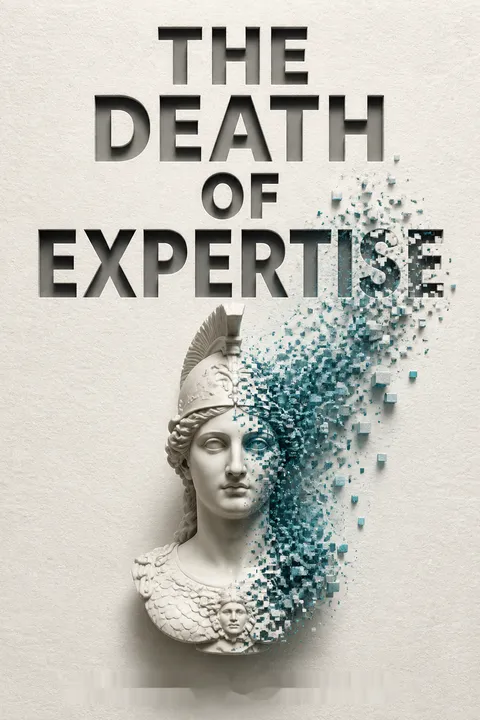


Key Takeaways
Treat expertise as shared infrastructure, not a rival to democracy.
Modern life depends on specialists. No citizen can master medicine, aviation, law, and public policy at once. Society works because people develop deep skills and rely on others to use theirs. Nichols argues that the danger is not ordinary lack of knowledge, but the conviction that every opinion deserves the same weight as tested expertise.
Confidence can outpace knowledge. In South Africa, President Thabo Mbeki embraced the unsupported claim that HIV did not cause AIDS and resisted treatment. Researchers estimated that the resulting delay cost more than 300,000 lives. In a 2014 US poll about Ukraine, only one in six people could locate the country, yet the least-informed respondents were especially eager to support military intervention. Ignorance did not stop people from taking consequential positions.
The useful distinction is between equal civic standing and equal command of a subject. Democratic equality gives people equal rights and votes, not identical knowledge. Expertise is best understood as shared infrastructure: it expands what a society can do without requiring each person to become a specialist. That reliance still needs safeguards. A credential should not grant anyone unchecked authority, and expert advice should remain open to scrutiny, explanation, and challenge.
Choose experts by relevant training, practice, and peer scrutiny.
Expertise has several markers. Nichols describes it as a combination of education, aptitude, experience, and recognition by others in the same field. Credentials help distinguish trained practitioners from hobbyists, but they are only a starting point. A degree does not guarantee talent, and experience matters most when it includes continued learning and a record of competent work.
Practice builds perception. Nichols recalls Soviet specialist Marshall Shulman, who could notice meaningful shifts in the formulaic language of Soviet newspapers after years of reading them. What looked like intuition was accumulated pattern recognition. Peer review, licensing, and professional oversight provide another check: they cannot guarantee flawless work, but they help test claims against shared standards rather than relying on a person’s confidence alone.
This account treats expertise as a social achievement, not a badge one awards oneself. Training develops skills, experience refines judgment, and peer scrutiny creates a correction mechanism. The combination matters because each signal can fail on its own: credentials can be weak, experience can stagnate, and professional groups can protect insiders. A sound judgment therefore asks not only who has a title, but whether the claim fits that person’s specialty and whether other qualified people can examine the work.
Before defending a belief, name what evidence could change it.
Bias distorts ordinary reasoning. Confirmation bias is the tendency to seek and accept evidence that supports existing beliefs while dismissing evidence that challenges them. The Dunning-Kruger Effect describes how people with weak performance in a particular area can overestimate their competence, partly because they lack the metacognition needed to recognize their own mistakes. Metacognition is the ability to assess one’s own thinking and skill.
Confidence can survive correction. In one survey discussed by Nichols, roughly 90 percent of respondents claimed some familiarity with at least one invented technical term. People also misjudge risk by remembering vivid examples, such as plane crashes, more readily than the many safe flights. Conspiracy theories intensify the problem when evidence, missing evidence, and contradictory evidence can all be treated as confirmation.
A practical test is to ask, before an argument, what observation would count against a favored explanation. If the answer is nothing, the belief has become insulated from learning. This question is useful because disagreement often mixes two problems: missing information and identity protection. Correcting a factual error may help with the first, but it can feel like a personal attack when a belief signals political or moral belonging. Good discussion separates the claim from the person making it.
Make a degree prove learning, not merely attendance and tuition.
College access is not the problem. Nichols credits expanded higher education with opportunity and social mobility. His concern is that many institutions sell a pleasant college experience while treating students as customers, weakening the link between a degree and demonstrated learning. Credential inflation adds to the confusion: more institutions offer advanced-sounding degrees, even when their resources and academic standards vary widely.
Grades can flatter rather than teach. By 2016, grades in the A and B range accounted for more than 80 percent of grades across subjects, according to figures cited in the book. Students also evaluate instructors, creating pressure to keep courses and grades pleasing. When a high grade becomes routine, it tells employers and graduates less about what a student can actually do.
The strongest version of this argument is about incentives, not nostalgia for an era when college was reserved for a privileged few. Wider access can be valuable while consumer-driven practices dilute what credentials communicate. At the same time, degrees vary for legitimate reasons, and vocational education is not inferior simply because it has a different purpose. The key question is whether a program teaches transferable knowledge and disciplined thinking, then assesses those abilities honestly.
Use search engines to locate evidence, not to certify knowledge.
More information is not the same as understanding. Sturgeon’s Law is the observation that most of the material in any large field is poor quality. Nichols applies it to the web, where useful research sits beside misinformation, advertising, and conspiracy theories, often displayed without a reliable referee. Search results make information easy to find, but finding a page is not the same as judging its source or understanding its argument.
Searching can inflate confidence. A Yale study described in the book found that people who searched online came away thinking they knew more, including about topics they had not searched. A separate study found that users often skim headings and abstracts rather than reading closely. Social platforms and search rankings can also make popularity or visibility look like evidence of reliability.
Digital search can genuinely extend memory and make research faster, especially for someone who already knows how to evaluate sources. The danger is confusing access with mastery. A useful habit is to trace a claim to its original source, check whether that source has relevant expertise, and look for independent confirmation. The screen can serve as a map to knowledge, but it cannot do the work of weighing evidence on the reader’s behalf.
Let crowds audit facts, not vote on complex causes.
Crowd judgment has a proper scope. The wisdom of crowds is the principle that combining many independent estimates can produce a better answer than relying on one person, especially for questions such as estimating an object’s weight. It does not mean every member of a crowd is an expert, or that a popular opinion can settle a difficult scientific or policy question.
A crowd can still catch a concrete error. In 2004, online readers noticed that documents used in a CBS report about George W. Bush’s military service appeared to use a typeface associated with Microsoft Word, which did not exist when the documents were supposedly created. The network investigated and withdrew the story. That is different from asking a crowd to determine why a crisis happened or what a country should do about it.
Crowds are strongest when members contribute independent information to a bounded task with a checkable answer. They are less reliable when the task requires causal explanation, specialized interpretation, or choices among competing values. Online participation can reveal overlooked evidence, as the CBS case shows, but a viral consensus can also amplify shared assumptions. The important question is not whether a crowd or expert wins in general, but what kind of problem is being solved.
Choose reporting for verification, not the emotional satisfaction of its angle.
News abundance can conceal weak reporting. Competition for clicks and constant updates rewards speed, novelty, and entertainment, while reporters have less time to build subject knowledge. In one experiment, journalist John Bohannon invented a researcher, a health institute, and a flimsy study claiming chocolate aided weight loss. News outlets around the world repeated the result without checking it with scientists.
A true statistic can still mislead. Reports about 22 veteran suicides per day often suggested that combat service explained the rate, while omitting context about the population counted and suicide trends in the wider public. Consumers can improve their odds by comparing outlets, checking the writer’s expertise, tracing claims to sources, and noticing whether a publication corrects errors openly.
Journalistic failure is not only a problem of individual carelessness. Newsrooms operate under commercial and technological pressures that reward fast, attention-grabbing material, while complicated stories take time to verify. That structural account does not excuse false reporting, but it helps explain why a confident headline is not a guarantee of reliable knowledge. Readers can resist the incentive loop by rewarding careful work with attention, rather than treating every story as a prompt for instant reaction.
Treat expert failure as a reason to audit, not abandon expertise.
Errors have different causes. Experts can make ordinary mistakes while research is developing, stretch beyond their field, forecast poorly, or commit fraud. These failures deserve different responses. An incorrect conclusion is not automatically misconduct, and one flawed study does not erase the accumulated evidence from a field. When research is challenged, professional scrutiny and correction are part of how knowledge improves.
Good judgment includes revision. Eighth grader Rebecca Fried used newspaper archives to show that an established historian was wrong about anti-Irish hiring signs. Philip Tetlock’s study of forecasts also found that flexible thinkers, described as foxes, tended to do better than hedgehogs who relied heavily on one central framework. Experts should disclose uncertainty, track their records, and correct errors; citizens should not demand impossible certainty.
The distinction between fallibility and uselessness is central. A missed prediction can expose a faulty model without proving that an untrained observer understands the issue better. Still, experts should not use the complexity of their work as a shield against accountability. Public trust grows when specialists identify what they know, what remains uncertain, and what changed their minds. The best defense of expertise is not a claim to infallibility, but a visible capacity for correction.
In a pandemic, politicized uncertainty can kill as surely as a virus.
COVID exposed an already fragile relationship. By the end of 2023, the United States, with about 4 percent of the world’s population, accounted for more than a fifth of reported COVID deaths. A nonpartisan review group estimated that American failures added at least half a million deaths. The vaccine developed through Operation Warp Speed was a major scientific success, but political leaders and public messaging often undermined the response.
Changing advice needed clearer explanations. Experts initially misunderstood airborne transmission and gave confusing guidance about masks, partly amid concern about shortages for health workers. Some politicians minimized the danger, while some public health decisions, including prolonged school closures, became entangled with partisan conflict. Scientific conclusions changed as evidence accumulated, but inconsistent communication made normal revision look like deception.
A crisis demands both technical advice and legitimate political judgment. Scientists can assess risks, but elected leaders must explain tradeoffs, set policy, and accept responsibility for choices. The pandemic shows how trust erodes when experts appear to make political exceptions or when officials conceal uncertainty to manage public reaction. Clear communication should distinguish what is known, what is provisional, and who has authority to decide. Neither blind obedience nor blanket distrust is an adequate civic response.
Learn enough to govern, or expertise will fill the vacuum.
Citizens need literacy, not omniscience. Nichols distinguishes the knowers, experts who study a subject, from the deciders, elected officials who choose policy. Experts advise; representatives make decisions and answer to voters. Citizens do not need to master every issue, but they do need enough knowledge to judge leaders and understand the consequences of their choices.
Small factual gaps can derail debate. Americans commonly estimated that foreign aid consumed about a quarter of the federal budget, though it was less than 0.75 percent; only 5 percent knew the approximate amount. People may reasonably disagree about foreign aid, but a debate built on a false estimate cannot clarify the real choice. When citizens disengage, experts gain power by default, not because democracy deliberately chose rule by specialists.
The civic standard here is demanding but achievable: learn enough to recognize the question, identify credible advice, and hold decision-makers responsible. That does not require every voter to become a policy analyst. It does require institutions and experts to make complex issues intelligible rather than treating the public as a nuisance. Skepticism remains essential, especially where expertise has failed, but skepticism becomes self-defeating when it refuses to distinguish evidence from preference.
Analysis
Nichols’s central contribution is to frame expertise as a relationship among citizens, specialists, and institutions, rather than as a contest between smart elites and an ignorant public. Complex societies depend on distributed knowledge. A person may not understand how vaccines are tested or how a national budget works, yet still rely on those systems every day. The democratic problem begins when reliance is mistaken for subordination, or when political equality is taken to mean that every factual claim deserves equal authority.
The book is strongest when it shows how several forces reinforce one another. Cognitive biases make correction uncomfortable. Digital platforms reward confident reactions. Commercialized universities and newsrooms weaken signals of quality. Political actors then convert distrust into loyalty. COVID is a powerful case study because scientific uncertainty, emergency decisions, and partisan identity collided in public view. It also exposes an important limit: a confusing change in guidance may reflect genuine learning, poor communication, or institutional self-protection. Those causes cannot be collapsed into one accusation.
Nichols’s polemic risks making the defense of expertise sound like a defense of status. That risk matters because citizens have legitimate reasons to distrust institutions that have failed, excluded them, or hidden mistakes. Credentials establish a starting presumption, not a final verdict. Trust should be earned through transparent methods, clear limits, correction, and accountability. Equally, public participation should not be reduced to an individual’s right to reject inconvenient evidence.
The book’s most useful implication is therefore procedural: create a public culture in which experts explain their reasoning, elected leaders own policy choices, and citizens evaluate claims with humility. Democracy does not require universal mastery. It requires citizens to recognize where their knowledge ends, and institutions to make expertise answerable without pretending that every opinion is equally informed.
Review Summary
The Death of Expertise receives mixed reviews, with readers praising its timely analysis of the declining trust in experts and established knowledge. Many appreciate Nichols' examination of factors like higher education, the internet, and media's role in this trend. However, some criticize the book for lacking concrete solutions, being repetitive, and occasionally biased. Readers generally agree that the book raises important questions about the relationship between experts and citizens in a democracy, though opinions vary on its effectiveness in addressing the issue comprehensively.
People Also Read



Glossary
Expertise
Specialized, tested knowledgeIn Nichols’s usage, expertise is mastery of a particular body of knowledge or skill that makes a person more likely than a non-specialist to provide accurate advice in that area. It is supported by relevant education, aptitude, experience, and recognition by peers. Expertise is limited to a domain, and it does not make someone infallible or automatically entitled to make public decisions.
Dunning-Kruger Effect
Overconfidence from limited skillA pattern identified by psychologists David Dunning and Justin Kruger in which people who perform poorly in a particular area often overestimate their ability. Their limited skill can also prevent them from recognizing errors in their own work. The effect is not a claim that every confident person is incompetent, but that accurate self-assessment itself requires abilities people may not yet have developed.
Metacognition
Assessing one’s own thinkingMetacognition is the ability to step back from one’s own performance and judge whether one understands a subject or is doing a task well. It helps a person notice gaps, recognize mistakes, and decide when to seek help. Nichols uses it to explain why someone with little knowledge may not realize that an argument is confused or that an expert has stronger grounds.
Confirmation bias
Favoring evidence for prior beliefsConfirmation bias is the tendency to seek, notice, and accept information that supports what one already believes, while discounting information that challenges it. It affects experts and non-experts alike. Because contrary evidence can be dismissed as an exception or as unreliable, the bias can make a belief difficult to test or revise, especially when the belief is tied to personal identity.
Sturgeon’s Law
Most material is low qualityNamed for science-fiction writer Theodore Sturgeon, this observation holds that most of the output in any large field is poor quality. Nichols applies the principle to the Internet: reliable research and reporting exist, but they are surrounded by a much larger volume of weak, misleading, or false material. The law warns readers not to mistake abundance or easy access for dependable knowledge.
wisdom of crowds
Aggregated estimates can outperform individualsThe wisdom of crowds is the idea that combining many people’s judgments can produce a more accurate estimate than relying on one person, particularly for bounded questions such as estimating an object’s weight. It depends on aggregating contributions, not on assuming every contributor is knowledgeable. Nichols cautions that this does not make crowds reliable judges of complex causes, scientific claims, or public policy.
equality bias
Deferring to unequal competenceEquality bias is a tendency to treat people’s contributions as equally authoritative even when participants know that their knowledge or abilities differ. Nichols discusses research in which social bonds and a desire to include everyone led more capable participants to defer to less capable ones. The instinct can preserve relationships, but it can undermine decisions when evidence and competence matter.
peer review
Colleague evaluation of researchPeer review is a process in which qualified researchers assess a study or scholarly work before publication or acceptance. Reviewers consider the quality of the evidence, methods, and conclusions, and may request changes. It can help catch errors and challenge a researcher’s assumptions, but it is not a guarantee against fraud, bias, or mistakes.
foxes and hedgehogs
Flexible and single-framework thinkersIn Philip Tetlock’s account of expert judgment, foxes draw on many ideas, consider competing explanations, and adjust their views when evidence changes. Hedgehogs rely more heavily on one organizing framework and may extend it beyond their area of knowledge. Nichols uses this distinction to explain why broad, self-correcting reasoning can outperform confident predictions built around a single theory.
conspirituality
Wellness beliefs fused with conspiracyConspirituality describes a blend of alternative spiritual or wellness beliefs with conspiracy thinking. Its adherents may believe that a hidden group controls society while humanity is undergoing a profound shift in consciousness. Nichols notes that, during COVID, this combination helped some wellness influencers spread health misinformation and draw audiences toward broader conspiratorial narratives.
parasocial relationships
One-sided bonds with public figuresParasocial relationships are feelings of familiarity or personal connection toward public figures who do not know the audience member personally. These attachments can be a normal part of fandom, but continuous access to a celebrity through media can make the bond feel unusually intimate. Nichols argues that such closeness can make a familiar personality seem more trustworthy than an unfamiliar specialist.
Knowers and Deciders
Experts advise, officials chooseNichols’s distinction separates experts who develop knowledge about an issue from elected officials who make policy choices. Experts can describe evidence, risks, and likely consequences, but they do not hold the final democratic authority to decide what a society values. Elected leaders must make those choices and remain accountable to citizens for the decisions they take.
Occam’s Razor
Start with the simpler explanationOccam’s Razor, also called the law of parsimony, is the reasoning principle that inquiry should begin with the explanation requiring the fewest unsupported assumptions. It does not prove that the simplest explanation is always true. Rather, it discourages elaborate theories when a more direct account fits the available evidence and can be tested.
FAQ
1. What is The Death of Expertise by Thomas M. Nichols about?
- Central theme: The book examines the growing rejection and hostility toward established knowledge and experts in modern society, especially in the United States.
- Threat to democracy: Nichols argues that this "death of expertise" undermines rational discourse, informed decision-making, and the stability of democratic institutions.
- Comprehensive analysis: The book explores historical, cultural, psychological, and technological factors that have contributed to the decline in respect for expertise.
2. Why should I read The Death of Expertise by Thomas M. Nichols?
- Timely relevance: The book addresses urgent issues like misinformation, anti-intellectualism, and the erosion of trust in experts, which are highly relevant in today’s world.
- Insightful analysis: Nichols provides a nuanced understanding of why expertise is being rejected, examining the roles of human nature, education, and digital media.
- Democratic importance: The book highlights the essential role of expertise in sustaining democracy and civic responsibility, making it crucial reading for anyone concerned about public discourse.
3. What are the key takeaways from The Death of Expertise by Thomas M. Nichols?
- Expertise under attack: There is a widespread and growing hostility toward experts, fueled by narcissism, misinformation, and the belief that all opinions are equally valid.
- Democracy at risk: Nichols stresses that a functioning democracy requires an informed public that respects expert advice; rejecting expertise risks democratic decay.
- Shared responsibility: Both experts and citizens must work to bridge the divide—experts by engaging more effectively, and citizens by committing to learning and critical thinking.
4. How does Thomas M. Nichols define "expertise" in The Death of Expertise?
- Combination of factors: Expertise is a recognized blend of education, talent, experience, and peer affirmation that enables someone to provide reliable knowledge in a specific field.
- Not all knowledge is equal: Experts possess significantly more knowledge than laypeople in their domain, though expertise is not infallible.
- Professional standards: True experts are held to standards like peer review, certification, and professional associations, which help maintain quality and trustworthiness.
5. What are the main causes of the "death of expertise" according to Thomas M. Nichols?
- Cultural narcissism: Modern society increasingly values personal opinion over established knowledge, leading to the belief that everyone’s view is equally valid.
- Media and internet changes: The decline of traditional journalism and the rise of social media have eroded information gatekeeping, amplifying misinformation and echo chambers.
- Educational trends: The commodification of higher education and the erosion of critical thinking skills have contributed to overconfidence and intellectual arrogance.
6. How does higher education contribute to the rejection of expertise in The Death of Expertise?
- Commodification of education: Colleges treat students as customers, leading to grade inflation and a focus on satisfaction over intellectual rigor.
- Erosion of critical thinking: Many graduates lack the ability to critically evaluate information or recognize true expertise, fostering overconfidence.
- Campus culture issues: Trends like safe spaces and speech codes sometimes prioritize feelings over reason, discouraging open debate and intellectual challenge.
7. What role does the internet and social media play in the "death of expertise" as described by Nichols?
- Information overload: The internet provides vast amounts of information, much of it low quality or false, making it hard to discern reliable knowledge.
- Illusion of knowledge: Easy access to facts creates a false sense of expertise, where superficial searches lead people to overestimate their understanding.
- Echo chambers: Social media fosters ideological bubbles and incivility, reducing opportunities for reasoned discussion and reinforcing misinformation.
8. How has journalism and media fragmentation affected expertise according to The Death of Expertise?
- Shift to entertainment: Media outlets increasingly prioritize entertainment and audience engagement over rigorous reporting, leading to sensationalism and misinformation.
- Decline of gatekeeping: The loss of experienced journalists and the rise of partisan networks have fragmented the media landscape, promoting distrust of mainstream sources.
- Confirmation bias: Consumers select sources that confirm their beliefs, deepening polarization and making it harder for experts to reach skeptical audiences.
9. What human cognitive biases contribute to the rejection of expertise in The Death of Expertise?
- Dunning-Kruger Effect: People with low ability or knowledge overestimate their competence, remaining unaware of their limitations.
- Confirmation Bias: Individuals seek out information that confirms their preexisting beliefs, dismissing contradictory evidence and making rational debate difficult.
- Equality Bias: Social dynamics can lead more competent individuals to defer to less competent ones, undermining the acceptance of expert knowledge.
10. What examples does Thomas M. Nichols use to illustrate the consequences of rejecting expertise?
- AIDS denialism in South Africa: President Thabo Mbeki’s rejection of scientific consensus on HIV/AIDS led to hundreds of thousands of preventable deaths.
- Vaccine skepticism: Celebrity misinformation and public distrust during the COVID-19 pandemic resulted in vaccine hesitancy and preventable illness and death.
- Raw milk movement and violence: The promotion of unpasteurized milk and cases of violence against experts highlight the real-world dangers of anti-expert attitudes.
11. How does The Death of Expertise analyze the COVID-19 pandemic in relation to expertise?
- Pandemic as a stress test: COVID-19 exposed and intensified the death of expertise, with distrust of science and misinformation leading to a public health crisis.
- Failures of leadership and experts: Mixed messaging and politicization by both leaders and some experts fueled confusion and resistance.
- Lasting consequences: The pandemic deepened partisan divides over science, illustrating the dangers of ignoring expertise and the need to rebuild trust.
12. What solutions and responsibilities does Thomas M. Nichols propose for experts and citizens in The Death of Expertise?
- Experts must engage: Professionals should communicate clearly, avoid jargon, and actively participate in public discourse to educate and build trust.
- Citizens must learn: Individuals have a responsibility to develop critical thinking skills, seek reliable information, and recognize the limits of their own knowledge.
- Mutual responsibility: Both experts and citizens must work together to uphold reason, evidence, and informed debate as foundations of democratic society.
Download PDF
Download EPUB
.epub digital book format is ideal for reading ebooks on phones, tablets, and e-readers.








