

Key Takeaways
False beliefs spread through the same networks that make knowledge possible.
Trust carries knowledge. Medieval scholars believed in the Vegetable Lamb, a supposed fruit containing tiny lambs. Reports from travelers and other respected witnesses reinforced one another, persuading even skeptics. The belief lasted for centuries, despite its clash with ordinary experience, until a systematic search found no such plant.
The same social route carries modern falsehoods. In 2016, a fabricated story that Pope Francis endorsed Donald Trump received about 960,000 Facebook shares and likes. The book’s central claim is not that people simply fail to think, but that beliefs travel through networks of testimony, trust, and repetition. Those networks transmit accurate discoveries, too, as when people share evidence about a health risk they could not test themselves.
The key tension is that social trust is not a defect to eliminate. Most people cannot personally verify scientific claims, so dependence on other people is unavoidable and often productive. The more useful question is how a network distinguishes independent confirmation from repetition of one original claim. Ten reports that all trace back to the same source do not provide ten independent reasons to believe. Popularity can indicate social reach, but it is not a substitute for checking where the claim came from and how it was tested.
Act on converging evidence, not an impossible demand for certainty.
Science supports decisions. In 1985, researchers at the British Antarctic Survey reported a dramatic ozone decline. NASA’s satellite data seemed to contradict them, but its software had discarded the lowest readings as impossible outliers. When scientists reexamined the data and took new measurements, they confirmed the ozone hole and traced it to chlorine released by CFCs. The Montreal Protocol followed, restricting those chemicals.
The episode illustrates why absolute certainty is the wrong standard for action. Evidence about the world is inductive: past observations cannot guarantee what will happen next. But evidence can still justify greater or lesser confidence. The authors use Bayesian reasoning, in which new evidence changes a belief’s degree of confidence, to argue for decisions based on the best available evidence rather than waiting for certainty no inquiry can deliver.
This account separates two questions that are often blurred: whether a claim is certain, and whether the evidence is strong enough to guide a decision. That distinction matters whenever delay itself has consequences. It also helps prevent uncertainty from being treated as if it always favors inaction. Still, evidence does not choose policy by itself. Decisions about regulation also involve judgments about acceptable risk, costs, and who bears them. Sound public reasoning makes those value choices visible instead of disguising them as purely scientific conclusions.
Protect independent research while evidence is still noisy.
Consensus can arrive too fast. The Zollman effect is the possibility that tightly connected researchers converge prematurely on a false conclusion because misleading results spread quickly through the group. Early evidence from E. D. Palmer appeared to show that bacteria could not live in the stomach. Many researchers abandoned the bacterial explanation for ulcers. Decades later, Robin Warren and Barry Marshall revived it, showed that bacteria could cause ulcers, and helped change treatment.
Models of scientific networks suggest a counterintuitive safeguard: when evidence is uncertain, limited communication can preserve different lines of investigation long enough for a misleading result to be challenged. Separation is not always better. Sharing results often helps groups discover what works, but total connectivity can allow one unlucky run of evidence to close off alternatives before the evidence is strong enough.
This is a valuable correction to the idea that faster agreement always means better knowledge. Scientific communities need both coordination and room for competing approaches. In research terms, this resembles the tension between exploring new possibilities and exploiting the best current option. The right balance depends on how noisy the evidence is and how costly a mistaken consensus would be. The models clarify a possible mechanism, not a universal rule: less communication can also slow the spread of a genuinely useful result.
Evaluate evidence on its merits, not by agreement alone.
Distrust can harden disagreement. In models described by the authors, researchers who trust evidence mainly from people who already agree with them can split into opposing camps. Each camp may see the other’s results yet discount them, leaving even strong evidence unable to bridge the divide. This pattern helps illuminate disputes such as the debate over persistent symptoms after Lyme disease, where patients, clinicians, and researchers have disagreed about diagnosis and treatment.
The book does not claim that every side in a dispute has equally good evidence. Rather, it warns that belief-based judgments of credibility can shut down learning. A better test asks how the evidence was gathered, whether the methods are sound, and whether results can be checked independently. A source’s position is not enough to decide whether its evidence deserves attention.
The distinction between evaluating evidence and evaluating its source is difficult in practice. Expertise, track record, and access to data legitimately affect credibility, especially when a reader cannot inspect the full research. But disagreement itself is a poor proxy for incompetence or dishonesty. Treating it as one creates a feedback loop in which every challenge confirms the group’s suspicion of outsiders. A more resilient standard makes methods and results open to scrutiny, while still allowing credible institutions to weigh evidence more heavily than unsupported assertion.
Conformity can silence evidence even when people privately recognize it.
Agreement has social costs. In psychologist Solomon Asch’s line-matching experiment, more than a third of participants went along with a group’s plainly incorrect answer at least once. The book connects this pressure to Ignaz Semmelweis, whose handwashing practice sharply reduced deaths from childbed fever but was rejected by many doctors. Accepting his explanation meant accepting that physicians could carry deadly material on their hands.
Conforming can sometimes be sensible: other people may know more, and group judgments can improve when people contribute independent information. The danger comes when agreement is driven by the discomfort of standing apart, or when people mistake others’ actions for independent proof. In these situations, a person may know what the evidence suggests but stay silent or keep acting as the group does.
Conformity is not merely a personal weakness. It can help people coordinate and can let a group combine knowledge no single member possesses. The problem is that visible agreement may conceal private doubt, making a group look more certain than it is. This is especially dangerous in institutions where dissent carries professional or social penalties. A useful safeguard is to create channels for disagreement before a decision is settled, so that speaking up is treated as part of the inquiry rather than an attack on the group.
Propaganda can distort truth by selecting real studies, not inventing data.
Cherry-picking can look scientific. After evidence linked smoking to lung cancer, tobacco companies created the Tobacco Industry Research Committee and publicly promoted doubt. The strategy did not require proving cigarettes safe. It could point to uncertainty, fund research, and highlight results that seemed to weaken the consensus. This helped delay public warnings and regulation even as evidence accumulated.
The authors distinguish biased production, in which a propagandist funds or conducts research and shares favorable results, from selective sharing, which promotes independent studies that happen to support an agenda. Small studies are particularly useful for this purpose: chance is more likely to produce a misleading result in a small sample, and a curator can publicize that result while ignoring others. No individual paper needs to be fabricated for the overall picture to mislead.
This account shifts attention from whether a study is technically real to how it is selected and presented. A single accurate finding can still create a false impression when it is detached from the full body of evidence. The same principle applies to any debate where outcomes vary across studies. Transparency about methods, funding, and publication practices helps, but readers also need summaries that show the distribution of results, not just the most dramatic outlier. The challenge is preserving genuine minority findings without letting selective attention masquerade as balanced evidence.
Track funding and research design, not merely individual honesty.
Incentives shape the field. Industrial selection is the influence of funders on which research approaches become more productive and widely copied. In a model discussed by the authors, a funder backs researchers whose methods tend to produce industry-favorable results. Those researchers publish more, train others, and gain influence, even if they are acting in good faith. The research community can shift without anyone falsifying data.
The book also describes antiarrhythmic drugs prescribed to suppress heart irregularities after heart attacks. Early studies used reduced arrhythmia as a measure of success, but later trials that measured deaths found the drugs increased mortality. The example shows how a convenient research endpoint can serve commercial interests while failing to measure the outcome patients actually care about.
This argument usefully moves scrutiny from individual virtue to the structure of incentives. People can be sincere and still participate in a system that rewards convenient measures, favors particular methods, or makes some questions easier to study than others. That is a more realistic account of institutional influence than assuming every funded scientist is bought. The counterpoint is that funding alone does not prove a result unreliable. Disclosure is a starting point, while independent replication, appropriate outcome measures, and comparison across methods provide stronger grounds for judgment.
Equal airtime can turn statistical noise into fake controversy.
Balance can distort evidence. The book argues that journalism can mislead without lying when it favors surprising findings or presents opposing views in equal measure. If most studies support one conclusion and a small minority support another, giving both sides equal space changes the apparent balance of the evidence. The tobacco industry exploited this kind of presentation to make a settled direction of research look like an open contest.
The opposite danger is real, too. Before the Iraq War, major news organizations did not sufficiently challenge the prevailing claim that Iraq had weapons of mass destruction. The authors therefore do not recommend blindly repeating consensus. They urge journalists to investigate how a controversy arose, explain the weight of the evidence, and distinguish an active scientific dispute from a contrarian view amplified for public attention.
Fairness is not the same as equal airtime. In statistical questions, the proportion and quality of evidence matter, so a format that gives every position identical space can misrepresent reality. At the same time, consensus should not become a shield against scrutiny, especially when policy depends on claims that experts or officials have not adequately tested. Good reporting has to do more than quote opposing sides: it must explain the evidence behind each position and show readers whether the disagreement is substantive, manufactured, or still unresolved.
Design networks around credible messengers, not just more information.
Connection is not trust. Russian-linked social media accounts described in the book built affinity pages around interests such as LGBTQ rights or animal welfare, then used those communities to reach people who saw the page as aligned with them. These groups could function like a star network: one central account broadcast messages to followers who were less connected to each other. Shared identity helped establish credibility before political content appeared.
The book’s proposed responses include exposing people to information beyond their immediate circles and finding trusted messengers willing to speak against their own group’s prevailing view. A conservative politician who accepts climate evidence may reach conservative audiences more effectively than a familiar opponent. Local issues can also make consequences visible, giving people direct experience to compare with claims they hear.
This section suggests that information architecture matters as much as information volume. A message’s route, source, and relationship to a community help determine whether it is heard as evidence or dismissed as an outside attack. Yet the same tactics can be used to manipulate, so trust-building cannot be treated as automatically virtuous. The durable goal is not to find a more effective persuader for every side, but to strengthen relationships and institutions in which claims can be challenged, checked, and revised without requiring people to abandon their identities.
Democracy needs informed deliberation, not votes on scientific facts.
Facts and values need different forums. The authors draw on philosopher Philip Kitcher’s idea of well-ordered science: decisions about research and policy should reflect informed deliberation among people who can understand relevant evidence and express the values affected. They contrast this ideal with vulgar democracy, where majority votes settle technical questions despite voters’ limited access to the evidence. Rule by experts alone is no better, because specialists cannot decide which social costs and priorities matter to everyone.
The practical challenge is to improve the institutions between evidence and policy. The book points toward independent scientific bodies, stronger standards for research and reporting, responsible platforms, and public discussion that takes both evidence and lived interests seriously. The goal is not to remove citizens from democracy, but to prevent misinformation from deciding questions that require expertise while keeping policy accountable to the people it affects.
The distinction is crucial: evidence can establish what is likely to happen, but it cannot determine whose interests should take priority. Treating scientific facts as a popularity contest weakens policy; treating expert judgment as a substitute for public deliberation weakens legitimacy. A democratic system needs both competent evidence assessment and meaningful participation in value choices. The authors leave institutional design open, appropriately, because the ideal of informed deliberation is easier to state than to achieve. Its practical test is whether citizens can understand the stakes and contest decisions made in their name.
Analysis
The book’s deepest move is to change the unit of explanation. Misinformation is often described as an individual failure: ignorance, bias, or gullibility. O’Connor and Weatherall instead show how ordinary processes of learning can produce collective error. People rationally rely on testimony, trust familiar sources, and update on other people’s actions. Yet when information is repeated rather than independently confirmed, when trust tracks agreement, or when social costs discourage dissent, reasonable individual responses can reinforce a false group belief.
The examples make the mechanism vivid across different settings. The Vegetable Lamb shows how repeated testimony can harden an implausible claim. The ozone story shows science correcting itself when distinct forms of measurement and evidence converge. Tobacco propaganda demonstrates that bad information need not be fabricated: selective funding, publication, and attention can skew the evidence reaching the public. Social media magnifies these problems by making distribution rapid and identity-based, but the book’s account also explains why misinformation predates the internet.
The computational models are best read as diagnostic tools, not forecasts of the exact probability that a society will be fooled. Their simplified agents isolate mechanisms, showing that network structure, conformity, and trust can matter even without irrationality or malicious intent. That strength also sets a limit: the models do not capture every influence, including institutional power, emotional attachment, and differences in who can command attention. The historical cases supply texture, but selected cases cannot establish how common each mechanism is across all disputes.
A useful response follows from that restraint. More information alone is insufficient; better systems for tracking provenance, aggregating evidence, protecting dissent, and distinguishing factual claims from value judgments are required. The democratic challenge is not to choose between experts and voters. It is to build institutions in which expertise informs public choices without taking those choices out of public hands.
Review Summary
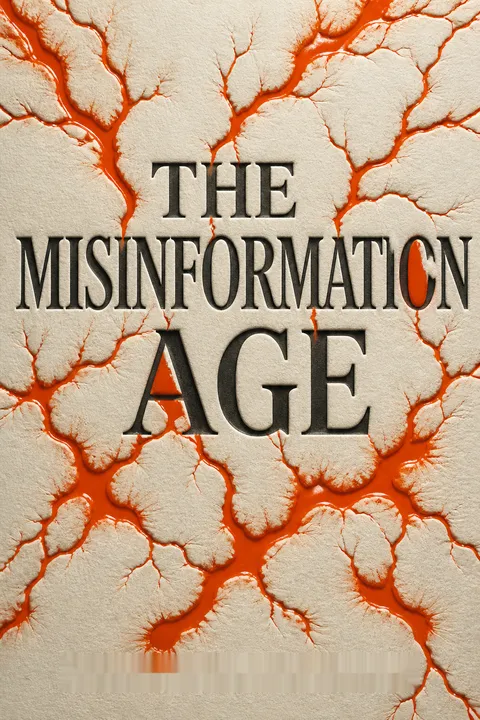
The Misinformation Age explores how false beliefs spread through social networks, even among scientists. It examines case studies like climate change denial and tobacco industry propaganda to illustrate how misinformation proliferates. The authors use mathematical models to explain belief formation and propagation. While some readers found it dry or overly academic, many praised its insights into the mechanisms behind fake news and scientific consensus. The book concludes with suggestions for combating misinformation, including reimagining democracy to be more responsive to facts and expert knowledge.
People Also Read




Glossary
Bayes’ rule
Updates confidence with evidenceA probability rule for revising a degree of belief after new evidence appears. The update depends on prior confidence and on how likely that evidence would be if the claim were true. In the book, Bayesian reasoning illustrates how people can adjust confidence without claiming absolute certainty.
Jeffrey’s rule
Updates on uncertain evidenceA rule for changing degrees of belief when a person is uncertain whether reported evidence is accurate or trustworthy. The book uses it in models where people discount information from sources they distrust, including sources whose conclusions differ from their own.
Zollman effect
Premature consensus from connectivityThe possibility that extensive communication can make a research community abandon a correct theory after misleading evidence spreads widely. Less-connected groups may preserve alternative investigations long enough for stronger evidence to emerge. The effect is most relevant when findings are noisy, not when evidence is consistently clear.
information cascade
Following others’ apparent informationA process in which people infer what others know from their visible choices, then follow those choices even when their own private evidence points elsewhere. Because each person’s action becomes evidence for the next, an early mistake can spread through a group and overwhelm more reliable individual information.
biased production
Funding favorable research resultsA propaganda tactic in which an interested party funds or conducts studies and selectively shares results that support its preferred conclusion. The studies may use real data, but the public sees a skewed sample because unfavorable findings are withheld or ignored.
selective sharing
Promoting favorable independent studiesA tactic that amplifies independent research when its findings happen to favor a propagandist’s position, while leaving contrary studies less visible. Unlike biased production, it does not require the propagandist to fund or conduct the research. It can distort public impressions even when every promoted study is genuine.
industrial selection
Funding shapes research methodsA way industry can alter science without directly corrupting researchers or falsifying results. Funding raises the productivity and influence of researchers whose methods tend to support industry interests. Their work can then shape future research through hiring, training, and imitation, changing the field’s direction over time.
conformity bias
Pressure to match the groupThe tendency to align public judgments or actions with those of a group, sometimes despite strong contrary evidence. The book distinguishes this social pressure from reasonable learning from others: conformity can suppress a person’s well-supported view because disagreement feels costly.
vulgar democracy
Majority rule over technical factsThe book’s term for treating majority voting as sufficient to settle decisions that depend on scientific or technical knowledge. The problem is not democratic participation itself, but asking uninformed votes to determine what the evidence shows. The authors contrast it with deliberation that includes both expertise and public values.
well-ordered science
Informed public science decisionsPhilip Kitcher’s ideal of science guided by deliberation among representative citizens who understand relevant evidence and can express the values affected by research and policy. It aims to avoid both majority rule uninformed by evidence and expert control detached from public interests.
FAQ
What's The Misinformation Age about?
- Exploration of false beliefs: The book delves into how false beliefs are formed, spread, and persist, particularly through misinformation and social networks.
- Historical and modern examples: It uses both historical anecdotes and contemporary cases, like fake news during elections, to illustrate belief formation mechanisms.
- Social dynamics focus: The authors emphasize that social factors, rather than just individual psychology, are crucial in how beliefs are adopted and maintained.
Why should I read The Misinformation Age?
- Understanding misinformation: The book offers insights into misinformation mechanisms, crucial in today's digital age where false information spreads rapidly.
- Practical implications: It highlights the consequences of false beliefs on decision-making, stressing the importance of critical thinking and evidence-based beliefs.
- Interdisciplinary approach: Combining philosophy, science, and social theory, it serves as a rich resource for understanding knowledge and belief complexities.
What are the key takeaways of The Misinformation Age?
- Beliefs influence decisions: The book stresses that beliefs significantly impact decisions, affecting areas like public health and policy.
- Social networks' role: It highlights how social interactions can spread both true and false beliefs, complicating truth pursuit.
- Critical evaluation need: The authors advocate for discerning information evaluation, urging readers to critically assess sources and evidence.
What are the best quotes from The Misinformation Age and what do they mean?
- “Our beliefs about the world matter.” This underscores the importance of beliefs in shaping actions and decisions, highlighting real-world consequences of false beliefs.
- “Widespread falsehood is a necessary, but harmful, corollary to our most powerful tools for learning truths.” This reflects the paradox of social learning, where mechanisms for acquiring knowledge can also spread misinformation.
- “The marketplace of ideas is a fiction, and a dangerous one.” This critiques the notion that free discourse naturally leads to truth, emphasizing vigilance against misinformation.
How do social networks influence belief formation according to The Misinformation Age?
- Information sharing: Beliefs often form based on what others in social networks believe, not just personal experience or evidence.
- Conformity effects: Individuals may conform to peers' beliefs, even when contradicting evidence, leading to persistent false beliefs.
- Echo chambers: The book highlights dangers of social media echo chambers, where individuals only encounter information reinforcing existing beliefs.
What role does propaganda play in spreading misinformation as discussed in The Misinformation Age?
- Deliberate misinformation: Propaganda creates doubt and confusion about established facts, often for political or commercial gain.
- Tobacco Strategy example: The book details how the tobacco industry used propaganda to obscure smoking health risks, showing systematic misinformation propagation.
- Impact on public perception: Propaganda significantly shapes public beliefs and policy decisions, often leading to harmful societal consequences.
What is the Zollman effect mentioned in The Misinformation Age?
- Communication pitfalls: The Zollman effect describes how increased communication among scientists can lead to consensus on false beliefs, especially with complex problems.
- Diversity of beliefs: Some belief diversity within scientific communities can be beneficial, allowing exploration of alternative hypotheses and preventing groupthink.
- Scientific inquiry implications: It highlights the importance of balancing collaboration and independent inquiry in research to avoid conformity pitfalls.
How does The Misinformation Age address the issue of trust in information sources?
- Trust dynamics: Trust in information sources is crucial for belief formation, with individuals often relying on the credibility of information sharers.
- Reputation weaponization: Reputations can be manipulated by propagandists to influence public opinion, as seen with Roger Revelle and climate change.
- Critical evaluation: The authors advocate for discerning source evaluation, emphasizing the need to consider motivations and biases of information providers.
How can individuals combat misinformation according to The Misinformation Age?
- Critical thinking: The book encourages adopting a critical mindset when consuming information, questioning sources and seeking evidence before forming beliefs.
- Engagement with diverse perspectives: It advocates for engaging with various viewpoints to avoid echo chambers and broaden understanding of complex issues.
- Promoting scientific literacy: Emphasizing scientific literacy, the authors suggest better education about scientific methods to help navigate misinformation effectively.
How does The Misinformation Age explain the spread of false beliefs?
- Social influence mechanisms: Social influence, like conformity and peer pressure, can lead to adopting false beliefs, creating echo chambers where misinformation thrives.
- Case studies: Examples like the anti-vaccine movement illustrate misinformation spread within tightly-knit communities, providing concrete evidence of theoretical claims.
- Role of media: Media platforms amplify misinformation, particularly through algorithms prioritizing engagement over accuracy, allowing false information to reach wide audiences quickly.
What methods does the author suggest for combating misinformation?
- Promoting critical thinking: Education emphasizing critical thinking skills can help individuals better evaluate information they encounter.
- Improving media literacy: Enhancing media literacy helps discern credible sources from unreliable ones, understanding how algorithms shape information landscapes.
- Encouraging diverse viewpoints: Exposing individuals to a range of perspectives can counteract echo chambers and promote nuanced understanding of complex issues.
What are the implications of misinformation for democracy as discussed in The Misinformation Age?
- Threat to informed decision-making: Misinformation undermines citizens' ability to make informed choices, essential for a functioning democracy.
- Polarization effects: Misinformation contributes to political polarization, complicating constructive dialogue and consensus.
- Call for action: Understanding misinformation mechanisms is crucial for developing effective strategies to combat it and protect democratic processes.
Download PDF
Download EPUB
.epub digital book format is ideal for reading ebooks on phones, tablets, and e-readers.








