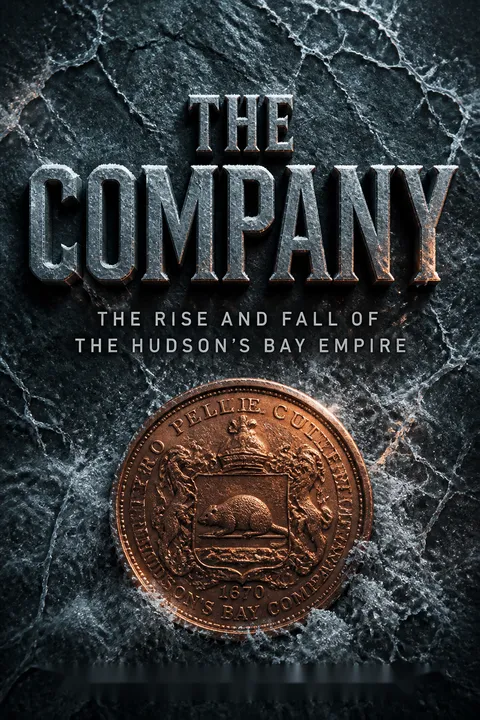


Key Takeaways
A few hundred London employees rode Indigenous networks across a continent
A daring business plan. In the 1660s, French traders Médard Groseilliers and Pierre-Esprit Radisson proposed bypassing New France and shipping furs directly from Hudson Bay to London. Their 1668 voyage on the Nonsuch proved the route could pay. In 1670, Charles II granted investors a monopoly over Rupert’s Land, a poorly understood territory of about four million square kilometres. Beaver pelts became fashionable felt hats in Europe, creating the demand that financed the venture.
A borrowed map of trade. The Company had few employees and no inland infrastructure. Cree traders brought furs to coastal posts, while Indigenous travel and trading networks carried European goods far beyond them. The Company’s reach was therefore much larger than its workforce, and depended on people whose lands its charter claimed but whose political realities London barely understood.
The striking asymmetry is between the Company’s tiny payroll and its immense geographic reach. In network terms, it did not build the system so much as attach itself to an existing one, using ships and manufactured goods to connect local exchange to European demand. That is a useful corrective to stories of empire as a one-way advance by organized states. Yet the charter’s sweeping language mattered: commercial access could become a legal pretext for claiming authority, even when the company had neither the knowledge nor the capacity to govern the territory it named.
Fur trading worked through kinship, ceremony, and credit, not prices alone
Exchange built trust. At York Factory, a trading visit could begin with formal welcomes, clothing gifts, shared meals, speeches, and a pipe ceremony. Only after these gestures of friendship and mutual obligation did individuals trade their furs. Cree trading captains organized groups and negotiated, but each family could refuse a deal if it felt insulted or poorly treated.
Credit meant commitment. The Company advanced supplies for winter hunting, expecting repayment in furs, and its traders might help partners during a bad season. Prices were often calculated in made beaver, a worn beaver robe used as a standard of value because its fur was especially useful for making felt. This was not simply a marketplace transaction. It was a continuing relationship, vulnerable to broken promises, poor-quality goods, and disrespect.
This trade resembles relational contracting: agreements work because partners expect repeated dealings, not because every obligation can be written down or enforced by a distant court. Ceremony was practical infrastructure, establishing trust across language and cultural differences. The comparison also clarifies why a seemingly small slight could damage business. Still, repeated exchange does not make power equal. The Company controlled access to imported goods and European markets, while Indigenous partners bore much of the risk of travel, hunting, and changing demand.
Indigenous brokers chose when to trade, what to trade, and with whom
Middlemen made markets. Cree and Assiniboine traders bought furs from people farther inland, then sold them at Company posts. They could protect profitable routes, set terms with distant suppliers, and decide whether to travel to the bay or sell to French traders. Anthony Henday’s journey west in 1754 showed the limits of Company persuasion: Blackfoot people declined the long trip to Hudson Bay because they already had trade goods, used horses rather than canoes, and preferred their own foods.
Diplomacy opened routes. Thanadelthur, a Chipewyan woman who escaped Cree captivity, helped negotiate peace between the groups and enabled a new northern trade relationship. Later, Chipewyan leader Matonabbee carried goods across vast distances and built influence as a broker. Neither man nor company could simply order these networks into existence.
These episodes reveal a plural economy, not a vacant space awaiting European commerce. Indigenous leaders assessed costs, defended advantages, and sometimes used rival traders to improve terms. In modern market language, brokers control access and information, which can be more valuable than owning the goods themselves. The Company’s records preserve these strategies unevenly, often through European observers. That source imbalance means apparent silence about Indigenous motives should not be mistaken for passivity.
Trade networks carried metal tools and deadly epidemics deep inland
Useful goods changed routines. Knives, axes, kettles, firearms, cloth, and sewing needles reduced the labour required for hunting, cooking, travel, and clothing. These objects spread through Indigenous trade routes far beyond Company posts. The trade also brought new economic dependence: in some communities, brokerage and access to goods gradually displaced older hunting and travel skills.
Disease travelled too. Smallpox, influenza, measles, and other infections moved inland with traders and travellers. The smallpox epidemic of 1779 to 1783 devastated communities across the interior; the account describes losses of up to 80 percent in some regions. Illness could stop hunting, leaving sick people without food or help, and deaths and displacement reshaped alliances and territory. Better tools and wider access to goods coexisted with catastrophe, not as a simple bargain but as entangled consequences.
This is a vivid case of how networks transmit more than intended products. An economic corridor can distribute tools, information, pathogens, and new dependencies at once. The epidemiological effects were intensified by distance and dispersed settlement, which made care and food sharing difficult during illness. The contrast also cautions against a simple ledger of benefits and harms: a kettle’s daily convenience cannot be meaningfully weighed against mass death, and the surviving records cannot fully recover how affected communities understood that upheaval.
Montreal competition forced the Company to abandon its coast-only business
A rival changed the rules. The North West Company, or Nor’Westers, sent traders from Montreal deep inland, where they could meet suppliers before furs reached Hudson Bay. Its working partners could make local decisions quickly and profit directly from expansion. The Hudson’s Bay Company had relied on ships and coastal forts, and for generations showed little interest in expensive inland travel.
Competition turned violent. As the rivals built posts near one another, they undercut prices, fought over customers, and increasingly used threats, raids, and liquor to secure trade. By the late eighteenth century, the Company began establishing inland posts and using York boats to move bulky cargo without relying on Indigenous carriers. The change was strategic, but it also weakened Indigenous middlemen and disrupted a trade once governed by recurring relationships and negotiated access.
The rivalry shows how organizational design shapes behaviour. A profit-sharing partnership could respond quickly to new opportunities, while a distant, salaried hierarchy moved cautiously. The Nor’Westers’ speed brought commercial growth, but competition also encouraged short-term tactics, including alcohol sales and violence, whose costs were borne by local communities. The lesson is not that competition is inherently harmful or beneficial. Its effects depend on what firms are rewarded for, what rules constrain them, and whose losses remain outside the accounts.
Mapping Indigenous routes made a vast continent legible to distant empires
Travellers supplied the knowledge. Alexander Mackenzie reached the Arctic Ocean in 1789 and the Pacific in 1793, travelling with Indigenous guides and interpreters. David Thompson later crossed the Rockies, followed the Columbia River, and assembled an exceptionally detailed map using years of astronomical observations. Their journeys depended on routes and knowledge already familiar to people living in the region.
Maps changed the scale. Once rivers, mountains, and distances could be represented on a chart, distant managers and governments could plan beyond local experience. The map made the continent seem bounded and strategically readable, supporting commercial expansion and competing British and American claims. Exploration was therefore both physical travel and a shift in perspective: the land became a space to administer and divide, even though its existing inhabitants had their own maps, names, routes, and authority.
A map is not just a picture of territory. It compresses local knowledge into a form that distant institutions can compare, store, and use for planning. That makes cartography a technology of administration as well as discovery. The section also raises a necessary question about credit: Mackenzie and Thompson produced records useful to European audiences, but their journeys relied on Indigenous guides and existing routes. The archive often magnifies the recorder’s achievement while rendering the knowledge system that made travel possible less visible.
The Red River colony turned a land grant into a war over food
Settlement threatened livelihoods. Lord Selkirk established a colony at Red River on land the Hudson’s Bay Company granted him, though Métis and Indigenous people already used the region. Its location also sat across important North West Company supply routes. The conflict sharpened when Governor Miles Macdonell issued the Pemmican Proclamation, forbidding the export of pemmican, dried bison meat and fat that fed voyageurs and sustained Métis trade.
A commercial dispute became armed conflict. Métis hunters and the Nor’Westers resisted the restrictions. In 1816, Métis leader Cuthbert Grant’s forces fought Governor Robert Semple’s party at Seven Oaks, where 21 settlers and Company employees died. The episode exposed the gap between a British company’s claim to land and the authority it actually possessed, as well as the danger of treating a food supply and a people’s livelihood as corporate property.
Pemmican was not a minor commodity. It was the fuel that kept a continent-spanning transport system moving, and the Métis economy organized around producing it. Restricting its movement therefore targeted both commercial infrastructure and local autonomy. The conflict also demonstrates a recurring error in colonial administration: treating a paper grant as if it created consent or uncontested authority. Legal claims can organize a dispute, but they cannot by themselves settle who has the right to live, trade, or govern.
Simpson’s efficiency centralized a continent and stripped people of agency
One manager imposed order. After the companies merged in 1821, George Simpson reorganized a territory of roughly 7.8 million square kilometres. He cut staffing, closed overlapping posts, tightened budgets, and used fast inspections to discipline local managers. The Company’s profits rose, and Simpson became its powerful North American governor. He treated forts, employees, and trade routes as parts of a single logistical system.
Control carried social costs. Simpson increasingly treated Indigenous customers as dependents rather than independent partners. He limited access to goods and trapping, marginalized many employees of mixed Indigenous and European ancestry, and helped shift Company attitudes toward Indigenous wives and families. His centralizing system improved efficiency for shareholders, but narrowed local decision-making and undermined relationships that had supported trade for generations.
Simpson’s achievement illustrates a management paradox: standardization can make a sprawling organization more effective while eroding the local knowledge and discretion on which it depends. His control of logistics was real, but the language of efficiency concealed political choices about whose interests counted. A further distinction matters: discipline applied to a company’s own operations is not equivalent to authority over the people whose lands and economies it occupies. Commercial success can make that distinction easier for distant owners to ignore.
Gold and settlers made the fur monopoly expendable in Oregon and BC
Settlement outran trade. In Old Oregon, John McLoughlin tried to preserve the Company’s position while aiding destitute American settlers arriving at Fort Vancouver. The 1846 Oregon Boundary Treaty placed the region south of the 49th parallel in the United States, ending the Company’s political future there. On the Pacific coast, James Douglas faced a new challenge when gold seekers began arriving in Victoria in 1858.
Roads replaced fur routes. Douglas issued mining licences, created a new British colony on the mainland, and built roads to connect the goldfields to the coast. These measures helped maintain British influence, but they also accelerated settlement and the decline of the fur business. Company forts became supply centres for miners and settlers. The organization was adapting, yet its old monopoly was no longer the main force shaping the region.
The shift from fur to settlement shows how a firm can help build the infrastructure that makes its own business model obsolete. Roads, ports, and legal administration served immediate strategic aims, but they also supported permanent communities and new industries. The story is not merely one of commercial decline. It is a change in what counted as valuable: mobile access to animal pelts gave way to land, minerals, transport, and political control. Those new priorities intensified pressure on Indigenous territories.
Canada received the Company’s territory without Indigenous consent
A transfer of immense scale. In 1870, the Hudson’s Bay Company surrendered its territorial rights to the British Crown, which transferred them to Canada. The Company received £300,000, kept many posts and surrounding lands, and gained five percent of the southern Fertile Belt. The transaction treated an enormous region as property passing between corporate and governmental authorities.
The people were excluded. Indigenous nations were not consulted in the transfer, despite having lived across and governed these lands. Métis resistance during the Red River uprising forced Canada to recognize some prior occupancy and helped bring Manitoba into Confederation. The larger question of Indigenous title remained unresolved and was pushed into later negotiations. The Company’s monopoly ended, but its maps, routes, and commercial infrastructure helped shape the country that followed.
The transfer reveals the difference between legal title within an imperial system and legitimacy among the people already living on the land. The Company’s charter helped make the region administratively visible to Britain and Canada, but it did not establish Indigenous consent. That distinction remains central to understanding how commercial institutions can become instruments of state formation. The history also resists a clean ending: the corporate monopoly disappears, while its routes, settlements, and unequal assumptions continue to shape political life.
Analysis
The Hudson’s Bay Company’s rise is best understood not as a small European firm conquering an empty wilderness, but as a commercial institution inserted into Indigenous political economies. Its ships linked London’s appetite for beaver felt to exchange networks, routes, and diplomatic customs that already crossed the continent. For much of its early history, Company success depended on Indigenous suppliers, brokers, guides, interpreters, and families. Its charter claimed territory more easily than its agents could control it.
The book’s narrative turns on a change in organizational form. A coastal company that could profit by waiting for trade became vulnerable when Montreal partners moved inland, accepted risk, and made decisions locally. Competition pushed the Company toward expansion and violence, then the 1821 merger enabled centralized management under George Simpson. Greater logistical efficiency did not simply increase output. It changed who could make decisions, who could advance within the workforce, and whether Indigenous trading partners were treated as autonomous parties or managed inputs.
The later chapters show how commerce became entangled with state-building. Exploration and mapping made routes usable by distant administrators; Red River settlement made a company land claim collide with Métis livelihoods; gold and migration shifted the value of the Pacific territories from fur to settlement and transport. The 1870 transfer was therefore not a neutral corporate exit. It converted an imperial monopoly into national territory while excluding the Indigenous peoples whose presence had made the trade possible.
A source-critical reading adds an important qualification. The narrative brings Indigenous agency into view through figures such as Thanadelthur, Matonabbee, and Cree trading captains, yet much of the evidence comes from European journals and company records. Those documents can describe negotiations in detail while leaving Indigenous interpretations less accessible. The book’s strongest insight is consequently structural: the Company’s story is not only about profit or exploration, but about how relationships, information, and legal claims shifted power over generations.
Review Summary
The Company: The Rise and Fall of the Hudson's Bay Empire receives mostly positive reviews for its comprehensive history of the HBC and early Canada. Readers praise Bown's engaging narrative style, detailed research, and balanced portrayal of Indigenous peoples' roles. Some criticize chronological jumps and occasional errors. The book is lauded for its insights into Canadian history, exploration, and the fur trade's impact. While dense, it's considered an essential read for those interested in North American history, offering a fresh perspective on the HBC's influence in shaping Canada.
People Also Read



Glossary
Rupert’s Land
Company chartered territoryThe territory claimed by the Hudson’s Bay Company under its 1670 royal charter, defined as the watershed draining into Hudson Bay. Its actual geography was initially unknown to the Company. The original grant covered about four million square kilometres; after the 1821 merger, the Company’s trading domain expanded much farther west and north.
made beaver
Fur trade value standardA unit of value used to price goods and furs in the Hudson’s Bay trade. Initially, it referred to a beaver skin worn as clothing, whose outer hairs had fallen away and whose underfur was especially suitable for felt-making. Other pelts and trade goods were assigned equivalents in made beaver, simplifying exchange across posts.
country marriage
Fur trade kinship unionA long-term union, commonly formed according to local Indigenous customs, between a Company employee and an Indigenous woman. These relationships could create kinship ties that supported trade, provided companionship, and connected families across cultures. They often produced mixed-heritage children, but their stability and mutuality varied, and some men abandoned partners when returning to Britain.
Pemmican
Portable bison travel foodA calorie-dense food made by pounding dried bison meat into powder and mixing it with rendered fat, sometimes with berries. Packed into bags, pemmican was durable and easy to transport, making it essential for voyageurs and fur brigades on long journeys. Métis hunters produced it at scale, so restrictions on its trade threatened both their livelihoods and company supply routes.
York boats
Company cargo transport boatsLarge, flat-bottomed boats adapted from a design associated with the Orkney Islands and built for the Hudson’s Bay Company’s inland transport. They carried heavy cargo and could be hauled across portages, making them useful where birchbark canoes and their materials were unavailable. Their adoption helped the Company move trade goods inland and bring furs back to Hudson Bay.
Home Guard
Indigenous fort-side communityThe term used for Indigenous people who lived near Company posts and had close, recurring relationships with the forts. They might work as hunters, guides, interpreters, labourers, cooks, or seamstresses, while also maintaining family and trading ties. Their role differed from that of more distant traders who travelled to the posts for seasonal exchange.
Character Book
Simpson’s coded personnel ledgerGeorge Simpson’s secret, coded collection of assessments of roughly 150 senior Company officers and possible managers. It recorded blunt judgments about their abilities, temperaments, and reliability. Simpson used these impressions to guide personnel decisions, but the assessments were rarely revised, so an early judgment could shape how he treated an employee for years.
About the Author
Other books by Stephen R. Bown
Download PDF
Download EPUB
.epub digital book format is ideal for reading ebooks on phones, tablets, and e-readers.








