

Key Takeaways
Private choices at court can redraw maps for people never consulted
A marriage became geopolitics. As a teenager, Isabella defied her half-brother, King Enrique of Castile, who wanted to marry her to Portugal’s aging King Afonso V. She secretly chose Ferdinand of Aragon instead. Their union strengthened her claim to Castile’s throne and threatened Portugal’s influence. Disputes over succession, including the contested legitimacy of Enrique’s daughter Juana, fed years of civil conflict and a Portuguese invasion. Isabella and Ferdinand’s forces prevailed at the Battle of Toro in 1476, and the Treaty of Alcáçovas in 1479 recognized their rule while granting Portugal important overseas privileges.
The feud outlived its actors. The rivalry between the two royal houses shaped the competition over Columbus’s discoveries. Bown’s central argument is that a domestic struggle among a handful of powerful people helped set the terms for Europe’s division of overseas territory.
What is striking is how personal relationships become consequential through institutions. A marriage mattered because inheritance rules, royal authority, and military alliances converted private decisions into state policy. This resembles path dependence: once an early choice channels institutions in one direction, later actors inherit constraints they did not choose. The story also cautions against treating history as the product of impersonal forces alone. Still, the family feud is a vivid entry point, not a complete cause. Portugal’s maritime ambitions, commercial incentives, and improving navigation made the dispute globally consequential.
Treaties turn guesses into borders, then make those borders worth fighting over
A line claimed the unknown. In 1493, Pope Alexander VI issued the bull Inter Caetera, granting Spain exclusive rights over lands Columbus had reached and other lands not yet discovered. The following year, Spain and Portugal formalized a division in the Treaty of Tordesillas. They shifted the dividing line west, placing lands to its east in Portugal’s sphere and lands to its west in Spain’s. This adjustment left room for Portugal’s African trade route and, as it turned out, put Brazil on Portugal’s side.
Maps could not settle it. Europeans did not know the full extent of the lands being divided, and navigators could not accurately measure longitude. The treaty therefore turned an uncertain geographical claim into a political and commercial rule, backed by royal power and papal authority. Its precision on paper exceeded the knowledge available at sea.
The episode shows how law can create facts on the ground, rather than simply record them. A boundary is not effective because it is accurate; it becomes powerful when institutions coordinate around it and states enforce it. Modern borders and exclusive economic zones work through similar combinations of maps, legal language, and enforcement, though not under a pope’s authority. The treaty’s instability also highlights a basic problem of governance: rules built on incomplete information can create durable expectations before anyone understands their consequences.
Columbus reached land by selling confidence built on bad geography
The proposal fit the moment. Columbus argued that sailing west would reach Asia. His calculations drew on geographic authorities who underestimated the earth’s size and on Marco Polo’s accounts of Asia, which he interpreted to make the Atlantic seem short. He put the crossing at about 2,400 miles, far below the actual distance to Asia by that route. Portuguese experts rejected the plan, in part because they judged the ocean crossing too dangerous and Portugal was already pursuing a route around Africa.
Spain had reasons to gamble. After Granada fell in 1492, Ferdinand and Isabella had a victorious but expensive campaign behind them, and experienced soldiers seeking opportunity. They approved Columbus’s voyage, which left Spain in August with three ships. His ships found Caribbean islands, not Asia. His success depended not on accurate geography, but on a viable route through Atlantic winds and royal sponsors willing to take the risk.
This is a useful case study in the difference between a correct conclusion and a sound argument. Columbus was wrong about the distance and destination, yet his voyage succeeded because his assumptions happened to meet an overlooked continent and a favorable wind system. Innovation often advances through imperfect models, but that does not make selective evidence harmless. Decision-makers benefit from separating confidence, evidence, and the value of an experiment. In this case, political ambition supplied the resources that an academic consensus would not.
Read religious justifications alongside the wealth they authorize
Faith and profit travelled together. Portuguese expansion along Africa began with stated aims that included finding a Christian kingdom and spreading the faith, but the trade also pursued gold, spices, and enslaved people. Papal bulls granted Portugal rights over lands and seas in Africa and authorized the enslavement of non-Christians. The Spanish and Portuguese claims to overseas rule likewise joined conversion to conquest: religious language helped present territorial control as a spiritual responsibility.
The human cost was enormous. Columbus described Caribbean people as potential workers and captives. Spanish conquest, forced labour, and imported disease devastated Indigenous communities. The text reports that disease killed as much as 90 percent of the population in some regions. Some church figures challenged abuses, and a 1537 papal declaration affirmed Indigenous people’s liberty and property rights, but condemnation did not end enslavement or extraction.
The section invites a careful distinction between stated motive and institutional effect. Religious conviction could be sincere while also legitimizing systems that transferred land, labour, and wealth to rulers. This is not unique to religion: states often frame material projects in moral language that makes them easier to defend. A useful test is to ask who gains authority, property, or revenue when a policy is described as benevolent. The account also demands care with scale: disease, warfare, and coercive labour interacted, and none should be used to obscure the others.
Magellan's circumnavigation exposed how little the treaty's mapmakers knew
The world was larger than expected. In 1519, Ferdinand Magellan led five ships west from Spain, seeking a route to the Spice Islands through territory he believed lay in Spain’s half of the world. The fleet found a strait at the southern end of the Americas and entered the Pacific. Magellan died in the Philippines; only the Victoria completed the return voyage, reaching Spain in 1522 with eighteen of the roughly 250 men who had departed. Its cargo of cloves covered the expedition’s costs.
The boundary remained uncertain. The voyage proved that the Pacific was vastly larger than European estimates suggested and that circumnavigation was possible, though not commercially easy. Spain and Portugal continued disputing the Spice Islands because longitude could not be measured accurately. In 1529, the Treaty of Zaragoza assigned the islands to Portugal in exchange for 350,000 gold ducats to Spain.
The voyage makes the gap between a map and a world impossible to ignore. Its navigators had enough knowledge to cross oceans, but not enough to calculate their position with precision or anticipate the Pacific’s scale. This is a recurring feature of technological change: new capabilities can outrun the measurement systems needed to govern them. The expedition also warns against confusing proof of possibility with proof of practicality. Circumnavigation became imaginable, but the losses reveal how different a demonstration voyage is from a sustainable route.
A monopoly invites smuggling, piracy, and rival legal claims
Control raised the cost of trade. Spain regulated colonial commerce through the Casa de Contratación, which licensed ships, collected taxes, and directed trade through Seville. The system aimed to preserve royal revenue, but its layers of duties and bureaucracy made goods expensive. The text gives the example of merchants in Potosí paying nearly forty times European prices for some manufactured goods. Foreign traders could undercut those prices, while colonial merchants had strong reasons to buy from them and smuggle bullion out.
Enforcement turned commerce violent. English mariner John Hawkins sold enslaved Africans and traded in Spanish Caribbean ports despite the ban. Francis Drake attacked Spanish shipping and settlements. Their voyages combined profit with defiance of the Iberian monopoly. As Protestant powers rejected papal authority, the old religious penalty of excommunication lost force, while piracy and privateering offered practical ways to challenge Spanish control.
The monopoly’s weakness was not simply that officials failed to police it. The rules helped create the market they were meant to suppress: high prices and scarce legal access made smuggling attractive to both suppliers and buyers. This resembles regulatory arbitrage, where people route around rules when the rewards are large and enforcement is uneven. Yet the market story should not make the violence sound like ordinary competition. Hawkins’s trade depended on enslaving Africans, and Drake’s profits came through armed seizure. Evasion could be commercially rational and still be brutal.
Open-seas arguments can serve commerce even when dressed as universal justice
A Dutch seizure became a legal argument. In 1603, Dutch captain Jacob van Heemskerck captured the Portuguese ship Santa Catarina in Asian waters. The cargo was extremely valuable, but some Dutch investors objected that a trading company should not wage war. The Dutch East India Company asked the young lawyer Hugo Grotius to defend the seizure. In 1609, Grotius published Mare Liberum, or The Free Sea, arguing that no nation could own the open oceans or deny other nations the right to navigate and trade.
Principle and interest overlapped. Grotius challenged the papal grants and the Treaty of Tordesillas as grounds for excluding other countries. His case helped shape later international law. But the Dutch company he served also sought commercial dominance. Grotius later defended Dutch efforts to exclude English rivals from parts of the spice trade, exposing the tension between universal principles and national advantage.
The strongest reading is not that Grotius’s principles were meaningless because he served Dutch interests. Rather, commercial conflict gave a universal argument both an audience and a practical use. That dual role is common in legal reform: a principle may expand rights while also benefiting the institution that promotes it. The contradiction matters because it asks whether rules apply equally to allies and rivals. Grotius’s work made the question of open navigation harder to avoid, even as the Dutch company’s conduct showed how selective its own commitment could be.
Build rules for shared spaces that powerful states cannot simply divide
The closed sea lost ground. Grotius’s case for open seas was challenged by thinkers who argued that nations could control some adjacent waters. In 1702, Cornelius Bynkershoek proposed that coastal control should extend roughly as far as a cannon could reach, a principle associated with the original three-mile limit. The emerging compromise distinguished waters a state could defend from the open sea beyond them.
The old line left visible traces. The Treaty of Tordesillas faded as Spain and Portugal lost the power to enforce their monopolies. Yet its division helped shape colonization: Brazil became Portuguese-speaking, much of Latin America Spanish-speaking, and the Philippines was colonized by Spain despite lying in the Portuguese half as defined by the treaty. The book connects the ensuing debate over maritime rights to the modern United Nations Convention on the Law of the Sea.
Shared spaces create a governance problem: unrestricted use can invite conflict, but exclusive control can deny access and concentrate benefits. The eventual distinction between coastal waters and the high seas is an institutional compromise, not a timeless natural boundary. Its legitimacy depends on broad agreement and workable rules, not only on who has the ships to enforce a claim. The historical lesson is therefore less that all seas must be entirely open than that common resources need rules that limit unilateral power while recognizing practical interests.
Analysis
1494 is a connected history rather than a conventional biography of a treaty. Bown begins with Isabella’s marriage choice, follows the rivalry between Castile and Portugal through Columbus and Magellan, and ends with arguments over maritime law. The structure makes a striking proposition memorable: a domestic dispute, amplified by dynastic politics, helped shape rules that affected exploration, trade, and empire for centuries.
Its strongest insight is that legal authority and material power reinforced one another. Papal bulls made exclusive claims appear legitimate to Catholic rulers; ships, forts, and armies made those claims enforceable. As geographical knowledge grew and religious authority weakened, excluded rivals challenged both the law and the monopoly. The result was not a clean march from imperial domination to freedom. English and Dutch critics of Iberian exclusivity also pursued their own monopolies, and the book’s account of Grotius makes that contradiction especially clear.
The narrative is persuasive because it treats contingency seriously. Columbus’s mistaken estimate, Isabella’s defiance, João II’s bargaining, and Magellan’s voyage each changed what rulers thought possible. Yet the family feud is an organizing lens, not a sufficient explanation. Atlantic wind patterns, ship design, commercial demand, state finance, and military capacity were necessary for the initial rivalry to expand into global competition. Without those conditions, the personal quarrels would likely have remained local.
The book’s most important moral tension concerns whose interests its legal story foregrounds. European rulers debated which crown owned distant lands, while the Indigenous people living there had no recognized place at the negotiating table. The eventual development of maritime law constrained some forms of unilateral control, but it did not undo the conquest that the earlier claims had helped justify. The story therefore offers two lessons at once: international rules can restrain conflict, and the communities excluded from writing those rules may bear their greatest costs. Its scale is ambitious, and that synthesis makes distant events legible without making their consequences seem inevitable.
Review Summary
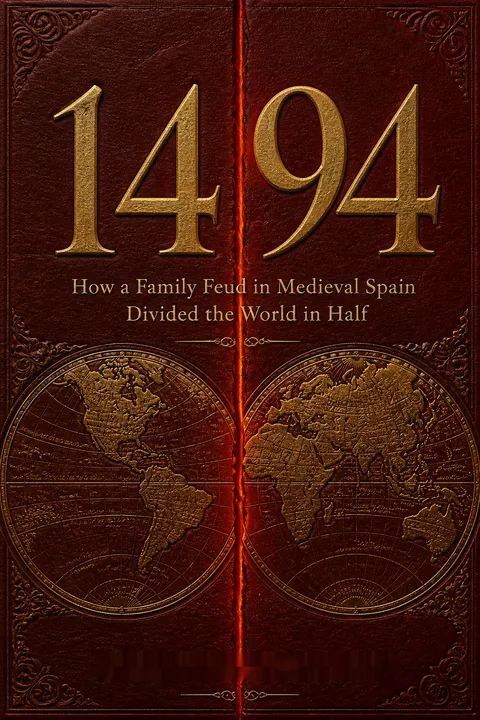
1494 by Stephen R. Bown examines the Treaty of Tordesillas, which divided the world between Spain and Portugal. Reviews are mixed (3.89/5). Critics question whether the treaty significantly impacted history beyond preventing war, calling the central thesis weak. However, most readers praise Bown's accessible, engaging writing style that brings historical figures and events to life. The book covers royal family dynamics, Columbus's voyages, and later challenges from other nations. Readers appreciate learning about lesser-known history, though some find the narrative meanders or becomes less compelling in later chapters.
People Also Read



Glossary
Inter Caetera
Papal grant to SpainA papal bull issued by Alexander VI in 1493. It granted Ferdinand and Isabella authority over lands Columbus had reached and territories still to be discovered, while restricting other Christians from trading or travelling there without Spanish permission. A second bull of the same name specified a north-south line in the Atlantic to divide Spanish and Portuguese spheres.
Treaty of Tordesillas
Spain-Portugal world divisionThe 1494 agreement between Spain and Portugal that formalized a division of overseas claims. It moved the Atlantic boundary west of the line proposed by Alexander VI, placing territory to the east in Portugal’s sphere and territory to the west in Spain’s. The agreement was made before Europeans knew the full geography of the lands and seas it purported to allocate.
line of demarcation
Boundary between imperial claimsThe north-south boundary used to distinguish the overseas spheres assigned to Spain and Portugal. The 1493 papal bull placed it a hundred leagues west of the Azores and Cape Verde Islands; the Treaty of Tordesillas shifted it to 370 leagues west of Cape Verde. Because longitude could not yet be measured accurately, its location remained disputed.
mare liberum
Freedom of the open seasLatin for “free sea,” the title and central principle of Hugo Grotius’s 1609 argument. It holds that the open ocean cannot be owned by a nation and that countries should be free to navigate and trade there. Grotius used the argument to challenge the Iberian maritime monopolies, while also serving Dutch commercial interests.
mare clausum
Nationally controlled seaLatin for “closed sea,” the position that a state can claim dominion over some maritime areas. Writers who opposed Grotius’s unrestricted concept of free navigation argued that waters near a country’s coast could fall under its jurisdiction. The debate helped produce distinctions between coastal waters subject to state control and the high seas.
Casa de Contratación
Spanish colonial trade authorityThe Spanish institution established in Seville to regulate commerce and travel between Spain and its American territories. It licensed ships and merchants, collected taxes, and directed colonial trade through official channels. The system concentrated control and revenue in the crown, but its burdensome rules and costs also encouraged smuggling.
Dutch East India Company (VOC)
Dutch Asian trading companyThe Dutch East India Company, known by its Dutch abbreviation VOC, was established in 1602 to consolidate Dutch trade in Asia and reduce competition among Dutch ventures. It also used military force against Portuguese ships and settlements. The company’s commercial ambitions helped motivate Grotius’s argument for free navigation, even as the VOC pursued its own trading privileges.
About the Author
Other books by Stephen R. Bown
Download PDF
Download EPUB
.epub digital book format is ideal for reading ebooks on phones, tablets, and e-readers.








