

Key Takeaways
Turn a prison audience into the world’s most consequential travel book
Capture became a writing room. In September 1298, Marco Polo fought for Venice at the Battle of Curzola. Genoa captured his ship and thousands of Venetians, including Marco, and brought them to prison. His captivity was not simply a tale of deprivation: prominent prisoners had some freedom and visitors, while Marco’s stories about Asia made him a local sensation.
A listener made the book possible. Marco met Rustichello of Pisa, a romance writer and fellow prisoner. Rustichello wrote down Marco’s account of his years traveling and serving Kublai Khan. The collaboration turned enforced idleness into a record of places and customs most Europeans had never encountered.
What’s striking is that the book begins not with a departure, but with a captive narrator and a receptive audience. That setting reminds readers that travel writing is made twice: first through experience, then through selection, memory, and an editor’s choices. Oral-history research similarly treats testimony as an interaction, not a transparent window onto events. Rustichello’s presence gives the account narrative force, while also making its authorship and accuracy harder to disentangle.
Use commerce to cross borders that politics and religion keep closed
Venice trained travelers to negotiate. Marco came from a city whose fortunes depended on sea trade, shipping, finance, and practical trust among merchants. Agreements such as the commenda let investors and traveling merchants share the risks and returns of a venture. Venice also required insurance for maritime trade beginning in 1253, an acknowledgment that ambition alone could not tame the sea.
Profit crossed enemy lines. Venetian merchants traded with Muslims, Jews, Greeks, and other peoples, even while Venice fought rivals for control of routes. The Fourth Crusade shows the contradiction starkly: Venetian ships helped capture Constantinople in 1204, turning a religious campaign into a seizure of wealth and strategic power. Trade connected communities, but it was never separate from force.
The book presents commerce as a practical language shared across religious and political divides. That insight anticipates the idea of interdependence: exchange can make distant societies matter to one another before they agree on beliefs. Yet trade is not automatically peaceful or fair. Venice’s commercial networks grew alongside naval coercion and plunder. The useful distinction is between connection and equality. A route can bring people into contact while leaving one side with the ships, capital, or weapons that set the terms.
Let detours become preparation, not proof the journey has failed
A failed return opened a new route. Marco’s father, Niccolò, and uncle Maffeo left Venice for trade in 1253. Political conflict and unsafe roads prevented them from returning as planned. In Bukhara, they met an envoy traveling to Kublai Khan’s court and chose to go farther east. Their delay gave them time to learn Mongol languages and gain access to the ruler.
Marco inherited the unfinished journey. After sixteen years away, his father and uncle returned to Venice and discovered that Marco, then fifteen, had grown up without knowing his father. In 1271, he joined them on their next expedition. The Silk Road, a modern name for a changing network of Eurasian routes rather than one paved highway, carried them across regions where trade, diplomacy, and danger overlapped.
The Polos’ story makes contingency look like a skill. Their plans repeatedly failed, but each delay produced local knowledge, relationships, or a safer next move. That resembles adaptive expertise: the capacity to adjust when familiar procedures stop working. Still, improvisation is not a universal remedy. The Polos had commercial resources, family ties, and eventually an imperial credential. Their flexibility mattered, but so did advantages unavailable to most travelers of their era.
Learn the ruler’s language, then make yourself useful to power
A foreigner earned a place at court. The Polos arrived with letters from Pope Gregory X and oil from Jerusalem, but Marco’s own value came from observation and communication. He learned languages and scripts, then served Kublai Khan on journeys across the empire. Marco says the ruler wanted reports about unfamiliar places and customs, not merely routine delivery of official messages. Marco took notes so he could return with more than a receipt.
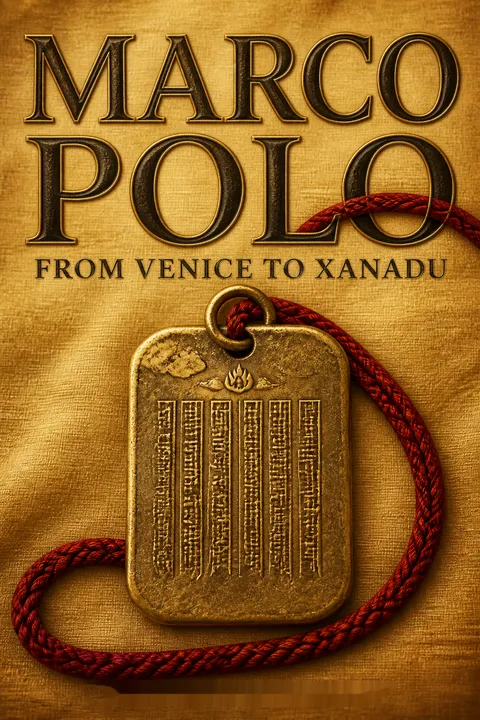
Access carried obligations. Marco spent years in the khan’s service and traveled under a paiza, a gold tablet authorizing its bearer to receive protection and provisions. It opened doors across a vast empire, but also marked the traveler as an agent of its ruler. His exceptional access gave him information few Europeans could collect, while tying his safety to Kublai’s favor.
Marco’s career shows how language and attention can become political resources. He does not merely cross a border; he learns how to be legible and useful within another government. The same dynamic appears in diplomacy and field research, where access depends on trust and reciprocity. But an insider’s view is never neutral. The person who grants access can shape what is seen, and the observer may confuse proximity to power with understanding the people governed by it.
Judge empire by the systems that move food, money, and messages
The Mongol state ran on logistics. Marco was impressed by Kublai Khan’s paper currency, which merchants could exchange for goods across the empire. He also described a relay network of stations where couriers changed horses, allowing urgent messages to travel roughly 200 miles or more in a day. These systems linked distant regions more effectively than the impressive palace alone could.
Administration could also protect lives. Kublai’s officials stored grain against shortages, distributed food to the poor, and reduced or waived taxes after disasters ruined crops or livestock. The Grand Canal helped connect the northern capital with wealthy cities farther south. Together, these examples show that empire depended on information, transport, and reserves, as well as soldiers.
The book’s strongest view of power is concrete: it follows the currency, roads, grain, and messengers that make rule possible. Political science calls part of this state capacity, the ability to collect information and deliver decisions across territory. The same systems can support relief and deepen control. A grain register may identify families needing help, while a courier network speeds military orders. Infrastructure is not inherently benevolent. Its effects depend on who directs it and who bears its costs.
Admire Mongol order without mistaking control for justice
Security was built through conquest. The Pax Mongolica refers to the relative stability and safer long-distance trade that followed Mongol expansion. For merchants, the reopened routes could be remarkably useful. For conquered populations, the same order followed devastation. Marco describes the destruction of Balkh after Genghis Khan’s forces attacked it in 1220, and records other examples of violence that made Mongol authority feared.
Tolerance had political uses. Kublai Khan employed people of different backgrounds and allowed several religions to operate in his realm. That policy helped him govern a diverse population, but it did not make the empire gentle or equal. Revolts, punishments, and court intrigues expose how precarious his rule could be. The apparent unity Marco encountered rested on military power, administrative bargains, and the ruler’s ability to keep rivals in line.
The account resists a simple verdict. Mongol rule could protect merchants, welcome varied religious communities, and still rest on catastrophic violence. Political order is often experienced differently by those who travel through it and those forced to live under it. The term Pax Mongolica can therefore conceal as much as it explains if “peace” is taken to mean consent. Marco’s perspective is especially valuable when it reveals the benefits of connection, and limited when it treats imperial stability as the whole story.
Treat unfamiliar customs as evidence about your own assumptions
Marco’s judgments changed on the road. At first, he often described non-Christian beliefs through the dismissive categories he had brought from Venice. Repeated contact with Buddhist communities complicated that view. In Tangut, he observed monasteries, rituals, and monks who practiced demanding forms of self-discipline. In India, he learned a story of the Buddha’s renunciation and compared his life favorably with that of Christian saints.
Curiosity did not erase prejudice. Marco sometimes recognized that unfamiliar practices made sense within their own traditions, but he also labeled people cruel, cowardly, or strange when they differed from his expectations. His attention to local customs expanded his understanding, yet his account continued to filter other societies through his own interests, including commerce, religion, and sex.
Marco’s changing outlook resembles cultural learning: contact can expose the limits of inherited categories without instantly removing them. His willingness to describe religious practices in detail creates room for comparison rather than simple dismissal. The caution is that curiosity can still turn people into spectacle. His recurring focus on sexual customs, for instance, often tells readers as much about his own gaze as about the communities described. Good cross-cultural observation asks who is interpreting, and whose complexity remains unseen.
Read Marco Polo as witness and storyteller, not a perfect transcript
His account mixes strong observation with embellishment. Marco reports that Hangzhou had 12,000 bridges, a figure the book treats as a conventional way of saying there were countless bridges; the actual number was far smaller. More seriously, he claims that he and his family helped win the siege of Xiangyang, although the siege took place while he was still in Afghanistan. The story cannot be accepted as eyewitness testimony.
Independent records also support him. Chinese and Persian sources confirm key details of the Polos’ mission escorting Princess Kokachin toward Persia. The Travels passed through many handwritten copies and translations, so passages could be altered, omitted, or misunderstood. The evidence calls for calibration, not an all-or-nothing choice between believing every detail and dismissing the entire journey.
This is a useful case study in historical method. A source can be unreliable in one passage and indispensable in another. Historians test claims against chronology, independent documents, material evidence, and the interests of the narrator. Marco’s self-promotion and Rustichello’s literary habits complicate the record, but they do not erase its value. The reader’s task is to separate levels of confidence: what Marco likely saw, what he heard, and what a storyteller or copyist may have added.
Marco’s account survived the Mongol empire that made it possible
Home did not restore the old Marco. The Polos returned to Venice in 1295 after roughly twenty-four years abroad. They dressed and spoke like men shaped by Mongol life, and accounts say some Venetians initially failed to recognize them. Marco’s travels were over, but his experience remained difficult to fit into ordinary Venetian life. He later fought for Venice, was captured by Genoa, and used that confinement to tell the story.
The manuscript outlasted its world. After Kublai Khan’s death, the Mongol Empire fractured, and the routes Marco had traveled grew less secure. Copies of his book circulated across Europe, informed maps, and captured the attention of later voyagers. The account preserved not only one man’s journey but descriptions of a political and commercial world that soon disappeared.
A travel account can preserve more than destinations. Marco’s narrative carries traces of the institutions, technologies, and encounters that enabled his movement, including systems that no longer existed by the time later readers used the book. Yet preservation is also transformation: scribes, translators, and readers reshaped the record to fit new expectations. The book’s endurance is therefore not a simple victory over forgetting. It is a long chain of interpretation that keeps a vanished world available, though never entirely intact.
Analysis
Bergreen frames Marco Polo’s life as a passage between worlds, but the deeper subject is the infrastructure that made that passage possible. Venetian contracts and shipping, Mongol safe-conduct, caravan stations, multilingual courts, and Rustichello’s writing all turn an individual’s movement into a durable story. Marco appears extraordinary, yet his range depends on networks built by merchants, officials, interpreters, guides, and rulers. The biography is strongest when it makes those systems visible through concrete scenes, such as the paper currency that puzzled Marco or the relay horses that carried messages across the empire.
The book also treats credibility as part of the adventure. Marco’s observations can be precise, his chronology unreliable, and his self-importance conspicuous. Bergreen’s account benefits from distinguishing corroborated episodes, such as the princess’s escort, from claims that do not survive scrutiny, such as the Polos’ supposed decisive role in the Xiangyang siege. This approach is more persuasive than trying to rehabilitate every detail. The many manuscript versions also mean that the familiar Marco Polo is partly a product of transmission, not simply the man speaking directly to posterity.
A tension remains between the book’s fascination with Kublai Khan’s administrative achievement and the violence that sustained Mongol expansion. The contradiction is not a flaw to remove; it is central to understanding the empire. Safer trade routes and relief systems could coexist with massacre, extraction, and political terror. Marco’s perspective illuminates what an unusually mobile outsider could see, but his access to the court did not make him a neutral interpreter of conquered societies. The book’s most lasting insight is therefore double-edged: connection broadens knowledge, while the power arranging connection shapes what gets noticed, recorded, and believed. Marco’s story is valuable not because it is a perfect map of Asia, but because its mistakes, blind spots, and discoveries together reveal how a medieval witness tried to make an immense world intelligible.
Review Summary
Marco Polo: From Venice to Xanadu is praised for its engaging narrative and historical context, offering insights into 13th-century Eurasia and Polo's adventures. Readers appreciate Bergreen's analysis of Polo's claims and the book's readability. Some find certain sections dry or overly detailed. The work is commended for its research and exploration of Polo's legacy. Critics note occasional speculation and attempts to justify Polo's accounts. Overall, it's considered a valuable resource for those interested in world history and exploration, despite some pacing issues.
People Also Read



Glossary
Silk Road
Eurasian trade-route networkA modern label for the shifting network of overland routes connecting regions of Asia and Europe through which merchants, goods, ideas, and religions traveled. It was not a single road with fixed boundaries in Marco Polo’s time. The German geographer Ferdinand von Richthofen introduced the evocative name in 1877.
paiza
Mongol travel credentialA tablet issued by a Mongol ruler to identify an authorized messenger or traveler. It instructed officials along the route to provide services such as lodging, horses, or an escort. Marco and his relatives carried paizas while traveling in the khan’s service, gaining protection that depended on the ruler’s authority.
Pax Mongolica
Mongol-imposed route securityA term for the relative stability across parts of Eurasia under Mongol rule that enabled long-distance travel and trade. It made some routes safer for merchants, but this security followed violent conquest and depended on imperial control. The phrase should not be mistaken for universal peace or freely accepted rule.
commenda
Merchant investment contractA form of commercial agreement used by Venetian merchants in which participants shared a trading venture, its risks, and its returns. It helped finance journeys that could take years and cross dangerous seas or distant trade routes. The practice reflects Venice’s sophisticated commercial culture before modern capitalism had a name.
ger
Portable felt dwellingA round, movable dwelling used by Mongol nomads. Its wooden frame could be assembled and covered with felt, then transported as families moved with their herds. Marco describes gers as part of a broader mobile way of life, in which homes, animals, and household goods traveled together across the Steppe.
The Secret History of the Mongols
Mongol dynastic chronicleA thirteenth-century work preserving Mongol history, customs, folklore, and political guidance. Written in poetic and prose forms, it recounts the rise of Genghis Khan and the world of the Mongol tribes. The original text is lost, and later versions derive from a Chinese transcript.
’Phags-pa script
Mongol imperial writing systemA writing system devised by the Tibetan monk ’Phags-pa at Kublai Khan’s request. Its symbols were intended to represent the sounds of Mongolian and other languages used across the empire. Kublai promoted it for official purposes, including currency and edicts, but established writing systems remained more widely used.
couvade
Father’s post-birth observanceA custom in which a father observes a period of ritual behavior associated with a child’s birth. Marco describes men in one region taking to bed after their wives delivered, while the mothers resumed household work. The term comes from a French word meaning to hatch and is used comparatively in anthropology.
Il Milione
Marco Polo’s nicknameA nickname associated with Marco Polo, linked in the book to his repeated descriptions of the immense wealth and numbers he encountered in Asia. It also reflects the impression that his reports sounded exaggerated to listeners. His account’s mixture of precise observations, hearsay, and grand claims helped sustain that reputation.
FAQ
1. What is Marco Polo: From Venice to Xanadu by Laurence Bergreen about?
- Epic journey and biography: The book chronicles Marco Polo’s life and his legendary travels from Venice to the Mongol Empire, focusing on his experiences at Kublai Khan’s court and explorations across Asia, India, and Africa.
- Historical and cultural exploration: Laurence Bergreen blends historical research with vivid storytelling, providing insights into the cultures, customs, and political landscapes of the 13th-century world.
- Personal and global impact: The narrative highlights Polo’s role as a cultural bridge between East and West, his service to Kublai Khan, and the legacy of his Travels in shaping European perceptions of Asia.
- Three-part structure: The book is organized into sections covering Polo’s origins in Venice, his journey through Asia, and his experiences in the Mongol Empire and beyond.
2. Why should I read Marco Polo: From Venice to Xanadu by Laurence Bergreen?
- Rich historical context: The book offers a detailed and nuanced portrayal of the Silk Road, the Mongol Empire, and the interconnectedness of Eurasian societies in the 13th century.
- Engaging storytelling: Bergreen combines scholarly research with compelling narrative, making complex history accessible and vivid through anecdotes and character studies.
- Cultural and personal insights: Readers gain a deeper understanding of medieval trade, diplomacy, religion, and the personal transformation of Marco Polo.
- Exploration of legacy: The book examines the authenticity, impact, and controversies surrounding Polo’s accounts, making it relevant for those interested in history, travel, and cultural exchange.
3. What are the key takeaways and themes from Marco Polo: From Venice to Xanadu by Laurence Bergreen?
- Cultural exchange and adaptation: The book illustrates how the Silk Road facilitated the blending of customs, languages, and religions between East and West.
- Complexity of medieval travel: Polo’s journey was fraught with danger, delay, and uncertainty, revealing the resilience and adaptability required for exploration.
- Power of storytelling: Marco Polo’s Travels shaped Western perceptions of Asia, blending fact and legend, and highlighting the importance of narrative in cultural transmission.
- Human curiosity and resilience: The Polos’ perseverance and openness to new experiences exemplify the spirit of discovery and the challenges of cross-cultural encounters.
4. Who were the key historical figures in Marco Polo: From Venice to Xanadu by Laurence Bergreen?
- Marco Polo: Venetian merchant and traveler whose adventures form the core of the book, serving as a bridge between Europe and Asia.
- Niccolò and Maffeo Polo: Marco’s father and uncle, experienced merchants who first established contact with the Mongol Empire and paved the way for Marco’s journey.
- Kublai Khan: Grandson of Genghis Khan, ruler of the Mongol Empire, and Marco Polo’s patron, depicted as a complex and innovative leader.
- Other notable figures: Genghis Khan (founder of the Mongol Empire), Ahmad (powerful Muslim official at court), and Teobaldo of Piacenza (Pope Gregory X), who played roles in diplomacy and administration.
5. How does Laurence Bergreen describe Venice’s significance in Marco Polo’s story?
- Commercial powerhouse: Venice was a leading city-state and global trade hub, with a sophisticated merchant aristocracy including the Polo family.
- Unique governance and culture: The city was an oligarchy ruled by merchant families, with traditions like the doge’s “marriage to the sea” and reliance on its lagoon for defense.
- Advanced business practices: Venice pioneered banking, insurance, and complex trade contracts, enabling long-distance commerce and adventurous merchants.
- Political rivalry: Ongoing conflict with Genoa shaped the environment in which Marco Polo lived, influencing his later capture and imprisonment.
6. How did the Polo family first come into contact with the Mongol Empire, according to Laurence Bergreen?
- Initial trading expedition: Niccolò and Maffeo Polo left Venice in 1253, traveling through Constantinople and eventually reaching Mongol territories.
- Extended stay and adaptation: They spent years in places like Soldaia and Bukhara, learning Mongol languages and customs, and gaining the trust of local rulers.
- Introduction to Kublai Khan: Through diplomatic channels, they were brought to Kublai Khan’s court, where they were honored and tasked with missions.
- Role as intermediaries: Kublai Khan sent them as envoys to the pope, marking the start of their role as cultural and diplomatic intermediaries between East and West.
7. What was the “paiza” and why was it important in the Polo family’s travels, as explained by Laurence Bergreen?
- Definition and function: The paiza was a golden tablet or passport issued by Kublai Khan, granting safe passage and privileges throughout the Mongol Empire.
- Symbol of authority: It commanded local officials to provide lodging, horses, and escorts to the bearer, under penalty of disgrace.
- Facilitated travel: The paiza was crucial for the Polos’ safe and relatively unhindered movement across vast and often dangerous territories.
- Diplomatic significance: It represented Kublai Khan’s trust and official sanction, elevating the Polos to the status of imperial emissaries.
8. How does Laurence Bergreen portray Kublai Khan’s court and the Mongol Empire’s administration in Marco Polo: From Venice to Xanadu?
- Lavish and ritualized court: Kublai Khan’s court featured elaborate ceremonies, a formalized selection of concubines, and grand feasts with thousands of guests.
- Merit-based military and bureaucracy: The Mongol military promoted officers based on valor, and the administration combined Mongol traditions with Chinese bureaucratic sophistication.
- Efficient communication: The empire’s postal system allowed rapid transmission of information, with relay stations and fresh horses enabling messengers to travel up to 250 miles a day.
- Welfare and resource management: Kublai Khan managed grain reserves, provided alms, and granted tax exemptions during disasters, reflecting both pragmatism and superstition.
9. What role did Marco Polo play in the Mongol Empire, according to Laurence Bergreen?
- Emissary and administrator: Marco Polo served as an emissary and tax collector for Kublai Khan, traveling to administer taxes and gather information in distant provinces.
- Explorer and observer: He documented local customs, economies, and political situations, providing a unique European perspective on Asia.
- Court insider and outsider: While enjoying privileges, Polo remained aware of his dependence on the khan’s favor and witnessed court intrigues and political shifts.
- Cultural bridge: His role allowed him to observe and report on the empire’s diversity, contributing to his later accounts that introduced Asia to Europe.
10. How does Laurence Bergreen depict the cultural and social life in major cities like Cambulac (Beijing) and Quinsai (Hangzhou)?
- Cambulac’s grandeur and order: The Mongol capital was designed with massive walls, broad streets, and canals, symbolizing Mongol power and blending architectural styles.
- Scientific and cultural hub: Cambulac housed observatories, astrologers, and diverse religious communities, reflecting the empire’s cosmopolitan nature.
- Quinsai’s wealth and refinement: Hangzhou was described as the world’s greatest city, with thousands of bridges, bustling markets, and a vibrant cultural life including poetry, drama, and festivals.
- Social regulation: Both cities were heavily policed by Mongol guards, with curfews and strict regulations to maintain order and prevent rebellion.
11. What challenges and dangers did Marco Polo and his family face during their travels, as described by Laurence Bergreen?
- Harsh geography and climate: The Polos crossed deserts, high mountain passes, and endured monsoons, extreme heat, and cold, often facing delays and hardship.
- Hostile peoples and bandits: They encountered marauders, pirates, and hostile tribes, requiring negotiation and caution to survive.
- Health and logistical risks: Marco suffered illnesses, and the family faced limited resources, unreliable transportation, and the constant threat of political instability.
- Political intrigue: The decline of the Mongol Empire and shifting alliances complicated their journey, but their diplomatic skills and paizas provided crucial protection.
12. How does Laurence Bergreen address the authenticity and legacy of Marco Polo’s Travels in Marco Polo: From Venice to Xanadu?
- Controversies over veracity: Bergreen discusses skepticism about whether Polo reached China or embellished his accounts, presenting evidence from Chinese and Mongol sources supporting Polo’s presence.
- Literary collaboration: Polo’s narrative was shaped by his collaboration with Rustichello of Pisa, whose literary style and multiple manuscript versions influenced the text’s tone and consistency.
- Enduring influence: Despite doubts, Polo’s Travels became foundational for European knowledge of Asia, inspiring explorers and shaping cartography and literature.
- Cultural transmission: Bergreen emphasizes Polo’s role as a “culture carrier,” whose stories bridged continents and centuries, leaving a lasting legacy.
About the Author
Other books by Laurence Bergreen

Download PDF
Download EPUB
.epub digital book format is ideal for reading ebooks on phones, tablets, and e-readers.








