

Key Takeaways
Read the four survivors as a first-contact story, not a conquest legend.
A return no one expected. In 1527, Pánfilo de Narváez led an expedition to settle Florida. About 300 men marched inland after a disastrous landing; by 1536, only three Spaniards and the African Estebanico had crossed the continent and reached Spanish-controlled territory. Their route included a desperate raft voyage, years of captivity, and an overland journey through regions Europeans had barely imagined.
A record with an agenda. The survivors’ accounts offer rare descriptions of Native communities, but they were also official reports shaped to win royal favor. Reséndez uses them alongside archaeology, geography, and other documents to reconstruct a story larger than European adventure: people separated for millennia meeting, misunderstanding, and learning how to live with one another.
What's striking is how the story reverses the familiar conquest script. The Europeans arrive without the weapons, maps, or authority that usually define them, and Indigenous people become their hosts, guides, captors, and interpreters of the land. That shift makes the account unusually vivid, but it does not make the encounter equal. The Native perspective reaches readers mainly through Spanish narrators, whose reports had political and religious purposes. The book's strength is to recover Indigenous agency while keeping the limits of the surviving record in view.
A leader's certainty made one navigation error impossible to recover from.
The wrong coast. Narváez wanted to reach the Rio de las Palmas, near present-day northeastern Mexico. His pilot, Diego Miruelo, misjudged the expedition's position and brought it to Tampa Bay, more than 900 miles from the intended river. Gulf currents and the limits of sixteenth-century navigation contributed to the mistake, but the leaders treated their uncertain location as settled fact.
A fatal division. Cabeza de Vaca warned that the group lacked interpreters, food, healthy horses, and a safe port. Narváez nevertheless split the expedition, sending most men inland toward the rumored wealth of Apalachee while the ships sailed away. The plan severed the land party from its best chance of rescue. Its failure began not with a single bad decision, but with ambition overriding several clear warnings.
The episode resembles a classic organizational failure: a small error becomes catastrophic when authority suppresses uncertainty. Safety research often distinguishes a mistake from the conditions that allow it to spread. Here, weak navigation, poor information, dwindling supplies, and a leader invested in a bold plan reinforced one another. Cabeza de Vaca's account also needs careful reading, since he wrote with hindsight and had reason to present himself as the voice of caution. Even so, the expedition's choices show why competent leadership includes treating inconvenient uncertainty as useful evidence.
Build survival from shared skill, not lost military advantage.
Weapons became materials. At the Bay of Horses, the stranded men killed their remaining horses for food and melted down weapons and metal gear to make tools. They cut trees, braided horsehair into rope, and sewed shirts into sails to construct five rafts. Reséndez estimates that each raft may have weighed about 15 tons when loaded, though the exact design is unknown.
Craft did not guarantee safety. The improvised fleet crossed the Gulf, battling hunger, storms, and failed water containers. Some rafts reached the Texas coast, while others were lost, attacked, or overturned. Narváez refused to help Cabeza de Vaca's raft and abandoned command; his own raft drifted out to sea, where he died. The survivors' ingenuity mattered, but so did weather, materials, and the choices of their leaders.
This is resilience without the comforting myth of self-sufficiency. The rafts depended on cooperation among people with different skills, yet they were built under extreme pressure and could not erase the dangers around them. In modern disaster planning, redundancy matters: several routes or water systems can prevent one failure from becoming decisive. Narváez's expedition had little such backup. Its resourcefulness is impressive precisely because it was not enough to make a bad situation safe.
Indigenous expertise kept the castaways alive, then exposed their dependence.
Hosts knew the seasons. On a Texas island, local people brought the shipwrecked Spaniards fish and edible roots, helped carry them to shelter, and shared knowledge of the coast. They moved between food sources according to a seasonal cycle. The Europeans, by contrast, had little ability to fish, hunt, or forage in this unfamiliar environment.
Hospitality had limits. As winter tightened food supplies, the castaways were expected to work. They gathered roots, carried water and wood, and endured beatings and other abuses. In the book's account, their relationship shifted from guests to enslaved dependents, though the coastal communities did not practice the large-scale labor systems familiar to Spain. Their survival relied on Native knowledge even as they suffered under Native authority.
The contrast exposes how easily people mistake unfamiliar technology for lack of knowledge. The islanders' mobility and food expertise were sophisticated adaptations to a difficult coast, not evidence of a lesser society. The changing relationship also resists simple labels: generosity, scarcity, coercion, and local conflict could coexist. Calling the castaways enslaved describes their loss of freedom, but it does not make these communities equivalent to imperial plantation systems. Historical comparison is strongest when it identifies both shared forms of domination and major differences in scale and purpose.
Learn the seasonal economy before mistaking captivity for a dead end.
Trade created movement. Cabeza de Vaca escaped his first captors and joined the Charrucos, who used him as a trader between communities. He carried coastal goods, including shells and sea beads, inland and exchanged them for hides, ochre, flint, and materials for arrows. The work gave him food, freedom to travel, and a chance to learn languages and routes.
Timing made escape possible. The four survivors eventually reunited near a river where pecans drew different groups together. They knew that their captors traveled south in summer to gather prickly pears. Their first escape plan failed when local conflict separated them, so they waited and tried again. In 1534, after years of captivity, they used the seasonal gathering to slip away together.
The escape turns on a form of knowledge that is easy to overlook: knowing when people move, not just where they live. Seasonal economies create predictable meeting points, trading opportunities, and moments when social arrangements loosen. The castaways' survival therefore depended on relationships and timing as much as physical endurance. Their trading role also complicates the idea that captivity ended their agency. They remained vulnerable, but they could learn, negotiate, and use a position created by local demand to widen their options.
Healing gave four strangers authority, but also entangled them in local power.
Patients made them healers. Indigenous people first demanded that the castaways treat the sick, using prayers, the sign of the cross, and blowing breath over patients. Castillo had grown up around his physician father, and Cabeza de Vaca eventually performed a dangerous operation to remove an arrowhead. People reported recoveries, and the strangers' reputation spread from group to group.
Authority carried obligations. Hosts brought food and gifts in exchange for treatment, while crowds followed the healers and helped arrange passage. Some Indigenous leaders used the visitors' prestige within a system of reciprocal gift-giving and plunder between communities. The four men did not control that system, but they benefited from it. Their influence joined Christian belief, local healing practices, and Indigenous politics in ways neither side fully shared or understood.
Healing can create trust because it combines practical care with a story about what illness means and who can help. Modern research on expectation and ritual suggests that belief can influence the experience of symptoms, but it cannot settle what happened in these specific cases or verify the reported cures. The historical point is broader: both Native communities and Spaniards had frameworks for interpreting spiritual power. The castaways gained status through that overlap, but their authority was not neutral. It could attract generosity, direct movement, and reinforce systems that harmed other communities.
Follow maize and copper to see a connected, changing North America.
A varied continent. The travelers encountered different kinds of societies: mobile coastal communities, the maize-growing chiefdom of Apalachee, and farming settlements near the meeting of the Rio Grande and Rio Conchos. Apalachee's fertile fields supported a large, ranked society; the coastal peoples relied on seasonal fishing, hunting, and gathering. Neither way of life was primitive or interchangeable with the other.
Trade crossed long distances. Inland, the castaways received maize flour, cotton cloth, and a copper bell whose makers were said to live far to the west. Archaeological evidence for exchanged goods, including scarlet macaws and copper objects, supports the existence of routes linking the Gulf region with the Southwest. The land was not an empty wilderness. Its communities managed resources, traded, fought, and adapted amid population losses already spreading after European contact.
The book challenges the pristine myth, the idea that the Americas before European settlement were largely untouched and thinly inhabited. The castaways' observations instead reveal cultivated landscapes, trade corridors, and political complexity. That correction matters, but it should not become a new overgeneralization: some regions supported dense agricultural settlements, while others depended on mobility and varied wild resources. The most accurate picture is a mosaic of human strategies. The narrative also shows why environmental history needs both ecological evidence and Indigenous history, since landscapes record choices as well as climate.
A peaceful alliance fails when armed colonizers profit from enslavement.
The return was another danger. In 1536, the survivors reached Spanish horsemen led by Diego de Alcaraz. The Native people traveling with the castaways expected them to stop the raids and protect them. Alcaraz's men, however, wanted captives to enslave. The Native visitors rejected the claim that these horsemen were their kin in any meaningful sense: they healed the sick, while the mounted Spaniards harmed and captured people.
Good intentions lacked force. Cabeza de Vaca argued that the region could prosper through peaceful settlement and trade, and that Indigenous communities would return to their fields if raids stopped. The slavers ignored this proposal, and raiding continued. The castaways could persuade people to trust them, but they could not make Spanish officials or soldiers honor a promise of peace.
The conflict separates personal ethics from institutional incentives. Cabeza de Vaca's experience helped him imagine colonization through alliance rather than immediate violence, but he still envisioned conversion and Spanish rule. His proposal was more humane than enslavement, yet it did not remove the unequal claim of empire over Indigenous land. A durable alternative would have required more than a persuasive intermediary: it needed enforceable limits on violence and a willingness to respect Native political authority. Neither was in the castaways' hands.
The journey transformed its survivors unevenly, not into one moral type.
Four paths diverged. Cabeza de Vaca returned to Spain hoping to lead a peaceful settlement, but the Crown had already granted Florida to another commander. As governor in the Rio de la Plata, he tried to restrain abuses and regulate trade, yet his men rebelled, and Indigenous communities resisted parts of his Christianizing program. He was removed and faced years of legal proceedings.
The others made different bargains. Dorantes and Castillo settled in New Spain, married wealthy widows, and held encomiendas that brought them Indigenous tribute. Estebanico returned north with a Spanish expedition and was killed after entering a community with demands for gifts and women. Their shared ordeal did not produce a shared politics. Each man's later position, choices, and power shaped what survival meant.
A life-changing experience does not automatically create a consistent moral identity. The contrast among the four men makes that plain: one tried to curb colonial abuses, two entered the colonial elite, and Estebanico's final expedition ended in violence. The record does not permit a complete psychological portrait of any of them, and it would be simplistic to treat their later choices as a tidy test of character. More useful is the structural lesson: people can carry new knowledge into old institutions and still be shaped by the incentives and hierarchies those institutions preserve.
Analysis
Reséndez's history is compelling because it treats survival as a political and cultural process, not merely a contest between bodies and nature. Narváez's expedition fails through the familiar machinery of conquest: ambition, unreliable information, a leader's refusal to heed dissent, and the assumption that weapons can substitute for local knowledge. Once those advantages disappear, the survivors must depend on Indigenous hosts and guides. The supposed conquerors become learners, captives, traders, healers, and eventually intermediaries whose influence rests on relationships they did not create alone.
The book's most important correction is to the image of a vacant, untouched continent. Apalachee's agricultural hierarchy, the mobile coastal economies, and long-distance exchange across northern Mexico and the Southwest show a world shaped by centuries of political organization and environmental expertise. It was also a world already changing under epidemic pressure. The survivors' descriptions are invaluable, but they are not transparent windows: the accounts were written for Spanish readers and royal authorities, and Indigenous motives must often be inferred from European testimony and material evidence. That limitation calls for caution, not dismissal.
The narrative's humane possibility is also its central tension. Cabeza de Vaca's years among Native peoples persuaded him that cooperation could replace enslavement. Yet his preferred alternative remained Christian conversion and Spanish governance, not Indigenous sovereignty. His later attempt to govern more gently in South America foundered against resistance from both colonists and Guaraní communities. The episode therefore supports a narrower, more durable conclusion than the claim that a kinder conqueror could have changed everything: cross-cultural understanding can alter what an individual considers possible, but it cannot by itself redirect an empire whose wealth and authority depend on taking land, labor, and lives.
The survivors' conflicting fates deepen that argument. Shared suffering did not erase the distinctions between a Spanish nobleman, an African slave, and Indigenous communities caught between them. Their story is memorable not because hardship made everyone wiser, but because it reveals how dependence can expose common humanity without abolishing unequal power.
Review Summary
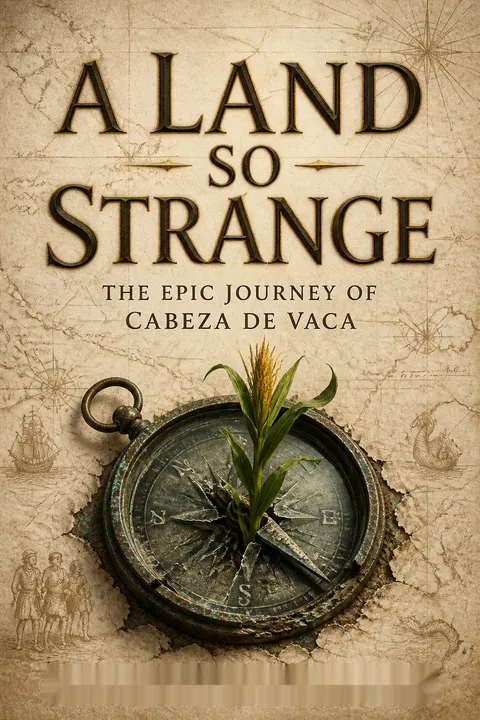
A Land So Strange recounts Cabeza de Vaca's epic journey across North America in the 1500s. Readers praise Reséndez's engaging writing style, thorough research, and ability to bring this incredible survival story to life. The book offers fascinating insights into early Spanish exploration and indigenous cultures. Many found it a gripping page-turner that reads like an adventure novel. Some critics felt the opening was slow or questioned the author's interpretations, but overall, reviewers highly recommend this compelling historical account for its vivid portrayal of a remarkable expedition.
People Also Read



Glossary
Adelantamiento
Crown grant for settlementA royal charter granting an explorer authority to occupy and govern specified territories. Narváez's adelantamiento covered a vast, poorly known region between Florida and the Rio de las Palmas. It promised titles, land, and potential wealth, while placing the costs and risks of colonization on the expedition's leader.
dead reckoning
Estimated position by courseA navigation method that estimates a ship's position from a known starting point, the direction sailed, and the distance traveled. Sixteenth-century pilots used a compass and estimates of speed, often plotting their progress on charts. Currents and other unseen forces could distort the estimate, as they did during Narváez's Gulf crossing.
portolan charts
Practical nautical chartsCharts designed for working sailors, emphasizing coastlines, islands, rivers, and compass-direction lines called rhumb lines. They helped pilots plan a course and estimate distances without requiring latitude and longitude. Their practical value did not eliminate the danger of unfamiliar currents, uncertain speed, or incomplete geographic knowledge.
Mississippian societies
Ranked agricultural societiesA broad archaeological term for societies that flourished along the Mississippi River and its tributaries. Many relied on intensive maize agriculture, had ranked political structures, took part in long-distance trade, and built ceremonial centers and mounds. Apalachee was part of this wider tradition, though each community had its own history and organization.
encomienda
Grant of Indigenous tributeA Spanish colonial grant that assigned a community of Indigenous people to a colonist, who could receive tribute and, in some contexts, labor. In theory, the colonist was responsible for protection and Christian instruction. In practice, the arrangement placed Indigenous communities under unequal colonial authority and could enable exploitation.
pristine myth
Untouched wilderness assumptionThe idea that North America before European settlement was largely wild, sparsely inhabited, and little changed by human activity. Reséndez uses the concept to challenge later colonial descriptions that overlooked Indigenous agriculture, burning, trade, warfare, and deliberate use of natural resources. The book instead presents a varied, inhabited, and changing continent.
middle ground
Negotiated intercultural spaceA historical concept for situations in which peoples with different languages, political systems, and expectations negotiate shared practices and meanings. Reséndez invokes it to interpret the castaways' dependence on Indigenous hosts and their efforts to communicate across cultural boundaries. Such negotiation does not imply equality or eliminate coercion.
Download PDF
Download EPUB
.epub digital book format is ideal for reading ebooks on phones, tablets, and e-readers.








