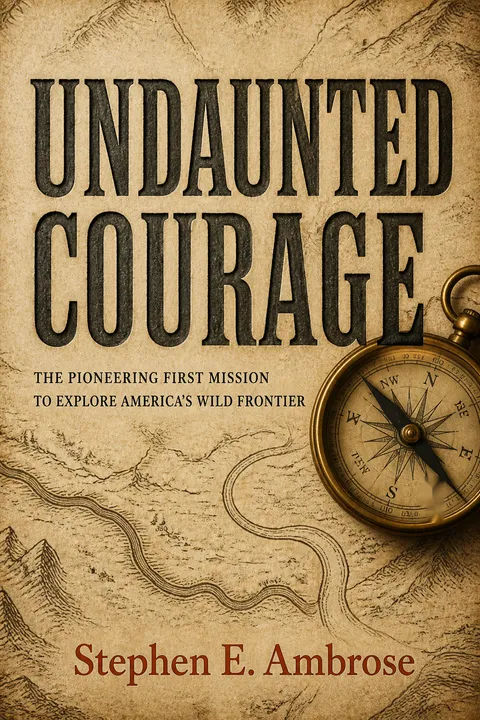


Key Takeaways
The Louisiana Purchase doubled the nation; the expedition tested its western ambitions
A map became a mission. In 1803, the United States bought roughly 825,000 square miles from France for about $15 million, nearly doubling its territory. Thomas Jefferson sent Meriwether Lewis west to discover what the country had acquired, search for a water route to the Pacific, gather scientific information, and encourage trade. William Clark joined as co-commander. Their journey lasted from 1804 to 1806, crossing thousands of miles through country unfamiliar to most Americans.
Exploration served power. The expedition was a scientific project, a diplomatic mission, and a way to assert American claims against British, Spanish, and French rivals. Its maps and descriptions also promised valuable furs and fertile land. The book presents the journey as a defining act of continental expansion, not simply a daring trip into the unknown.
The expedition shows how knowledge and state power reinforce one another. Mapping a river can help naturalists understand a region, but it can also guide traders, soldiers, and settlers. That does not make the science false or the courage less real. It does mean that exploration should be read in two registers at once: as the disciplined effort to learn about a place, and as an instrument for deciding who will control it.
Pair complementary leaders, then give them authority to adapt
Preparation met partnership. Lewis had learned to hunt, ride, observe plants, and manage a plantation, but had limited formal scientific training. During his years as Jefferson’s private secretary, the president taught him about geography, botany, and instruments for measuring latitude and longitude. Lewis also knew the western army and its officers. He recruited William Clark, a skilled surveyor, waterman, and commander whose strengths complemented his own.
Trust mattered more than rank. Jefferson authorized a second officer, but Clark received a lieutenant’s commission rather than the captaincy Lewis had promised. Lewis concealed the discrepancy from the party and treated Clark as an equal. Their shared command worked because each trusted the other’s competence, divided responsibility, and accepted the other’s judgment. The expedition’s success depended on that practical equality, even when official paperwork contradicted it.
This partnership resembles a well-designed leadership team: different skills, shared purpose, and enough trust to disagree without turning disagreement into a contest for control. Its strength was not simply that both men were capable. They understood where each was strongest and allowed that expertise to shape decisions. The arrangement also depended on unusual personal chemistry, so it should not be mistaken for a universal solution to command structure.
Budget for the unknown, because logistics decide whether ambition survives
The river set the terms. Lewis expected a party of about a dozen men, but the expedition grew to more than thirty as the captains discovered how much muscle was needed to move boats and cargo upstream. They bought rifles, ammunition, medical supplies, trade goods, food, and scientific instruments. The journey repeatedly exposed the limits of those plans: the Missouri’s current demanded exhausting labor, and shifting water, weather, illness, and food shortages forced constant adjustment.
An ingenious tool can still fail. At the Great Falls, the captains faced a portage nearly eighteen miles long. Lewis had hauled an experimental iron-frame boat across the continent, expecting to cover it with hides. The seams leaked, and the craft had to be abandoned. The party improvised wagons and built wooden canoes instead. Preparation reduced danger, but field judgment and backup plans kept one failed invention from ending the expedition.
The expedition is a vivid case of the difference between a plan and a capability. A design becomes useful only when materials, labor, timing, and local conditions cooperate. Lewis’s failed boat was not merely a technical setback; it consumed time and exposed the cost of committing to an untested solution. The broader lesson is not to avoid ambitious experiments, but to protect the core mission with alternatives.
Measure carefully, and let evidence correct the map in your head
Observation replaced speculation. Jefferson and Lewis hoped the Missouri might connect to the Columbia through a short portage across manageable mountains. The captains tested that expectation with celestial measurements, river surveys, sketches, and firsthand descriptions of landforms, plants, animals, and Indigenous communities. They collected and labeled specimens, sent samples back east, and gathered accounts from traders and Native people when they could not see a region themselves.
The record was substantial. At Fort Mandan, Lewis and Clark produced a report of roughly 45,000 words, along with maps, specimens, and descriptions of dozens of Indigenous nations. Lewis’s observations helped identify many plants and animals unknown to American science. Their journals also contain long gaps, so the surviving record is not complete. Even so, it transformed a largely speculative map into a far more detailed account of the continent’s interior.
The expedition’s strongest scientific habit was separating what the explorers saw from what they had merely been told, even though the distinction was not always maintained. That practice is central to reliable inquiry: record observations, state uncertainty, and revise a model when the terrain disagrees. The journals also remind readers that data are shaped by attention. The captains measured rivers closely, while some social realities received less careful scrutiny.
Negotiate with the people who live on the land you claim
The purchase did not include consent. The United States had acquired Louisiana from France, but the Indigenous nations living there had not agreed to become American subjects. Jefferson instructed Lewis to announce a new political authority, encourage peace among tribes, and redirect trade from British to American merchants. The captains offered medals, flags, and goods, while also warning that the United States had the power to punish those who resisted.
A council nearly became a battle. The Tetons demanded tobacco before allowing the expedition to proceed. Tension rose until warriors grabbed the boat’s line and the captains prepared their guns. Black Buffalo helped avert violence, but the Americans left without securing the friendship they wanted. Their speeches and gifts assumed that Indigenous leaders could promise obedience for whole nations. The encounters instead revealed communities with their own interests, politics, and authority.
The failed councils expose a basic problem in diplomacy: one side treated a territorial sale between European governments as a transfer of authority, while the people on the land had their own political order. Gifts and ceremony could open conversation, but they could not make that mismatch disappear. The captains’ restraint often prevented bloodshed. Their assumption that trade would eventually secure compliance, however, made diplomacy part of a larger expansion project.
Credit the local knowledge and labor that make discovery possible
The expedition depended on its guides. Sacagawea helped the captains communicate with the Shoshones, and her recognition of her brother Cameahwait eased a crucial encounter. Shoshone horses made it possible to cross the divide. The guide Old Toby led the party over the Bitterroots, while Nez Percé communities supplied food, horses, and knowledge of routes. A Nez Percé woman, Watkuweis, reportedly persuaded her people not to harm the explorers when they first arrived sick and vulnerable.
The explorers were not self-sufficient heroes. York, Clark’s enslaved companion, drew intense attention from Indigenous people and helped signal that the party included more than armed white men. Local skill also shaped canoe travel, food gathering, and passage through difficult terrain. Yet the captains often described this help as a resource for American goals, and Sacagawea received no pay for her work. The expedition’s achievements were collective, even when its fame was not.
Discovery narratives often focus on the person who writes the report, not the people who made the journey possible. This expedition makes that imbalance difficult to ignore. Indigenous guides supplied practical knowledge that the captains could not reproduce from maps or instruments, and women shaped encounters in ways the official story often underplays. Recovering those contributions does not diminish Lewis and Clark. It gives a more accurate account of how knowledge is produced.
Confidence is useful until it stops you from hearing warnings
Courage needed a brake. Jefferson specifically told Lewis to favor safety over additional discoveries. Lewis sometimes followed that advice, but his ambition and impatience could overpower caution. In 1806, he began crossing the snowbound Lolo Trail without guides, despite warnings from the Nez Percé. The party had to turn back, cache its journals and instruments, and wait for guides. The delay was avoidable, and the risk threatened the evidence the expedition had spent years collecting.
The Marias trip raised the stakes. On the return journey, Lewis divided the expedition into several small detachments to explore separate routes. His four-man party encountered Blackfeet. One warrior was killed, another was wounded, and Lewis’s men barely escaped with their horses and lives. The exploration yielded little, while leaving the larger party exposed. His nerve helped the expedition survive crises, but it did not make every risk wise.
Confidence helps leaders act when information is incomplete. It becomes dangerous when confidence is treated as proof that warnings can be ignored. Lewis’s decisions show how a strong sense of mission can narrow attention: he saw the possible discoveries and discounted the cost of failure. In high-stakes work, dissent and contingency planning are not signs of timidity. They are ways to protect the very objective that makes risk worthwhile.
A route can be navigable on paper and brutal on foot
The geography overturned the dream. The Missouri and Columbia did not join through a convenient chain of rivers, as Jefferson and Lewis hoped. The Great Falls required a grueling portage, and the iron-frame boat failed. Beyond the Missouri’s headwaters, the explorers faced the Bitterroots, where deep snow, steep trails, and scarce food made the crossing far harder than maps or secondhand reports suggested.
The best passage was still a land route. Lewis later reported that the most practicable connection required a long overland segment between the Missouri and Columbia drainages, including formidable mountains. The expedition had found a route that people could use, not the water highway Jefferson had imagined. The distinction mattered: a path can exist without being easy, cheap, or suitable for the commercial system its sponsors hope to build.
The gap between map distance and lived distance is a recurring problem in infrastructure planning. Rivers look like continuous lines on a chart, but currents, falls, portages, weather, and food determine whether they function as a route. The expedition’s negative finding was valuable precisely because it replaced an attractive assumption with costly reality. A failed search can be a successful investigation when it closes off a false premise.
Ask what your discoveries enable, not only what they reveal
The maps had consequences. Lewis and Clark described the West in ways that could serve science, commerce, and government. Lewis counted beaver, assessed farmland, identified trading locations, and proposed ways to bring Indigenous nations into an American trade network. His reports made the region more legible to officials and entrepreneurs. That knowledge helped the United States imagine a continental empire, even though many communities already lived there and had their own claims to the land.
The promise of liberty had limits. Jefferson wanted an expanding republic of equal states, not colonies, but his vision relied on Indigenous removal and westward settlement. He opposed slavery in principle while benefiting from it; Lewis inherited a plantation and enslaved people. The book treats expansion as both a remarkable political achievement and a process that dispossessed Native nations. Its heroism is real, but it is not morally neutral.
Maps are often presented as passive descriptions, but they can function as infrastructure for action. By locating rivers, resources, and routes, a map changes what governments and businesses believe they can do. This does not erase the scientific value of Lewis and Clark’s work. It asks readers to account for its uses and costs. Their story is most illuminating when admiration for individual skill coexists with attention to the power that skill served.
Achievement does not immunize a leader against failure or despair
The return was only the beginning. Lewis came home in 1806 to public acclaim and a generous reward, but the journals remained unpublished. He became governor of Louisiana Territory, fought with his secretary, made speculative investments, and accumulated debts. He also struggled with heavy drinking and recurring periods of depression that Jefferson had observed before the expedition. The work he most wanted to publish stalled while his political and financial responsibilities multiplied.
His final journey was tragic. In 1809, Lewis headed east to answer questions about disputed government expenses and his conduct as governor. He died on the Natchez Trace, apparently by suicide, after a period of severe distress. The precise causes remain uncertain. His story ends not with a simple diagnosis or moral lesson, but with a stark contrast: a leader capable of guiding others through extreme danger could not secure his own recovery or finish his most important work.
Lewis’s death resists a neat explanation. The record points to distress, drinking, financial pressure, political conflict, and an unfinished publication, but it does not establish a single cause. That uncertainty is important: a diagnosis imposed from a distance can turn a complicated life into a cautionary fable. His trajectory also shows how organizations can celebrate a person’s achievement while leaving the practical aftermath, including publication and support, poorly managed.
Analysis
Ambrose structures the story as both an expedition narrative and a biography of a man shaped by public purpose. The first half builds Lewis toward the journey: a restless youth acquires frontier competence, military discipline, and scientific instruction under Jefferson. The central expedition then tests that preparation against current, weather, hunger, illness, translation failures, and the limits of the map. Its dramatic engine is the widening gap between the imagined passage and the country encountered. The final chapters turn from exploration to governance, publication, money, and Lewis’s death, showing that returning safely did not resolve the expedition’s consequences.
The book’s strongest insight is that exploration is organized uncertainty. Success depended less on heroic daring alone than on provisioning, accurate observation, delegation, partnership, and the capacity to revise plans. The Missouri’s falls and the Bitterroots defeated the promised water route, but the resulting information was itself a major achievement. Lewis’s finest leadership moments emerge when he listens, shares authority, and protects the party. His worst decisions come when impatience or anger narrows that judgment.
The narrative also complicates national celebration. The expedition gathered valuable scientific and geographic knowledge, yet its sponsors sought trade, sovereignty, and settlement in lands already inhabited. Indigenous diplomacy alternated between genuine curiosity, material exchange, paternalism, and coercion. Native people were not scenery: they were guides, suppliers, interpreters, political actors, and sometimes adversaries. The book’s treatment of slavery sharpens the contradiction. A republic speaking in the language of liberty expanded through the labor of enslaved people and the displacement of Native nations.
Ambrose’s admiration for Lewis gives the story its energy, but it can also tilt attention toward the commander’s interior life and away from the perspectives of those he encountered. The most durable reading holds both truths together: Lewis and Clark accomplished a formidable journey, and the journey helped make western expansion practicable. Their maps opened knowledge, but also opened the way for power. Lewis’s unfinished journals and troubled final years leave the reader with a final irony: the man who made the continent legible could not bring his own account fully into public view.
Review Summary
Undaunted Courage receives mostly positive reviews for its detailed account of the Lewis and Clark expedition. Readers praise Ambrose's storytelling and ability to bring the journey to life. Many find the book informative and engaging, though some note it can be overly detailed at times. The exploration of the American West and interactions with Native tribes fascinate readers. While the expedition narrative is widely enjoyed, some find the sections on Lewis's post-expedition life less compelling. Overall, the book is highly recommended for those interested in American history and exploration.
People Also Read


Glossary
Corps of Discovery
Exploration partyThe name used for the permanent party led by Meriwether Lewis and William Clark across the continent. It included U.S. Army personnel and several civilians, including York, Sacagawea, and Toussaint Charbonneau. The group conducted military duties alongside exploration, surveying, collecting scientific specimens, and diplomatic encounters with Indigenous nations.
Northwest Passage
Continental water routeA hoped-for navigable connection across North America between the Missouri River system and waters flowing to the Pacific. Jefferson and Lewis expected that the rivers might be linked by a short portage over the mountains. The expedition established that no such easy water route existed, although it identified a difficult overland passage between the river systems.
Empire of Liberty
Jefferson’s continental republicThomas Jefferson’s vision of a United States expanding across North America while incorporating new territories as equal states rather than governing them as colonies. The ideal joined republican government with continental expansion. In practice, the expansion depended on acquiring Indigenous lands and encouraging settlement, creating a tension between the language of liberty and the consequences of territorial growth.
FAQ
What’s Undaunted Courage by Stephen E. Ambrose about?
- Chronicles the Lewis and Clark Expedition: The book details the first American mission to explore the Louisiana Purchase and the American West from 1804 to 1806, led by Meriwether Lewis and William Clark.
- Focus on Leadership and Discovery: It explores the challenges, discoveries, and leadership of Lewis, highlighting his personal journey and the broader historical context.
- Blends History, Science, and Politics: Ambrose situates the expedition within early 19th-century American politics, Jefferson’s vision, and the scientific and diplomatic goals of the mission.
Why should I read Undaunted Courage by Stephen E. Ambrose?
- Comprehensive Historical Insight: The book offers a richly detailed, accessible account of one of America’s most significant exploratory missions, combining scholarly research with vivid storytelling.
- Humanizes Historical Figures: Ambrose presents Lewis, Clark, and their men as real people, exploring their strengths, weaknesses, and emotional struggles.
- Reveals Lasting Impact: Readers gain an understanding of the expedition’s legacy on American expansion, Indian policy, and scientific knowledge.
What are the key takeaways from Undaunted Courage by Stephen E. Ambrose?
- Birth of American Expansionism: The expedition symbolizes the United States’ emergence as a continental nation and the origins of its westward ambitions.
- Leadership and Endurance: The story highlights the importance of leadership, teamwork, and resilience in overcoming extreme adversity.
- Scientific and Cultural Contributions: Lewis and Clark’s meticulous documentation of plants, animals, geography, and Native American cultures greatly expanded American knowledge and set standards for future exploration.
Who was Meriwether Lewis, and how did his background prepare him for the expedition in Undaunted Courage?
- Frontier Upbringing and Education: Lewis grew up in Virginia with a mix of wilderness skills and formal education, showing early signs of leadership and curiosity.
- Military and Administrative Experience: He served in the Virginia militia and U.S. Army, gaining experience in leadership, logistics, and frontier survival.
- Mentorship by Jefferson: As Jefferson’s private secretary, Lewis received intensive training in natural history, geography, and navigation, shaping him into a capable explorer and scientist.
What was President Thomas Jefferson’s vision for the Lewis and Clark Expedition in Undaunted Courage?
- Empire of Liberty: Jefferson aimed to expand the United States from coast to coast, using the expedition to explore and claim the vast western lands of the Louisiana Purchase.
- Scientific and Commercial Goals: The mission was tasked with finding a water route to the Pacific, mapping the territory, and studying its natural resources.
- Political and Strategic Motives: Jefferson wanted to assert American sovereignty, counter European influence, and integrate the West into the Union.
How did the Louisiana Purchase shape the Lewis and Clark Expedition according to Undaunted Courage?
- Doubled the Nation’s Size: The Purchase added 825,000 square miles, creating an urgent need to explore and understand the new territory.
- Shifted Political Boundaries: Control of the land moved from Spain and France to the U.S., requiring the expedition to assert American presence and inform Native tribes of their new “Great Father.”
- Expanded Objectives: The acquisition increased the expedition’s importance, urgency, and scope, including mapping unknown boundaries and securing American claims.
What were the main challenges faced by Lewis and Clark during the expedition as described in Undaunted Courage?
- Geographical Unknowns: The team navigated uncharted rivers, mountains, and wilderness with limited maps and knowledge.
- Relations with Native Americans: They encountered numerous tribes, requiring delicate diplomacy, negotiation, and sometimes defense.
- Logistical and Environmental Hardships: The expedition faced harsh weather, difficult terrain, supply shortages, disease, and physical exhaustion.
How did Lewis and Clark interact with Native American tribes in Undaunted Courage?
- Peaceful Diplomacy with Caution: Jefferson’s orders emphasized making favorable impressions and avoiding conflict, but the captains prepared for defense if necessary.
- Use of Interpreters and Gifts: They employed interpreters and distributed trade goods, medals, and flags to symbolize American friendship and sovereignty.
- Cultural Misunderstandings: The captains sometimes misjudged tribal politics and customs, leading to both successful alliances and diplomatic challenges.
What scientific and ethnographic contributions did Lewis and Clark make according to Undaunted Courage?
- Natural History Documentation: The expedition collected and described numerous new plants and animals, expanding scientific knowledge of North America.
- Meteorological and Geographical Data: Lewis kept weather diaries and Clark created detailed maps, providing the first accurate data for the region.
- Ethnographic Studies: They recorded languages, customs, and social structures of Native American tribes, contributing to early American anthropology.
What role did Sacagawea play in the Lewis and Clark Expedition as described in Undaunted Courage?
- Interpreter and Guide: Sacagawea, a Shoshone woman, facilitated communication with Native tribes and helped guide the expedition through difficult terrain.
- Symbol of Peace: Her presence, especially with her infant son, signaled peaceful intentions to other tribes and reduced the risk of conflict.
- Personal Resilience: She endured illness, pregnancy, and the journey’s hardships, contributing to the expedition’s survival and success.
What leadership qualities did Meriwether Lewis demonstrate during the expedition in Undaunted Courage?
- Resilience and Determination: Lewis led his men through extreme adversity, maintaining morale and discipline.
- Hands-on and Participative: He shared in the work and hardships, earning the trust and loyalty of his men.
- Diplomatic and Scientific Skill: Lewis balanced diplomacy with Native tribes, scientific curiosity, and practical command, ensuring the mission’s success.
What are the best quotes from Undaunted Courage by Stephen E. Ambrose and what do they mean?
- Jefferson on Lewis: “Of courage undaunted, possessing a firmness & perseverance of purpose which nothing but impossibilities could divert from it’s direction…”—Jefferson’s praise for Lewis’s unique qualifications.
- Lewis on His Mission: “The charge of this expedition is honorable to myself, as it is important to my Country.”—Reflects Lewis’s sense of duty and national pride.
- On Accomplishment and Reflection: “I reflected that I had as yet done but little, very little indeed, to further the hapiness of the human race…”—Lewis’s humility and Enlightenment ideals.
- On Leadership and Endurance: “If the Indians could pass these mountains with their women and Children, that we could also pass them.”—Lewis’s confidence in his men and leadership.
- On the Louisiana Purchase: “The annexation of Louisiana was an event so portentous as to defy measurement…”—Henry Adams on the transformative impact of the Purchase.
About the Author
Other books by Stephen E. Ambrose



Download PDF
Download EPUB
.epub digital book format is ideal for reading ebooks on phones, tablets, and e-readers.








